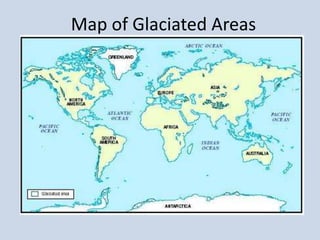
Map of Glaciated Areas
Landforms created by glacial erosion
The landforms created by glacial erosion are:
1.   Corries, cirque, cwm.
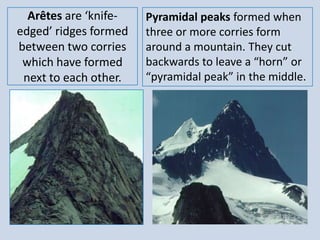
2.    Arêtes
3.    Pyramidal Peaks
4.   Glacial Troughs (U-Shaped Valleys)
5.   Truncated Spurs
6.   Hanging Valleys
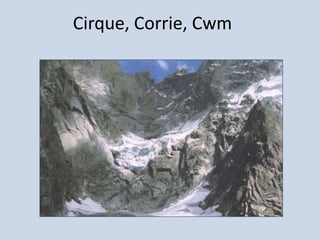
Cirque, Corrie, Cwm
How is a cirque formed?
• Snow collects in a natural hollow on the side of a
  mountain. Over time, further snow collects in the hollow.
  This extra weight compresses the snow
  underneath, turning it into ice.
• The ice is pulled downhill by gravity, it doesn’t move
  straight down, it moves in a curved way
• The hollow is deepened and widened by the corrie glacier
  through the processes of abrasion and plucking.
• This over deepening leads to an ‘armchair’ shape
  characteristic of a corrie and causes a ‘rock lip’ to be
  formed.
• Plucking and freeze-thaw mean that the back wall of the
  corrie is very steep.
• When the ice melts, a small lake may be left behind the
  lip, this is called a corrie-lake or a tarn.
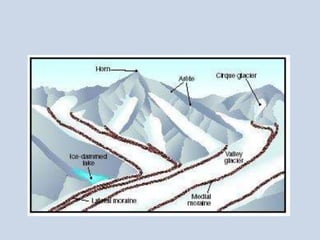
Arêtes are ‘knife-   Pyramidal peaks formed when
edged’ ridges formed   three or more corries form
between two corries    around a mountain. They cut
 which have formed     backwards to leave a “horn” or
 next to each other.   “pyramidal peak” in the middle.
Characteristics of a glacial trough

1. Between truncated spurs are hanging
valleys which have not been eroded as
deeply as the main valley.

2. Interlocking spurs are truncated as the
glacier cuts straight through the landscape.

3. The river that flows through the valley
after the ice age is described as a misfit
stream.
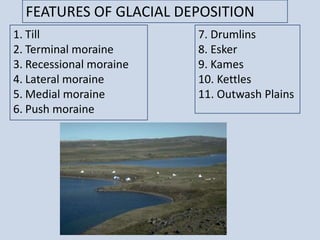
FEATURES OF GLACIAL DEPOSITION
1. Till                  7. Drumlins
2. Terminal moraine      8. Esker
3. Recessional moraine   9. Kames
4. Lateral moraine       10. Kettles
5. Medial moraine        11. Outwash Plains
6. Push moraine
Glacial landforms2

Glacial landforms2

  • 1.
  • 2.
    Landforms created byglacial erosion The landforms created by glacial erosion are: 1. Corries, cirque, cwm. 2. Arêtes 3. Pyramidal Peaks 4. Glacial Troughs (U-Shaped Valleys) 5. Truncated Spurs 6. Hanging Valleys
  • 5.
  • 6.
    How is acirque formed? • Snow collects in a natural hollow on the side of a mountain. Over time, further snow collects in the hollow. This extra weight compresses the snow underneath, turning it into ice. • The ice is pulled downhill by gravity, it doesn’t move straight down, it moves in a curved way • The hollow is deepened and widened by the corrie glacier through the processes of abrasion and plucking. • This over deepening leads to an ‘armchair’ shape characteristic of a corrie and causes a ‘rock lip’ to be formed. • Plucking and freeze-thaw mean that the back wall of the corrie is very steep. • When the ice melts, a small lake may be left behind the lip, this is called a corrie-lake or a tarn.
  • 7.
    Arêtes are ‘knife- Pyramidal peaks formed when edged’ ridges formed three or more corries form between two corries around a mountain. They cut which have formed backwards to leave a “horn” or next to each other. “pyramidal peak” in the middle.
  • 8.
    Characteristics of aglacial trough 1. Between truncated spurs are hanging valleys which have not been eroded as deeply as the main valley. 2. Interlocking spurs are truncated as the glacier cuts straight through the landscape. 3. The river that flows through the valley after the ice age is described as a misfit stream.
  • 10.
    FEATURES OF GLACIALDEPOSITION 1. Till 7. Drumlins 2. Terminal moraine 8. Esker 3. Recessional moraine 9. Kames 4. Lateral moraine 10. Kettles 5. Medial moraine 11. Outwash Plains 6. Push moraine