GEOSTROPHIC WINDS
 Geo means earth and Strophic means
turning.
 Have a look on Figure 1 that shows a map of
Northern hemisphere.
 It shows horizontal pressure variations @
altitude 1km above earth surface.
 The isobars are evenly spaced and indicate a
constant pressure gradient force PGF
directed from south towards north as given by
an left arrow in the figure.
 Now what is PGF
 If there are isobars showing the horizontal
pressure difference change. If we compute
the amount of pressure change that occurs
over a given distance the PGF is given as:
difference in pressure
PGF= ____________________
distance
 Suppose there is an air parcel at position 1.
 The PGF acts immediately at position 1
upon the air parcel pushing it northward
towards low pressure.
 Now as the air moves the Coriolis force
deflects the air towards its right, curving its
path.
 The air parcel increases its speed at points
2, 3, 4 and with it the magnitude of the
Coriolis force also increases (as shown by the
longer arrows).
 This causes the bending of the wind more
and more towards its right.
 Atlast the wind speed increases to a point
where the Coriolis force just balances the
PGF (shown by point 5).
 Now the wind no longer accelerates as the
net force is zero.
 Here the wind flows in a straight path parallel
to the isobars at a constant speed.
 This flow of air is called Geostrophic wind.
 The figure also shows that geostrophic wind
blows in the Northern hemisphere with lower
pressure to its left and higher pressure to its
right
 When the air flow is purely geostrophic the
isobars are straight ,evenly spaced and the
wind speed is constant.
 In the atmosphere the isobars are hardly
straight or evenly spaced and the wind
changes its speed as it moves.
 The figure shows that a geostrophic wind flowing
parallel to the isobars is similar to the water in a
stream flowing parallel to its bank.
 At position 1 the wind is blowing at a low speed
& at position 2 the PGF increases and the wind
speed also increases.
 At position 2, where the wind sped is greater
the Coriolis force is greater and balances the
PGF
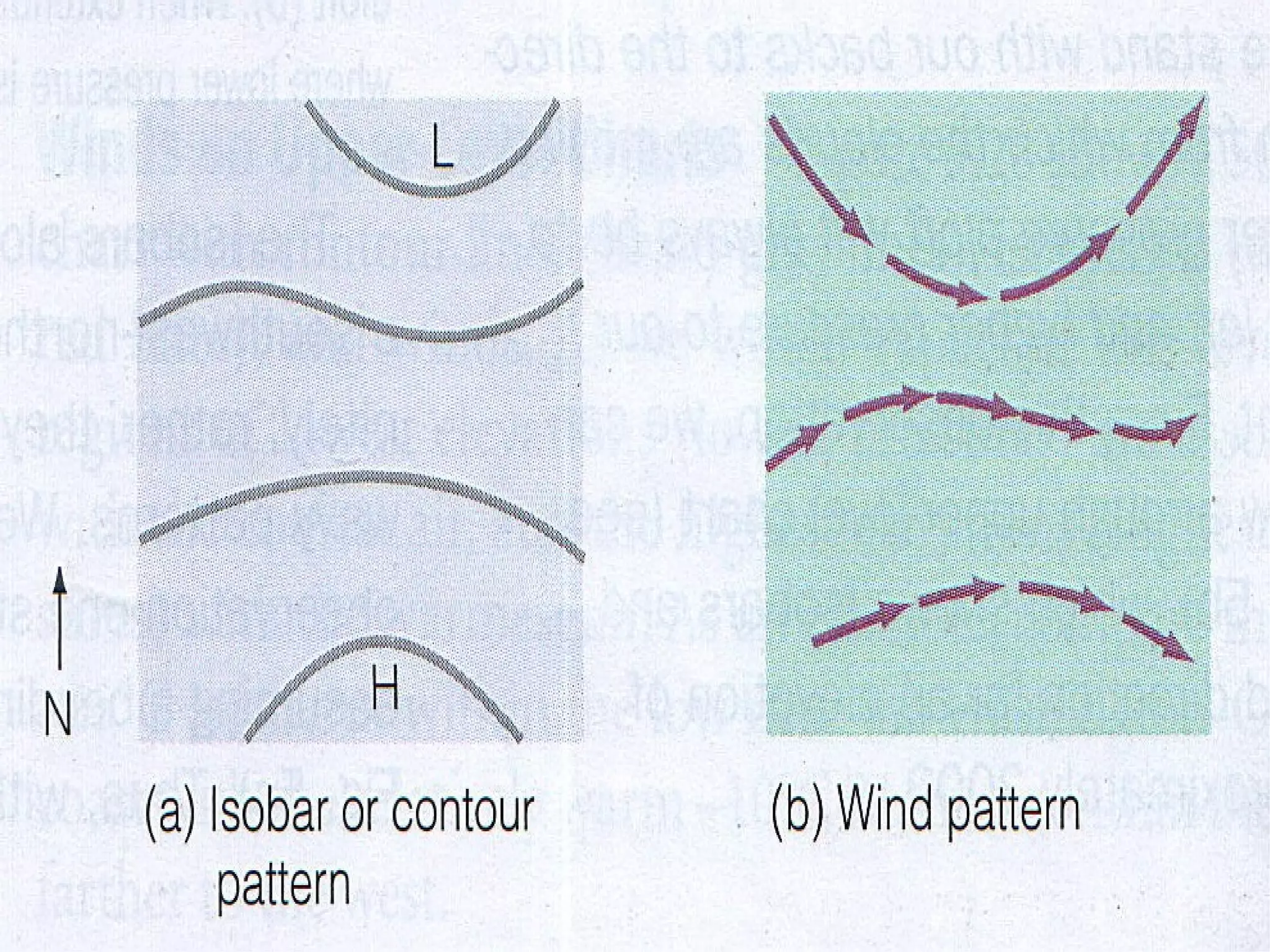
 The figure shows an isobaric chart.
 On this chart the geostrophic wind direction and
speed can be determined.
 If we know the geostrophic wind direction &
speed, we can estimate the orientation and
spacing of the isobars.
 Winds do not always blow in a straight line, they
frequently curve and change their direction.
 Above the friction level (500-1000) m above
the earth surface, the winds tend to blow
parallel to the isobars (contours).
 At any given latitude the speed of the
geostrophic wind is proportional to the
pressure gradient and is given as:
d
p
Vg
∆
≈
 Vg = geostrophic wind
 Δp = pressure difference between two places
 d = horizontal distance
 The equation shows that greater the pressure
gradient, stronger is the geostrophic wind.
 When we take a unit mass of moving air, the air
density (ρ) should be taken into account.
 The geosptrophic wind can now be written as:
d
p
Vg
∆
≈
ρ
1
 Mathematically Coriolis force is represented
as:
 Coriolis force = 2ΏVsinØ
a. Ώ = earth’s angular spin (constant factor)
b. V = wind speed
c. Ø = latitude
 At equator 0° sinØ= 0, at 30 ° sinØ= 0.5 and at
poles sinØ = 1.
 The balance between the Coriolis force and the
pressure gradient force is given as:
CF = PGF
2ΏVgsinØ =
d
p∆
ρ
1
 Solving for V the geostrophic wind is given as:
 If we combine (2Ώ) & (sinØ) by a single factor f
(Coriolis parameter), the expression can now be
written as:
d
p
Vg
∆
Ω
= .
sin2
1
φ
d
p
f
Vg
∆
≈ .
1

Compute the geostrophic wind???
 Wind is blowing parallel to the isobars in the
Northern hemisphere.
 Latitude = 40°N
 Isobar spacing = 200km
 Pressure difference = 4 mb
 Altitude (above sea level) = 5600 m
 Air temp. = -25°C
 Air density = 0.70 kg/m3
 Δp = 4 mb = 400 Newtons/m2
 d= 200 km = 200000 m
 Sin Ø= sin (40°) = 0.64
 ρ = 0.70 kg/m3
 2Ώ = 14.6 X10⁻⁵
radian/sec.
 Putting in eqn.
d
p
Vg
∆
Ω
= .
sin2
1
φ
.
10270.064.0106.14
400
55
×××××
= −gV
sec/6.30 mVg =
 OR 59.4 knots
 knots x 0.515 = meters/sec.
 Rate of earth’s rotation (Ώ) = 360° per day.
 Earth’s sidereal period of rotation =23h
56m
4.1s.
(86164 seconds)
 But we need (Ώ) in radians
 2π radians = 360° (where π=3.14)
 So (Ώ) = 2π radians /86164 sec=7.29x10⁻⁶
radian/sec.
 2 Ώ = 14.6x10⁻⁶
radian/sec

Geostrophic winds

  • 1.
  • 2.
     Geo meansearth and Strophic means turning.  Have a look on Figure 1 that shows a map of Northern hemisphere.  It shows horizontal pressure variations @ altitude 1km above earth surface.
  • 4.
     The isobarsare evenly spaced and indicate a constant pressure gradient force PGF directed from south towards north as given by an left arrow in the figure.  Now what is PGF
  • 5.
     If thereare isobars showing the horizontal pressure difference change. If we compute the amount of pressure change that occurs over a given distance the PGF is given as: difference in pressure PGF= ____________________ distance
  • 6.
     Suppose thereis an air parcel at position 1.  The PGF acts immediately at position 1 upon the air parcel pushing it northward towards low pressure.  Now as the air moves the Coriolis force deflects the air towards its right, curving its path.
  • 7.
     The airparcel increases its speed at points 2, 3, 4 and with it the magnitude of the Coriolis force also increases (as shown by the longer arrows).  This causes the bending of the wind more and more towards its right.
  • 8.
     Atlast thewind speed increases to a point where the Coriolis force just balances the PGF (shown by point 5).  Now the wind no longer accelerates as the net force is zero.
  • 9.
     Here thewind flows in a straight path parallel to the isobars at a constant speed.  This flow of air is called Geostrophic wind.  The figure also shows that geostrophic wind blows in the Northern hemisphere with lower pressure to its left and higher pressure to its right
  • 10.
     When theair flow is purely geostrophic the isobars are straight ,evenly spaced and the wind speed is constant.  In the atmosphere the isobars are hardly straight or evenly spaced and the wind changes its speed as it moves.
  • 12.
     The figureshows that a geostrophic wind flowing parallel to the isobars is similar to the water in a stream flowing parallel to its bank.  At position 1 the wind is blowing at a low speed & at position 2 the PGF increases and the wind speed also increases.  At position 2, where the wind sped is greater the Coriolis force is greater and balances the PGF
  • 14.
     The figureshows an isobaric chart.  On this chart the geostrophic wind direction and speed can be determined.  If we know the geostrophic wind direction & speed, we can estimate the orientation and spacing of the isobars.  Winds do not always blow in a straight line, they frequently curve and change their direction.
  • 15.
     Above thefriction level (500-1000) m above the earth surface, the winds tend to blow parallel to the isobars (contours).  At any given latitude the speed of the geostrophic wind is proportional to the pressure gradient and is given as: d p Vg ∆ ≈
  • 16.
     Vg =geostrophic wind  Δp = pressure difference between two places  d = horizontal distance  The equation shows that greater the pressure gradient, stronger is the geostrophic wind.
  • 17.
     When wetake a unit mass of moving air, the air density (ρ) should be taken into account.  The geosptrophic wind can now be written as: d p Vg ∆ ≈ ρ 1
  • 18.
     Mathematically Coriolisforce is represented as:  Coriolis force = 2ΏVsinØ a. Ώ = earth’s angular spin (constant factor) b. V = wind speed c. Ø = latitude
  • 19.
     At equator0° sinØ= 0, at 30 ° sinØ= 0.5 and at poles sinØ = 1.  The balance between the Coriolis force and the pressure gradient force is given as: CF = PGF 2ΏVgsinØ = d p∆ ρ 1
  • 20.
     Solving forV the geostrophic wind is given as:  If we combine (2Ώ) & (sinØ) by a single factor f (Coriolis parameter), the expression can now be written as: d p Vg ∆ Ω = . sin2 1 φ d p f Vg ∆ ≈ . 1 
  • 21.
  • 22.
     Wind isblowing parallel to the isobars in the Northern hemisphere.  Latitude = 40°N  Isobar spacing = 200km  Pressure difference = 4 mb  Altitude (above sea level) = 5600 m  Air temp. = -25°C  Air density = 0.70 kg/m3
  • 23.
     Δp =4 mb = 400 Newtons/m2  d= 200 km = 200000 m  Sin Ø= sin (40°) = 0.64  ρ = 0.70 kg/m3  2Ώ = 14.6 X10⁻⁵ radian/sec.
  • 24.
     Putting ineqn. d p Vg ∆ Ω = . sin2 1 φ . 10270.064.0106.14 400 55 ××××× = −gV sec/6.30 mVg =
  • 25.
     OR 59.4knots  knots x 0.515 = meters/sec.
  • 26.
     Rate ofearth’s rotation (Ώ) = 360° per day.  Earth’s sidereal period of rotation =23h 56m 4.1s. (86164 seconds)  But we need (Ώ) in radians  2π radians = 360° (where π=3.14)  So (Ώ) = 2π radians /86164 sec=7.29x10⁻⁶ radian/sec.  2 Ώ = 14.6x10⁻⁶ radian/sec