INDEX:
1. Short Introduction…………. SLIDE 3 y 4
2. Definition of equatorial climate ………… SLIDE 5
3. Temperatures & Rainfalls…………. SLIDE 6
4. Rivers of the Equatorial climate……….. SLIDE 7
5. Fauna of the Equatorial climate…………. SLIDE 8 y 9
6. Vegetation of the Equatorial climate..……… SLIDE 10 y 11
7. Inhabitants in the Equatorial climate……….. SLIDE 12
8. Economic activities in the Equatorial climate……….. 13
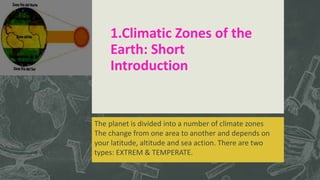
1.Climatic Zones of the
Earth: Short
Introduction
The planet is divided into a number of climate zones
The change from one area to another and depends on
your latitude, altitude and sea action. There are two
types: EXTREM & TEMPERATE.
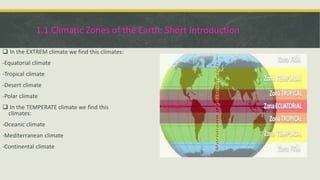
1.1.Climatic Zones of the Earth: Short Introduction
 In the EXTREM climate we find this climates:
-Equatorial climate
-Tropical climate
-Desert climate
-Polar climate
 In the TEMPERATE climate we find this
climates:
-Oceanic climate
-Mediterranean climate
-Continental climate
2. Definition of the Equatorial climate
 Is a tropical climate usually found along the equator but not always.
All months have an average precipitation value of at least 60 mm. Tropical
rainforest have no summer or winter. It is typically hot and wet throughout the
year and rainfall is both heavy and frequent. The change in temperatura between
day and night may be larger tan the average change in temperatura along the year.
The Equatorial climate is the most diverse biome on Earth.
 The Equatorial climate zone is situated around the equator and cover wide áreas
in South America, Central Africa and South-East Asia.
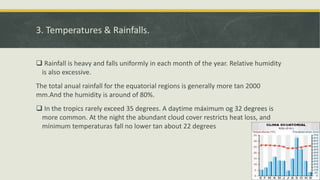
3. Temperatures & Rainfalls.
 Rainfall is heavy and falls uniformly in each month of the year. Relative humidity
is also excessive.
The total anual rainfall for the equatorial regions is generally more tan 2000
mm.And the humidity is around of 80%.
 In the tropics rarely exceed 35 degrees. A daytime máximum og 32 degrees is
more common. At the night the abundant cloud cover restricts heat loss, and
mínimum temperaturas fall no lower tan about 22 degrees
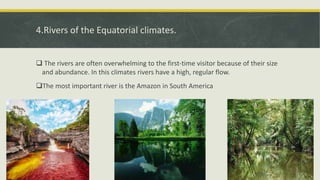
4.Rivers of the Equatorial climates.
 The rivers are often overwhelming to the first-time visitor because of their size
and abundance. In this climates rivers have a high, regular flow.
The most important river is the Amazon in South America
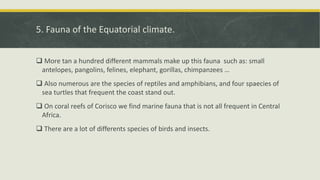
5. Fauna of the Equatorial climate.
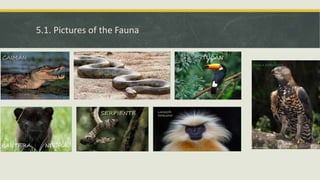
 More tan a hundred different mammals make up this fauna such as: small
antelopes, pangolins, felines, elephant, gorillas, chimpanzees …
 Also numerous are the species of reptiles and amphibians, and four spaecies of
sea turtles that frequent the coast stand out.
 On coral reefs of Corisco we find marine fauna that is not all frequent in Central
Africa.
 There are a lot of differents species of birds and insects.
5.1. Pictures of the Fauna
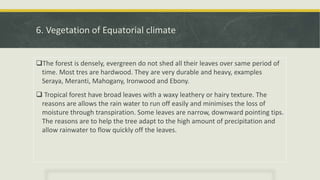
6. Vegetation of Equatorial climate
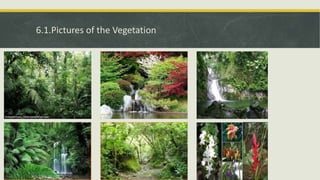
The forest is densely, evergreen do not shed all their leaves over same period of
time. Most tres are hardwood. They are very durable and heavy, examples
Seraya, Meranti, Mahogany, Ironwood and Ebony.
 Tropical forest have broad leaves with a waxy leathery or hairy texture. The
reasons are allows the rain water to run off easily and minimises the loss of
moisture through transpiration. Some leaves are narrow, downward pointing tips.
The reasons are to help the tree adapt to the high amount of precipitation and
allow rainwater to flow quickly off the leaves.
6.1.Pictures of the Vegetation
7. Inhabitants in the Equatorial Climates
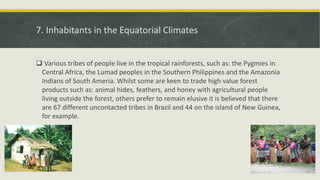
 Various tribes of people live in the tropical rainforests, such as: the Pygmies in
Central Africa, the Lumad peoples in the Southern Philippines and the Amazonia
Indians of South Ameria. Whilst some are keen to trade high value forest
products such as: animal hides, feathers, and honey with agricultural people
living outside the forest, others prefer to remain elusive it is believed that there
are 67 different uncontacted tribes in Brazil and 44 on the island of New Guinea,
for example.
8. Economic Activities in the Equatorial climate
 In the economic activities influence much the consumption of Wood for
manufacture mostly paper.
 The economic activities of this climate are related to the extraction of nature
itself, afforestation, harvesting, and implanted productive activities such as:
agriculture and livestock, in addition to the explotation of energy resources and
in some cases mining.
BY: Patricia Silva Santos
3º A

equatorial climate

  • 2.
    INDEX: 1. Short Introduction………….SLIDE 3 y 4 2. Definition of equatorial climate ………… SLIDE 5 3. Temperatures & Rainfalls…………. SLIDE 6 4. Rivers of the Equatorial climate……….. SLIDE 7 5. Fauna of the Equatorial climate…………. SLIDE 8 y 9 6. Vegetation of the Equatorial climate..……… SLIDE 10 y 11 7. Inhabitants in the Equatorial climate……….. SLIDE 12 8. Economic activities in the Equatorial climate……….. 13
  • 3.
    1.Climatic Zones ofthe Earth: Short Introduction The planet is divided into a number of climate zones The change from one area to another and depends on your latitude, altitude and sea action. There are two types: EXTREM & TEMPERATE.
  • 4.
    1.1.Climatic Zones ofthe Earth: Short Introduction  In the EXTREM climate we find this climates: -Equatorial climate -Tropical climate -Desert climate -Polar climate  In the TEMPERATE climate we find this climates: -Oceanic climate -Mediterranean climate -Continental climate
  • 5.
    2. Definition ofthe Equatorial climate  Is a tropical climate usually found along the equator but not always. All months have an average precipitation value of at least 60 mm. Tropical rainforest have no summer or winter. It is typically hot and wet throughout the year and rainfall is both heavy and frequent. The change in temperatura between day and night may be larger tan the average change in temperatura along the year. The Equatorial climate is the most diverse biome on Earth.  The Equatorial climate zone is situated around the equator and cover wide áreas in South America, Central Africa and South-East Asia.
  • 6.
    3. Temperatures &Rainfalls.  Rainfall is heavy and falls uniformly in each month of the year. Relative humidity is also excessive. The total anual rainfall for the equatorial regions is generally more tan 2000 mm.And the humidity is around of 80%.  In the tropics rarely exceed 35 degrees. A daytime máximum og 32 degrees is more common. At the night the abundant cloud cover restricts heat loss, and mínimum temperaturas fall no lower tan about 22 degrees
  • 7.
    4.Rivers of theEquatorial climates.  The rivers are often overwhelming to the first-time visitor because of their size and abundance. In this climates rivers have a high, regular flow. The most important river is the Amazon in South America
  • 8.
    5. Fauna ofthe Equatorial climate.  More tan a hundred different mammals make up this fauna such as: small antelopes, pangolins, felines, elephant, gorillas, chimpanzees …  Also numerous are the species of reptiles and amphibians, and four spaecies of sea turtles that frequent the coast stand out.  On coral reefs of Corisco we find marine fauna that is not all frequent in Central Africa.  There are a lot of differents species of birds and insects.
  • 9.
  • 10.
    6. Vegetation ofEquatorial climate The forest is densely, evergreen do not shed all their leaves over same period of time. Most tres are hardwood. They are very durable and heavy, examples Seraya, Meranti, Mahogany, Ironwood and Ebony.  Tropical forest have broad leaves with a waxy leathery or hairy texture. The reasons are allows the rain water to run off easily and minimises the loss of moisture through transpiration. Some leaves are narrow, downward pointing tips. The reasons are to help the tree adapt to the high amount of precipitation and allow rainwater to flow quickly off the leaves.
  • 11.
  • 12.
    7. Inhabitants inthe Equatorial Climates  Various tribes of people live in the tropical rainforests, such as: the Pygmies in Central Africa, the Lumad peoples in the Southern Philippines and the Amazonia Indians of South Ameria. Whilst some are keen to trade high value forest products such as: animal hides, feathers, and honey with agricultural people living outside the forest, others prefer to remain elusive it is believed that there are 67 different uncontacted tribes in Brazil and 44 on the island of New Guinea, for example.
  • 13.
    8. Economic Activitiesin the Equatorial climate  In the economic activities influence much the consumption of Wood for manufacture mostly paper.  The economic activities of this climate are related to the extraction of nature itself, afforestation, harvesting, and implanted productive activities such as: agriculture and livestock, in addition to the explotation of energy resources and in some cases mining.
  • 14.
    BY: Patricia SilvaSantos 3º A