The Human Race
   Our Origins
Evolution of Primates
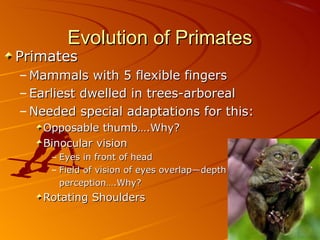
Primates
– Mammals with 5 flexible fingers
– Earliest dwelled in trees-arboreal
– Needed special adaptations for this:
   Opposable thumb….Why?
   Binocular vision
     – Eyes in front of head
     – Field of vision of eyes overlap—depth
       perception….Why?
   Rotating Shoulders
Evolution of Primates
Primates divided into 2
groups: prosimians and
anthropoids
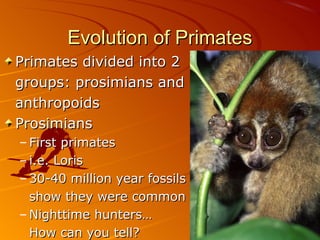
Prosimians
– First primates
– i.e. Loris
– 30-40 million year fossils
  show they were common
– Nighttime hunters…
  How can you tell?
Evolution of Primates
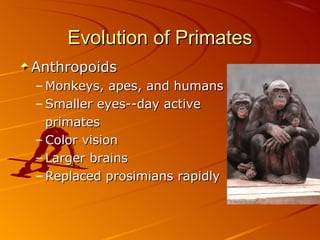
Anthropoids
– Monkeys, apes, and humans
– Smaller eyes--day active
  primates
– Color vision
– Larger brains
– Replaced prosimians rapidly
Anthropoids
Anthropoids
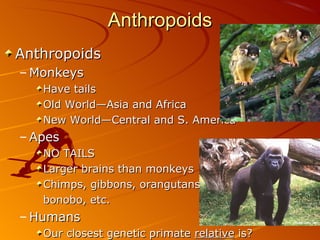
– Monkeys
   Have tails
   Old World—Asia and Africa
   New World—Central and S. America
– Apes
   NO TAILS
   Larger brains than monkeys
   Chimps, gibbons, orangutans,
   bonobo, etc.
– Humans
   Our closest genetic primate relative is?
Evolution of Humans
Vocab:
– Bipedal: walk upright on two legs
– Hominid: bipedal primates such as
  humans and their closest fossil relatives
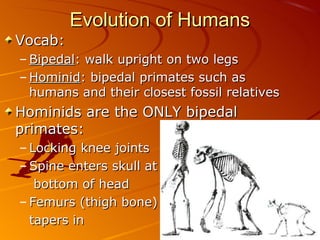
Hominids are the ONLY bipedal
primates:
– Locking knee joints
– Spine enters skull at
   bottom of head
– Femurs (thigh bone)
  tapers in
Evolution of Humans
Fossils are rare
– When they are found they must be
  identified
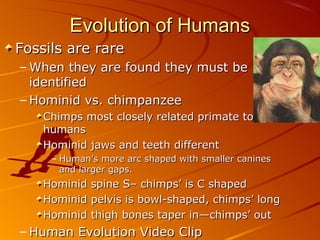
– Hominid vs. chimpanzee
    Chimps most closely related primate to
    humans
    Hominid jaws and teeth different
     – Human’s more arc shaped with smaller canines
       and larger gaps.
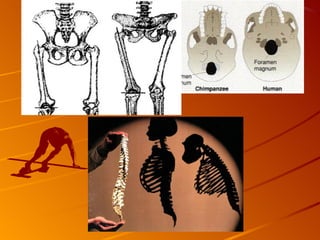
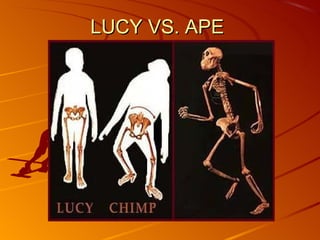
    Hominid   spine S– chimps’ is C shaped
    Hominid   pelvis is bowl-shaped, chimps’ long
    Hominid   thigh bones taper in—chimps’ out
– Human Evolution Video Clip
Early Hominids
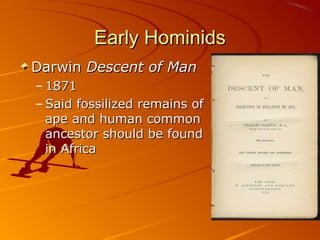
Darwin Descent of Man
– 1871
– Said fossilized remains of
  ape and human common
  ancestor should be found
  in Africa
Early Hominids
Genus Australopithecus
– LucyAustralopithecus afarensis
– Fossil found in Africa
– Hominids—shape of pelvis and femurs
  showed they were bipedal. How?
– Short—3’6’’
– Brain size of chimps
– Jaws more rounded than apes
– Teeth like humans
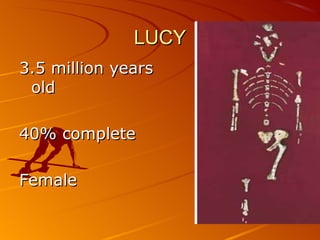
LUCY
3.5 million years
 old

40% complete

Female
LUCY
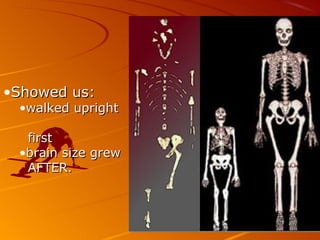
She walked upright
She was a bipedal hominid
–Bowl-shaped pelvis
–Thigh bones taper in
–Locking knee joint
•Showed us:
 •walked upright

  first
 •brain size grew
  AFTER.
LUCY VS. APE
SKULLS
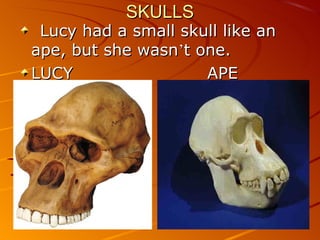
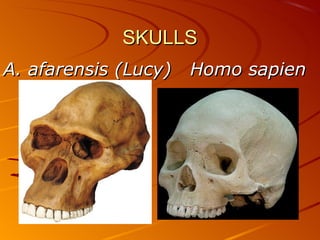
 Lucy had a small skull like an
ape, but she wasn’t one.
LUCY                 APE
SKULLS
A. afarensis (Lucy)   Homo sapien
Early Hominids
• Genus Australopithecus
  A. afarensis
• Genus Homo              Time
  Homo habilis
  H. erectus
  H. sapiens
NOT A COMPLETE LIST! THERE ARE
  OTHERS!
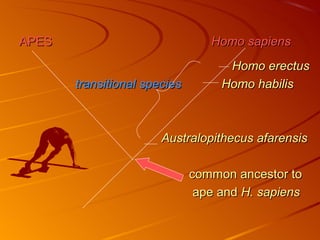
APES                             Homo sapiens
                                    Homo erectus
       transitional species        Homo habilis


                       Australopithecus afarensis

                              common ancestor to
                               ape and H. sapiens
Homo habilis
Means: Handy man
Small structure like
Lucy
Skull 2X’s the size
of Lucy
2- 1.8 mya in
Africa
Tools made of bone
and stone.
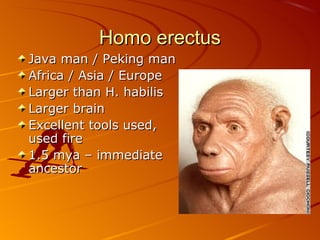
Homo erectus
Java man / Peking man
Africa / Asia / Europe
Larger than H. habilis
Larger brain
Excellent tools used,
used fire
1.5 mya – immediate
ancestor
Early Hominids
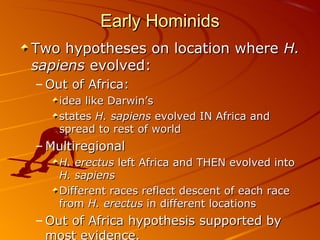
Two hypotheses on location where H.
sapiens evolved:
– Out of Africa:
    idea like Darwin’s
    states H. sapiens evolved IN Africa and
    spread to rest of world
– Multiregional
    H. erectus left Africa and THEN evolved into
    H. sapiens
    Different races reflect descent of each race
    from H. erectus in different locations
– Out of Africa hypothesis supported by
  most evidence.
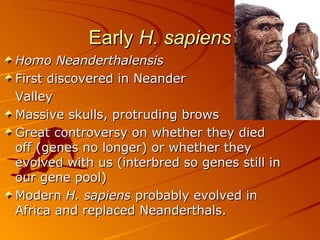
Early H. sapiens
Homo Neanderthalensis
First discovered in Neander
Valley
Massive skulls, protruding brows
Great controversy on whether they died
off (genes no longer) or whether they
evolved with us (interbred so genes still in
our gene pool)
Modern H. sapiens probably evolved in
Africa and replaced Neanderthals.
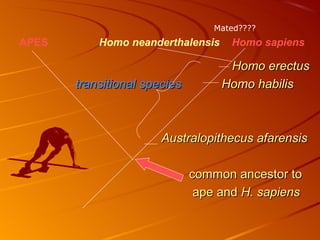
Mated????
APES       Homo neanderthalensis     Homo sapiens

                                    Homo erectus
       transitional species        Homo habilis


                       Australopithecus afarensis

                              common ancestor to
                               ape and H. sapiens

The human race origins

  • 1.
    The Human Race Our Origins
  • 2.
    Evolution of Primates Primates –Mammals with 5 flexible fingers – Earliest dwelled in trees-arboreal – Needed special adaptations for this: Opposable thumb….Why? Binocular vision – Eyes in front of head – Field of vision of eyes overlap—depth perception….Why? Rotating Shoulders
  • 3.
    Evolution of Primates Primatesdivided into 2 groups: prosimians and anthropoids Prosimians – First primates – i.e. Loris – 30-40 million year fossils show they were common – Nighttime hunters… How can you tell?
  • 4.
    Evolution of Primates Anthropoids –Monkeys, apes, and humans – Smaller eyes--day active primates – Color vision – Larger brains – Replaced prosimians rapidly
  • 5.
    Anthropoids Anthropoids – Monkeys Have tails Old World—Asia and Africa New World—Central and S. America – Apes NO TAILS Larger brains than monkeys Chimps, gibbons, orangutans, bonobo, etc. – Humans Our closest genetic primate relative is?
  • 6.
    Evolution of Humans Vocab: –Bipedal: walk upright on two legs – Hominid: bipedal primates such as humans and their closest fossil relatives Hominids are the ONLY bipedal primates: – Locking knee joints – Spine enters skull at bottom of head – Femurs (thigh bone) tapers in
  • 7.
    Evolution of Humans Fossilsare rare – When they are found they must be identified – Hominid vs. chimpanzee Chimps most closely related primate to humans Hominid jaws and teeth different – Human’s more arc shaped with smaller canines and larger gaps. Hominid spine S– chimps’ is C shaped Hominid pelvis is bowl-shaped, chimps’ long Hominid thigh bones taper in—chimps’ out – Human Evolution Video Clip
  • 9.
    Early Hominids Darwin Descentof Man – 1871 – Said fossilized remains of ape and human common ancestor should be found in Africa
  • 10.
    Early Hominids Genus Australopithecus –LucyAustralopithecus afarensis – Fossil found in Africa – Hominids—shape of pelvis and femurs showed they were bipedal. How? – Short—3’6’’ – Brain size of chimps – Jaws more rounded than apes – Teeth like humans
  • 11.
    LUCY 3.5 million years old 40% complete Female
  • 12.
    LUCY She walked upright Shewas a bipedal hominid –Bowl-shaped pelvis –Thigh bones taper in –Locking knee joint
  • 13.
    •Showed us: •walkedupright first •brain size grew AFTER.
  • 14.
  • 15.
    SKULLS Lucy hada small skull like an ape, but she wasn’t one. LUCY APE
  • 16.
  • 17.
    Early Hominids • GenusAustralopithecus A. afarensis • Genus Homo Time Homo habilis H. erectus H. sapiens NOT A COMPLETE LIST! THERE ARE OTHERS!
  • 18.
    APES Homo sapiens Homo erectus transitional species Homo habilis Australopithecus afarensis common ancestor to ape and H. sapiens
  • 19.
    Homo habilis Means: Handyman Small structure like Lucy Skull 2X’s the size of Lucy 2- 1.8 mya in Africa Tools made of bone and stone.
  • 20.
    Homo erectus Java man/ Peking man Africa / Asia / Europe Larger than H. habilis Larger brain Excellent tools used, used fire 1.5 mya – immediate ancestor
  • 21.
    Early Hominids Two hypotheseson location where H. sapiens evolved: – Out of Africa: idea like Darwin’s states H. sapiens evolved IN Africa and spread to rest of world – Multiregional H. erectus left Africa and THEN evolved into H. sapiens Different races reflect descent of each race from H. erectus in different locations – Out of Africa hypothesis supported by most evidence.
  • 22.
    Early H. sapiens HomoNeanderthalensis First discovered in Neander Valley Massive skulls, protruding brows Great controversy on whether they died off (genes no longer) or whether they evolved with us (interbred so genes still in our gene pool) Modern H. sapiens probably evolved in Africa and replaced Neanderthals.
  • 23.
    Mated???? APES Homo neanderthalensis Homo sapiens Homo erectus transitional species Homo habilis Australopithecus afarensis common ancestor to ape and H. sapiens