Muhammad Tahir Waseem
Rol. No. 28
7th semester
 The evolutionary path to humans starts with the
advent of primates.
 The first hominids to evolve were australopithecines.
 The genus Homo evolved in Africa.
 Modern humans evolved quite recently.
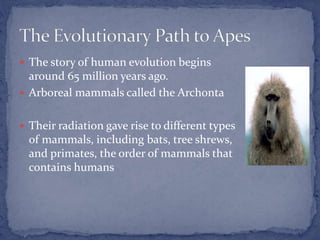
 The story of human evolution begins
around 65 million years ago.
 Arboreal mammals called the Archonta
 Their radiation gave rise to different types
of mammals, including bats, tree shrews,
and primates, the order of mammals that
contains humans
 Grasping fingers and toes.
 Binocular vision.
 Other mammals have binocular vision, but only
primates have both binocular vision and grasping
hands, making them particularly well adapted to their
environment
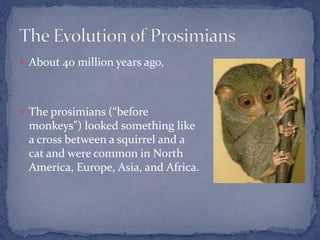
 About 40 million years ago,
 The prosimians (“before
monkeys”) looked something like
a cross between a squirrel and a
cat and were common in North
America, Europe, Asia, and Africa.
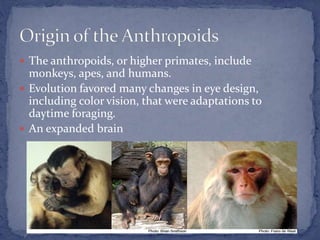
 The anthropoids, or higher primates, include
monkeys, apes, and humans.
 Evolution favored many changes in eye design,
including color vision, that were adaptations to
daytime foraging.
 An expanded brain
 About 30 million years ago, some anthropoids
migrated to South America, where they evolved in
isolation. Their descendants, known as the New World
monkeys, are easy to identify: all are arboreal, they
have flat spreading noses, and many of them grasp
objects with long prehensile tails
 Around 25 million years ago, anthropoids that
remained in Africa split into two lineages: one gave rise
to the Old World monkeys and one gave rise to the
hominoids
 None of the Old World monkeys have prehensile tails.
Their nostrils are close together, their noses point
downward, and some have toughened pads of skin for
prolonged sitting
 The earliest primates arose from small, tree-
dwelling, insect-eaters and gave rise to prosimians
and then anthropoids. Early anthropoids gave rise
to New World monkeys and Old World monkeys.
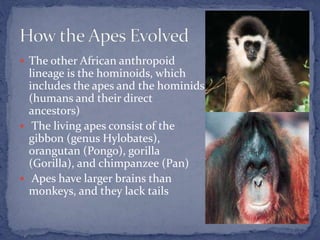
 The other African anthropoid
lineage is the hominoids, which
includes the apes and the hominids
(humans and their direct
ancestors)
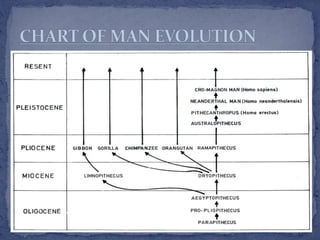
 The living apes consist of the
gibbon (genus Hylobates),
orangutan (Pongo), gorilla
(Gorilla), and chimpanzee (Pan)
 Apes have larger brains than
monkeys, and they lack tails
 Considerable controversy exists about the identity of
the first hominoid.
 . In 1932, a candidate fossil, an 8-million-year-old jaw
with teeth, was unearthed in India
 It was called Ramapithecus
 However, because very few fossils have been recovered
from the period 5 to 10 million years ago, it is not yet
possible to identify with certainty the first hominoid
ancestor.
Chimpanze
 Skull attaches posteriorly
 Spine slightly curved
 Arms longer than legs and also used
for walking
 Long, narrow pelvis
 Skull attaches inferiorly
 Spine S-shaped
 Arms shorter than legs and not used
for walking
 Bowl-shaped pelvis
Human
 Hominoids, the apes and hominids, arose from Old
World monkeys. Among living apes, chimpanzees
seem the most closely related to humans.
 Five to 10 million years ago, the world’s climate began
to get cooler, and the great forests of Africa were
largely replaced with savannas and open woodland. In
response to these changes, a new kind of hominoid
was evolving, one that was bipedal. These new
hominoids are classified as hominids—that is, of the
human line.
 There are two major groups of hominids: three to
seven species of the genus Homo
 The first hominid was discovered in 1924 by Raymond
Dart
 Professor Dart uncovered a skull unlike that of any ape
he had ever seen
 The skull was of a five-year-old individual, still with
its milk teeth
 The ventral position of the foramen magnum
suggested that the creature had walked upright.
 Australopithecus africanus
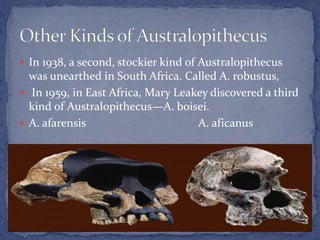
 In 1938, a second, stockier kind of Australopithecus
was unearthed in South Africa. Called A. robustus,
 In 1959, in East Africa, Mary Leakey discovered a third
kind of Australopithecus—A. boisei.
 A. afarensis A. aficanus
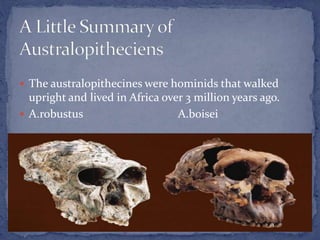
 The australopithecines were hominids that walked
upright and lived in Africa over 3 million years ago.
 A.robustus A.boisei
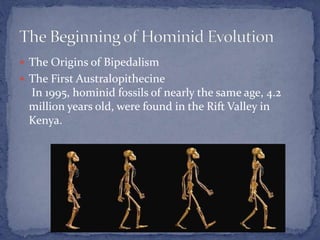
 The Origins of Bipedalism
 The First Australopithecine
In 1995, hominid fossils of nearly the same age, 4.2
million years old, were found in the Rift Valley in
Kenya.
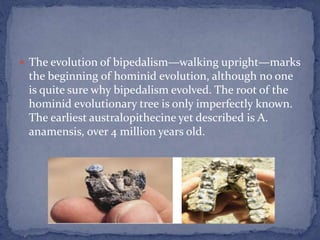
 The evolution of bipedalism—walking upright—marks
the beginning of hominid evolution, although no one
is quite sure why bipedalism evolved. The root of the
hominid evolutionary tree is only imperfectly known.
The earliest australopithecine yet described is A.
anamensis, over 4 million years old.
 The first humans evolved from australopithecine
ancestors about 2 million years ago.
 Homo habilis
 Homo rudolfensis
 Homo ergaster
 Homo erectus
 Homo heidelbergensis
 H. neanderthalensis
 In the early 1960s, stone tools were found scattered
among hominid bones close to the site where A. boisei
had been unearthed.
 A brain volume of about 680 cubic centimeters, larger
than the australopithecine range of 400 to 550 cubic
centimeters
 In 1972, Richard Leakey, working east of Lake Rudolf
in northern Kenya, discovered a virtually complete
skull about the same age as H. habilis.
 The skull, 1.9 million years old, had a brain volume of
750 cubic centimeters and many of the characteristics
of human skulls
 Some of the early Homo fossils being discovered do
not easily fit into either of these species
 They tend to have even larger brains than H.
rudolfensis, with skeletons less like an
australopithecine and more like a modern human in
both size and proportion.
 Interestingly, they also have small cheek teeth, as
modern humans do.
 Early species of Homo, the oldest members of our
genus, had a distinctly larger brain than
australopithecines and most likely used tools. There
may have been several different species.
 Eugene Dubois in 1891 found a skull cap and theigh
bone from orangutan, Java.
 He was very excited by his find, informally called Java
man, for two reasons
 The structure of the thigh bone clearly indicated that
the individual had long, straight legs and was an
excellent walker.
 The size of the skull cap suggested a very large brain,
about 1000 cubic centimeters.
 In the 1920s a skull was discovered near Peking (now
Beijing), China, that closely resembled Java man. In
the 1920s a skull was discovered near Peking (now
Beijing), China, that closely resembled Java man.
 Investigators who focus on human diversity consider
there to have been three species of modern humans:
Homo heidelbergensis, H. neanderthalensis, and H.
sapiens
 Other investigators lump the three species into one,
H. sapiens (“wise man”).
 The oldest modern human, Homo heidelbergensis, is
known from a 600,000-year-old fossil from Ethiopia
 H. heidelbergensis has more advanced anatomical
features, such as a bony keel running along the
midline of the skull, a thick ridge over the eye sockets,
and a large brain. Also, its forehead and nasal bones
are very like those of H. sapiens.
 Neanderthals were short, stocky, and powerfully built.
Their skulls were massive, with protruding faces,
heavy, bony ridges over the brows
 The oldest fossil known of Homo sapiens, our own
species, is from Ethiopia and is about 130,000 years
old.
 Outside of Africa and the Middle East, there are no
clearly dated H. sapiens fossils older than roughly
40,000 years of age.
 The implication is that H. sapiens evolved in Africa,
then migrated to Europe and Asia, the Out-of-Africa
model.
 An opposing view, the Multiregional model, argues
that the human races independently evolved from H.
erectus in different parts of the world.
 Recently, scientists studying human mitochondrial
DNA have added fuel to the fire of this controversy.
Because DNA accumulates mutations over time, the
oldest populations should show the greatest genetic
diversity. It turns out that the greatest number of
different mitochondrial DNA sequences occur among
modern Africans. This result is consistent with the
hypothesis that humans have been living in Africa
longer than on any other continent, and from there
spread to all parts of the world, retracing the path
taken
 Homo sapiens, our species, seems to have evolved in
Africa and then, like H.erectus before it, migrated to
Europe and Asia.
 Our species, Homo sapiens, is good at conceptual
thought and tool use, and is the only animal that uses
symbolic language
 H.habilis H.erectus
 Homo neanderthalensis H.sapiens
Evolution of Human
Evolution of Human
Evolution of Human

Evolution of Human

  • 1.
    Muhammad Tahir Waseem Rol.No. 28 7th semester
  • 2.
     The evolutionarypath to humans starts with the advent of primates.  The first hominids to evolve were australopithecines.  The genus Homo evolved in Africa.  Modern humans evolved quite recently.
  • 3.
     The storyof human evolution begins around 65 million years ago.  Arboreal mammals called the Archonta  Their radiation gave rise to different types of mammals, including bats, tree shrews, and primates, the order of mammals that contains humans
  • 4.
     Grasping fingersand toes.  Binocular vision.  Other mammals have binocular vision, but only primates have both binocular vision and grasping hands, making them particularly well adapted to their environment
  • 6.
     About 40million years ago,  The prosimians (“before monkeys”) looked something like a cross between a squirrel and a cat and were common in North America, Europe, Asia, and Africa.
  • 7.
     The anthropoids,or higher primates, include monkeys, apes, and humans.  Evolution favored many changes in eye design, including color vision, that were adaptations to daytime foraging.  An expanded brain
  • 8.
     About 30million years ago, some anthropoids migrated to South America, where they evolved in isolation. Their descendants, known as the New World monkeys, are easy to identify: all are arboreal, they have flat spreading noses, and many of them grasp objects with long prehensile tails
  • 9.
     Around 25million years ago, anthropoids that remained in Africa split into two lineages: one gave rise to the Old World monkeys and one gave rise to the hominoids  None of the Old World monkeys have prehensile tails. Their nostrils are close together, their noses point downward, and some have toughened pads of skin for prolonged sitting
  • 10.
     The earliestprimates arose from small, tree- dwelling, insect-eaters and gave rise to prosimians and then anthropoids. Early anthropoids gave rise to New World monkeys and Old World monkeys.
  • 11.
     The otherAfrican anthropoid lineage is the hominoids, which includes the apes and the hominids (humans and their direct ancestors)  The living apes consist of the gibbon (genus Hylobates), orangutan (Pongo), gorilla (Gorilla), and chimpanzee (Pan)  Apes have larger brains than monkeys, and they lack tails
  • 12.
     Considerable controversyexists about the identity of the first hominoid.  . In 1932, a candidate fossil, an 8-million-year-old jaw with teeth, was unearthed in India  It was called Ramapithecus  However, because very few fossils have been recovered from the period 5 to 10 million years ago, it is not yet possible to identify with certainty the first hominoid ancestor.
  • 13.
    Chimpanze  Skull attachesposteriorly  Spine slightly curved  Arms longer than legs and also used for walking  Long, narrow pelvis  Skull attaches inferiorly  Spine S-shaped  Arms shorter than legs and not used for walking  Bowl-shaped pelvis Human
  • 14.
     Hominoids, theapes and hominids, arose from Old World monkeys. Among living apes, chimpanzees seem the most closely related to humans.
  • 15.
     Five to10 million years ago, the world’s climate began to get cooler, and the great forests of Africa were largely replaced with savannas and open woodland. In response to these changes, a new kind of hominoid was evolving, one that was bipedal. These new hominoids are classified as hominids—that is, of the human line.  There are two major groups of hominids: three to seven species of the genus Homo
  • 16.
     The firsthominid was discovered in 1924 by Raymond Dart  Professor Dart uncovered a skull unlike that of any ape he had ever seen  The skull was of a five-year-old individual, still with its milk teeth  The ventral position of the foramen magnum suggested that the creature had walked upright.  Australopithecus africanus
  • 17.
     In 1938,a second, stockier kind of Australopithecus was unearthed in South Africa. Called A. robustus,  In 1959, in East Africa, Mary Leakey discovered a third kind of Australopithecus—A. boisei.  A. afarensis A. aficanus
  • 18.
     The australopithecineswere hominids that walked upright and lived in Africa over 3 million years ago.  A.robustus A.boisei
  • 19.
     The Originsof Bipedalism  The First Australopithecine In 1995, hominid fossils of nearly the same age, 4.2 million years old, were found in the Rift Valley in Kenya.
  • 20.
     The evolutionof bipedalism—walking upright—marks the beginning of hominid evolution, although no one is quite sure why bipedalism evolved. The root of the hominid evolutionary tree is only imperfectly known. The earliest australopithecine yet described is A. anamensis, over 4 million years old.
  • 21.
     The firsthumans evolved from australopithecine ancestors about 2 million years ago.  Homo habilis  Homo rudolfensis  Homo ergaster  Homo erectus  Homo heidelbergensis  H. neanderthalensis
  • 22.
     In theearly 1960s, stone tools were found scattered among hominid bones close to the site where A. boisei had been unearthed.  A brain volume of about 680 cubic centimeters, larger than the australopithecine range of 400 to 550 cubic centimeters
  • 23.
     In 1972,Richard Leakey, working east of Lake Rudolf in northern Kenya, discovered a virtually complete skull about the same age as H. habilis.  The skull, 1.9 million years old, had a brain volume of 750 cubic centimeters and many of the characteristics of human skulls
  • 24.
     Some ofthe early Homo fossils being discovered do not easily fit into either of these species  They tend to have even larger brains than H. rudolfensis, with skeletons less like an australopithecine and more like a modern human in both size and proportion.  Interestingly, they also have small cheek teeth, as modern humans do.
  • 25.
     Early speciesof Homo, the oldest members of our genus, had a distinctly larger brain than australopithecines and most likely used tools. There may have been several different species.
  • 26.
     Eugene Duboisin 1891 found a skull cap and theigh bone from orangutan, Java.  He was very excited by his find, informally called Java man, for two reasons  The structure of the thigh bone clearly indicated that the individual had long, straight legs and was an excellent walker.  The size of the skull cap suggested a very large brain, about 1000 cubic centimeters.
  • 27.
     In the1920s a skull was discovered near Peking (now Beijing), China, that closely resembled Java man. In the 1920s a skull was discovered near Peking (now Beijing), China, that closely resembled Java man.
  • 28.
     Investigators whofocus on human diversity consider there to have been three species of modern humans: Homo heidelbergensis, H. neanderthalensis, and H. sapiens  Other investigators lump the three species into one, H. sapiens (“wise man”).  The oldest modern human, Homo heidelbergensis, is known from a 600,000-year-old fossil from Ethiopia
  • 29.
     H. heidelbergensishas more advanced anatomical features, such as a bony keel running along the midline of the skull, a thick ridge over the eye sockets, and a large brain. Also, its forehead and nasal bones are very like those of H. sapiens.  Neanderthals were short, stocky, and powerfully built. Their skulls were massive, with protruding faces, heavy, bony ridges over the brows
  • 30.
     The oldestfossil known of Homo sapiens, our own species, is from Ethiopia and is about 130,000 years old.  Outside of Africa and the Middle East, there are no clearly dated H. sapiens fossils older than roughly 40,000 years of age.
  • 31.
     The implicationis that H. sapiens evolved in Africa, then migrated to Europe and Asia, the Out-of-Africa model.  An opposing view, the Multiregional model, argues that the human races independently evolved from H. erectus in different parts of the world.
  • 32.
     Recently, scientistsstudying human mitochondrial DNA have added fuel to the fire of this controversy. Because DNA accumulates mutations over time, the oldest populations should show the greatest genetic diversity. It turns out that the greatest number of different mitochondrial DNA sequences occur among modern Africans. This result is consistent with the hypothesis that humans have been living in Africa longer than on any other continent, and from there spread to all parts of the world, retracing the path taken
  • 33.
     Homo sapiens,our species, seems to have evolved in Africa and then, like H.erectus before it, migrated to Europe and Asia.  Our species, Homo sapiens, is good at conceptual thought and tool use, and is the only animal that uses symbolic language
  • 34.
  • 35.