By
Farshid Mokhberi
Shahid Beheshti University Of Medical Sciences and
Health Service
Overview
Evolution of Primates
Evolution of Hominids
Focus on Homo
Human Variation
Humans as a selective agent
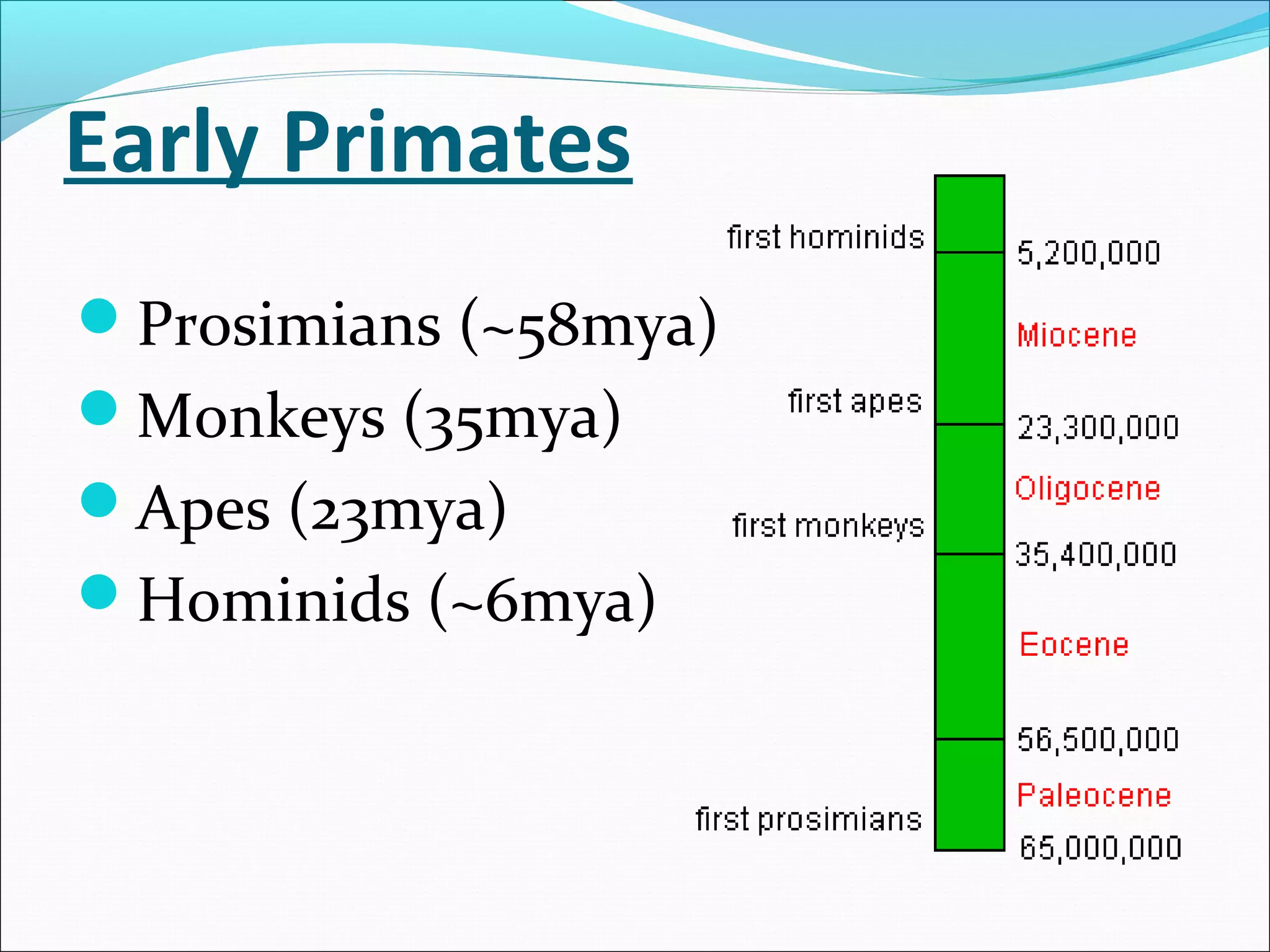
Early Primates
Prosimians (~58mya)
Monkeys (35mya)
Apes (23mya)
Hominids (~6mya)
First Arboreal Mammals
The first arboreal mammals probably
resembled shrews:
long snouts.
Good sense of smell.
Probably nocturnal.
Very active.
CLAWS
First Arboreal Mammals
Eosimias
The First Primate?
TarsiersTarsiers
LemursLemurs
LorisPottos
ProsimiansProsimians
Primate Characteristics
What is the major selective
pressure associated with life in the
trees?
How are primates adapted to this
life?
Binocular Color Vision
Mobile Limbs
Most primates have flat nails as well as sensitive pads
on the undersides of fingers and toes.
Many also have both an opposable big toe and thumb.
Mobile limbs and clawless opposable digits allow
primates to freely grasp and release tree limbs.
Other important features
Upright posture.
Small litter size.
Expanded forebrain, larger brain
capacity.
Two main groups of primates:
1. Prosimians – lemurs, lorises,
pottos & tarsiers
2. Anthropoids – monkeys, apes
and man
TarsiersTarsiers
LemursLemurs
LorisPottos
ProsimiansProsimians
ANTHROPOIDS
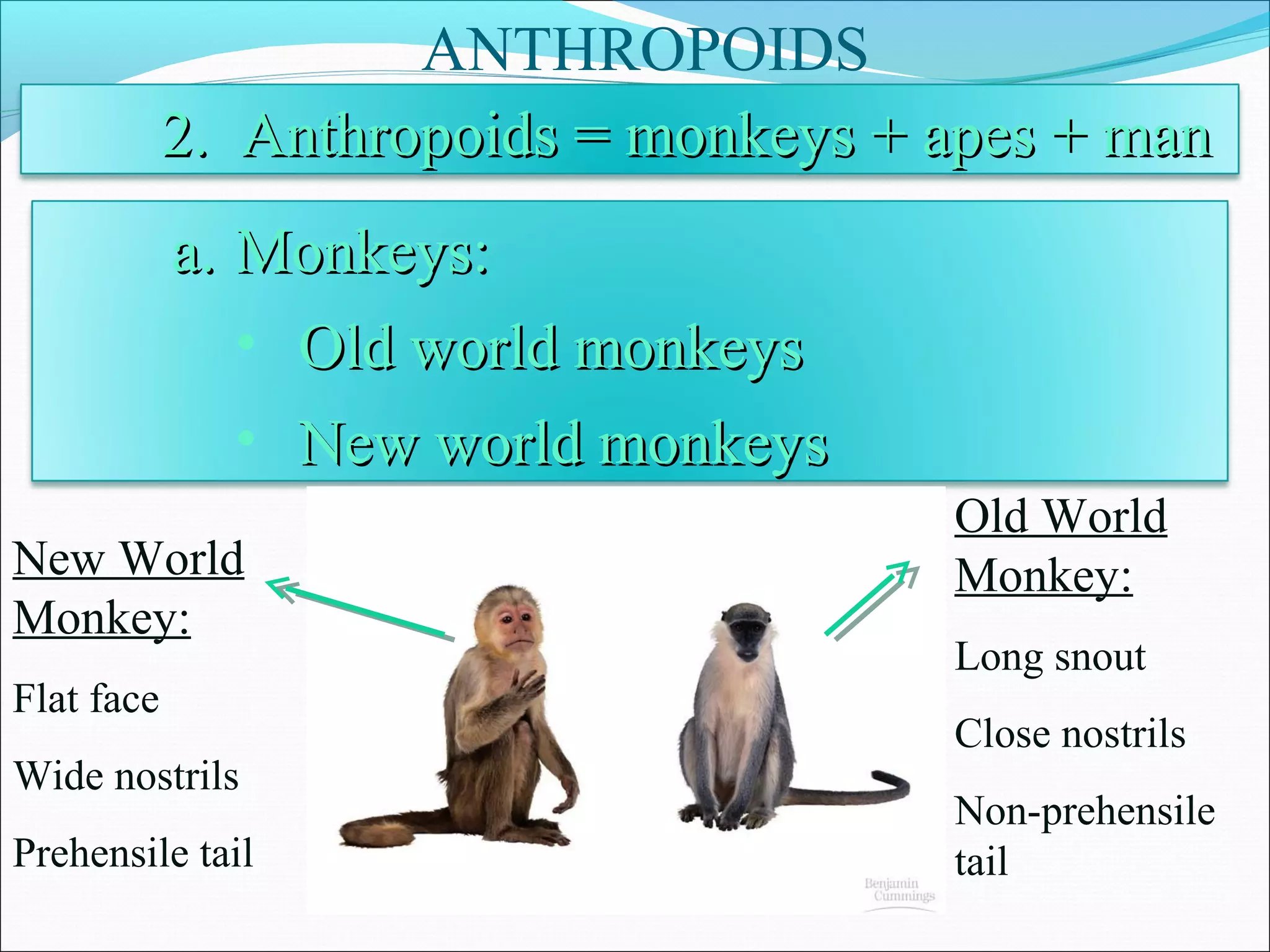
2. Anthropoids = monkeys + apes + man2. Anthropoids = monkeys + apes + man
a.a. Monkeys:Monkeys:
• Old world monkeysOld world monkeys
• New world monkeysNew world monkeys
New World
Monkey:
Flat face
Wide nostrils
Prehensile tail
Old World
Monkey:
Long snout
Close nostrils
Non-prehensile
tail
Taxonomy
Anthropoids= Hominoids +
monkeys
Hominoids= Asian and African
Apes + Hominids
Hominids= Humans
Proconsul- Ancestor to Hominoids?
A skull of
Proconsul
africanus from
the Kenya
National
Museum.
Selective pressures
East
Africa
Rift
Valley
Skull Comparisons:
Hominids:
Bipedal primates.
To be Human
 standard primate characteristics
 upright, bipedal posture
 much expanded brain
 well defined sexual dimorphism
 hidden estrus
 altered female sexual response
 extended childhood
 language
 society
 culture
Map of Australopithecus
sites in Africa, with a
focus on the East African
rift valley and limestone
caves of South Africa.
““LucyLucy”” Australopithecus afarensisAustralopithecus afarensis
An Example of Mosaic Evolution
A. afarensis
A. africanus
A. boisei
A. robustus
Australopithecus africanus
2.8 million years ago
Cranial capacity 460 cc
Homo habilis
Artist’s
representation
of a Homo
habilis band
as it might
have existed
two million
years ago.
Brain~600cc
“Handy Man”
Olduwan tools
Speech?
Homo erectus
“Upright Man”
Larger brain than H. habilis
Migrated
Acheulean tools
More advanced culture?
Homo erectus
Homo erectus
Neanderthals
Neanderthal (H. neanderthalensis) skeletons were
first discovered in Germany’s Neander Valley.
Skeletons date back 200,000 years.
Neanderthal Culture
Neanderthal Man
Homo floresiensis – Nature, Oct. 28, 2004
Nature
Oct 28, 2004
Science, Nov
19, 2004
Homo sapiens
Archaic – 100,000 to
35,000 years BP
Sometimes called Homo
sapiens and Homo sapiens
neanderthalensis
Modern – 35,000 years BP
to present
Anatomically modern
Sometimes called Homo
sapiens sapiens
Cro-Magnons
Oldest fossils to be designated H. sapiens.
Modern humans who entered Asia and Europe from
Africa 100,000 years ago.
Aurignacian tools.
Accomplished hunters.
Language.
Cro-Magnon Man
 Cro-MagnonCro-Magnon
humanshumans
 1,600 cc cranial1,600 cc cranial
capacitycapacity
 NotNot a differenta different
species, just oldspecies, just old
Homo sapiensHomo sapiens
from Europefrom Europe
Artist’s reconstruction of a Cro-Magnon man
Archaic H. sapiens Culture
 ArtArt
 Female figurinesFemale figurines
 27,000 to 22,00027,000 to 22,000
years agoyears ago
 Called “venuses,”Called “venuses,”
Archaic H. sapiens Culture
Human Variation
Responses to the environment:
• Bergmann’s Rule
• Allen’s Rule
Common
ancestor
Homo
sapiens
Modern
apes
Australopithecus
afarensis
Australopithecus
africanus
Homo
habilis
Homo
erectus
Homo
neanderthalensis

Human Evolution

Editor's Notes