Lecture 5 Integumentary System
2 Divisions of the Integumentary system 1. Skin = integument = Cutaneous membrane Skin is the largest organ of the body Composed of the  superficial EPIDERMIS and the deeper DERMIS 2.  Accessory skin structures = Appendages of the skin: i) Sweat (sudoriferous) glands   ii) Sebaceous ( oil) glands iii)  Hair/hair follicles iv)  Nails
Figure 5.1:  Skin structure, p. 153. Epidermis Dermis Hypodermis (superficial fascia) Hair root Hair shaft Pore Dermal papillae  (papillary layer of dermis) Meissner's corpuscle Free nerve ending Reticular layer of dermis  Sebaceous (oil) gland Arrector pili muscle Sensory nerve fiber Eccrine sweat gland Pacinian corpuscle Artery Vein Adipose tissue Hair follicle receptor (root hair plexus) Hair follicle Eccrine sweat gland
Strata of the Epidermis Stratum Basale –  deepest stratum Stratum Spinosum  – contains tonofilaments Stratum Granulosum – contains granules Stratum Lucidum –  present only in thick skin Stratum Corneum -  superficial stratum
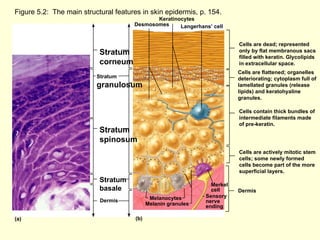
Figure 5.2:  The main structural features in skin epidermis, p. 154. Sensory nerve ending Melanocytes Melanin granules Merkel cell Langerhans’ cell Stratum corneum Stratum granulosum Stratum spinosum Stratum basale Dermis Dermis Cells are dead; represented only by flat membranous sacs filled with keratin. Glycolipids in extracellular space. Cells are flattened; organelles deteriorating; cytoplasm full of lamellated granules (release lipids) and keratohyaline granules. Cells contain thick bundles of intermediate filaments made of pre-keratin. Cells are actively mitotic stem cells; some newly formed cells become part of the more superficial layers. Keratinocytes Desmosomes (b) (a)
Stratum Basale The deepest stratum. A single layer of cells including Keratinocytes, Melanocytes, Merkel cells: Keratinocytes are mitotically active producing cells for the superficial layers hence, the stratum basale is also known as the  stratum Germinativum Melanocvtes produce the pigment  MELANIN  contained in granules called melanosomes – melanosomes accumulate on the superficial surface of the keratinocvtes in the stratum basale. Melanin acts as a chemical shield to protect the nuclei of the keratinocytes from the harmful effects  of UV radiation in sunlight. Melanin gives skin its color.  When you go out into the  sun , these cells make extra melanin to protect you from getting burned by the sun's ultraviolet, or UV, rays = tanning Merkel cells at the epidermal-dermal junction associate with free nerve endings to form  Merkel Discs which act as Touch receptors
Stratum Spinosum Several layers of cells Cells are connected by  desmosomes  – hold cells together which  cause the cells to appear “spiny” during histological preparation Cells contain intermediate filaments called  Tonofilaments Epidermal dendritic cells –  Langerhans’ cells  in the stratum spinosum act as macrophages to engulf and digest pathogens
Stratum Granulosum Composed of 3-5 layers of cells Cells contain 2 types of granules: Lamellated granules  – contain  Glycolipids  – the lipids make the  epidermis water-proof. keratohyaline granules  – contain the  tough, insoluble protein,  Keratin , which  makes the epidermis tough and abrasive-  resistant
Stratum Lucidum Thin, translucent layer of dead cells Present only in thick skin  – palms, soles
Stratum Corneum Superficial layer of the epidermis Composed of 20-30 layers of dead, flat cells  Dead cells are impregnated with glycolipids and keratin to provide a tough, durable, water-proof “coat”. Replaced every three to four weeks
The Dermis Consists of the  superficial PAPILLARY layer and the deep RETICULAR layer  The papillary Layer Composed of areolar CT In thick skin, the surface of the papillary layer forms  Dermal Ridges  which form impressions on the epidermal surface called the  EPIDERMAL RIDGES (= friction ridges)  – increase friction and  enhance gripping Pattern of epidermal ridges is genetically determined and therefore unique to an individual –  acts as the basis for finger-printing Contains the  Meissner’s Corpuscles  – act as touch receptors
Figure 5.1:  Skin structure, p. 153. Epidermis Dermis Hypodermis (superficial fascia) Hair root Hair shaft Pore Dermal papillae  (papillary layer of dermis) Meissner's corpuscle Free nerve ending Reticular layer of dermis  Sebaceous (oil) gland Arrector pili muscle Sensory nerve fiber Eccrine sweat gland Pacinian corpuscle Artery Vein Adipose tissue Hair follicle receptor (root hair plexus) Hair follicle Eccrine sweat gland
Reticular Layer of the Dermis Deeper layer accounting for 80% of the dermis Composed of dense irregular CT Contains the touch receptors for deep pressure called  Pacinian corpuscles Cleavage (tension) lines – areas of the reticular layer with less collagen bundles Incisions made parallel to the cleavage lines gape less  and therefore heal faster. Striae ( stretch marks) – indicate dermal tearing replaced by slivery white scars
Location of the Nervous Structures in the Skin Merkel discs :  epidermal-dermal junctions Meissner’s Corpuscles : Papillary layer of the dermis Root hair plexus :  wrapped around the base of a hair follicle called the hair bulb and it’s stimulated when the hair bend Pacinian Corpuscles : located in the reticular layer of the dermis and they respond to deep pressure placed on the skin
Accessory Structures of the Skin Sweat glands Sebaceous glands Hairs/hair follicles Nails
Accessory structures of the skin All derived from the epidermis but reside in the dermis: Sweat ( Sudoriferous) glands Sebaceous ( oil ) glands Hairs/hair follicles Nail
Figure 5.3:  Cutaneous glands, p. 159. Sebaceous gland duct Sebaceous gland Sweat pore Eccrine g land (a) Sectioned sebaceous gland (b) Sectioned eccrine gland
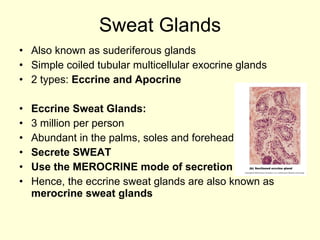
Sweat Glands Also known as suderiferous glands Simple coiled tubular multicellular exocrine glands 2 types:  Eccrine and Apocrine Eccrine Sweat Glands: 3 million per person Abundant in the palms, soles and forehead Secrete SWEAT Use the MEROCRINE mode of secretion Hence, the eccrine sweat glands are also known as  merocrine sweat glands
Composition of Sweat Hypotonic filtrate of blood 99% water Antibodies Vitamin C Salts – NaCl Metabolic wastes Dermicidin – antimicrobial protein pH  between 4-6  = Acidic ACIDIC MANTLE – acidic pH of sweat prevents microbial growth on the surface of the skin
Apocrine Sweat glands 2000 of them located in the anogenital and axillary (armpits) areas Become active after puberty when they are stimulated by the sex steroid hormones Secrete a viscous, yellowish fluid onto hair follicles Secrete their product via MEROCRINE mode of secretion Secretion is associated with body odor hence, the apocrine sweat glands are also known as “ODORIFEROUS” glands
2 Specialized Sweat Glands Ceruminous glands : specialized sweat glands located in the lining of the external ear canal; they secrete a bitter substance called  CERUMEN (earwax) which prevents entry of foreign objects  such as, insects and water, into the ear Mammary glands :  specialized sweat glands located in breasts; secrete  milk  to feed the young
Figure 5.3a
Sebaceous Glands Also known as Oil glands Simple alveolar glands Found all over the body except the palms/soles Secrete an oily substance called  SEBUM  into  hair follicles and via pores to the surface of the skin Sebum  softens and  lubricates hair and skin Secrete via the  HOLOCRINE  mode of secretion Whiteheads:  sebum accumulated in the ducts of the sebaceous glands Blackheads : popped whiteheads that result in oxidation and darkening  Acne : inflammation of sebaceous glands caused by bacteria
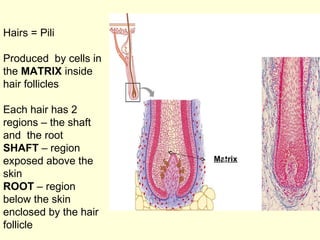
Figure 5.4 Hairs = Pili Produced  by cells in the  MATRIX  inside  hair follicles Each hair has 2 regions – shaft and root SHAFT  – region exposed above the skin ROOT  – region below the skin enclosed by the hair follicle
Hairs = Pili Produced  by cells in the  MATRIX  inside  hair follicles Each hair has 2 regions – the shaft and  the root SHAFT  – region exposed above the skin ROOT  – region below the skin enclosed by the hair follicle Matrix
Figure 5.5c-d:  Structure of a hair and hair follicle , p. 161. Hair shaft Arrector pili Sebaceous gland Hair root  Hair bulb in follicle Hair root (cuticle, cortex,  medulla) Internal epithelial root sheath External epithelial root sheath Connective tissue root sheath Hair matrix e Hair papilla Subcutaneous adipose tissue Medulla Cortex Glassy membrane (d) (c)
Figure 5.5a-b:  Structure of a hair and hair follicle, p. 161. Hair shaft Arrector pili Sebaceous gland Hair root  Hair bulb in follicle Connective tissue root sheath Follicle wall Cuticle Cortex Medulla Internal epithelial root sheath  External epithelial root sheath Glassy membrane (a) (b) 2 regions – shaft and root SHAFT –  region above the skin ROOT  – region below the skin enclosed by the hair follicles
3 Concentric Layers of hair Hair is composed of 3 concentric layers of keratinized cells: Inner medulla  – the core Middle cortex –  the largest layer Outer cuticle  – a single layer of overlapping cells that protects the underlying layers and to prevent hair from matting Conditioners keep the cuticle smooth to prevent matting of the hair and split ends Alopecia – rate of hair loss outpaces rate of hair growth
Function of Hairs For protection; hair on scalp, eyelashes To provide insulation: in cold weather, bands of smooth muscle attached to the hair follicles called  the arrector pili muscles , contract pulling the hair follicles and hairs from an oblique position to an upright position resulting in dimpling of the skin referred to as “goose bumps”; in this position a layer of air can be trapped on the surface of skin to act as an insulator to prevent heat loss from the body
Figure 5.6:  Structure of a nail , p. 163. Free edge of nail Body of nail Lateral nail fold Lunula Eponychium (cuticle) Nail matrix Root of nail Proximal nail fold Eponychium (cuticle) Body of nail Nail bed Free edge of nail Hyponychium Phalanx (bone of fingertip) (a) (b)
Figure 5.7 Basal cell carcinoma Squamous cell carcinoma Melanoma
Skin Cancer Basal Cell Carcinoma : involves the proliferation of stratum basale cells. The least malignant and most common type of skin cancer ( 80% ); grows slowly Squamous Cell Carcinoma : involves the cells in the stratum spinosum. Second most common type of skin cancer; grows rapidly Melanoma : proliferation of the melanocytes; most aggressive type of skin cancer, highly metastatic and resistant to chemotherapy; least common Further reading: www.mayoclinic.com/health/skin-cancer/DS00190
Figure 5.8:  Estimating the extent and severity of burns, p. 167. Totals Anterior and posterior head and neck, 9% Anterior and posterior upper limbs, 18% Anterior and posterior trunk, 36% Anterior and posterior lower limbs, 36% (Perineum, 1%) 100% 4 1 / 2 % Anterior trunk, 18% 9% 9% (a) (b) (c) (d) 4 1 / 2 % 4 1 / 2 % First-degree burn Second-degree burn Third-degree burn blisters
Burns Tissue damage by intense heat, radiation, electricity and chemicals such as acids Classified based on severity:  First-degree burns  – damage is confined to only the epidermis; associated with redness, swelling and pain; heal in 3day without medical intervention.  Ex. Sunburn Second-degree burns  – damage to the entire epidermis and the papillary layer of the dermis; associated with  blisters  ( fluid collection at the epidermal-dermal junction), swelling, redness and pain; heal in 3-4 weeks if infection is prevented Third-degree burns  – damage to the entire skin= damage to the entire epidermis and dermis including all nerve endings hence, the burn site is not painful; subjected to infections and fluid loss; medical intervention involving grafting, fluid, protein and ion replacement are required for healing
Wrinkles How Do Wrinkles Form?   loss of elasticity  - thinning skin  - lack of moisture When skin is young, thick, and full of elasticity it can resist muscle tension and does not develop a grove or crease when a facial muscle is contracted - such as a frown, squint, or a smile. However as we age and our skin becomes thinner, drier, less resilient, it starts to adhere itself to the underlying muscle tissue. So now when we frown the skin gets pulled along with the muscle creating a valley, a line, or a deep wrinkle over time.  Botox blocks the transmission of signals from nerves to the muscles, by hindering the production of the neurotransmitter (the chemical which relays the signals). When used for cosmetic purposes this causes the muscle to relax giving it a smoother appearance and greatly reducing the appearance of lines and wrinkles Source:  botoxguidance.com
Figure UN 5.1

Integumentary system

  • 1.
  • 2.
    2 Divisions ofthe Integumentary system 1. Skin = integument = Cutaneous membrane Skin is the largest organ of the body Composed of the superficial EPIDERMIS and the deeper DERMIS 2. Accessory skin structures = Appendages of the skin: i) Sweat (sudoriferous) glands ii) Sebaceous ( oil) glands iii) Hair/hair follicles iv) Nails
  • 3.
    Figure 5.1: Skin structure, p. 153. Epidermis Dermis Hypodermis (superficial fascia) Hair root Hair shaft Pore Dermal papillae (papillary layer of dermis) Meissner's corpuscle Free nerve ending Reticular layer of dermis Sebaceous (oil) gland Arrector pili muscle Sensory nerve fiber Eccrine sweat gland Pacinian corpuscle Artery Vein Adipose tissue Hair follicle receptor (root hair plexus) Hair follicle Eccrine sweat gland
  • 4.
    Strata of theEpidermis Stratum Basale – deepest stratum Stratum Spinosum – contains tonofilaments Stratum Granulosum – contains granules Stratum Lucidum – present only in thick skin Stratum Corneum - superficial stratum
  • 5.
    Figure 5.2: The main structural features in skin epidermis, p. 154. Sensory nerve ending Melanocytes Melanin granules Merkel cell Langerhans’ cell Stratum corneum Stratum granulosum Stratum spinosum Stratum basale Dermis Dermis Cells are dead; represented only by flat membranous sacs filled with keratin. Glycolipids in extracellular space. Cells are flattened; organelles deteriorating; cytoplasm full of lamellated granules (release lipids) and keratohyaline granules. Cells contain thick bundles of intermediate filaments made of pre-keratin. Cells are actively mitotic stem cells; some newly formed cells become part of the more superficial layers. Keratinocytes Desmosomes (b) (a)
  • 6.
    Stratum Basale Thedeepest stratum. A single layer of cells including Keratinocytes, Melanocytes, Merkel cells: Keratinocytes are mitotically active producing cells for the superficial layers hence, the stratum basale is also known as the stratum Germinativum Melanocvtes produce the pigment MELANIN contained in granules called melanosomes – melanosomes accumulate on the superficial surface of the keratinocvtes in the stratum basale. Melanin acts as a chemical shield to protect the nuclei of the keratinocytes from the harmful effects of UV radiation in sunlight. Melanin gives skin its color. When you go out into the sun , these cells make extra melanin to protect you from getting burned by the sun's ultraviolet, or UV, rays = tanning Merkel cells at the epidermal-dermal junction associate with free nerve endings to form Merkel Discs which act as Touch receptors
  • 7.
    Stratum Spinosum Severallayers of cells Cells are connected by desmosomes – hold cells together which cause the cells to appear “spiny” during histological preparation Cells contain intermediate filaments called Tonofilaments Epidermal dendritic cells – Langerhans’ cells in the stratum spinosum act as macrophages to engulf and digest pathogens
  • 8.
    Stratum Granulosum Composedof 3-5 layers of cells Cells contain 2 types of granules: Lamellated granules – contain Glycolipids – the lipids make the epidermis water-proof. keratohyaline granules – contain the tough, insoluble protein, Keratin , which makes the epidermis tough and abrasive- resistant
  • 9.
    Stratum Lucidum Thin,translucent layer of dead cells Present only in thick skin – palms, soles
  • 10.
    Stratum Corneum Superficiallayer of the epidermis Composed of 20-30 layers of dead, flat cells Dead cells are impregnated with glycolipids and keratin to provide a tough, durable, water-proof “coat”. Replaced every three to four weeks
  • 11.
    The Dermis Consistsof the superficial PAPILLARY layer and the deep RETICULAR layer The papillary Layer Composed of areolar CT In thick skin, the surface of the papillary layer forms Dermal Ridges which form impressions on the epidermal surface called the EPIDERMAL RIDGES (= friction ridges) – increase friction and enhance gripping Pattern of epidermal ridges is genetically determined and therefore unique to an individual – acts as the basis for finger-printing Contains the Meissner’s Corpuscles – act as touch receptors
  • 12.
    Figure 5.1: Skin structure, p. 153. Epidermis Dermis Hypodermis (superficial fascia) Hair root Hair shaft Pore Dermal papillae (papillary layer of dermis) Meissner's corpuscle Free nerve ending Reticular layer of dermis Sebaceous (oil) gland Arrector pili muscle Sensory nerve fiber Eccrine sweat gland Pacinian corpuscle Artery Vein Adipose tissue Hair follicle receptor (root hair plexus) Hair follicle Eccrine sweat gland
  • 13.
    Reticular Layer ofthe Dermis Deeper layer accounting for 80% of the dermis Composed of dense irregular CT Contains the touch receptors for deep pressure called Pacinian corpuscles Cleavage (tension) lines – areas of the reticular layer with less collagen bundles Incisions made parallel to the cleavage lines gape less and therefore heal faster. Striae ( stretch marks) – indicate dermal tearing replaced by slivery white scars
  • 14.
    Location of theNervous Structures in the Skin Merkel discs : epidermal-dermal junctions Meissner’s Corpuscles : Papillary layer of the dermis Root hair plexus : wrapped around the base of a hair follicle called the hair bulb and it’s stimulated when the hair bend Pacinian Corpuscles : located in the reticular layer of the dermis and they respond to deep pressure placed on the skin
  • 15.
    Accessory Structures ofthe Skin Sweat glands Sebaceous glands Hairs/hair follicles Nails
  • 16.
    Accessory structures ofthe skin All derived from the epidermis but reside in the dermis: Sweat ( Sudoriferous) glands Sebaceous ( oil ) glands Hairs/hair follicles Nail
  • 17.
    Figure 5.3: Cutaneous glands, p. 159. Sebaceous gland duct Sebaceous gland Sweat pore Eccrine g land (a) Sectioned sebaceous gland (b) Sectioned eccrine gland
  • 18.
    Sweat Glands Alsoknown as suderiferous glands Simple coiled tubular multicellular exocrine glands 2 types: Eccrine and Apocrine Eccrine Sweat Glands: 3 million per person Abundant in the palms, soles and forehead Secrete SWEAT Use the MEROCRINE mode of secretion Hence, the eccrine sweat glands are also known as merocrine sweat glands
  • 19.
    Composition of SweatHypotonic filtrate of blood 99% water Antibodies Vitamin C Salts – NaCl Metabolic wastes Dermicidin – antimicrobial protein pH between 4-6 = Acidic ACIDIC MANTLE – acidic pH of sweat prevents microbial growth on the surface of the skin
  • 20.
    Apocrine Sweat glands2000 of them located in the anogenital and axillary (armpits) areas Become active after puberty when they are stimulated by the sex steroid hormones Secrete a viscous, yellowish fluid onto hair follicles Secrete their product via MEROCRINE mode of secretion Secretion is associated with body odor hence, the apocrine sweat glands are also known as “ODORIFEROUS” glands
  • 21.
    2 Specialized SweatGlands Ceruminous glands : specialized sweat glands located in the lining of the external ear canal; they secrete a bitter substance called CERUMEN (earwax) which prevents entry of foreign objects such as, insects and water, into the ear Mammary glands : specialized sweat glands located in breasts; secrete milk to feed the young
  • 22.
  • 23.
    Sebaceous Glands Alsoknown as Oil glands Simple alveolar glands Found all over the body except the palms/soles Secrete an oily substance called SEBUM into hair follicles and via pores to the surface of the skin Sebum softens and lubricates hair and skin Secrete via the HOLOCRINE mode of secretion Whiteheads: sebum accumulated in the ducts of the sebaceous glands Blackheads : popped whiteheads that result in oxidation and darkening Acne : inflammation of sebaceous glands caused by bacteria
  • 24.
    Figure 5.4 Hairs= Pili Produced by cells in the MATRIX inside hair follicles Each hair has 2 regions – shaft and root SHAFT – region exposed above the skin ROOT – region below the skin enclosed by the hair follicle
  • 25.
    Hairs = PiliProduced by cells in the MATRIX inside hair follicles Each hair has 2 regions – the shaft and the root SHAFT – region exposed above the skin ROOT – region below the skin enclosed by the hair follicle Matrix
  • 26.
    Figure 5.5c-d: Structure of a hair and hair follicle , p. 161. Hair shaft Arrector pili Sebaceous gland Hair root Hair bulb in follicle Hair root (cuticle, cortex, medulla) Internal epithelial root sheath External epithelial root sheath Connective tissue root sheath Hair matrix e Hair papilla Subcutaneous adipose tissue Medulla Cortex Glassy membrane (d) (c)
  • 27.
    Figure 5.5a-b: Structure of a hair and hair follicle, p. 161. Hair shaft Arrector pili Sebaceous gland Hair root Hair bulb in follicle Connective tissue root sheath Follicle wall Cuticle Cortex Medulla Internal epithelial root sheath External epithelial root sheath Glassy membrane (a) (b) 2 regions – shaft and root SHAFT – region above the skin ROOT – region below the skin enclosed by the hair follicles
  • 28.
    3 Concentric Layersof hair Hair is composed of 3 concentric layers of keratinized cells: Inner medulla – the core Middle cortex – the largest layer Outer cuticle – a single layer of overlapping cells that protects the underlying layers and to prevent hair from matting Conditioners keep the cuticle smooth to prevent matting of the hair and split ends Alopecia – rate of hair loss outpaces rate of hair growth
  • 29.
    Function of HairsFor protection; hair on scalp, eyelashes To provide insulation: in cold weather, bands of smooth muscle attached to the hair follicles called the arrector pili muscles , contract pulling the hair follicles and hairs from an oblique position to an upright position resulting in dimpling of the skin referred to as “goose bumps”; in this position a layer of air can be trapped on the surface of skin to act as an insulator to prevent heat loss from the body
  • 30.
    Figure 5.6: Structure of a nail , p. 163. Free edge of nail Body of nail Lateral nail fold Lunula Eponychium (cuticle) Nail matrix Root of nail Proximal nail fold Eponychium (cuticle) Body of nail Nail bed Free edge of nail Hyponychium Phalanx (bone of fingertip) (a) (b)
  • 31.
    Figure 5.7 Basalcell carcinoma Squamous cell carcinoma Melanoma
  • 32.
    Skin Cancer BasalCell Carcinoma : involves the proliferation of stratum basale cells. The least malignant and most common type of skin cancer ( 80% ); grows slowly Squamous Cell Carcinoma : involves the cells in the stratum spinosum. Second most common type of skin cancer; grows rapidly Melanoma : proliferation of the melanocytes; most aggressive type of skin cancer, highly metastatic and resistant to chemotherapy; least common Further reading: www.mayoclinic.com/health/skin-cancer/DS00190
  • 33.
    Figure 5.8: Estimating the extent and severity of burns, p. 167. Totals Anterior and posterior head and neck, 9% Anterior and posterior upper limbs, 18% Anterior and posterior trunk, 36% Anterior and posterior lower limbs, 36% (Perineum, 1%) 100% 4 1 / 2 % Anterior trunk, 18% 9% 9% (a) (b) (c) (d) 4 1 / 2 % 4 1 / 2 % First-degree burn Second-degree burn Third-degree burn blisters
  • 34.
    Burns Tissue damageby intense heat, radiation, electricity and chemicals such as acids Classified based on severity: First-degree burns – damage is confined to only the epidermis; associated with redness, swelling and pain; heal in 3day without medical intervention. Ex. Sunburn Second-degree burns – damage to the entire epidermis and the papillary layer of the dermis; associated with blisters ( fluid collection at the epidermal-dermal junction), swelling, redness and pain; heal in 3-4 weeks if infection is prevented Third-degree burns – damage to the entire skin= damage to the entire epidermis and dermis including all nerve endings hence, the burn site is not painful; subjected to infections and fluid loss; medical intervention involving grafting, fluid, protein and ion replacement are required for healing
  • 35.
    Wrinkles How DoWrinkles Form? loss of elasticity - thinning skin - lack of moisture When skin is young, thick, and full of elasticity it can resist muscle tension and does not develop a grove or crease when a facial muscle is contracted - such as a frown, squint, or a smile. However as we age and our skin becomes thinner, drier, less resilient, it starts to adhere itself to the underlying muscle tissue. So now when we frown the skin gets pulled along with the muscle creating a valley, a line, or a deep wrinkle over time. Botox blocks the transmission of signals from nerves to the muscles, by hindering the production of the neurotransmitter (the chemical which relays the signals). When used for cosmetic purposes this causes the muscle to relax giving it a smoother appearance and greatly reducing the appearance of lines and wrinkles Source: botoxguidance.com
  • 36.

Editor's Notes

  • #3 Largest internal organ is the liver Largest in general is the skin Hypodermis is part of the fascia – binds dermis to the skeletal muscle
  • #4 Areolar connective tissue, dense regular connective tissue in dermis
  • #5 Most skin is of the thin type… thick skin in soles of feet and palms 4 types of layers in thick skin (the list above is from deepest to most superficial)
  • #7 Abutting basal membrane **FUNCTION OF MELANIN – protective function
  • #8 3-5 layers of cells Cells contain tonofilaments (intermediate filaments) Cells are connected by desmosomes Contains epidermal dendritic cells (Langerhans’ cells) that act as macrophages
  • #10 Started listening to the lecture here, seems like she’s been covering slides word for word
  • #11 Glycolipids make it waterproof You lose 20,000 cells per minute! You lose 40 lbs of skin in a lifetime
  • #12 Surface of dermis is saturated with blood vessels and nerve endings Meissner’s Corpuscles and Merkel cells both act as TOUCH RECEPTORS
  • #13 Notice that dermis is much thicker than the epidermis
  • #19 Release sweat as exocytosis
  • #21 Apocrine name is a MISNOMER. Merocrine mode of secretion is used.. WATCH OUT FOR THIS
  • #22 Ear drum surface kept moist by cerumen
  • #24 To cure acne, you need to take an antibiotic
  • #25 Derived from BASAL EPIDERMIS… look at slide 16
  • #26 Hair is for protection Hair matrix highly vascularized
  • #29 Alopecia – ALL the hair on your body is falling out and the rate of growth can’t keep up
  • #31 FUNCTION - SCRATCHING