Human Anatomy
An Orientation
By Dr Wambete Amos
MBChB, MPH, PGDHSMHC, PGDM&E
An Overview of Anatomy
▪ Anatomy - The study of the structure of the
human body
▪ Physiology - The study of body function
An Overview of Anatomy
▪ Anatomical terminology
▪ Based on ancient Greek or Latin
▪ Provides standard nomenclature worldwide
▪ Branches of anatomy
▪ Gross anatomy
▪ Microscopic anatomy (histology)
▪ Surface anatomy
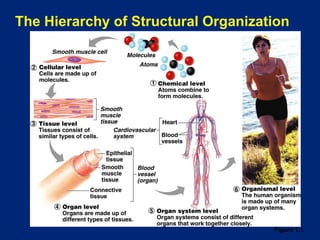
The Hierarchy of Structural Organization
▪ Chemical level – atoms form molecules
▪ Cellular level – cells and their functional subunits
▪ Tissue level – a group of cells performing a common
function
▪ Organ level – a discrete structure made up of more than
one tissue
▪ Organ system – organs working together for a common
purpose
▪ Organismal level – the result of all simpler levels working
in unison
The Hierarchy of Structural Organization
Figure 1.1
Systemic v. Regional Anatomy
▪ Systemic – study of anatomy by system
▪ Regional – study of anatomy by region
▪ Most students use a combination of regional and
systemic study
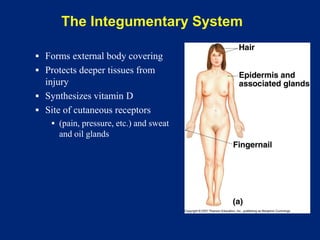
The Integumentary System
▪ Forms external body covering
▪ Protects deeper tissues from
injury
▪ Synthesizes vitamin D
▪ Site of cutaneous receptors
▪ (pain, pressure, etc.) and sweat
and oil glands
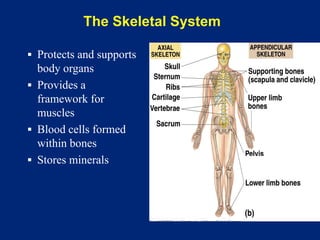
The Skeletal System
▪ Protects and supports
body organs
▪ Provides a
framework for
muscles
▪ Blood cells formed
within bones
▪ Stores minerals
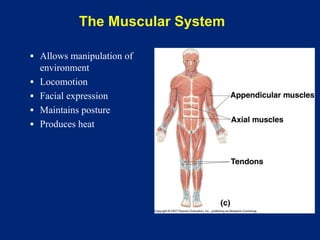
The Muscular System
▪ Allows manipulation of
environment
▪ Locomotion
▪ Facial expression
▪ Maintains posture
▪ Produces heat
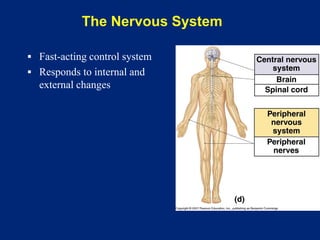
The Nervous System
▪ Fast-acting control system
▪ Responds to internal and
external changes
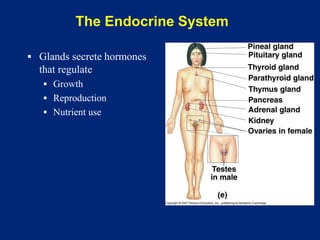
The Endocrine System
▪ Glands secrete hormones
that regulate
▪ Growth
▪ Reproduction
▪ Nutrient use
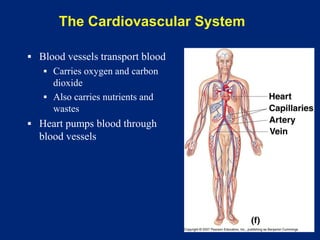
The Cardiovascular System
▪ Blood vessels transport blood
▪ Carries oxygen and carbon
dioxide
▪ Also carries nutrients and
wastes
▪ Heart pumps blood through
blood vessels
Figure 1-2(f)
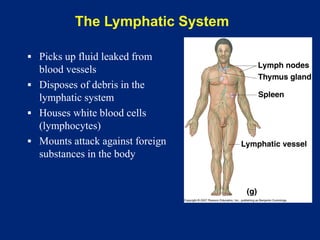
The Lymphatic System
▪ Picks up fluid leaked from
blood vessels
▪ Disposes of debris in the
lymphatic system
▪ Houses white blood cells
(lymphocytes)
▪ Mounts attack against foreign
substances in the body
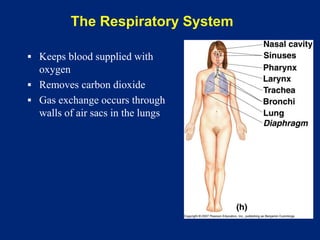
The Respiratory System
▪ Keeps blood supplied with
oxygen
▪ Removes carbon dioxide
▪ Gas exchange occurs through
walls of air sacs in the lungs
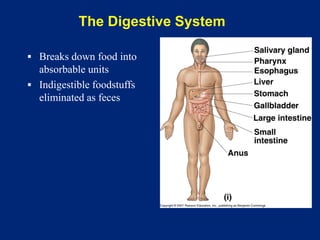
The Digestive System
▪ Breaks down food into
absorbable units
▪ Indigestible foodstuffs
eliminated as feces
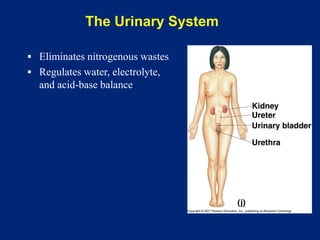
The Urinary System
▪ Eliminates nitrogenous wastes
▪ Regulates water, electrolyte,
and acid-base balance
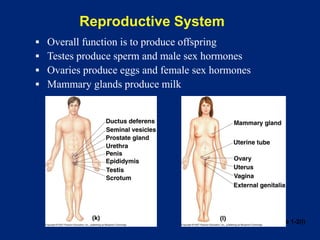
Reproductive System
Figure 1-2(l)
▪ Overall function is to produce offspring
▪ Testes produce sperm and male sex hormones
▪ Ovaries produce eggs and female sex hormones
▪ Mammary glands produce milk
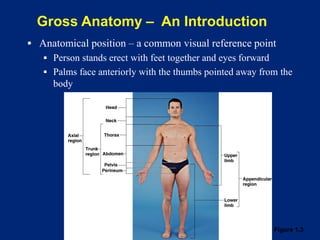
Gross Anatomy – An Introduction
Figure 1.3
▪ Anatomical position – a common visual reference point
▪ Person stands erect with feet together and eyes forward
▪ Palms face anteriorly with the thumbs pointed away from the
body
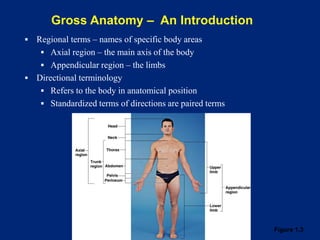
Gross Anatomy – An Introduction
Figure 1.3
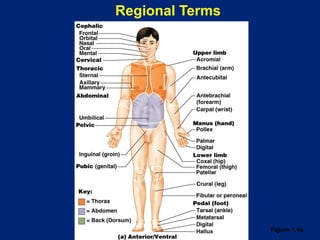
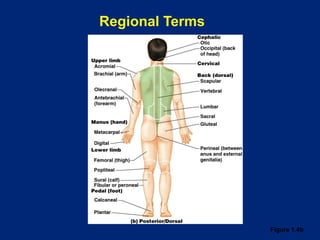
▪ Regional terms – names of specific body areas
▪ Axial region – the main axis of the body
▪ Appendicular region – the limbs
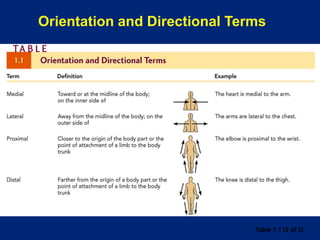
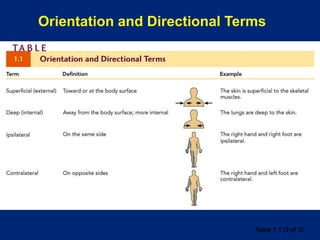
▪ Directional terminology
▪ Refers to the body in anatomical position
▪ Standardized terms of directions are paired terms
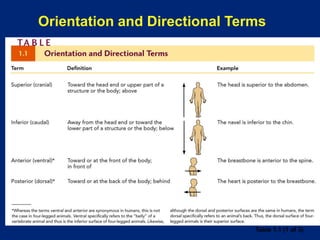
Orientation and Directional Terms
Table 1.1 (1 of 3)
Orientation and Directional Terms
Table 1.1 (2 of 3)
Orientation and Directional Terms
Table 1.1 (3 of 3)
Regional Terms
Figure 1.4a
Regional Terms
Figure 1.4b
Body Planes and Sections
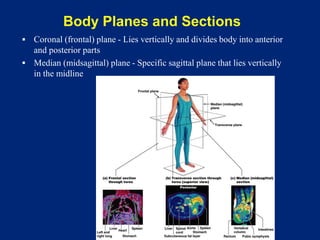
▪ Coronal (frontal) plane - Lies vertically and divides body into anterior
and posterior parts
▪ Median (midsagittal) plane - Specific sagittal plane that lies vertically
in the midline
Body Planes and Sections
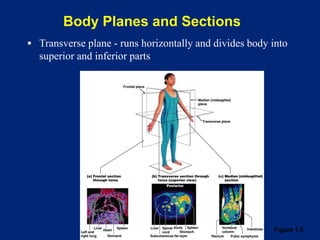
▪ Transverse plane - runs horizontally and divides body into
superior and inferior parts
Figure 1.5
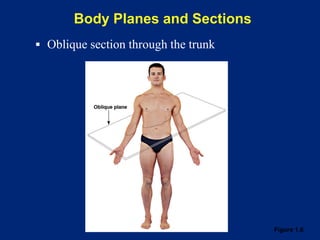
Figure 1.6
Body Planes and Sections
▪ Oblique section through the trunk
Body Cavities and Membranes
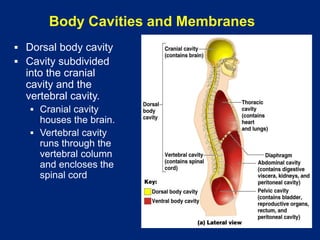
▪ Dorsal body cavity
▪ Cavity subdivided
into the cranial
cavity and the
vertebral cavity.
▪ Cranial cavity
houses the brain.
▪ Vertebral cavity
runs through the
vertebral column
and encloses the
spinal cord
Body Cavities and Membranes
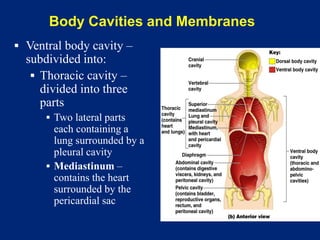
▪ Ventral body cavity –
subdivided into:
▪ Thoracic cavity –
divided into three
parts
▪ Two lateral parts
each containing a
lung surrounded by a
pleural cavity
▪ Mediastinum –
contains the heart
surrounded by the
pericardial sac
Body Cavities and Membranes
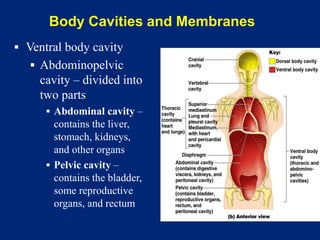
▪ Ventral body cavity
▪ Abdominopelvic
cavity – divided into
two parts
▪ Abdominal cavity –
contains the liver,
stomach, kidneys,
and other organs
▪ Pelvic cavity –
contains the bladder,
some reproductive
organs, and rectum
Body Cavities and Membranes
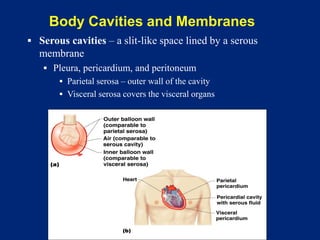
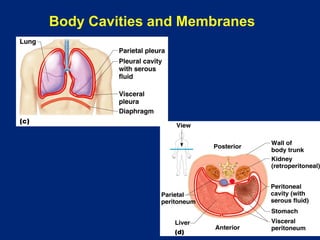
▪ Serous cavities – a slit-like space lined by a serous
membrane
▪ Pleura, pericardium, and peritoneum
▪ Parietal serosa – outer wall of the cavity
▪ Visceral serosa covers the visceral organs
Body Cavities and Membranes
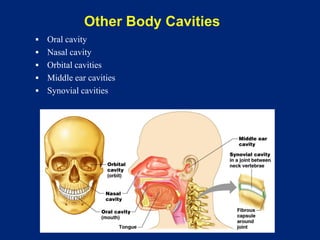
Other Body Cavities
▪ Oral cavity
▪ Nasal cavity
▪ Orbital cavities
▪ Middle ear cavities
▪ Synovial cavities
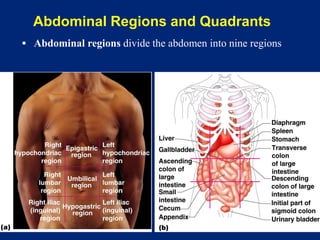
Abdominal Regions and Quadrants
▪ Abdominal regions divide the abdomen into nine regions
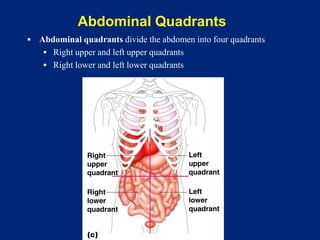
Abdominal Quadrants
▪ Abdominal quadrants divide the abdomen into four quadrants
▪ Right upper and left upper quadrants
▪ Right lower and left lower quadrants

3ef0eca9-2f64-495a-9896-07ac3de6067a (1).pdf

  • 1.
    Human Anatomy An Orientation ByDr Wambete Amos MBChB, MPH, PGDHSMHC, PGDM&E
  • 2.
    An Overview ofAnatomy ▪ Anatomy - The study of the structure of the human body ▪ Physiology - The study of body function
  • 3.
    An Overview ofAnatomy ▪ Anatomical terminology ▪ Based on ancient Greek or Latin ▪ Provides standard nomenclature worldwide ▪ Branches of anatomy ▪ Gross anatomy ▪ Microscopic anatomy (histology) ▪ Surface anatomy
  • 4.
    The Hierarchy ofStructural Organization ▪ Chemical level – atoms form molecules ▪ Cellular level – cells and their functional subunits ▪ Tissue level – a group of cells performing a common function ▪ Organ level – a discrete structure made up of more than one tissue ▪ Organ system – organs working together for a common purpose ▪ Organismal level – the result of all simpler levels working in unison
  • 5.
    The Hierarchy ofStructural Organization Figure 1.1
  • 6.
    Systemic v. RegionalAnatomy ▪ Systemic – study of anatomy by system ▪ Regional – study of anatomy by region ▪ Most students use a combination of regional and systemic study
  • 7.
    The Integumentary System ▪Forms external body covering ▪ Protects deeper tissues from injury ▪ Synthesizes vitamin D ▪ Site of cutaneous receptors ▪ (pain, pressure, etc.) and sweat and oil glands
  • 8.
    The Skeletal System ▪Protects and supports body organs ▪ Provides a framework for muscles ▪ Blood cells formed within bones ▪ Stores minerals
  • 9.
    The Muscular System ▪Allows manipulation of environment ▪ Locomotion ▪ Facial expression ▪ Maintains posture ▪ Produces heat
  • 10.
    The Nervous System ▪Fast-acting control system ▪ Responds to internal and external changes
  • 11.
    The Endocrine System ▪Glands secrete hormones that regulate ▪ Growth ▪ Reproduction ▪ Nutrient use
  • 12.
    The Cardiovascular System ▪Blood vessels transport blood ▪ Carries oxygen and carbon dioxide ▪ Also carries nutrients and wastes ▪ Heart pumps blood through blood vessels Figure 1-2(f)
  • 13.
    The Lymphatic System ▪Picks up fluid leaked from blood vessels ▪ Disposes of debris in the lymphatic system ▪ Houses white blood cells (lymphocytes) ▪ Mounts attack against foreign substances in the body
  • 14.
    The Respiratory System ▪Keeps blood supplied with oxygen ▪ Removes carbon dioxide ▪ Gas exchange occurs through walls of air sacs in the lungs
  • 15.
    The Digestive System ▪Breaks down food into absorbable units ▪ Indigestible foodstuffs eliminated as feces
  • 16.
    The Urinary System ▪Eliminates nitrogenous wastes ▪ Regulates water, electrolyte, and acid-base balance
  • 17.
    Reproductive System Figure 1-2(l) ▪Overall function is to produce offspring ▪ Testes produce sperm and male sex hormones ▪ Ovaries produce eggs and female sex hormones ▪ Mammary glands produce milk
  • 18.
    Gross Anatomy –An Introduction Figure 1.3 ▪ Anatomical position – a common visual reference point ▪ Person stands erect with feet together and eyes forward ▪ Palms face anteriorly with the thumbs pointed away from the body
  • 19.
    Gross Anatomy –An Introduction Figure 1.3 ▪ Regional terms – names of specific body areas ▪ Axial region – the main axis of the body ▪ Appendicular region – the limbs ▪ Directional terminology ▪ Refers to the body in anatomical position ▪ Standardized terms of directions are paired terms
  • 20.
    Orientation and DirectionalTerms Table 1.1 (1 of 3)
  • 21.
    Orientation and DirectionalTerms Table 1.1 (2 of 3)
  • 22.
    Orientation and DirectionalTerms Table 1.1 (3 of 3)
  • 23.
  • 24.
  • 25.
    Body Planes andSections ▪ Coronal (frontal) plane - Lies vertically and divides body into anterior and posterior parts ▪ Median (midsagittal) plane - Specific sagittal plane that lies vertically in the midline
  • 26.
    Body Planes andSections ▪ Transverse plane - runs horizontally and divides body into superior and inferior parts Figure 1.5
  • 27.
    Figure 1.6 Body Planesand Sections ▪ Oblique section through the trunk
  • 28.
    Body Cavities andMembranes ▪ Dorsal body cavity ▪ Cavity subdivided into the cranial cavity and the vertebral cavity. ▪ Cranial cavity houses the brain. ▪ Vertebral cavity runs through the vertebral column and encloses the spinal cord
  • 29.
    Body Cavities andMembranes ▪ Ventral body cavity – subdivided into: ▪ Thoracic cavity – divided into three parts ▪ Two lateral parts each containing a lung surrounded by a pleural cavity ▪ Mediastinum – contains the heart surrounded by the pericardial sac
  • 30.
    Body Cavities andMembranes ▪ Ventral body cavity ▪ Abdominopelvic cavity – divided into two parts ▪ Abdominal cavity – contains the liver, stomach, kidneys, and other organs ▪ Pelvic cavity – contains the bladder, some reproductive organs, and rectum
  • 31.
    Body Cavities andMembranes ▪ Serous cavities – a slit-like space lined by a serous membrane ▪ Pleura, pericardium, and peritoneum ▪ Parietal serosa – outer wall of the cavity ▪ Visceral serosa covers the visceral organs
  • 32.
  • 33.
    Other Body Cavities ▪Oral cavity ▪ Nasal cavity ▪ Orbital cavities ▪ Middle ear cavities ▪ Synovial cavities
  • 34.
    Abdominal Regions andQuadrants ▪ Abdominal regions divide the abdomen into nine regions
  • 35.
    Abdominal Quadrants ▪ Abdominalquadrants divide the abdomen into four quadrants ▪ Right upper and left upper quadrants ▪ Right lower and left lower quadrants