
PROTEINS
RODNEY L. PEÑAFIEL
Fish known as the
cheapest source of
protein as became major
part of the family
consumption in the
Philippines.
Proteins
Any a large numbers of
organinc compounds that
make up living organisms
and are essential to their
functioning.
Are made up of amino
acids.
Amino Acids
An important class of
organic compounds that
contain both the amino (-
NH2) and carboxyl (-COOH)
groups.
Of these acids,
20 serve as the
building blocks
of proteins.
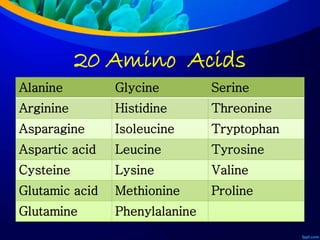
20 Amino Acids
Alanine Glycine Serine
Arginine Histidine Threonine
Asparagine Isoleucine Tryptophan
Aspartic acid Leucine Tyrosine
Cysteine Lysine Valine
Glutamic acid Methionine Proline
Glutamine Phenylalanine
When a living cell
makes protein, the
carboxyl group of one
amino acid is linked
to the amino group of
another to form a
piptide bond.
The carboxyl group
of the second amino
acid is similarly linked
to the amino group of a
third, and so on, until a
long cahin is produced.
This chainlike
molecule, which
may contain from
50 to several
hundred amino acid
subunits, is called
a polypeptide.
A protein may be formed
of a single polypetide
chain, or it may consist
of several such chain
held together by weak
molecular bonds.
Bonds of Proteins
The primary (1° )
structure of a protein is
simply the sequence of
the amino acids.
Lys-glu-pro-leu- and
so on.
The secondary (2° )
structure of a protein is the
interactions between
portions of the peptide chain.
Hydrogen bonding is one such
interaction that leads
to a helix, b sheet and triple
helix structures.
The tertiary (3°)
structure of a protein
can be thought of as
its three dimensional
structure. The
tertiary structure
involves the
overlapping or folding
of a peptide upon
itself.
A protein has
quaternary (4°)
structure if two or more
polypeptides interact
with one another to from
a biologically active
protein.
Each protein is
formed according to a
precise set of
instructions
contained within the
nucleic acid, which is
the genetic material
of the cell.
These instructions
determine which of the
20 standards amino acids
are to be incorporated
into the protein, and in
what sequence.
Classification of
Proteins
1. Accrdg. to
composition
2. Accrdg. to
fucntion
Accrdg. to Composition
1. Simple Proteins
2. Conjugated Proteins
*Simple Proteins
Chemically made
up of amino acid
Simple Proteins
1. Albumin
-most impotant and
common group of
protein. Present in egg
white and blood.
2. Globulin
-widely distributed
group of proteins
e.g. as antibodies
and fibrinogen.
3. Histones
-are found to be
associated with nucleic
acids of the cell.
4. Scleroprotein
(albuminoids)
-Have structural
and protective
functions.
E.g. Keratin (hair,skin,
and nails)
Collagen (bone, tendon
and cartilage)
Elastin (elastic fibers
of connective tissue)
*Conjugated Proteins
Contains other
chemical groups
other than amino
acids.
May be carbohydrates,
lipids, bound metals
ions and organic
groups.
Conjugated proteins
Prosthetic group
1. Phosphoproteins - e.g.
casein
2. Glycoproteins - e.g.
mucin
3. Nucleoprotein
4. Lipoproteis - compound
lipids
5. Chromoprotein –
pigmented prothetic
group e.g hemoglobin
(with iron – containing
pigment, heme)
coordinated to a simple
protein portion, globin.
Accrdg. to function
1.Structural proteins
– more than half of
the total protein of
the mammalian body
is collagen, found in
skin, cartillage and
bone.
2. Contactile protein-
examples are actin
and myosin isolated
from skeletal muscle.
3. Enzymes- these
biological catalysts
are vitally
important to all
living systems.
4. Hormones- e.g.
insulins
5. Antibodies
the body produces
antibodies to destroy
any foreign materials
(antigens) released
into the body by an
infectious agent.
6. Blood proteins
the albumins, globulins
and fibrinogen are the
three major protein
constituents of the blood.
PROTEIN
AUTOLYSIS
Autolysis
au-tol-sis
noun Self-digestion of
cell: the digestion of
cells by their own
enzymes.
Leads to structural
changes = softening of
fish flesh
(basis of TOUCH TEST)
Proteins are broken
down by steps into
amino acids and
other nitrogenous
end products.
1. Amines
2. Ammonia
Indole
Skatole
H2O
3. CO2
Biogenic amines
-are volatile amines
that are produced as a
result of the breakdown of
amino acids, typically on
death of the animal.
Other end products used
in estimating of seafood
spoilage:
Indole
pH
Tyrosin
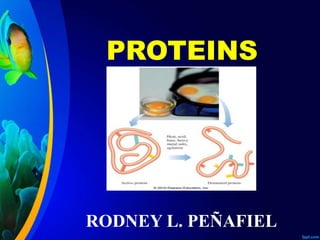
Protein Denaturation
Any change the secondary
and tertiary structure of
protein without causing a
concomitant cleavage of
the peptide bonds.
Accompanied by
changes in the
physical and
biochemical nature
of the protein.
Thank you!
Rodney

Proteins