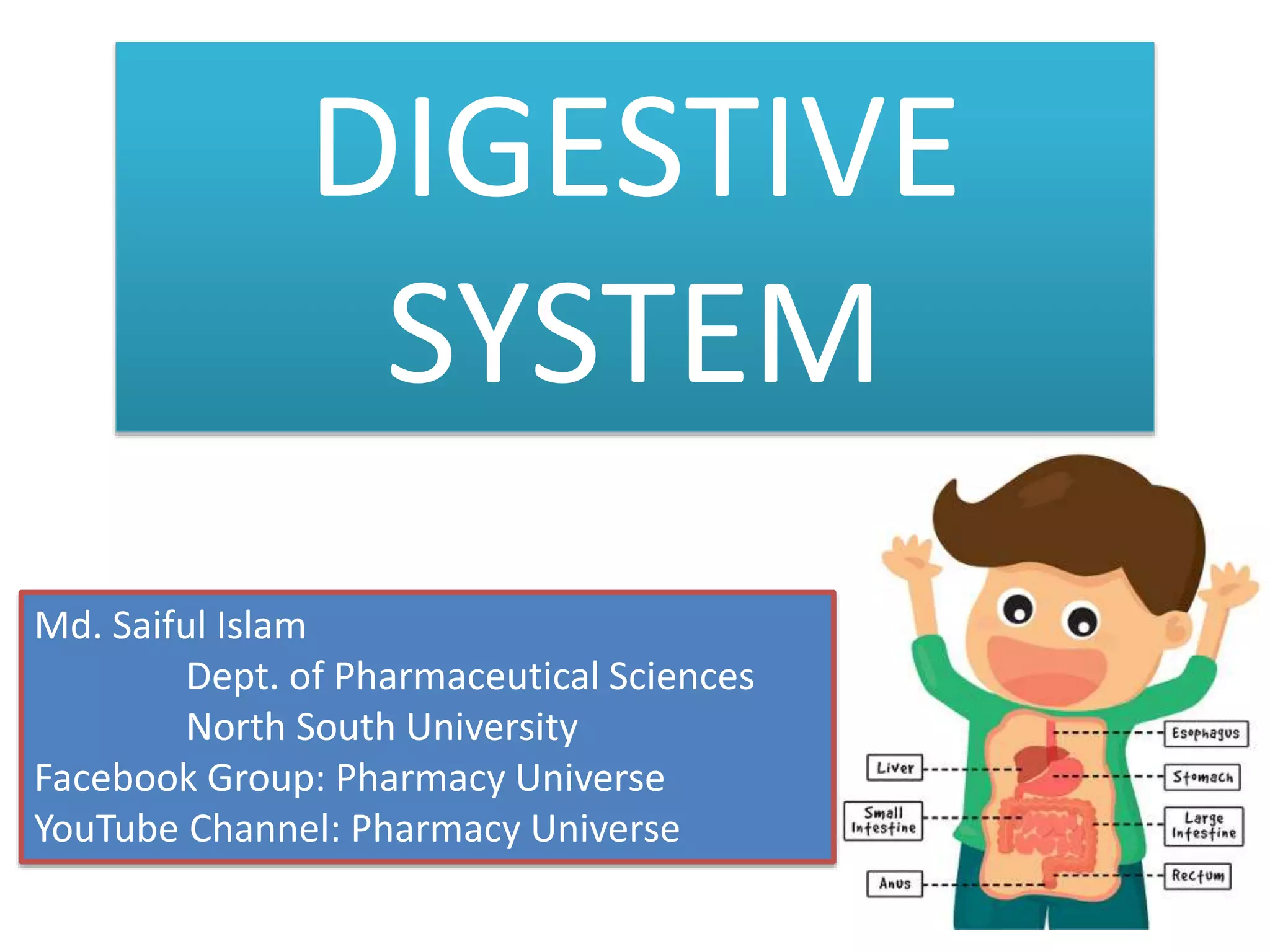

DIGESTIVE
SYSTEM
Md. Saiful Islam
Dept. of Pharmaceutical Sciences
North South University
Facebook Group: Pharmacy Universe
YouTube Channel: Pharmacy Universe
Digestion
• Digestion may be defined as physiological process by
which complex food particles are broken down into
simple form which are suitable for absorption and
subsequent utilization.
Digestive system
• Digestive system is the system which involves organs that
are responsible for the process of digestion.
Gastrointestinal Tract:
• The digestive system is composed of a long muscular tube
– the gastrointestinal (GI) tract, or alimentary canal – and
a set of accessory organs.
Functions of Digestive (GI) Tract
• Ingestion
– Occurs when material
enters via the mouth
• Mechanical Processing
– Crushing / Shearing –
makes material easier to
move through the tract
• Digestion
– Chemical breakdown of
food into small organic
compounds for absorption
• Secretion
– Release of water acids,
buffers, enzymes & salts by
epithelium of GI tract and
glandular organs
• Absorption
– Movement of organic
substrates, electrolytes,
vitamins & water across
digestive epithelium
• Excretion
– Removal of waste products
from body fluids
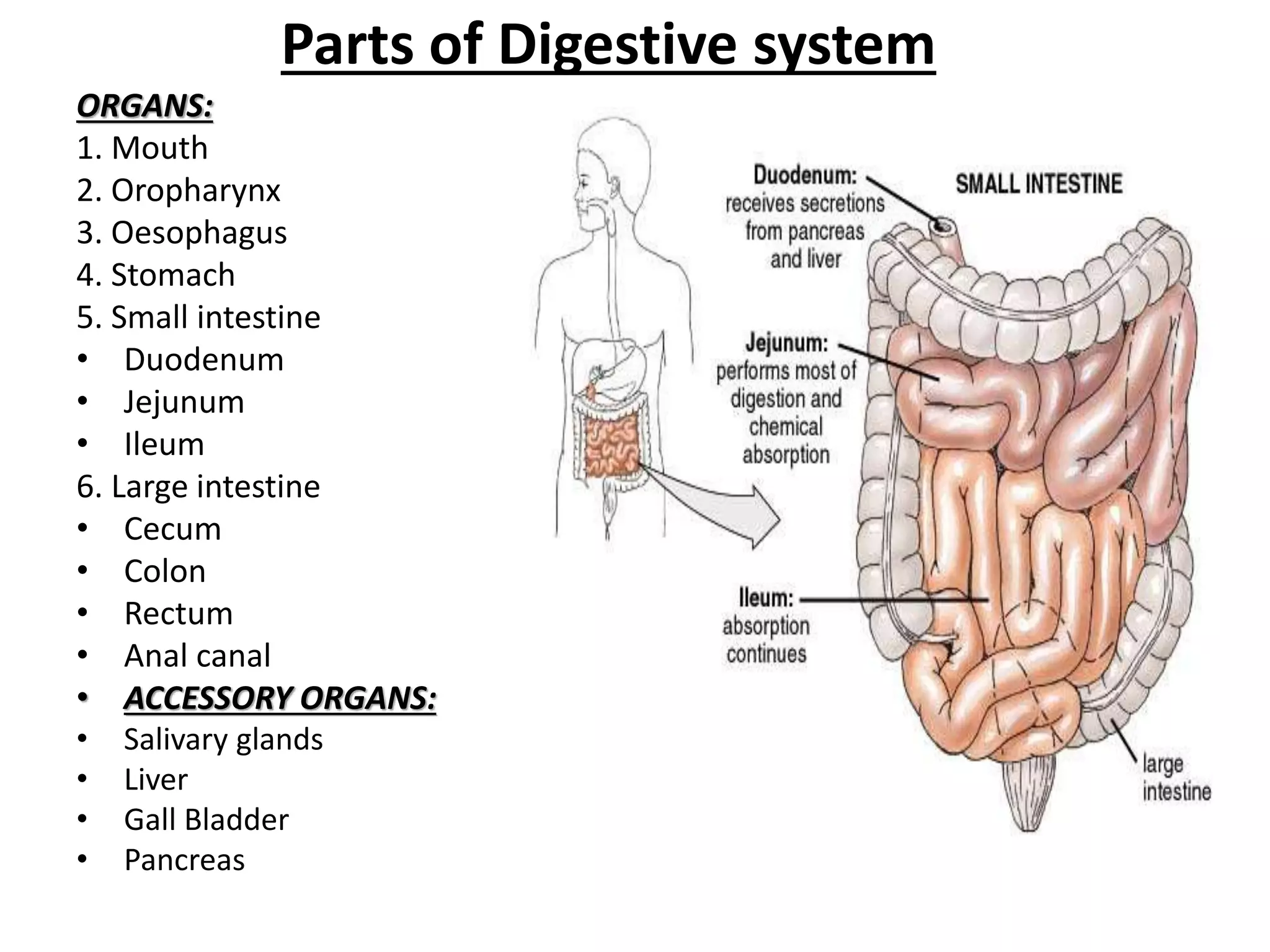
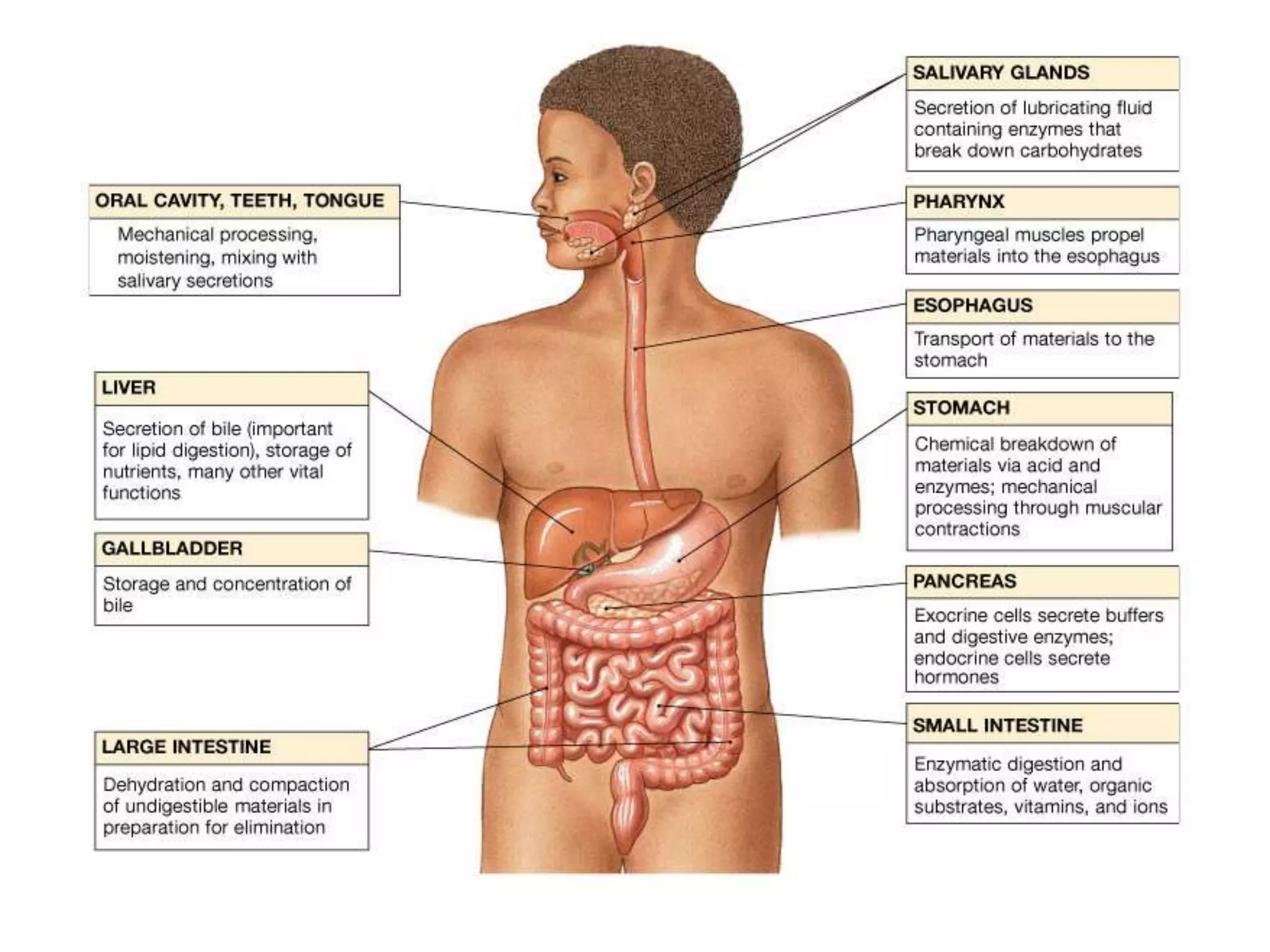
Parts of Digestive system
ORGANS:
1. Mouth
2. Oropharynx
3. Oesophagus
4. Stomach
5. Small intestine
• Duodenum
• Jejunum
• Ileum
6. Large intestine
• Cecum
• Colon
• Rectum
• Anal canal
• ACCESSORY ORGANS:
• Salivary glands
• Liver
• Gall Bladder
• Pancreas
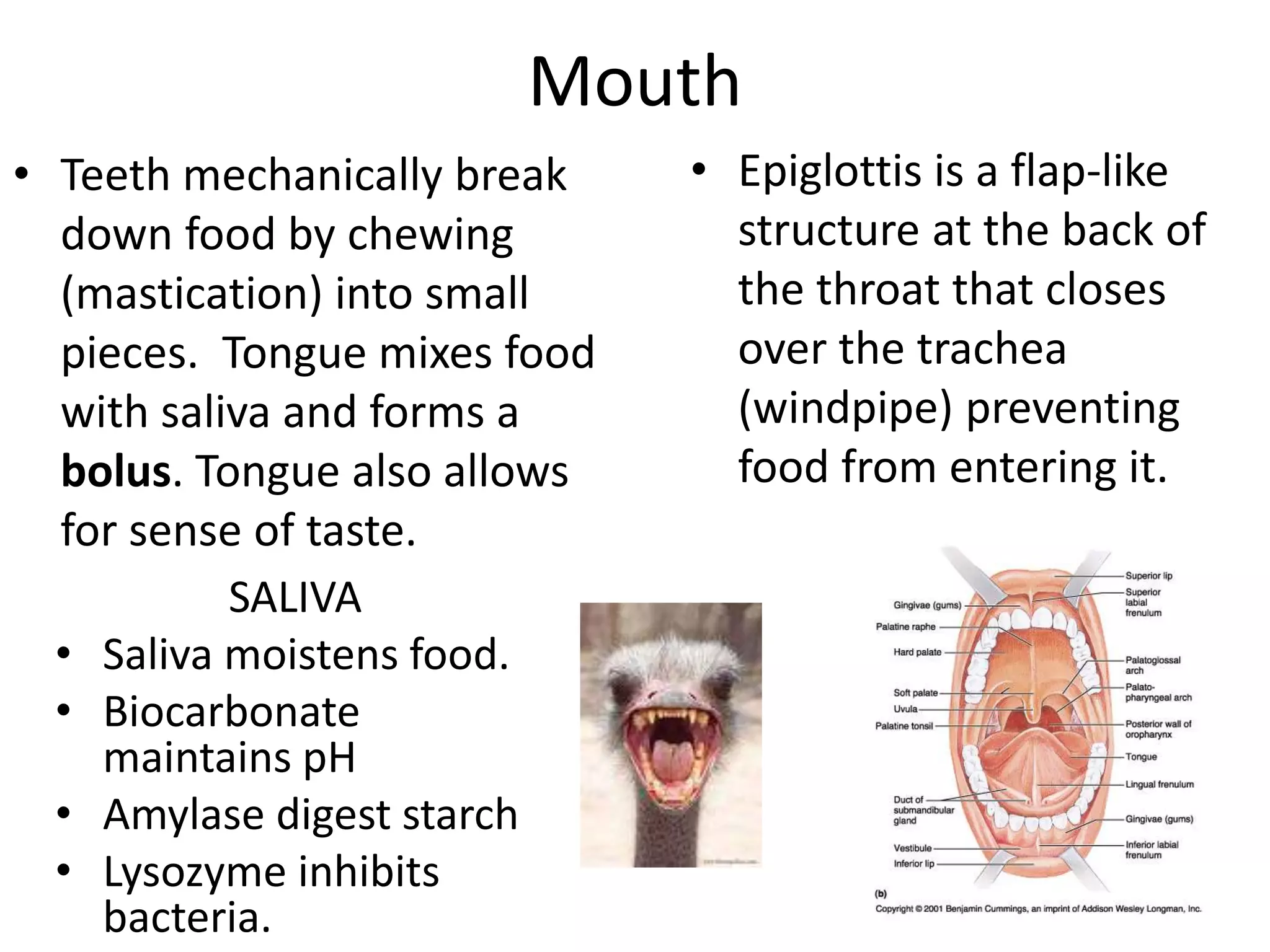
Mouth
• Teeth mechanically break
down food by chewing
(mastication) into small
pieces. Tongue mixes food
with saliva and forms a
bolus. Tongue also allows
for sense of taste.
• Epiglottis is a flap-like
structure at the back of
the throat that closes
over the trachea
(windpipe) preventing
food from entering it.
SALIVA
• Saliva moistens food.
• Biocarbonate
maintains pH
• Amylase digest starch
• Lysozyme inhibits
bacteria.
PHARYNX
 The back of the throat
 Passageway for food and air.
 Pharyngeal muscle propels the material
into esophagus and thus participates in
swallowing.
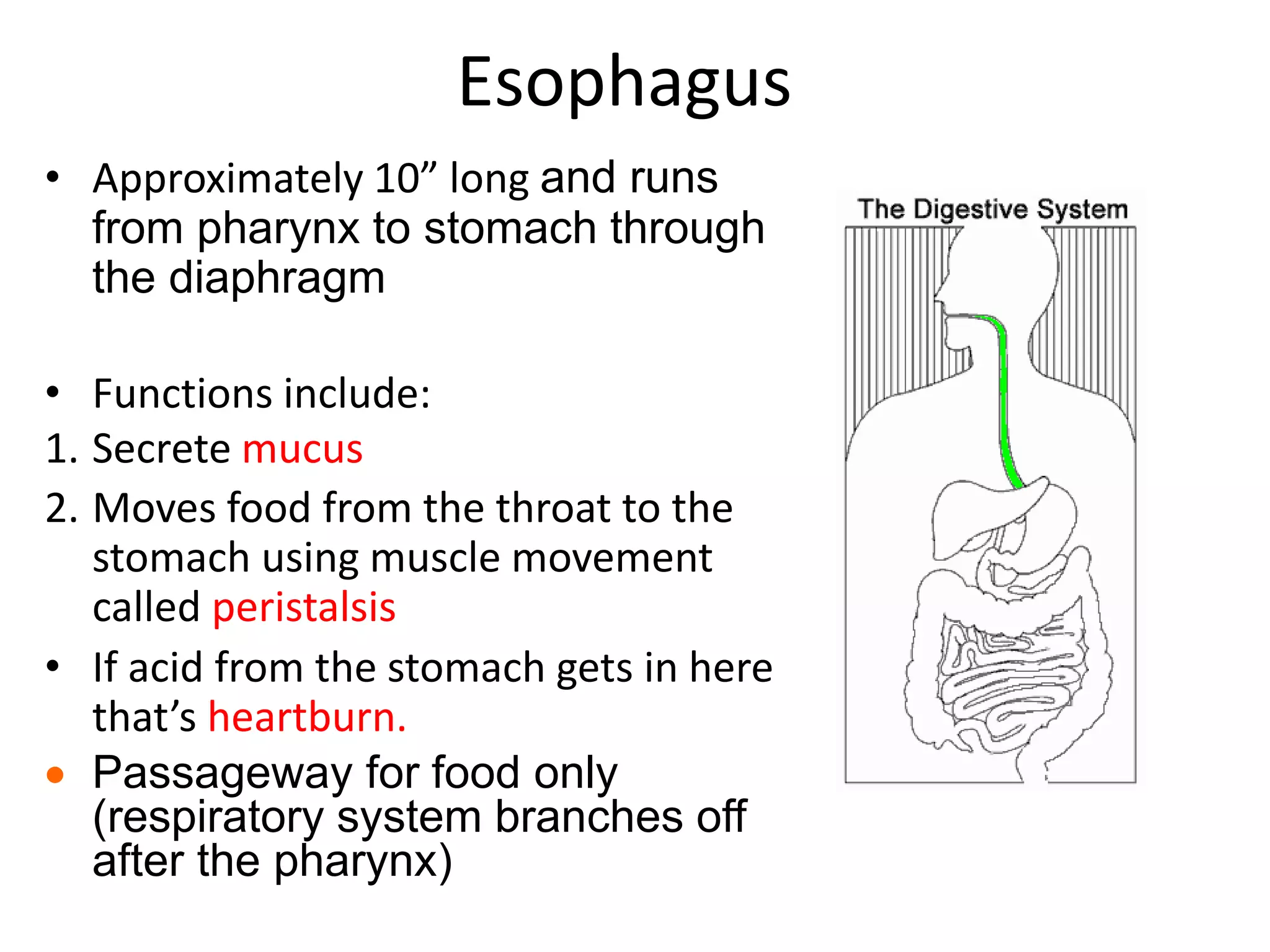
Esophagus
• Approximately 10” long and runs
from pharynx to stomach through
the diaphragm
• Functions include:
1. Secrete mucus
2. Moves food from the throat to the
stomach using muscle movement
called peristalsis
• If acid from the stomach gets in here
that’s heartburn.
 Passageway for food only
(respiratory system branches off
after the pharynx)
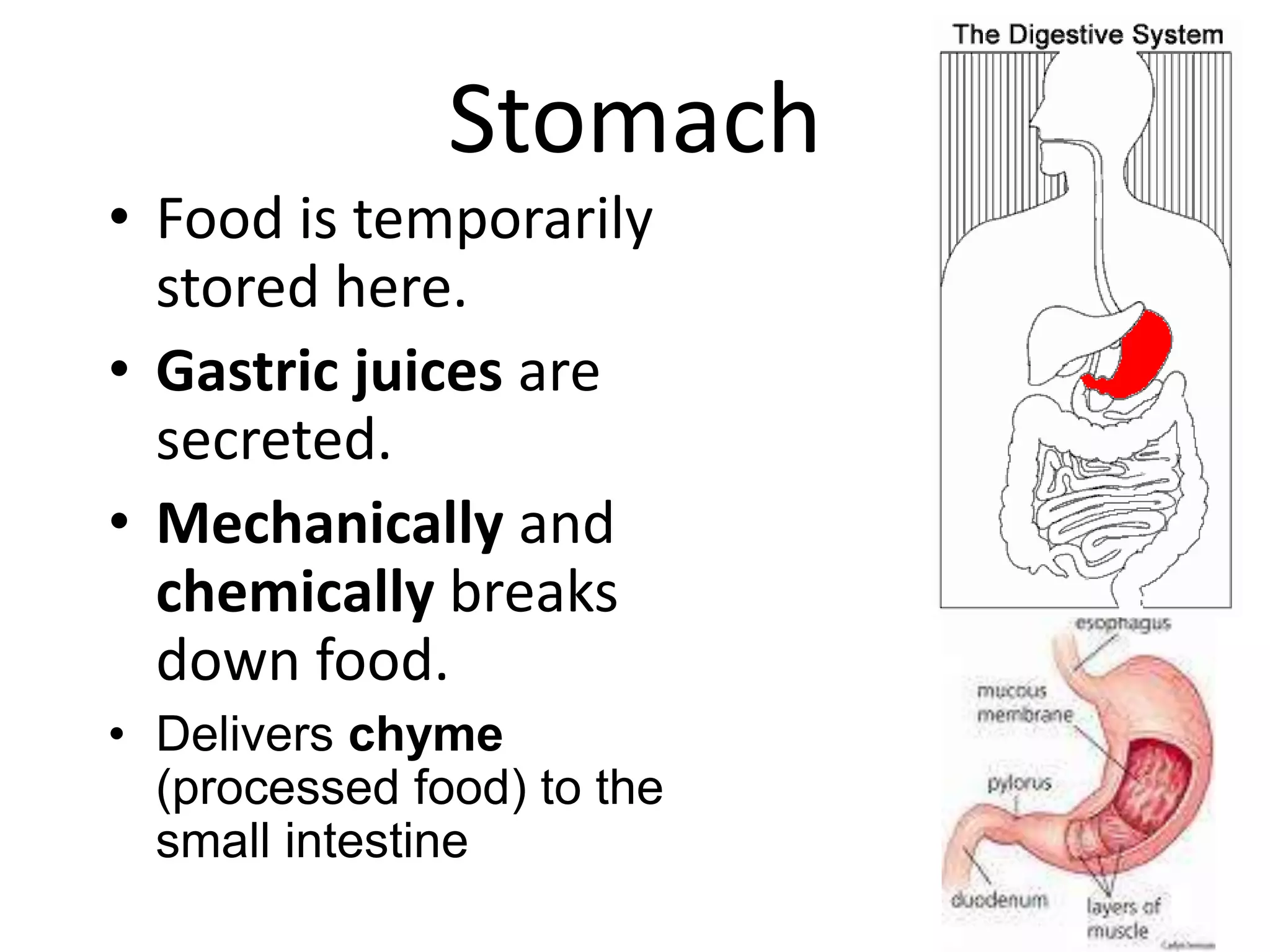
Stomach
• Food is temporarily
stored here.
• Gastric juices are
secreted.
• Mechanically and
chemically breaks
down food.
• Delivers chyme
(processed food) to the
small intestine
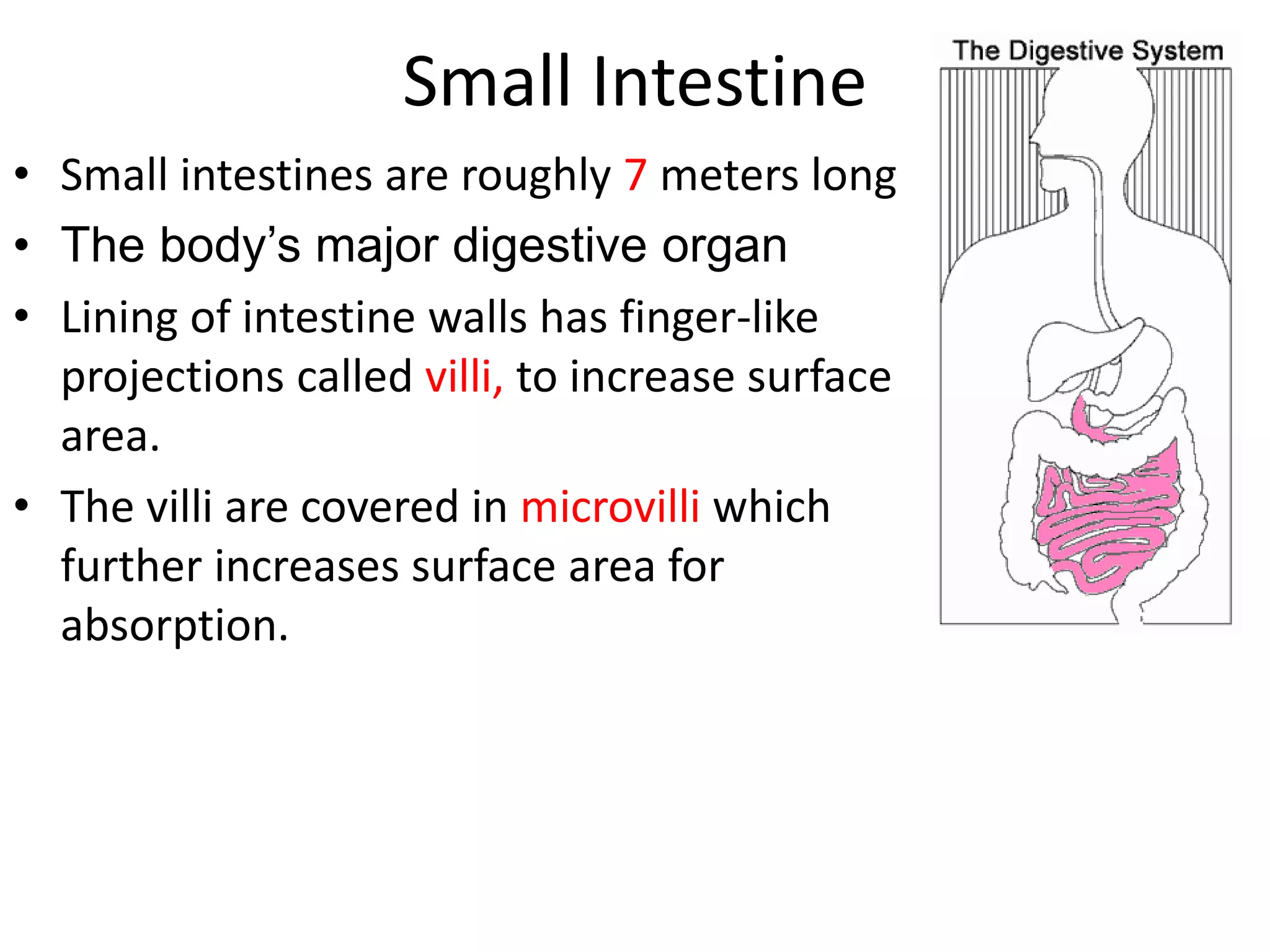
Small Intestine
• Small intestines are roughly 7 meters long
• The body’s major digestive organ
• Lining of intestine walls has finger-like
projections called villi, to increase surface
area.
• The villi are covered in microvilli which
further increases surface area for
absorption.
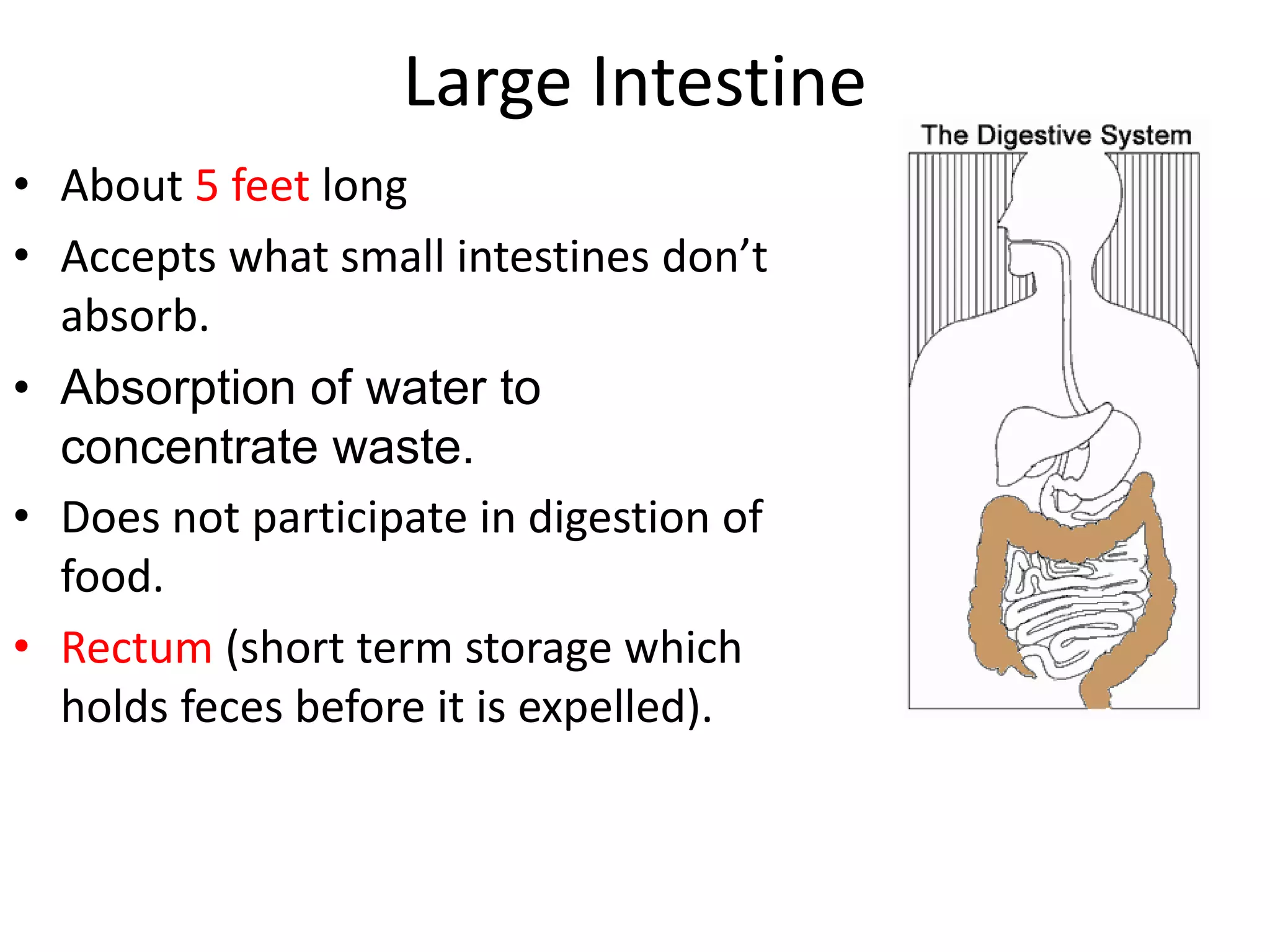
Large Intestine
• About 5 feet long
• Accepts what small intestines don’t
absorb.
• Absorption of water to
concentrate waste.
• Does not participate in digestion of
food.
• Rectum (short term storage which
holds feces before it is expelled).
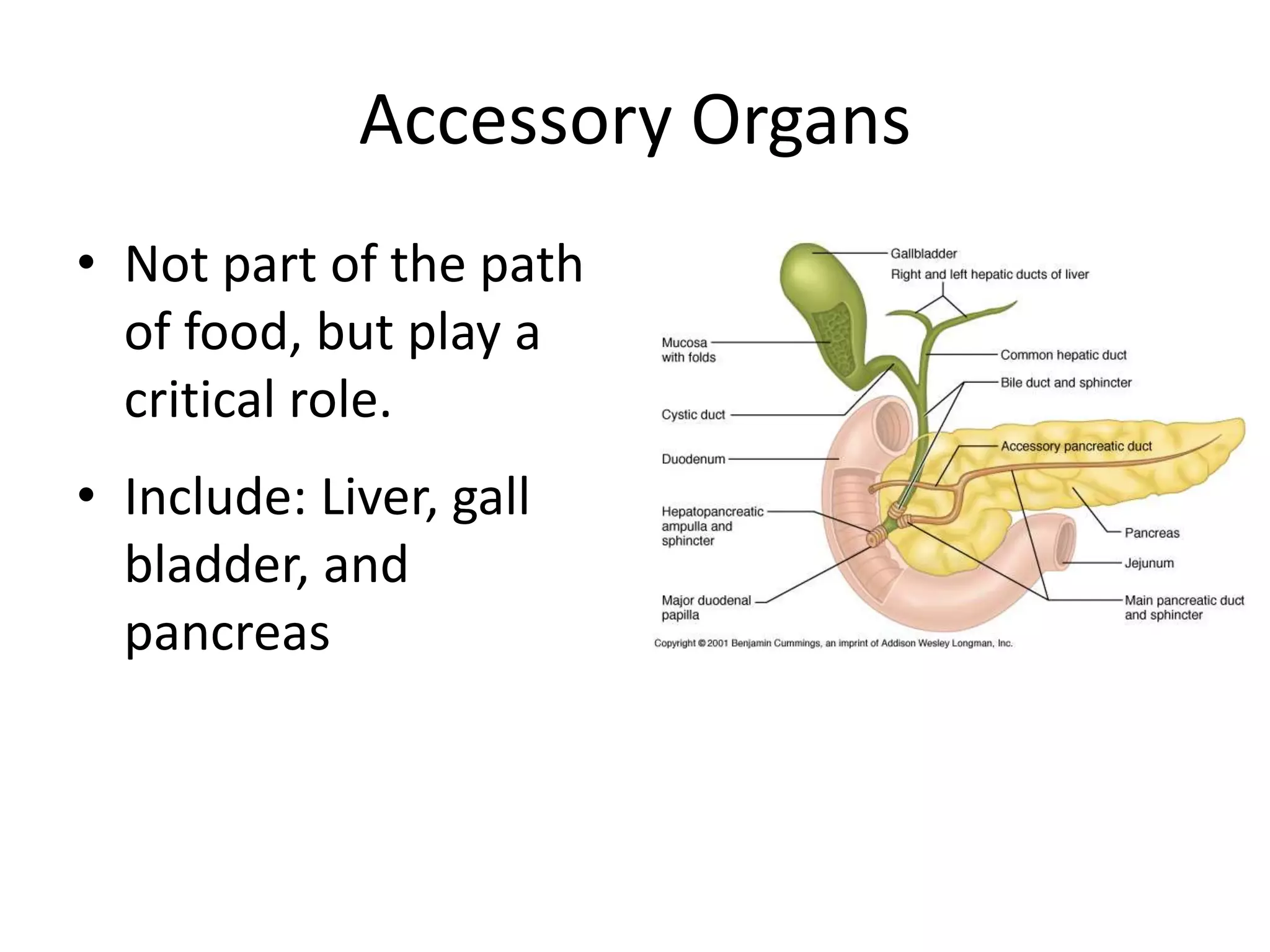
Accessory Organs
• Not part of the path
of food, but play a
critical role.
• Include: Liver, gall
bladder, and
pancreas
Liver
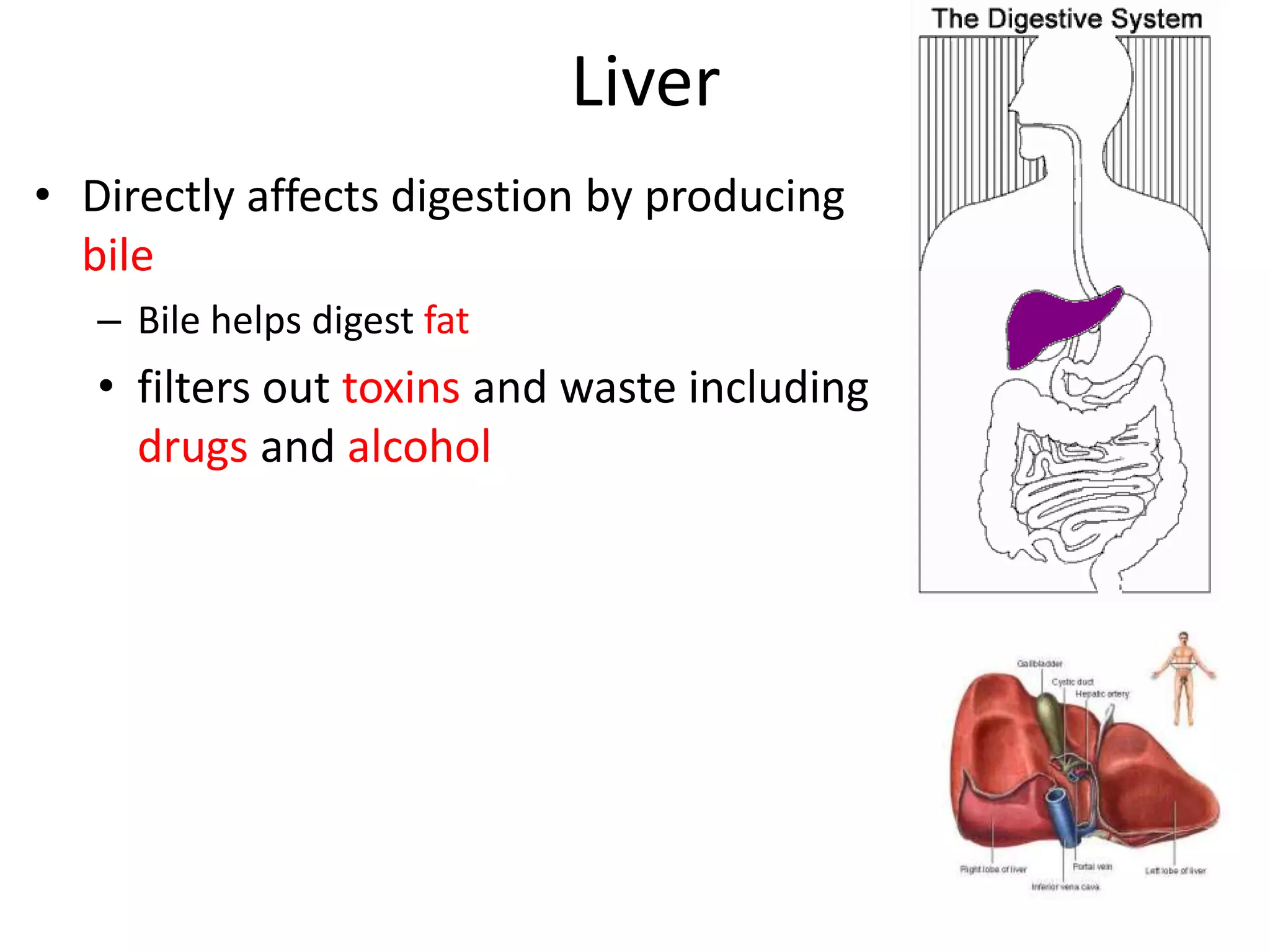
• Directly affects digestion by producing
bile
– Bile helps digest fat
• filters out toxins and waste including
drugs and alcohol
13
Gall Bladder
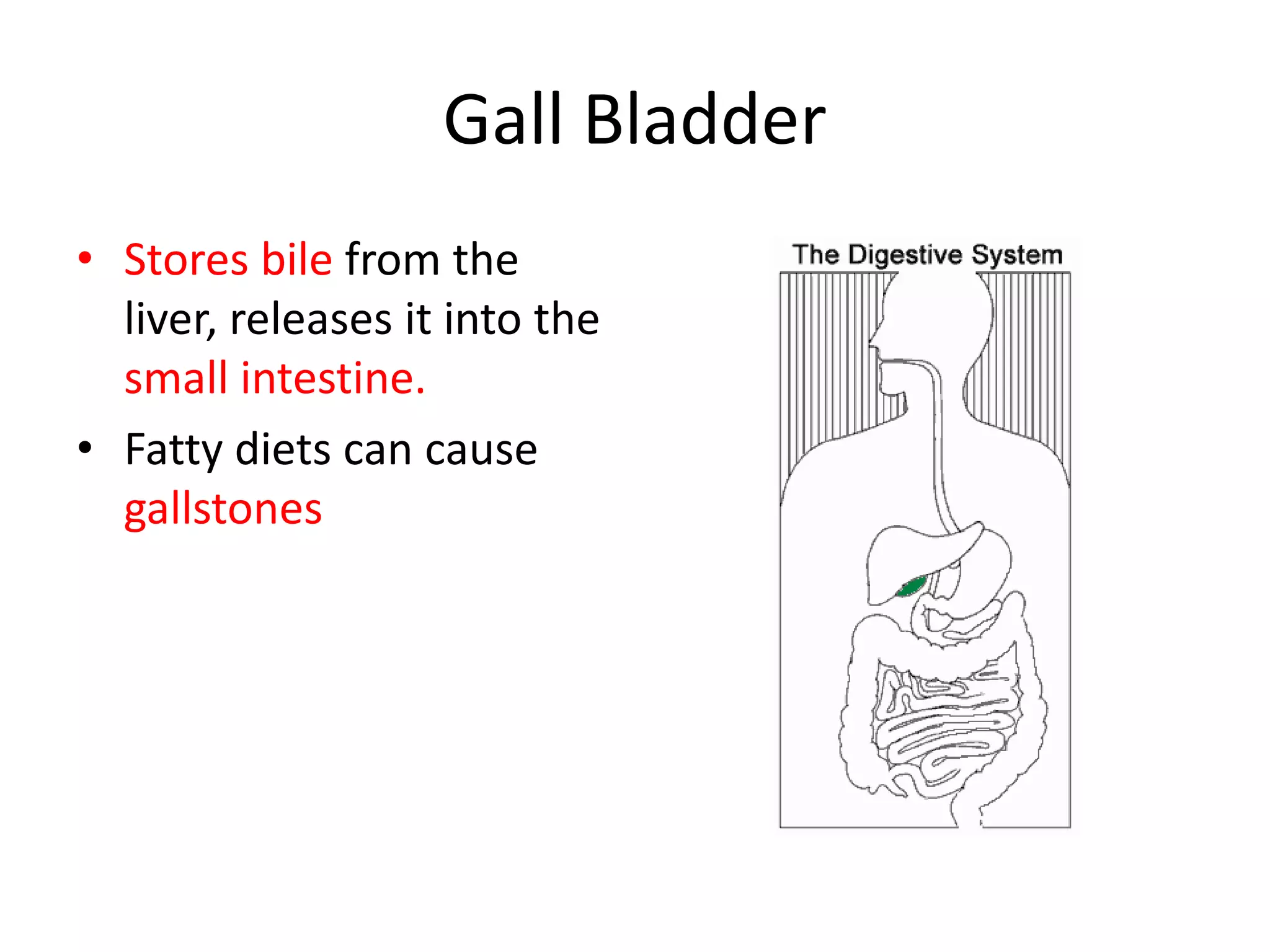
• Stores bile from the
liver, releases it into the
small intestine.
• Fatty diets can cause
gallstones
Pancreas
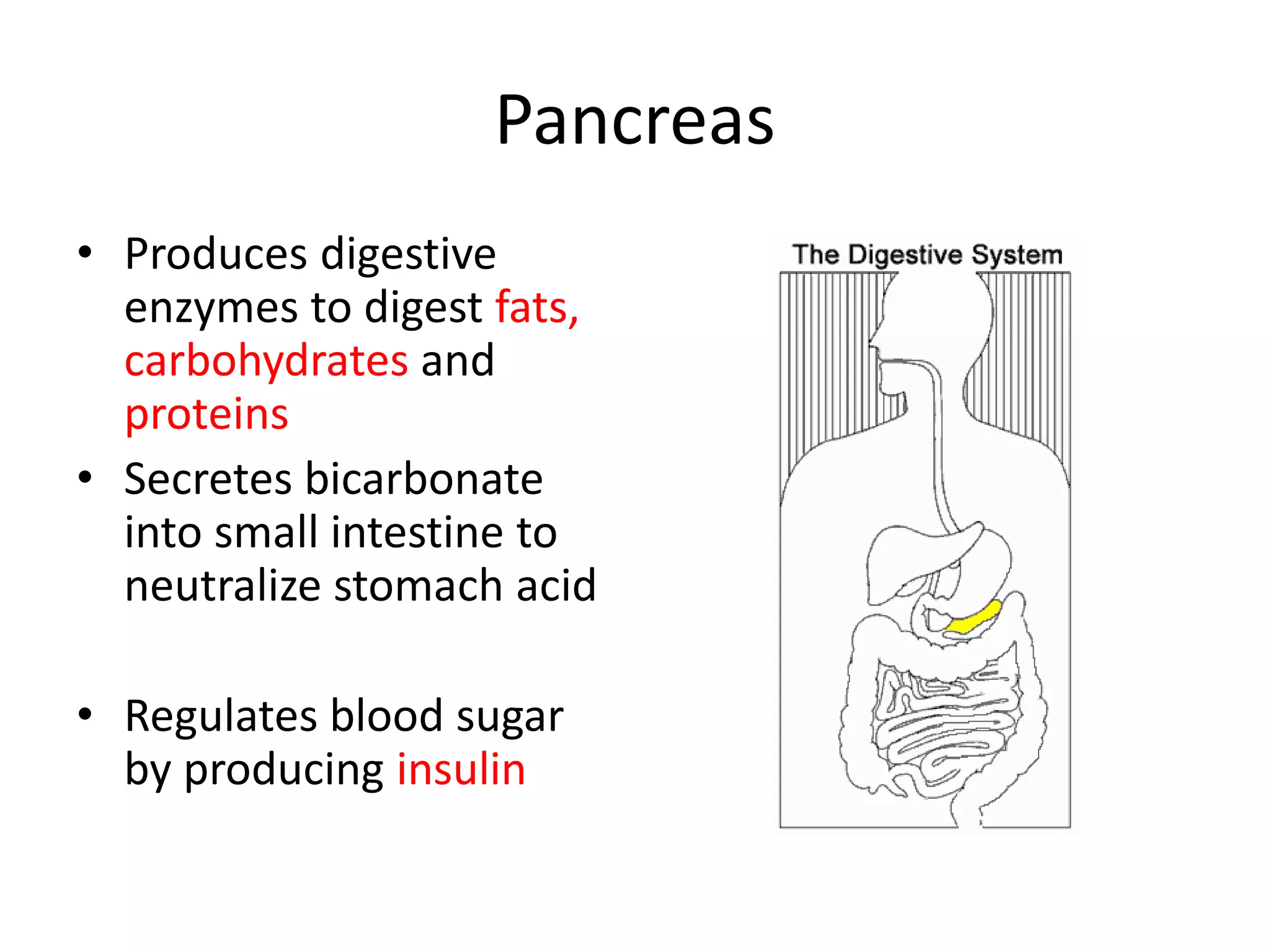
• Produces digestive
enzymes to digest fats,
carbohydrates and
proteins
• Secretes bicarbonate
into small intestine to
neutralize stomach acid
• Regulates blood sugar
by producing insulin
Digestive Process
Processes of the Digestive System
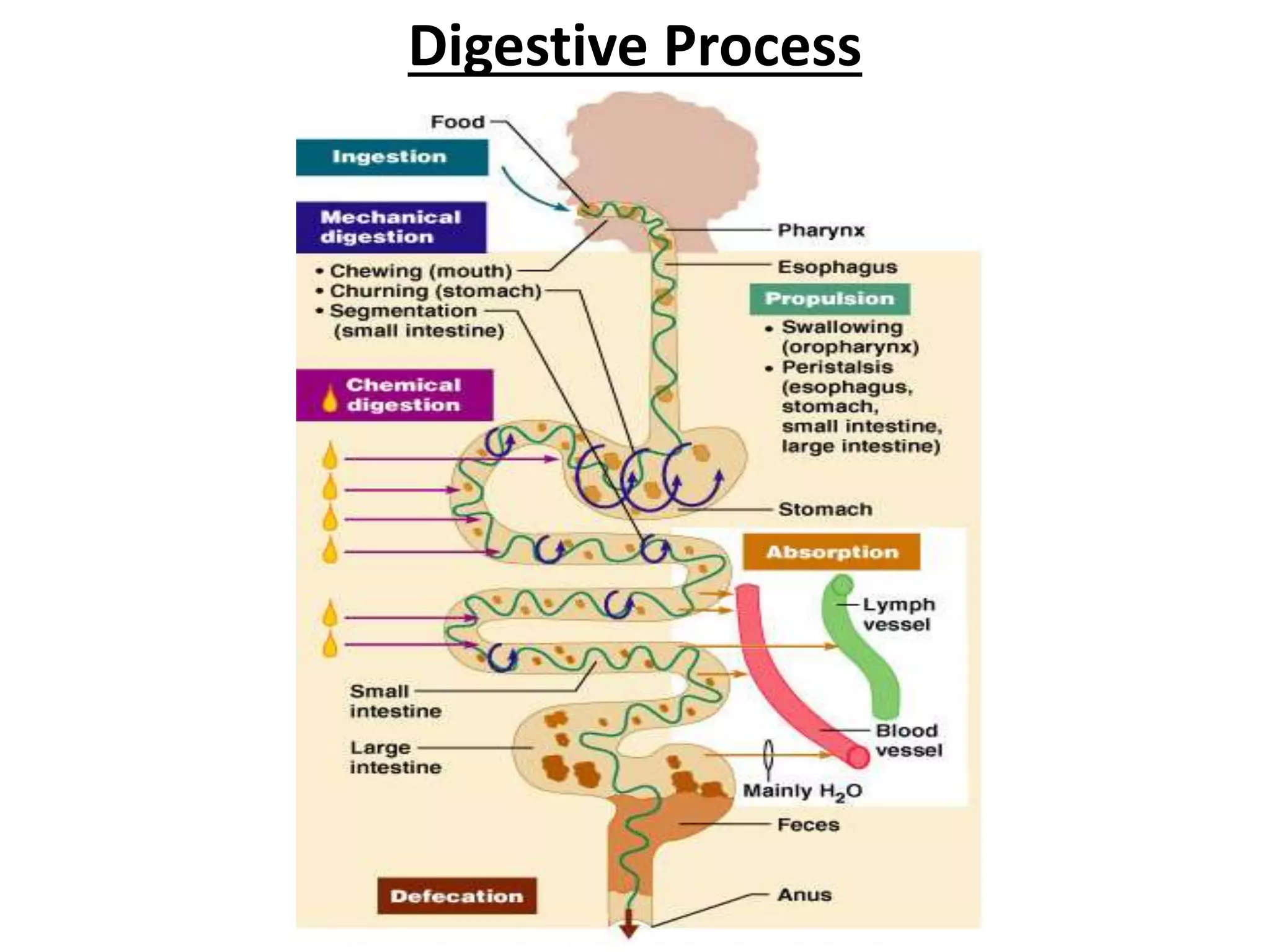
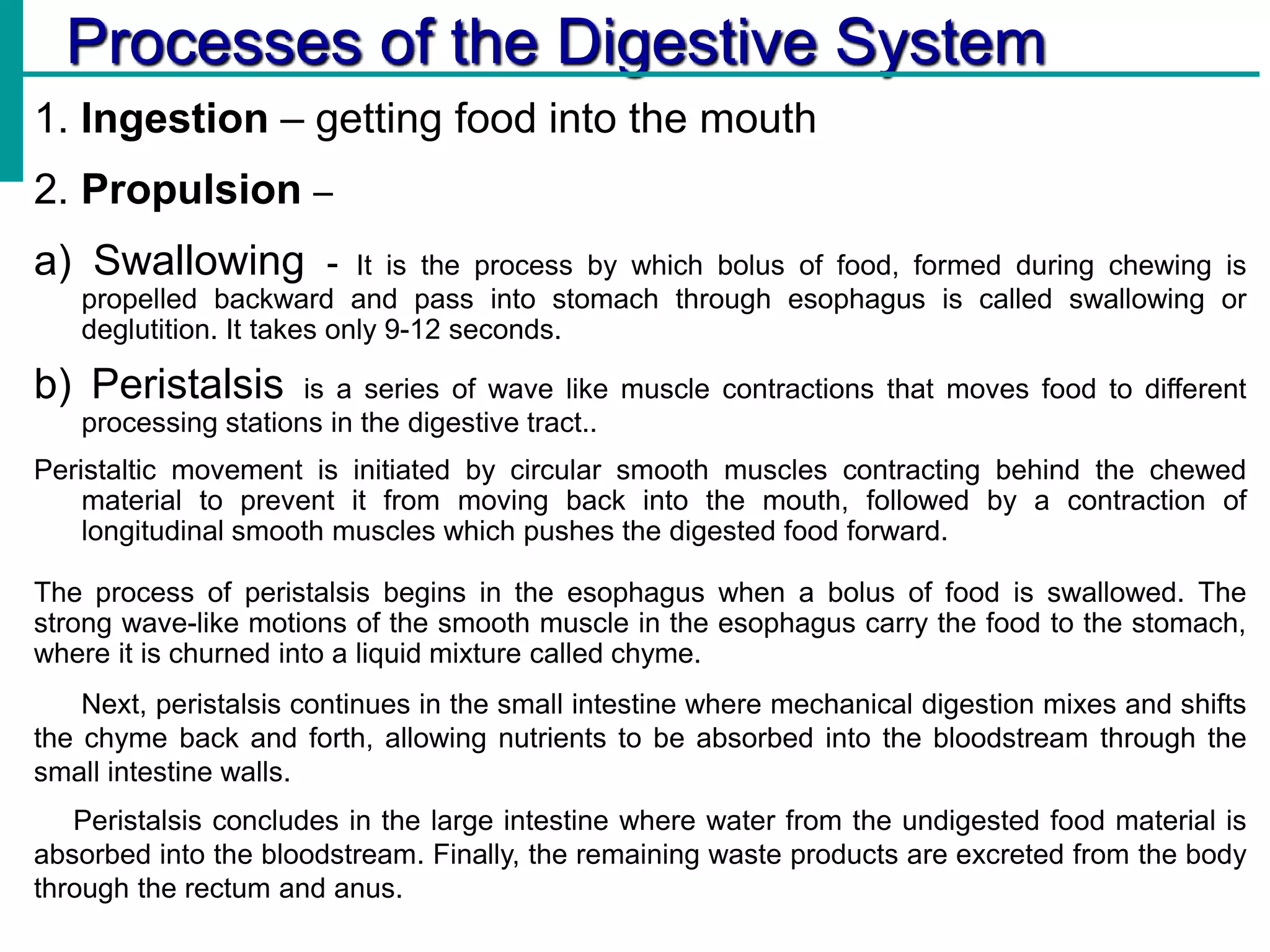
1. Ingestion – getting food into the mouth
2. Propulsion –
a) Swallowing - It is the process by which bolus of food, formed during chewing is
propelled backward and pass into stomach through esophagus is called swallowing or
deglutition. It takes only 9-12 seconds.
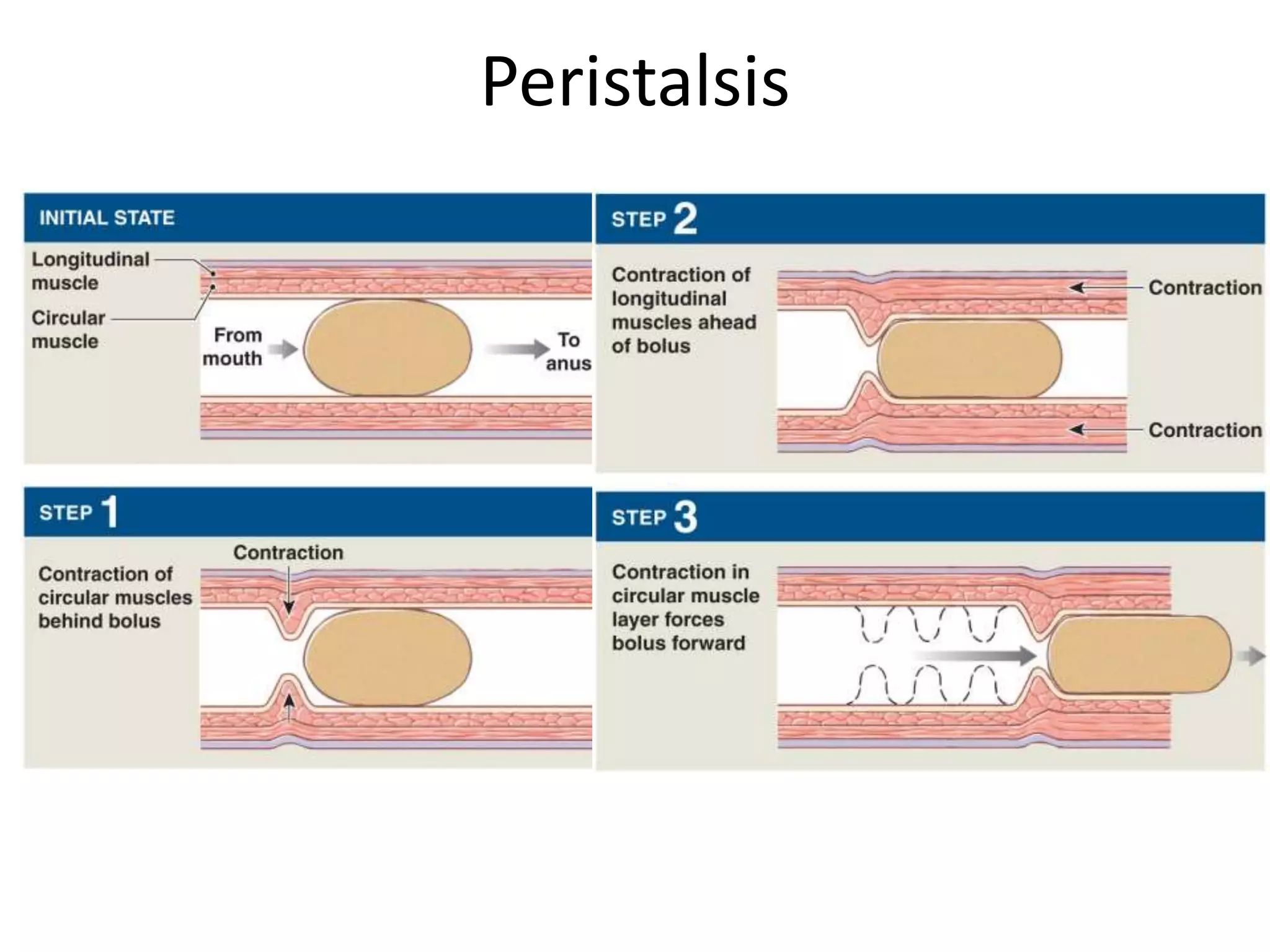
b) Peristalsis is a series of wave like muscle contractions that moves food to different
processing stations in the digestive tract..
Peristaltic movement is initiated by circular smooth muscles contracting behind the chewed
material to prevent it from moving back into the mouth, followed by a contraction of
longitudinal smooth muscles which pushes the digested food forward.
The process of peristalsis begins in the esophagus when a bolus of food is swallowed. The
strong wave-like motions of the smooth muscle in the esophagus carry the food to the stomach,
where it is churned into a liquid mixture called chyme.
Next, peristalsis continues in the small intestine where mechanical digestion mixes and shifts
the chyme back and forth, allowing nutrients to be absorbed into the bloodstream through the
small intestine walls.
Peristalsis concludes in the large intestine where water from the undigested food material is
absorbed into the bloodstream. Finally, the remaining waste products are excreted from the body
through the rectum and anus.
Peristalsis
Processes of the Digestive System
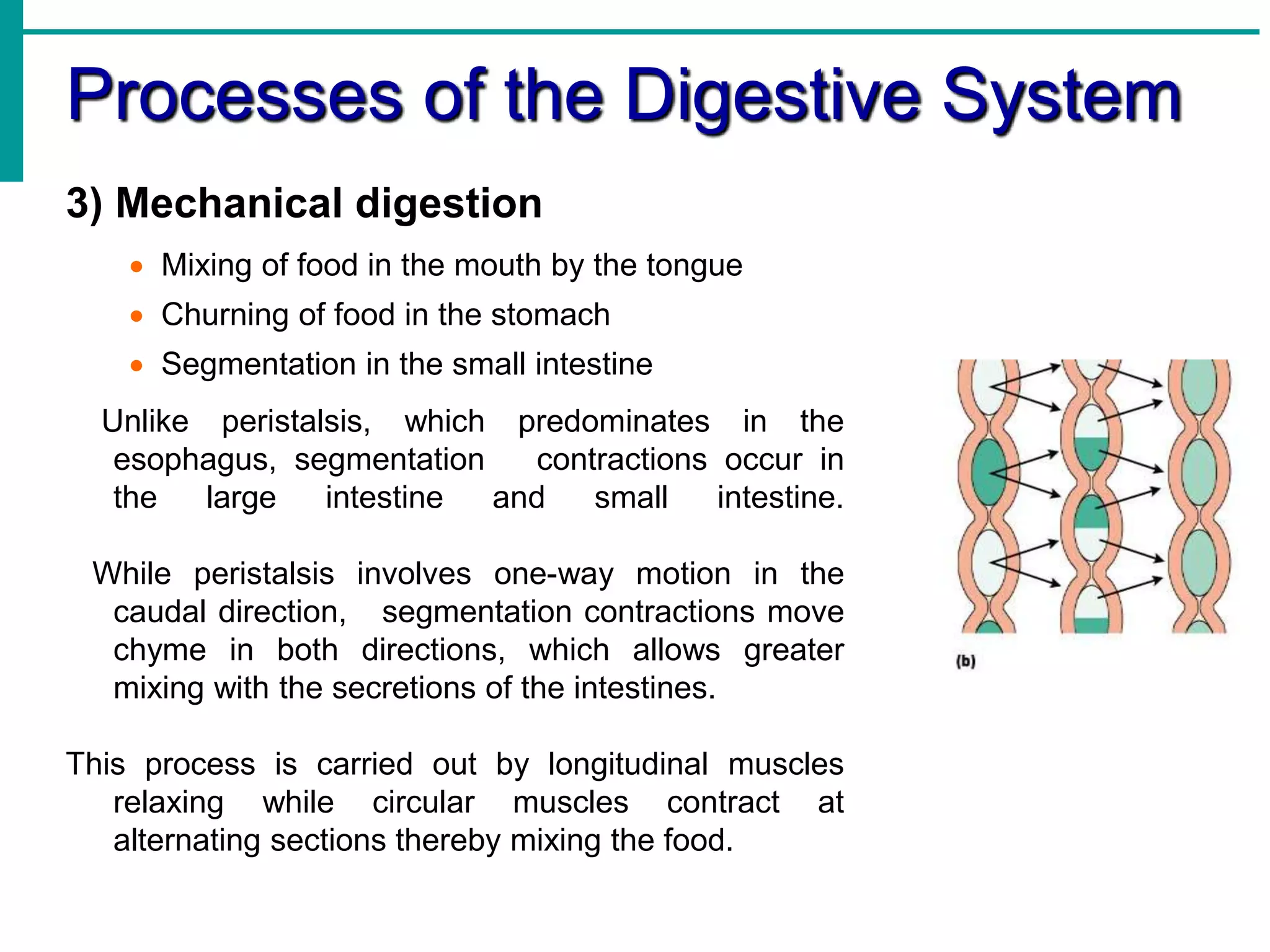
3) Mechanical digestion
 Mixing of food in the mouth by the tongue
 Churning of food in the stomach
 Segmentation in the small intestine
Unlike peristalsis, which predominates in the
esophagus, segmentation contractions occur in
the large intestine and small intestine.
While peristalsis involves one-way motion in the
caudal direction, segmentation contractions move
chyme in both directions, which allows greater
mixing with the secretions of the intestines.
This process is carried out by longitudinal muscles
relaxing while circular muscles contract at
alternating sections thereby mixing the food.
Processes of the Digestive System
SlideCopyright © 2003 Pearson Education, Inc. publishing as Benjamin Cummings
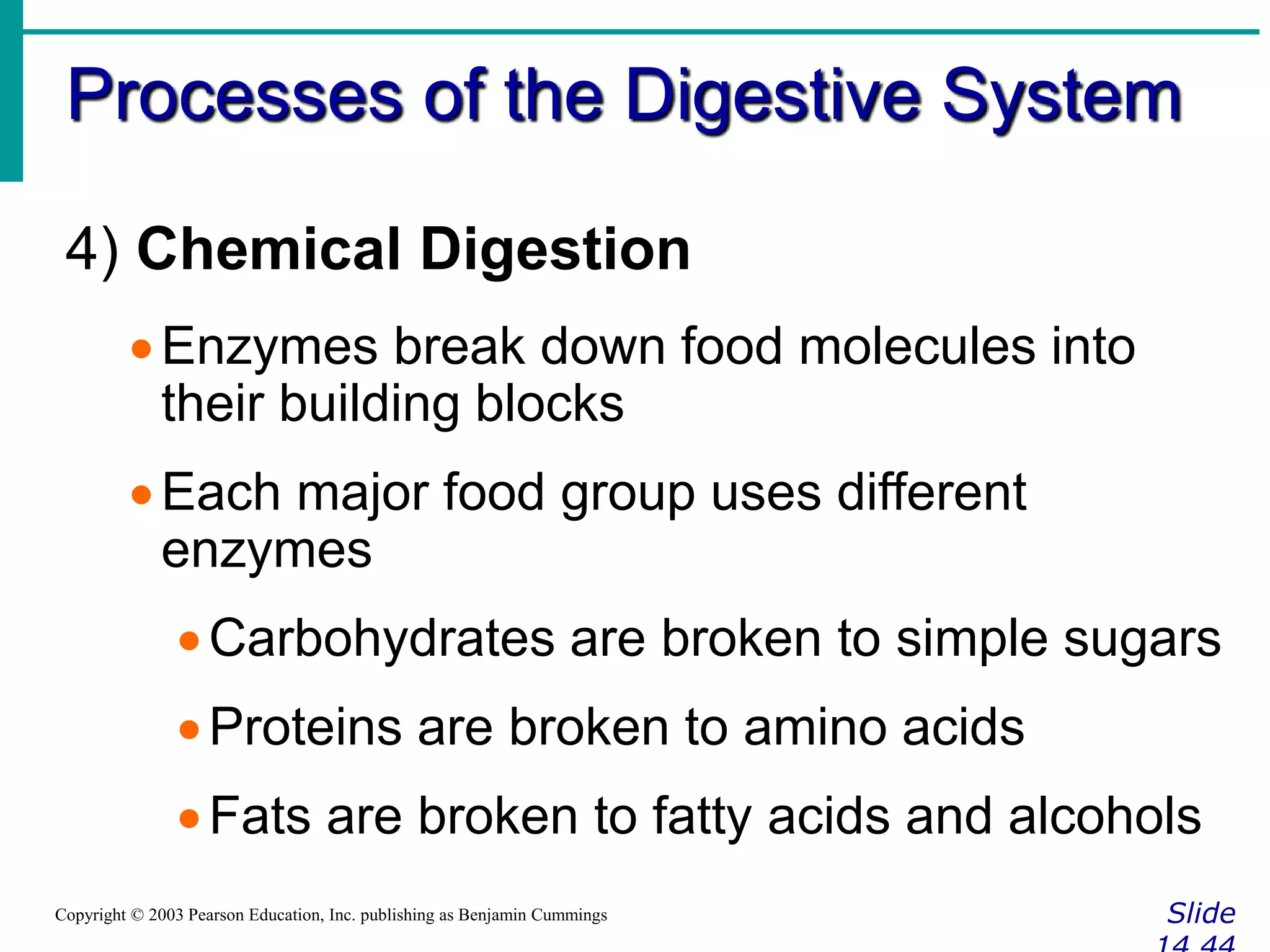
4) Chemical Digestion
Enzymes break down food molecules into
their building blocks
Each major food group uses different
enzymes
Carbohydrates are broken to simple sugars
Proteins are broken to amino acids
Fats are broken to fatty acids and alcohols
Processes of the Digestive System
SlideCopyright © 2003 Pearson Education, Inc. publishing as Benjamin Cummings
5.Absorption
End products of digestion are absorbed in
the blood or lymph
Food must enter mucosal cells and then
into blood or lymph capillaries
6.Defecation
Elimination of indigestible substances as
feces
THANK YOU

Introduction to Digestive System

  • 1.
    DIGESTIVE SYSTEM Md. Saiful Islam Dept.of Pharmaceutical Sciences North South University Facebook Group: Pharmacy Universe YouTube Channel: Pharmacy Universe
  • 2.
    Digestion • Digestion maybe defined as physiological process by which complex food particles are broken down into simple form which are suitable for absorption and subsequent utilization. Digestive system • Digestive system is the system which involves organs that are responsible for the process of digestion. Gastrointestinal Tract: • The digestive system is composed of a long muscular tube – the gastrointestinal (GI) tract, or alimentary canal – and a set of accessory organs.
  • 3.
    Functions of Digestive(GI) Tract • Ingestion – Occurs when material enters via the mouth • Mechanical Processing – Crushing / Shearing – makes material easier to move through the tract • Digestion – Chemical breakdown of food into small organic compounds for absorption • Secretion – Release of water acids, buffers, enzymes & salts by epithelium of GI tract and glandular organs • Absorption – Movement of organic substrates, electrolytes, vitamins & water across digestive epithelium • Excretion – Removal of waste products from body fluids
  • 4.
    Parts of Digestivesystem ORGANS: 1. Mouth 2. Oropharynx 3. Oesophagus 4. Stomach 5. Small intestine • Duodenum • Jejunum • Ileum 6. Large intestine • Cecum • Colon • Rectum • Anal canal • ACCESSORY ORGANS: • Salivary glands • Liver • Gall Bladder • Pancreas
  • 6.
    Mouth • Teeth mechanicallybreak down food by chewing (mastication) into small pieces. Tongue mixes food with saliva and forms a bolus. Tongue also allows for sense of taste. • Epiglottis is a flap-like structure at the back of the throat that closes over the trachea (windpipe) preventing food from entering it. SALIVA • Saliva moistens food. • Biocarbonate maintains pH • Amylase digest starch • Lysozyme inhibits bacteria.
  • 7.
    PHARYNX  The backof the throat  Passageway for food and air.  Pharyngeal muscle propels the material into esophagus and thus participates in swallowing.
  • 8.
    Esophagus • Approximately 10”long and runs from pharynx to stomach through the diaphragm • Functions include: 1. Secrete mucus 2. Moves food from the throat to the stomach using muscle movement called peristalsis • If acid from the stomach gets in here that’s heartburn.  Passageway for food only (respiratory system branches off after the pharynx)
  • 9.
    Stomach • Food istemporarily stored here. • Gastric juices are secreted. • Mechanically and chemically breaks down food. • Delivers chyme (processed food) to the small intestine
  • 10.
    Small Intestine • Smallintestines are roughly 7 meters long • The body’s major digestive organ • Lining of intestine walls has finger-like projections called villi, to increase surface area. • The villi are covered in microvilli which further increases surface area for absorption.
  • 11.
    Large Intestine • About5 feet long • Accepts what small intestines don’t absorb. • Absorption of water to concentrate waste. • Does not participate in digestion of food. • Rectum (short term storage which holds feces before it is expelled).
  • 12.
    Accessory Organs • Notpart of the path of food, but play a critical role. • Include: Liver, gall bladder, and pancreas
  • 13.
    Liver • Directly affectsdigestion by producing bile – Bile helps digest fat • filters out toxins and waste including drugs and alcohol 13
  • 14.
    Gall Bladder • Storesbile from the liver, releases it into the small intestine. • Fatty diets can cause gallstones
  • 15.
    Pancreas • Produces digestive enzymesto digest fats, carbohydrates and proteins • Secretes bicarbonate into small intestine to neutralize stomach acid • Regulates blood sugar by producing insulin
  • 16.
  • 17.
    Processes of theDigestive System 1. Ingestion – getting food into the mouth 2. Propulsion – a) Swallowing - It is the process by which bolus of food, formed during chewing is propelled backward and pass into stomach through esophagus is called swallowing or deglutition. It takes only 9-12 seconds. b) Peristalsis is a series of wave like muscle contractions that moves food to different processing stations in the digestive tract.. Peristaltic movement is initiated by circular smooth muscles contracting behind the chewed material to prevent it from moving back into the mouth, followed by a contraction of longitudinal smooth muscles which pushes the digested food forward. The process of peristalsis begins in the esophagus when a bolus of food is swallowed. The strong wave-like motions of the smooth muscle in the esophagus carry the food to the stomach, where it is churned into a liquid mixture called chyme. Next, peristalsis continues in the small intestine where mechanical digestion mixes and shifts the chyme back and forth, allowing nutrients to be absorbed into the bloodstream through the small intestine walls. Peristalsis concludes in the large intestine where water from the undigested food material is absorbed into the bloodstream. Finally, the remaining waste products are excreted from the body through the rectum and anus.
  • 18.
  • 19.
    Processes of theDigestive System 3) Mechanical digestion  Mixing of food in the mouth by the tongue  Churning of food in the stomach  Segmentation in the small intestine Unlike peristalsis, which predominates in the esophagus, segmentation contractions occur in the large intestine and small intestine. While peristalsis involves one-way motion in the caudal direction, segmentation contractions move chyme in both directions, which allows greater mixing with the secretions of the intestines. This process is carried out by longitudinal muscles relaxing while circular muscles contract at alternating sections thereby mixing the food.
  • 20.
    Processes of theDigestive System SlideCopyright © 2003 Pearson Education, Inc. publishing as Benjamin Cummings 4) Chemical Digestion Enzymes break down food molecules into their building blocks Each major food group uses different enzymes Carbohydrates are broken to simple sugars Proteins are broken to amino acids Fats are broken to fatty acids and alcohols
  • 21.
    Processes of theDigestive System SlideCopyright © 2003 Pearson Education, Inc. publishing as Benjamin Cummings 5.Absorption End products of digestion are absorbed in the blood or lymph Food must enter mucosal cells and then into blood or lymph capillaries 6.Defecation Elimination of indigestible substances as feces
  • 22.