Accessory Organs & Glands,
Absorption of Food, Elimination of
Waste Materials
Accessory Organs and Glands
• Both the liver and the pancreas are
considered digestive helpers.
• Other than their roles in digestion, they
also have other functions.
• Accessory digestive organ: An organ that
helps with digestion but is not part of the
digestive tract. The accessory digestive
organs are the tongue, salivary
glands, pancreas, liver, and gallbladder.
• The liver, pancreas, and gall bladder are
not part of the alimentary canal but they
have important functions in the digestive
process. They are called accessory parts
of the digestive system.
• They are also called digestive helpers.
Liver
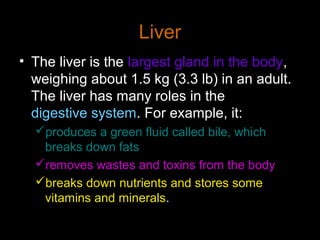
• The liver is the largest gland in the body,
weighing about 1.5 kg (3.3 lb) in an adult.
The liver has many roles in the
digestive system. For example, it:
produces a green fluid called bile, which
breaks down fats
removes wastes and toxins from the body
breaks down nutrients and stores some
vitamins and minerals.
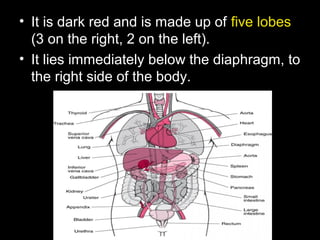
• It is dark red and is made up of five lobes
(3 on the right, 2 on the left).
• It lies immediately below the diaphragm, to
the right side of the body.
• One of its important functions is to aid
digestion by producing an alkaline,
greenish yellow liquid, containing bile salts
and bile pigments called bile.
• It stores glycogen, vitamins and some
minerals, such as iron and copper, which
are released when needed by the body.
• Summing up the functions: protein
synthesis, iron storage, detoxification, heat
production
What the liver does to digested
food?
• Food absorbed by the blood from the small
intestine is carried to the liver.
• The work of the liver is to processed digested
food.
• Food that can already be used is distributed to
different parts of the body through the blood.
• Excess food is converted to a form that can be
stored.
• The stored food becomes a source of energy.
Pancreas
• It is a soft triangular gland lying between the
small intestine and the stomach.
• The pancreas produces pancreatic juice, which
is a mixture of digestive enzymes.
• Pancreatic juice helps in neutralizing or
weakening the acid in food inside the stomach
before it moves onto the small intestine; also
contains different enzymes that are needed to
further break down starch, proteins and fats in
the small intestine.
• The pancreas also secretes the hormone
insulin, which plays an important role in
the control of the blood sugar level in the
body and utilization of carbohydrates.
Absorption of Food
• Absorption in the Small Intestine
• Absorption in the Large Intestine
Absorption in the Small Intestine
• After 3-5 hours, most of the food in the
small intestine is digested.
• Proteins are broken down into individual
amino acids.
• An amino acid is a type of organic acid
that contains an acid functional group and
an amine functional group on adjacent
carbon atoms. Amino acids are
considered to be the building blocks of
proteins.
• Carbohydrates (starches & sugars) are
broken down into simple sugars, and fats
are broken down into fatty acids and
glycerol.
• Digestive juices from the pancreas and the
liver mix with chyme.
• Chyme is the food that has changed into a
pulpy liquid called chyme.
• Pancreatic juice from the pancreas further
breaks down protein, carbohydrates and
fats into simpler substances.
• Bile from the liver breaks fats into tiny
droplets, making it easy for an enzyme to
act on them.
• The digested food in the small intestine is
now in liquid form and is absorbed into the
blood through the villi on the walls of the
intestine.
• By the time the food is ready to leave the
small intestine, it is basically free of
nutrients.
• All the nutrients have been absorbed.
What remains are undigested substances.
Absorption in the Large Intestine
• No all food can be digested.
• As undigested food leaves the small
intestine, it passes into the large intestine,
which is shorter but much broader than
the small intestine.
• The main function of the large intestine is
to absorb water and mineral salts from the
undigested food material.
• After about 18-24 hours in the large
intestine, most of the water that is
contained in undigested food is absorbed.
• Helpful bacterial residents of large
intestine make certain vitamins, such as
vitamin K and 2B, that are needed by the
body.
Elimination of Waste Materials
• Materials that are not absorbed in the
large intestine form a solid waste known
as feces.
• Feces, which is made up of dead bacteria
and some fat and protein, undigested food
roughage, dried out digested juices,
mucus, and discarded intestinal cells, is
stored temporarily in the rectum.
• When the rectum contracts, the feces is
expelled through an opening called the
anus.
• The process of removing undigested
matter from the body is called egestion,
defecation, or bowel movement.
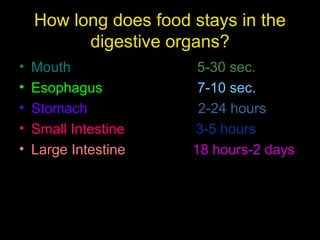
How long does food stays in the
digestive organs?
• Mouth 5-30 sec.
• Esophagus 7-10 sec.
• Stomach 2-24 hours
• Small Intestine 3-5 hours
• Large Intestine 18 hours-2 days
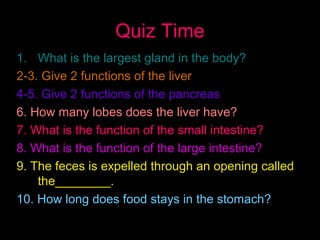
Quiz Time
1. What is the largest gland in the body?
2-3. Give 2 functions of the liver
4-5. Give 2 functions of the pancreas
6. How many lobes does the liver have?
7. What is the function of the small intestine?
8. What is the function of the large intestine?
9. The feces is expelled through an opening called
the________.
10. How long does food stays in the stomach?
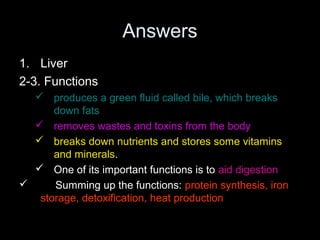
Answers
1. Liver
2-3. Functions
 produces a green fluid called bile, which breaks
down fats
 removes wastes and toxins from the body
 breaks down nutrients and stores some vitamins
and minerals.
 One of its important functions is to aid digestion
 Summing up the functions: protein synthesis, iron
storage, detoxification, heat production
4-5. Functions
helps in neutralizing or weakening the acid
in food inside the stomach before it moves
onto the small intestine; also contains
different enzymes that are needed to
further break down starch, proteins and
fats in the small intestine.
• The pancreas also secretes the hormone
insulin, which plays an important role in
the control of the blood sugar level in the
body and utilization of carbohydrates.
6. 5 lobes
7. Function of Small Intestine
the food in the small intestine is digested.
8. Function of Large Intestine
 The main function of the large intestine is
to absorb water and mineral salts from the
undigested food material.
9. Anus
10. Stomach – 2-24 hours
FINISHED


Accessory organs & glands

  • 1.
    Accessory Organs &Glands, Absorption of Food, Elimination of Waste Materials
  • 2.
    Accessory Organs andGlands • Both the liver and the pancreas are considered digestive helpers. • Other than their roles in digestion, they also have other functions. • Accessory digestive organ: An organ that helps with digestion but is not part of the digestive tract. The accessory digestive organs are the tongue, salivary glands, pancreas, liver, and gallbladder.
  • 3.
    • The liver,pancreas, and gall bladder are not part of the alimentary canal but they have important functions in the digestive process. They are called accessory parts of the digestive system. • They are also called digestive helpers.
  • 4.
    Liver • The liveris the largest gland in the body, weighing about 1.5 kg (3.3 lb) in an adult. The liver has many roles in the digestive system. For example, it: produces a green fluid called bile, which breaks down fats removes wastes and toxins from the body breaks down nutrients and stores some vitamins and minerals.
  • 5.
    • It isdark red and is made up of five lobes (3 on the right, 2 on the left). • It lies immediately below the diaphragm, to the right side of the body.
  • 6.
    • One ofits important functions is to aid digestion by producing an alkaline, greenish yellow liquid, containing bile salts and bile pigments called bile. • It stores glycogen, vitamins and some minerals, such as iron and copper, which are released when needed by the body. • Summing up the functions: protein synthesis, iron storage, detoxification, heat production
  • 7.
    What the liverdoes to digested food? • Food absorbed by the blood from the small intestine is carried to the liver. • The work of the liver is to processed digested food. • Food that can already be used is distributed to different parts of the body through the blood. • Excess food is converted to a form that can be stored. • The stored food becomes a source of energy.
  • 8.
    Pancreas • It isa soft triangular gland lying between the small intestine and the stomach. • The pancreas produces pancreatic juice, which is a mixture of digestive enzymes. • Pancreatic juice helps in neutralizing or weakening the acid in food inside the stomach before it moves onto the small intestine; also contains different enzymes that are needed to further break down starch, proteins and fats in the small intestine.
  • 9.
    • The pancreasalso secretes the hormone insulin, which plays an important role in the control of the blood sugar level in the body and utilization of carbohydrates.
  • 10.
    Absorption of Food •Absorption in the Small Intestine • Absorption in the Large Intestine
  • 11.
    Absorption in theSmall Intestine • After 3-5 hours, most of the food in the small intestine is digested. • Proteins are broken down into individual amino acids. • An amino acid is a type of organic acid that contains an acid functional group and an amine functional group on adjacent carbon atoms. Amino acids are considered to be the building blocks of proteins.
  • 12.
    • Carbohydrates (starches& sugars) are broken down into simple sugars, and fats are broken down into fatty acids and glycerol. • Digestive juices from the pancreas and the liver mix with chyme. • Chyme is the food that has changed into a pulpy liquid called chyme. • Pancreatic juice from the pancreas further breaks down protein, carbohydrates and fats into simpler substances.
  • 13.
    • Bile fromthe liver breaks fats into tiny droplets, making it easy for an enzyme to act on them. • The digested food in the small intestine is now in liquid form and is absorbed into the blood through the villi on the walls of the intestine. • By the time the food is ready to leave the small intestine, it is basically free of nutrients. • All the nutrients have been absorbed. What remains are undigested substances.
  • 14.
    Absorption in theLarge Intestine • No all food can be digested. • As undigested food leaves the small intestine, it passes into the large intestine, which is shorter but much broader than the small intestine. • The main function of the large intestine is to absorb water and mineral salts from the undigested food material.
  • 15.
    • After about18-24 hours in the large intestine, most of the water that is contained in undigested food is absorbed. • Helpful bacterial residents of large intestine make certain vitamins, such as vitamin K and 2B, that are needed by the body.
  • 16.
    Elimination of WasteMaterials • Materials that are not absorbed in the large intestine form a solid waste known as feces. • Feces, which is made up of dead bacteria and some fat and protein, undigested food roughage, dried out digested juices, mucus, and discarded intestinal cells, is stored temporarily in the rectum.
  • 17.
    • When therectum contracts, the feces is expelled through an opening called the anus. • The process of removing undigested matter from the body is called egestion, defecation, or bowel movement.
  • 18.
    How long doesfood stays in the digestive organs? • Mouth 5-30 sec. • Esophagus 7-10 sec. • Stomach 2-24 hours • Small Intestine 3-5 hours • Large Intestine 18 hours-2 days
  • 19.
    Quiz Time 1. Whatis the largest gland in the body? 2-3. Give 2 functions of the liver 4-5. Give 2 functions of the pancreas 6. How many lobes does the liver have? 7. What is the function of the small intestine? 8. What is the function of the large intestine? 9. The feces is expelled through an opening called the________. 10. How long does food stays in the stomach?
  • 20.
    Answers 1. Liver 2-3. Functions produces a green fluid called bile, which breaks down fats  removes wastes and toxins from the body  breaks down nutrients and stores some vitamins and minerals.  One of its important functions is to aid digestion  Summing up the functions: protein synthesis, iron storage, detoxification, heat production
  • 21.
    4-5. Functions helps inneutralizing or weakening the acid in food inside the stomach before it moves onto the small intestine; also contains different enzymes that are needed to further break down starch, proteins and fats in the small intestine. • The pancreas also secretes the hormone insulin, which plays an important role in the control of the blood sugar level in the body and utilization of carbohydrates.
  • 22.
    6. 5 lobes 7.Function of Small Intestine the food in the small intestine is digested. 8. Function of Large Intestine  The main function of the large intestine is to absorb water and mineral salts from the undigested food material. 9. Anus 10. Stomach – 2-24 hours
  • 23.