The compton effect
Presented by: Sehrish Inam, Lecturer Physics
Table of contents
 Introduction
 Figure
 Discussion
 Equation
Compton scatter
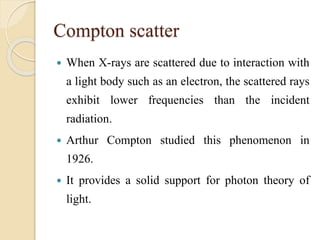
 When X-rays are scattered due to interaction with
a light body such as an electron, the scattered rays
exhibit lower frequencies than the incident
radiation.
 Arthur Compton studied this phenomenon in
1926.
 It provides a solid support for photon theory of
light.
Compton scatter
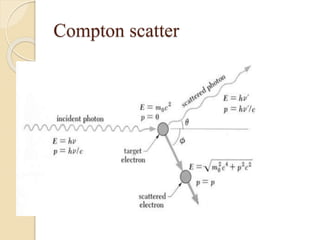
 Assumptions
1. Energy of incoming photon, E = h𝜈
2. Electron to be targeted is considered at
rest.
Compton scatter
Compton scatter
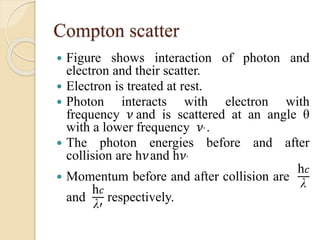
 Figure shows interaction of photon and
electron and their scatter.
 Electron is treated at rest.
 Photon interacts with electron with
frequency 𝜈 and is scattered at an angle θ
with a lower frequency 𝜈’ .
 The photon energies before and after
collision are h𝜈and h𝜈’
 Momentum before and after collision are
h 𝑐
λ
and
h 𝑐
λ′
respectively.
Compton scatter
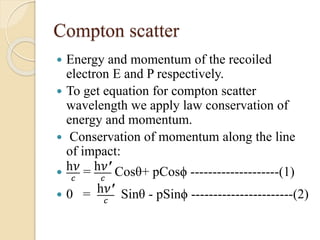
 Energy and momentum of the recoiled
electron E and P respectively.
 To get equation for compton scatter
wavelength we apply law conservation of
energy and momentum.
 Conservation of momentum along the line
of impact:

h𝜈
𝑐
= h𝜈′
𝑐
Cosθ+ pCosϕ --------------------(1)
 0 = h𝜈′
𝑐
Sinθ - pSinϕ -----------------------(2)
Compton scatter
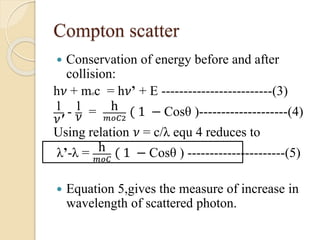
 Conservation of energy before and after
collision:
h𝜈 + moc = h𝜈’ + E -------------------------(3)
1
𝜈′
- 1
𝜈 = h
𝑚𝑜𝐶2
( 1 − Cosθ )--------------------(4)
Using relation 𝜈 = c/λ equ 4 reduces to
λ’-λ = h
𝑚𝑜𝐶
( 1 − Cosθ ) ----------------------(5)
 Equation 5,gives the measure of increase in
wavelength of scattered photon.
Compton scatter
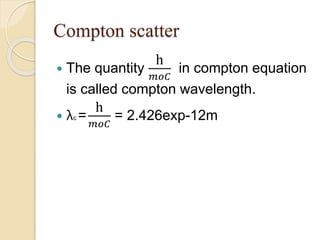
 The quantity
h
𝑚𝑜𝐶
in compton equation
is called compton wavelength.
 λc =
h
𝑚𝑜𝐶
= 2.426exp-12m
 the compton effect or the compton scatter

the compton effect or the compton scatter

  • 1.
    The compton effect Presentedby: Sehrish Inam, Lecturer Physics
  • 2.
    Table of contents Introduction  Figure  Discussion  Equation
  • 3.
    Compton scatter  WhenX-rays are scattered due to interaction with a light body such as an electron, the scattered rays exhibit lower frequencies than the incident radiation.  Arthur Compton studied this phenomenon in 1926.  It provides a solid support for photon theory of light.
  • 4.
    Compton scatter  Assumptions 1.Energy of incoming photon, E = h𝜈 2. Electron to be targeted is considered at rest.
  • 5.
  • 6.
    Compton scatter  Figureshows interaction of photon and electron and their scatter.  Electron is treated at rest.  Photon interacts with electron with frequency 𝜈 and is scattered at an angle θ with a lower frequency 𝜈’ .  The photon energies before and after collision are h𝜈and h𝜈’  Momentum before and after collision are h 𝑐 λ and h 𝑐 λ′ respectively.
  • 7.
    Compton scatter  Energyand momentum of the recoiled electron E and P respectively.  To get equation for compton scatter wavelength we apply law conservation of energy and momentum.  Conservation of momentum along the line of impact:  h𝜈 𝑐 = h𝜈′ 𝑐 Cosθ+ pCosϕ --------------------(1)  0 = h𝜈′ 𝑐 Sinθ - pSinϕ -----------------------(2)
  • 8.
    Compton scatter  Conservationof energy before and after collision: h𝜈 + moc = h𝜈’ + E -------------------------(3) 1 𝜈′ - 1 𝜈 = h 𝑚𝑜𝐶2 ( 1 − Cosθ )--------------------(4) Using relation 𝜈 = c/λ equ 4 reduces to λ’-λ = h 𝑚𝑜𝐶 ( 1 − Cosθ ) ----------------------(5)  Equation 5,gives the measure of increase in wavelength of scattered photon.
  • 9.
    Compton scatter  Thequantity h 𝑚𝑜𝐶 in compton equation is called compton wavelength.  λc = h 𝑚𝑜𝐶 = 2.426exp-12m