REPORTER:
ALEGADO, MARVIN C.
After the report, the students should be able to:
• explain how X-rays are scattered by electrons and how this leads to a
change in wavelength;
• compare classical wave theory with the observed results of the Compton
Effect;
• calculate the wavelength shift using the Compton formula; and
• explore practical applications of the Compton Effect, such as X-ray
imaging and diffraction.
We will further discuss the Compton effect, which
played a very important role in providing irrefutable
evidence for the picture of light, where light behaves
like packets or particles or photons.
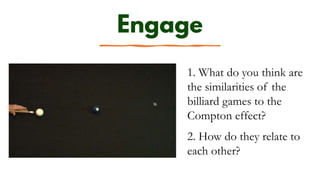
1. What do you think are
the similarities of the
billiard games to the
Compton effect?
2. How do they relate to
each other?
1. What is the Compton Effect?
2. What changes do you observe in the scattered radiation compared to
the incident radiation?
3. What is the relationship between the scattering angle and the
wavelength shift?
4. How does the Compton Effect challenge classical wave theory?
5. What implications does the Compton Effect have for our understanding
of light?
A. Compton Effect Overview:
• When a high-energy photon (e.g., an X-ray) collides with an
electron, it transfers some of its energy and momentum to the
electron.
• As a result, the photon changes direction (scatters) and experiences
a wavelength shift (increase in wavelength).
B. Changes in Scattered Radiation:
• Compared to the incident radiation (original X-ray), the
scattered radiation has:
• Increased wavelength: The wavelength of the scattered
photon becomes longer.
• Decreased energy: The scattered photon loses energy during
the interaction.
• The Compton shift (Δλ) quantifies this change in
wavelength.
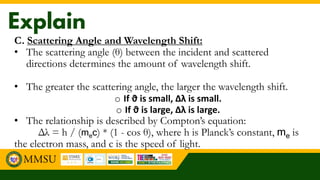
C. Scattering Angle and Wavelength Shift:
• The scattering angle (θ) between the incident and scattered
directions determines the amount of wavelength shift.
• The greater the scattering angle, the larger the wavelength shift.
o If ϑ is small, ∆λ is small.
o If ϑ is large, ∆λ is large.
• The relationship is described by Compton’s equation:
Δλ = h / (mec) * (1 - cos θ), where h is Planck’s constant, me is
the electron mass, and c is the speed of light.
D. Challenge to Classical Wave Theory:
• Classical wave theory predicts that the wavelength of scattered
radiation should remain unchanged.
• However, the Compton Effect demonstrates that light behaves as
both waves and particles (photons).
• This challenged classical physics and led to the development of
quantum mechanics.
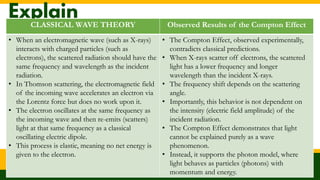
CLASSICAL WAVE THEORY Observed Results of the Compton Effect
• When an electromagnetic wave (such as X-rays)
interacts with charged particles (such as
electrons), the scattered radiation should have the
same frequency and wavelength as the incident
radiation.
• In Thomson scattering, the electromagnetic field
of the incoming wave accelerates an electron via
the Lorentz force but does no work upon it.
• The electron oscillates at the same frequency as
the incoming wave and then re-emits (scatters)
light at that same frequency as a classical
oscillating electric dipole.
• This process is elastic, meaning no net energy is
given to the electron.
• The Compton Effect, observed experimentally,
contradicts classical predictions.
• When X-rays scatter off electrons, the scattered
light has a lower frequency and longer
wavelength than the incident X-rays.
• The frequency shift depends on the scattering
angle.
• Importantly, this behavior is not dependent on
the intensity (electric field amplitude) of the
incident radiation.
• The Compton Effect demonstrates that light
cannot be explained purely as a wave
phenomenon.
• Instead, it supports the photon model, where
light behaves as particles (photons) with
momentum and energy.
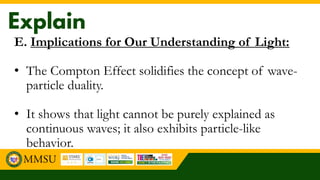
E. Implications for Our Understanding of Light:
• The Compton Effect solidifies the concept of wave-
particle duality.
• It shows that light cannot be purely explained as
continuous waves; it also exhibits particle-like
behavior.
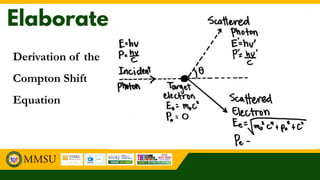
Derivation of the
Compton Shift
Equation
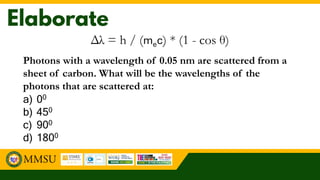
Photons with a wavelength of 0.05 nm are scattered from a
sheet of carbon. What will be the wavelengths of the
photons that are scattered at:
a) 00
b) 450
c) 900
d) 1800
Practical
Applications
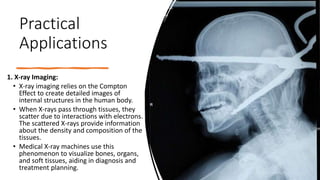
1. X-ray Imaging:
• X-ray imaging relies on the Compton
Effect to create detailed images of
internal structures in the human body.
• When X-rays pass through tissues, they
scatter due to interactions with electrons.
The scattered X-rays provide information
about the density and composition of the
tissues.
• Medical X-ray machines use this
phenomenon to visualize bones, organs,
and soft tissues, aiding in diagnosis and
treatment planning.
Practical Applications
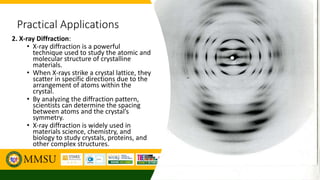
2. X-ray Diffraction:
• X-ray diffraction is a powerful
technique used to study the atomic and
molecular structure of crystalline
materials.
• When X-rays strike a crystal lattice, they
scatter in specific directions due to the
arrangement of atoms within the
crystal.
• By analyzing the diffraction pattern,
scientists can determine the spacing
between atoms and the crystal’s
symmetry.
• X-ray diffraction is widely used in
materials science, chemistry, and
biology to study crystals, proteins, and
other complex structures.
Practical
Applications
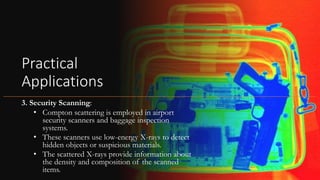
3. Security Scanning:
• Compton scattering is employed in airport
security scanners and baggage inspection
systems.
• These scanners use low-energy X-rays to detect
hidden objects or suspicious materials.
• The scattered X-rays provide information about
the density and composition of the scanned
items.
Practical
Applications
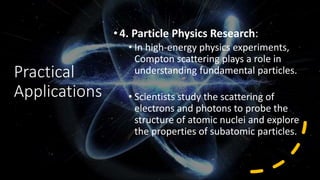
•4. Particle Physics Research:
• In high-energy physics experiments,
Compton scattering plays a role in
understanding fundamental particles.
• Scientists study the scattering of
electrons and photons to probe the
structure of atomic nuclei and explore
the properties of subatomic particles.
1. Calculate the Compton wavelength of a
proton.
2. Reflect on what you’ve learned and what you
found interesting or challenging about the
lesson.
1. Review and prepare for a short quiz next meeting.
2. Conduct further research on the Compton Effect and its
applications in various fields such as medicine, archaeology, and
engineering.
3. Write a short reflection on what you’ve learned and how you think
the Compton Effect can be used in our daily lives.
Send us a message or
visit us
City of Batac, Ilocos Norte,
Philippines
(63) 77-600-0459
op@mmsu.edu.ph
Get in Touch
With Us
facebook.com/MMSUofficial
www.mmsu.edu.ph
Follow us for updates

#3_Compton_Effect_Alegado,Marvin_Castillo.pptx

  • 2.
  • 3.
    After the report,the students should be able to: • explain how X-rays are scattered by electrons and how this leads to a change in wavelength; • compare classical wave theory with the observed results of the Compton Effect; • calculate the wavelength shift using the Compton formula; and • explore practical applications of the Compton Effect, such as X-ray imaging and diffraction.
  • 6.
    We will furtherdiscuss the Compton effect, which played a very important role in providing irrefutable evidence for the picture of light, where light behaves like packets or particles or photons.
  • 7.
    1. What doyou think are the similarities of the billiard games to the Compton effect? 2. How do they relate to each other?
  • 9.
    1. What isthe Compton Effect? 2. What changes do you observe in the scattered radiation compared to the incident radiation? 3. What is the relationship between the scattering angle and the wavelength shift? 4. How does the Compton Effect challenge classical wave theory? 5. What implications does the Compton Effect have for our understanding of light?
  • 11.
    A. Compton EffectOverview: • When a high-energy photon (e.g., an X-ray) collides with an electron, it transfers some of its energy and momentum to the electron. • As a result, the photon changes direction (scatters) and experiences a wavelength shift (increase in wavelength).
  • 12.
    B. Changes inScattered Radiation: • Compared to the incident radiation (original X-ray), the scattered radiation has: • Increased wavelength: The wavelength of the scattered photon becomes longer. • Decreased energy: The scattered photon loses energy during the interaction. • The Compton shift (Δλ) quantifies this change in wavelength.
  • 13.
    C. Scattering Angleand Wavelength Shift: • The scattering angle (θ) between the incident and scattered directions determines the amount of wavelength shift. • The greater the scattering angle, the larger the wavelength shift. o If ϑ is small, ∆λ is small. o If ϑ is large, ∆λ is large. • The relationship is described by Compton’s equation: Δλ = h / (mec) * (1 - cos θ), where h is Planck’s constant, me is the electron mass, and c is the speed of light.
  • 14.
    D. Challenge toClassical Wave Theory: • Classical wave theory predicts that the wavelength of scattered radiation should remain unchanged. • However, the Compton Effect demonstrates that light behaves as both waves and particles (photons). • This challenged classical physics and led to the development of quantum mechanics.
  • 15.
    CLASSICAL WAVE THEORYObserved Results of the Compton Effect • When an electromagnetic wave (such as X-rays) interacts with charged particles (such as electrons), the scattered radiation should have the same frequency and wavelength as the incident radiation. • In Thomson scattering, the electromagnetic field of the incoming wave accelerates an electron via the Lorentz force but does no work upon it. • The electron oscillates at the same frequency as the incoming wave and then re-emits (scatters) light at that same frequency as a classical oscillating electric dipole. • This process is elastic, meaning no net energy is given to the electron. • The Compton Effect, observed experimentally, contradicts classical predictions. • When X-rays scatter off electrons, the scattered light has a lower frequency and longer wavelength than the incident X-rays. • The frequency shift depends on the scattering angle. • Importantly, this behavior is not dependent on the intensity (electric field amplitude) of the incident radiation. • The Compton Effect demonstrates that light cannot be explained purely as a wave phenomenon. • Instead, it supports the photon model, where light behaves as particles (photons) with momentum and energy.
  • 16.
    E. Implications forOur Understanding of Light: • The Compton Effect solidifies the concept of wave- particle duality. • It shows that light cannot be purely explained as continuous waves; it also exhibits particle-like behavior.
  • 17.
  • 18.
    Photons with awavelength of 0.05 nm are scattered from a sheet of carbon. What will be the wavelengths of the photons that are scattered at: a) 00 b) 450 c) 900 d) 1800
  • 19.
    Practical Applications 1. X-ray Imaging: •X-ray imaging relies on the Compton Effect to create detailed images of internal structures in the human body. • When X-rays pass through tissues, they scatter due to interactions with electrons. The scattered X-rays provide information about the density and composition of the tissues. • Medical X-ray machines use this phenomenon to visualize bones, organs, and soft tissues, aiding in diagnosis and treatment planning.
  • 20.
    Practical Applications 2. X-rayDiffraction: • X-ray diffraction is a powerful technique used to study the atomic and molecular structure of crystalline materials. • When X-rays strike a crystal lattice, they scatter in specific directions due to the arrangement of atoms within the crystal. • By analyzing the diffraction pattern, scientists can determine the spacing between atoms and the crystal’s symmetry. • X-ray diffraction is widely used in materials science, chemistry, and biology to study crystals, proteins, and other complex structures.
  • 21.
    Practical Applications 3. Security Scanning: •Compton scattering is employed in airport security scanners and baggage inspection systems. • These scanners use low-energy X-rays to detect hidden objects or suspicious materials. • The scattered X-rays provide information about the density and composition of the scanned items.
  • 22.
    Practical Applications •4. Particle PhysicsResearch: • In high-energy physics experiments, Compton scattering plays a role in understanding fundamental particles. • Scientists study the scattering of electrons and photons to probe the structure of atomic nuclei and explore the properties of subatomic particles.
  • 23.
    1. Calculate theCompton wavelength of a proton. 2. Reflect on what you’ve learned and what you found interesting or challenging about the lesson.
  • 24.
    1. Review andprepare for a short quiz next meeting. 2. Conduct further research on the Compton Effect and its applications in various fields such as medicine, archaeology, and engineering. 3. Write a short reflection on what you’ve learned and how you think the Compton Effect can be used in our daily lives.
  • 26.
    Send us amessage or visit us City of Batac, Ilocos Norte, Philippines (63) 77-600-0459 op@mmsu.edu.ph Get in Touch With Us facebook.com/MMSUofficial www.mmsu.edu.ph Follow us for updates

Editor's Notes

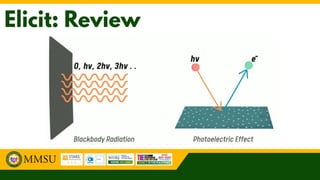
  • #6 Each member can only speak one word at a time. by combining the words, it needs to form sentences giving the definition, explaining the concept, or particular applications of the given topic. In our previous discussion, we tackled about the blackbody radiation and photoelectric effect. These gave us a conclusion about the nature of light. The blackbody radiation experiment suggested that the blackbody walls emit electromagnetic radiation in discrete values of Hν (H-Planck's constant; v-frequency). In the photoelectric effect, we found that the electrons absorb electromagnetic energy in the form of Hv or packets of energy called photons. So, this gave us the photon picture of radiation. In the photon picture of radiation, light or electromagnetic radiation is composed of these discrete packets or particles having Energy= Hv.
  • #8 WHAT DO YOU THINK THE SIMILARITIES OF THE BILLIARD GAMES TO THE COMPTON EFFECT? HOW THEY RELATE TO EACH OTHER?
  • #17 COMPTON POSTULATED THAT THE INCIDENT RADIATION IS NOT COMPOSED OF ELECTROMAGNETIC WAVES IN THE CLASSICAL PICTURE BUT INSTEAD IS COMPOSED OF PHOTONS JUST LIKE WHAT EINSTEIN ASSUMED IN THE PHOTOELECTRIC EFFECT EXPERIMENT – WHERE THE PHOTOELECTRIC EFFECT, EINSTEIN SUGGESTED THAT THE INCIDENT RADIATION IS COMPOSED OF THESE PHOTON PARTICLES. THESE PHOTONS ARE DISCRETE PACKETS OF ENERGY AND EVERY SINGLE ELECTRON THAT IS RELEASED FROM THE SURFACE ABSORBS THE ENERGY OF THE PHOTON ONE-ON-ONE. EXAMPLE: BILLIARD, EXCHANGING ENERGY AND MOMENTUM WHEN COLLIDES. THIS PROCESS CAN BE REPLICATED HERE BETWEEN THE INTERACTION OF THE PHOTON AND ELECTRON. WHERE IN THE CLASSICAL PICTURE THE ELECTRONS ABSORB THE ENERGY BY BECOMING OSCILLATORS AND THEN RELEASING THAT ENERGY IN THE FORM OF ELECTROMAGNETIC RADIATION. BUT IN THE QUANTUM PICTURE, THE INCIDENT RADIATION IS COMPOSED OF PHOTON PARTICLES AND THESE PHOTONS ARE CAPABLE OF COLLIDING WITH THE ELECTRON RESULTING INTO AN EXCHANGE OF ENERGY AND MOMENTUM.
  • #18 Total relativistic energy. Or relativistic massless particles, photon is a particle move with the speed of light.
  • #19 Using the compton formula will find the wavelengths of the photons that are scattered at each angles