EXPERIMENTAL MODULE 8
Identification of an Unknown
Specimen
Presented by
Sehrish inam
Xray diffraction
• Identify an unknown specimen by comparing it
with standard powder diffraction patterns.
• Match interplanar spacings (d values) of
standard and observed diffraction patterns.
• This was realized as early as 1919 by Hull
Advantages of powder diffraction
• Shows exact atomic arrangement in a material,
like a "fingerprint“.
• Each substance produces its own characteristic
diffraction pattern independently of the others.
• Small amount of the material is required
JCPD
• The Powder Diffraction File (PDF) organized
by the Joint Committee on Powder Diffraction
Standards (JCPDS), later renamed the
International Centre for Diffraction Data, has
standard diffraction patterns.
• These files called "cards“
JCPD (Cont…)
• The cards list the interplanar spacings (d
values) and not 2ϴ value and depend on the
wavelength of the x-rays.
• Miller indices (hkl) of the planes having these
spacings, and the relative intensities (I/Io) of all
the reflections observed.
• The ICDD publishes two indexes alphabetical and
numerical, separately for inorganic and organic phases.
• The alphabetical index manual lists all the compounds
in alphabetical order.
• The numerical index manual (Hanawalt Search
Manual) lists the compounds in decreasing order of the
d spacings.
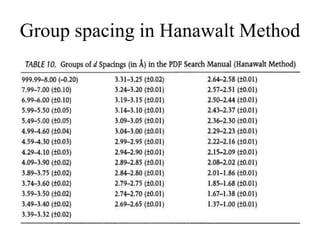
• These d spacings are arranged in groups starting from
999.9 to 8.00 Ao as one group, 7.99 to 7.00 Ao as
another group, etc., down to 1.37 to 1.00 Ao
JCPD (Cont…)
Group spacing in Hanawalt Method
• The d value of the strongest peak in the pattern
determines the group into which the entry falls,
and the d value of the second strongest peak
determines the subgroup.
Identification of unknown specimen
• Identification of an unknown specimen begins
with recording its x –ray diffraction pattern
with a suitable radiation and under suitable
voltage and current conditions. You should
ensure that the specimen, if in powder form,
has the ideal fine grain size to give a good x-
ray diffraction pattern
Identifying the unknown material
1. Designate the interplanar spacing corresponding
to the most intense peak by d1, d2, and d3.
2. Locate d1 group in the Hanawalt Search Manual.
3. Look for the closest match to d2 and d3
4. Compare their relative integrated intensities with
the tabulated values.
5. Locate the proper card and compare the d and
intensity values for all the reflections.
• In practice, the unknown material may contain
one or more phases.
• The procedure for identification of only one
phase is easy.
Identifying the unknown material
Identification of single phase material
Single-Phase Material Identification
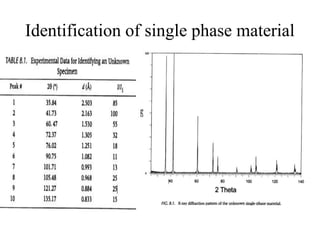
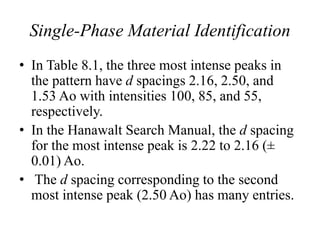
• In Table 8.1, the three most intense peaks in
the pattern have d spacings 2.16, 2.50, and
1.53 Ao with intensities 100, 85, and 55,
respectively.
• In the Hanawalt Search Manual, the d spacing
for the most intense peak is 2.22 to 2.16 (±
0.01) Ao.
• The d spacing corresponding to the second
most intense peak (2.50 Ao) has many entries.
Double phase identification
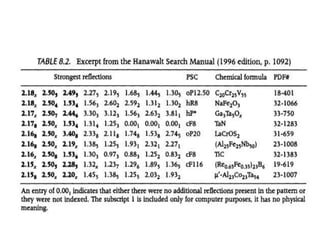
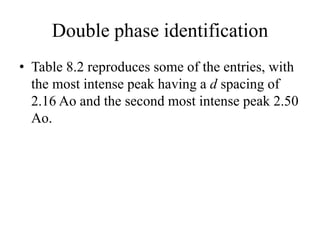
• Table 8.2 reproduces some of the entries, with
the most intense peak having a d spacing of
2.16 Ao and the second most intense peak 2.50
Ao.
• In Table 8.2 notice that only three phases-NaFe20 3, TaN, and
TiC have d spacing of 1.53 Ao for the third strongest
reflection.
• Therefore, we now have to decide which of these three
substances is our unknown specimen.
• To do this, compare the list of d spacings obtained from the x-
ray diffraction pattern of the unknown specimen and
intensities of the
other reflections with those of the possible materials in Table 8.2.
• The unknown pattern has a d spacing of 1.30 Ao for the fourth
most intense reflection, so the specimen cannot be NaFe2O3,
which has a d spacing of 1.56 Ao for the fourth most intense
reflection.
Slide share version experimental module 8

Slide share version experimental module 8

  • 1.
    EXPERIMENTAL MODULE 8 Identificationof an Unknown Specimen Presented by Sehrish inam
  • 2.
    Xray diffraction • Identifyan unknown specimen by comparing it with standard powder diffraction patterns. • Match interplanar spacings (d values) of standard and observed diffraction patterns. • This was realized as early as 1919 by Hull
  • 3.
    Advantages of powderdiffraction • Shows exact atomic arrangement in a material, like a "fingerprint“. • Each substance produces its own characteristic diffraction pattern independently of the others. • Small amount of the material is required
  • 4.
    JCPD • The PowderDiffraction File (PDF) organized by the Joint Committee on Powder Diffraction Standards (JCPDS), later renamed the International Centre for Diffraction Data, has standard diffraction patterns. • These files called "cards“
  • 5.
    JCPD (Cont…) • Thecards list the interplanar spacings (d values) and not 2ϴ value and depend on the wavelength of the x-rays. • Miller indices (hkl) of the planes having these spacings, and the relative intensities (I/Io) of all the reflections observed.
  • 6.
    • The ICDDpublishes two indexes alphabetical and numerical, separately for inorganic and organic phases. • The alphabetical index manual lists all the compounds in alphabetical order. • The numerical index manual (Hanawalt Search Manual) lists the compounds in decreasing order of the d spacings. • These d spacings are arranged in groups starting from 999.9 to 8.00 Ao as one group, 7.99 to 7.00 Ao as another group, etc., down to 1.37 to 1.00 Ao JCPD (Cont…)
  • 7.
    Group spacing inHanawalt Method
  • 8.
    Group spacing inHanawalt Method • The d value of the strongest peak in the pattern determines the group into which the entry falls, and the d value of the second strongest peak determines the subgroup.
  • 9.
    Identification of unknownspecimen • Identification of an unknown specimen begins with recording its x –ray diffraction pattern with a suitable radiation and under suitable voltage and current conditions. You should ensure that the specimen, if in powder form, has the ideal fine grain size to give a good x- ray diffraction pattern
  • 10.
    Identifying the unknownmaterial 1. Designate the interplanar spacing corresponding to the most intense peak by d1, d2, and d3. 2. Locate d1 group in the Hanawalt Search Manual. 3. Look for the closest match to d2 and d3 4. Compare their relative integrated intensities with the tabulated values. 5. Locate the proper card and compare the d and intensity values for all the reflections.
  • 11.
    • In practice,the unknown material may contain one or more phases. • The procedure for identification of only one phase is easy. Identifying the unknown material
  • 12.
  • 13.
    Single-Phase Material Identification •In Table 8.1, the three most intense peaks in the pattern have d spacings 2.16, 2.50, and 1.53 Ao with intensities 100, 85, and 55, respectively. • In the Hanawalt Search Manual, the d spacing for the most intense peak is 2.22 to 2.16 (± 0.01) Ao. • The d spacing corresponding to the second most intense peak (2.50 Ao) has many entries.
  • 15.
    Double phase identification •Table 8.2 reproduces some of the entries, with the most intense peak having a d spacing of 2.16 Ao and the second most intense peak 2.50 Ao.
  • 16.
    • In Table8.2 notice that only three phases-NaFe20 3, TaN, and TiC have d spacing of 1.53 Ao for the third strongest reflection. • Therefore, we now have to decide which of these three substances is our unknown specimen. • To do this, compare the list of d spacings obtained from the x- ray diffraction pattern of the unknown specimen and intensities of the other reflections with those of the possible materials in Table 8.2. • The unknown pattern has a d spacing of 1.30 Ao for the fourth most intense reflection, so the specimen cannot be NaFe2O3, which has a d spacing of 1.56 Ao for the fourth most intense reflection.