Ain Shams University
Mathematics and Engineering Physics Department


 Pre-Junior Communication Systems Engineering Students


                        Lecture 11
 Modern Physics and Quantum Mechanics Course (EPHS 240)
                     9 December 2009

                   Dr. Hatem El-Refaei
Contents
         Infinite barrier
         Finite barrier
         Quantum tunnelling


hatem@oilpeakinarabic.org   Dr. Hatem El-Refaei   1
Note
    All problems today are unbounded problem, i.e. the
    particle is not confined in a certain region, so:
         We will not be able to do the normalization condition.
         Therefore, we will not be able to solve for all unknowns.
         Therefore, we will not get a characteristic equation.
         Therefore, energy levels are not quantized, and all energies
         are possible.
    But still there are a lot of important characteristics to
    understand and learn today.


hatem@oilpeakinarabic.org     Dr. Hatem El-Refaei                  2
Infinite barrier


hatem@oilpeakinarabic.org        Dr. Hatem El-Refaei   3
Potential step of infinite height and infinite width

               Energy
                                                      ∞


                                 ∞
                            E

                                                          x
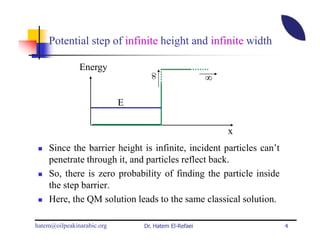
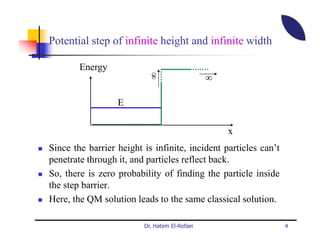
    Since the barrier height is infinite, incident particles can’t
    penetrate through it, and particles reflect back.
    So, there is zero probability of finding the particle inside
    the step barrier.
    Here, the QM solution leads to the same classical solution.

hatem@oilpeakinarabic.org       Dr. Hatem El-Refaei                  4
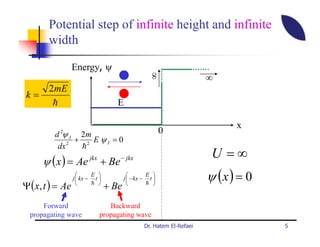
Potential step of infinite height and infinite
       width

                 Energy, ψ
                                                                      ∞


                                                 ∞
       2mE
 k=
        h                          E

                                                                            x
         d ψ I 2m
           2                                            0
             2
               + 2 E ψI = 0
          dx    h
                                                                       U =∞
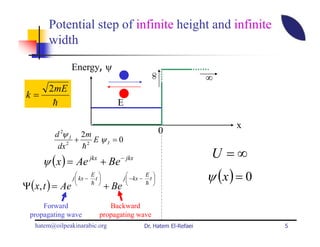
      ψ ( x ) = Ae      jkx
                              + Be   − jkx

                        E 
                 j  kx − t 
                                                E 
                                       j  − kx − t                  ψ (x ) = 0
Ψ (x, t ) = Ae          h 
                                + Be            h 


      Forward                    Backward
  propagating wave            propagating wave
   hatem@oilpeakinarabic.org                    Dr. Hatem El-Refaei                5
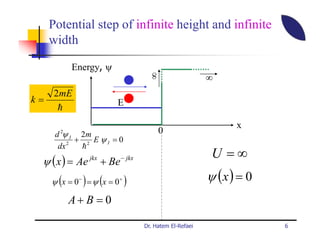
Potential step of infinite height and infinite
     width

            Energy, ψ
                                                              ∞


                                         ∞
      2mE
k=                          E
       h
                                                                    x
      d ψ I 2m
        2                                    0
          2
            + 2 E ψI = 0
       dx    h
                                                               U =∞
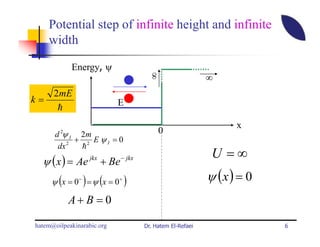
  ψ ( x ) = Ae     jkx
                         + Be   − jkx


     ψ (x = 0 − ) = ψ (x = 0 + )                              ψ (x ) = 0
            A+ B = 0

hatem@oilpeakinarabic.org               Dr. Hatem El-Refaei                6
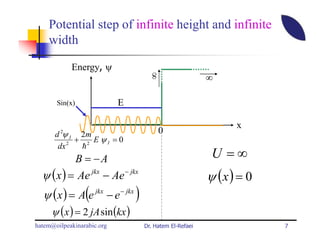
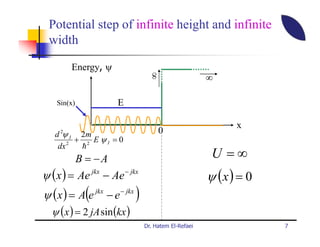
Potential step of infinite height and infinite
    width

            Energy, ψ
                                                       ∞


                                  ∞
       Sin(x)               E

                                                             x
      d ψ I 2m
        2                             0
          2
            + 2 E ψI = 0
       dx    h
                B = −A                                  U =∞
  ψ (x ) = Ae jkx − Ae − jkx                           ψ (x ) = 0
  ψ (x ) = A(e jkx − e − jkx )
     ψ ( x ) = 2 jA sin (kx )
hatem@oilpeakinarabic.org        Dr. Hatem El-Refaei                7
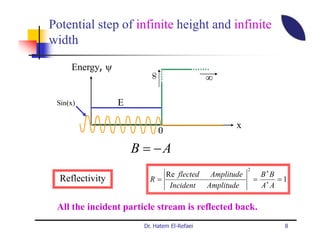
Potential step of infinite height and infinite
    width

            Energy, ψ
                                                       ∞


                                  ∞
       Sin(x)               E

                                                           x
                                      0
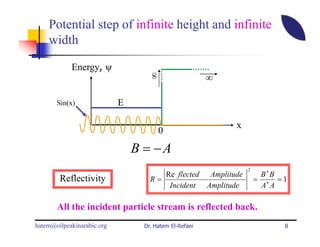
                                B = −A
                                                               2
                                      Re flected Amplitude          B∗B
        Reflectivity               R=                              = ∗ =1
                                       Incident Amplitude           A A

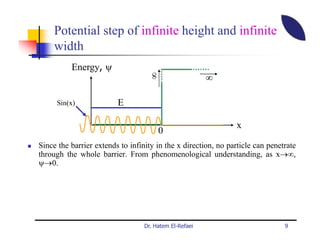
       All the incident particle stream is reflected back.
hatem@oilpeakinarabic.org        Dr. Hatem El-Refaei                    8
Potential step of infinite height and infinite
      width
            Energy, ψ
                                                         ∞


                                    ∞
       Sin(x)               E

                                                                x
                                        0
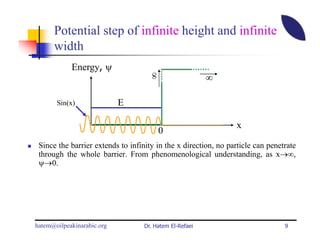
 Since the barrier extends to infinity in the x direction, no particle can penetrate
 through the whole barrier. From phenomenological understanding, as x→∞,
 ψ→0.


hatem@oilpeakinarabic.org          Dr. Hatem El-Refaei                          9
Finite barrier


hatem@oilpeakinarabic.org       Dr. Hatem El-Refaei   10
Potential step of finite height and infinite
      width
               Energy
                                E<Uo

                                                      ∞
                            E
                                              Uo
                                                          x
                                     0


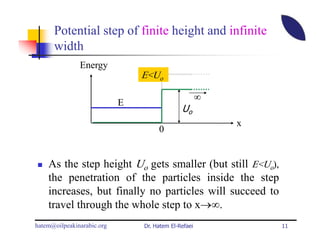
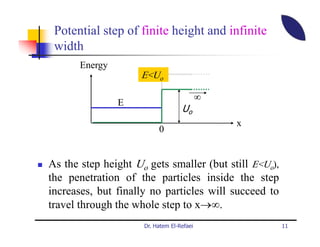
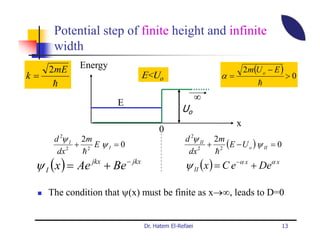
    As the step height Uo gets smaller (but still E<Uo),
    the penetration of the particles inside the step
    increases, but finally no particles will succeed to
    travel through the whole step to x→∞.
hatem@oilpeakinarabic.org       Dr. Hatem El-Refaei           11
Potential step of finite height and infinite
       width
     2mE        Energy                                                  2m(U o − E )
k=                               E<Uo                          α=                      >0
      h                                                                     h
                                                          ∞
                             E
                                                  Uo
                                                                    x
                                         0
       d 2ψ I 2m                                    d 2ψ II 2m
           2
             + 2 EψI =0                                 2
                                                           + 2 (E − U o ) ψ II = 0
        dx    h                                      dx     h
 ψ I ( x ) = Ae jkx + Be − jkx                     ψ II ( x ) = C e −α x + Deα x
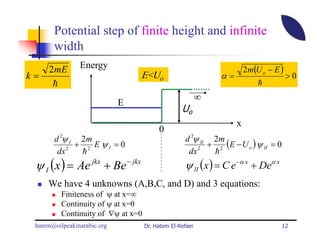
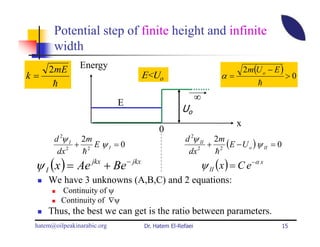
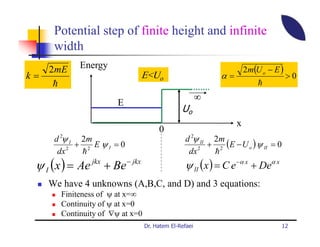
     We have 4 unknowns (A,B,C, and D) and 3 equations:
          Finiteness of ψ at x=∞
          Continuity of ψ at x=0
          Continuity of ∇ψ at x=0
 hatem@oilpeakinarabic.org          Dr. Hatem El-Refaei                              12
Potential step of finite height and infinite
       width
     2mE        Energy                                               2m(U o − E )
k=                               E<Uo                       α=                      >0
      h                                                                  h
                                                       ∞
                             E
                                               Uo
                                                                 x
                                      0
       d 2ψ I 2m                                 d 2ψ II 2m
           2
             + 2 EψI =0                              2
                                                        + 2 (E − U o ) ψ II = 0
        dx    h                                   dx     h
 ψ I ( x ) = Ae jkx + Be − jkx                  ψ II ( x ) = C e −α x + Deα x

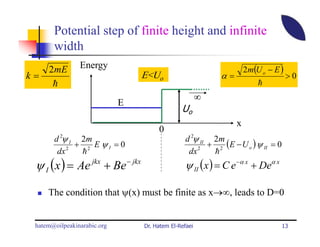
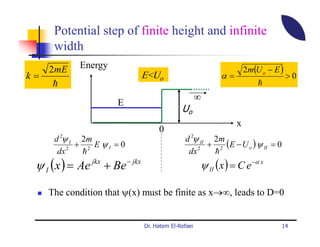
     The condition that ψ(x) must be finite as x→∞, leads to D=0


 hatem@oilpeakinarabic.org       Dr. Hatem El-Refaei                              13
Potential step of finite height and infinite
       width
     2mE        Energy                                                2m(U o − E )
k=                               E<Uo                        α=                      >0
      h                                                                   h
                                                       ∞
                             E
                                               Uo
                                                                  x
                                      0
       d 2ψ I 2m                                 d 2ψ II 2m
           2
             + 2 EψI =0                              2
                                                        + 2 (E − U o ) ψ II = 0
        dx    h                                   dx     h
 ψ I ( x ) = Ae jkx + Be − jkx                         ψ II (x ) = C e −α x

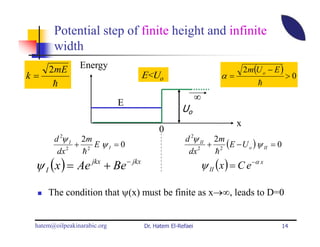
     The condition that ψ(x) must be finite as x→∞, leads to D=0


 hatem@oilpeakinarabic.org       Dr. Hatem El-Refaei                              14
Potential step of finite height and infinite
       width
     2mE        Energy                                                2m(U o − E )
k=                               E<Uo                        α=                      >0
      h                                                                   h
                                                       ∞
                             E
                                               Uo
                                                                  x
                                      0
       d 2ψ I 2m                                 d 2ψ II 2m
           2
             + 2 EψI =0                              2
                                                        + 2 (E − U o ) ψ II = 0
        dx    h                                   dx     h
 ψ I ( x ) = Ae jkx + Be − jkx                         ψ II (x ) = C e −α x
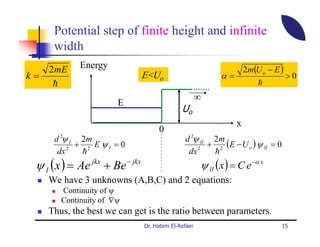
     We have 3 unknowns (A,B,C) and 2 equations:
          Continuity of ψ
          Continuity of ∇ψ
     Thus, the best we can get is the ratio between parameters.
 hatem@oilpeakinarabic.org       Dr. Hatem El-Refaei                              15
Potential step of finite height and infinite
       width
     2mE        Energy                                                         2m(U o − E )
k=                               E<Uo                             α=                          >0
      h                                                                            h
                                                       ∞
                             E
                                               Uo
                                                                           x
 ψ I ( x ) = Ae jkx + Be − jkx        0
                                                       ψ II (x ) = C e −α x
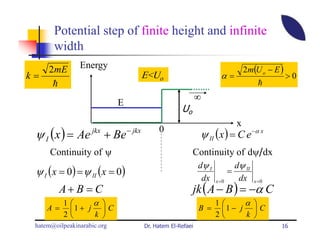
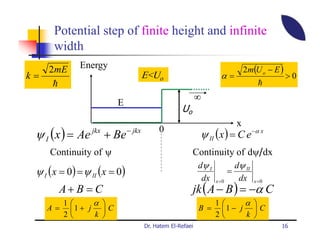
      Continuity of ψ                               Continuity of dψ/dx
                                                     dψ I     dψ II
 ψ I ( x = 0) = ψ II (x = 0)                                           =
                                                           dx              dx
                                                    jk ( A − B ) = −α C
                                                                x =0              x =0
         A+ B = C
          1     α                                             1     α 
     A=    1 + j  C                                  B =       1 − j  C
          2     k                                             2     k 
 hatem@oilpeakinarabic.org       Dr. Hatem El-Refaei                                      16
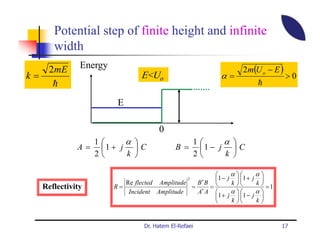
Potential step of finite height and infinite
        width
       2mE      Energy                                                         2m(U o − E )
k=                                   E<Uo                         α=                          >0
        h                                                                            h

                              E

                                           0
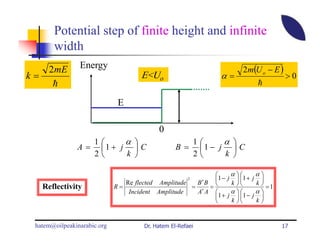
                     1        α                         1        α 
               A=         1+ j  C               B =          1− j  C
                     2        k                         2        k 

                                                                       α          α
                                                      2    1 −
                                                              ∗     j   1 +    j 
                                Re flected Amplitude  BB            k          k
     Reflectivity            R=                      = ∗ =                           =1
                                 Incident Amplitude   AA            α          α
                                                           1 +     j  1 −     j 
                                                                    k          k


 hatem@oilpeakinarabic.org            Dr. Hatem El-Refaei                                 17
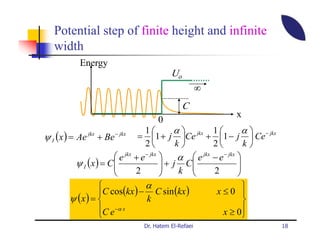
Potential step of finite height and infinite
      width
               Energy
                                              Uo
                                                          ∞
                                                   C
                                                                   x
                                         0
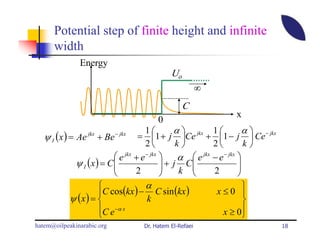
                                       1        α  jkx 1             α  − jkx
   ψ I (x ) = Ae + Be
                  jkx       − jkx
                                    = 1 + j Ce + 1 − j  Ce
                                       2         k        2          k
                            e jkx + e − jkx     α  e jkx − e − jkx 
              ψ I (x ) = C 
                                             + j C
                                                                    
                                                                      
                                  2              k       2         
                                 α                                 
                     C cos(kx ) − C sin (kx )                x≤0 
            ψ (x ) =             k                                 
                     C e −α x                                 x ≥ 0
                                                                   
hatem@oilpeakinarabic.org           Dr. Hatem El-Refaei                             18
Potential step of finite height and infinite
      width
               Energy
                                       Uo
                                                   ∞
                                            C
                                                       x
                                  0

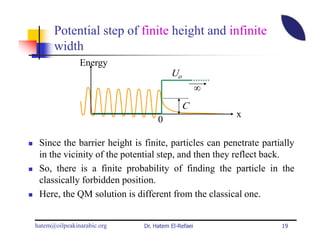
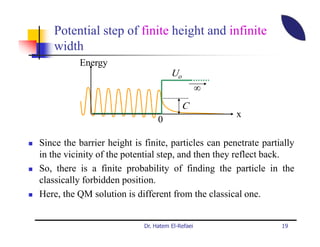
 Since the barrier height is finite, particles can penetrate partially
 in the vicinity of the potential step, and then they reflect back.
 So, there is a finite probability of finding the particle in the
 classically forbidden position.
 Here, the QM solution is different from the classical one.


hatem@oilpeakinarabic.org    Dr. Hatem El-Refaei                  19
Potential step of finite height and infinite
      width
               Energy
                            E<Uo                     Case 3            2m(U o − E )
                                                              α=                      >0
                                                     Case 2                h


                                                 Case 2   ψ ( x ) = C e −α x
                                                                   x
                                    0
                                            Case 3

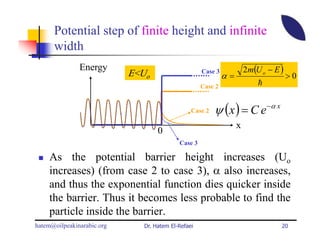
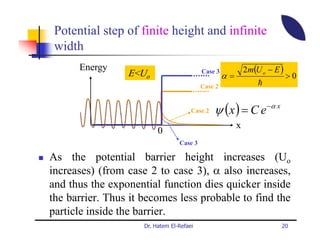
    As the potential barrier height increases (Uo
    increases) (from case 2 to case 3), α also increases,
    and thus the exponential function dies quicker inside
    the barrier. Thus it becomes less probable to find the
    particle inside the barrier.
hatem@oilpeakinarabic.org      Dr. Hatem El-Refaei                                20
Potential step of finite height and infinite
      width
                 Energy
                            E<Uo                              2m(U o − E )
                                                     α=                      >0
                                                                  h


                                                    ψ ( x ) = C e −α x
                                                          x
                                     0
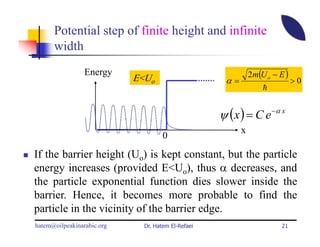
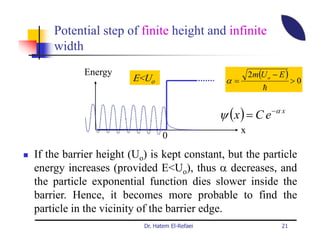
If the barrier height (Uo) is kept constant, but the particle
energy increases (provided E<Uo), thus α decreases, and
the particle exponential function dies slower inside the
barrier. Hence, it becomes more probable to find the
particle in the vicinity of the barrier edge.
hatem@oilpeakinarabic.org     Dr. Hatem El-Refaei                       21
Tunneling through a potential
                barrier


hatem@oilpeakinarabic.org   Dr. Hatem El-Refaei   22
Potential barrier of finite height and finite
      width
                   Energy          E<Uo
                                    Uo
                            E

                                                      x


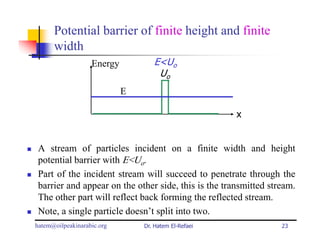
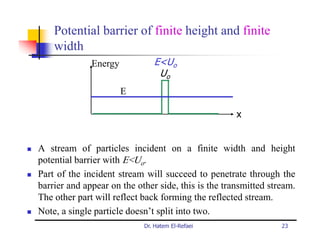
 A stream of particles incident on a finite width and height
 potential barrier with E<Uo.
 Part of the incident stream will succeed to penetrate through the
 barrier and appear on the other side, this is the transmitted stream.
 The other part will reflect back forming the reflected stream.
 Note, a single particle doesn’t split into two.
hatem@oilpeakinarabic.org       Dr. Hatem El-Refaei               23
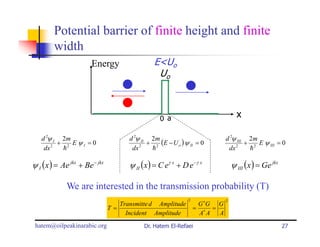
Potential barrier of finite height and finite
        width
                        Energy            E<Uo
        2mE                                Uo                                2m(U o − E )
k=                                                                   γ=                         >0
         h                                                                         h


                                             0 a                         x

   d 2ψ I 2m                     d 2ψ II 2m                          d 2ψ III 2m
         + 2 EψI = 0                    + 2 (E − U o ) ψ II = 0              + 2 E ψ III = 0
    dx 2  h                       dx 2   h                            dx 2    h

ψ I ( x ) = Ae jkx + Be − jkx    ψ II (x ) = C eγ x + D e −γ x    ψ III (x ) = Ge jkx + Fe − jkx
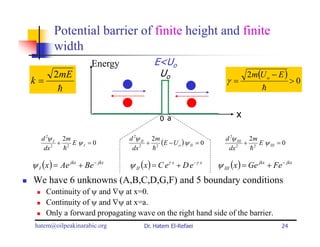
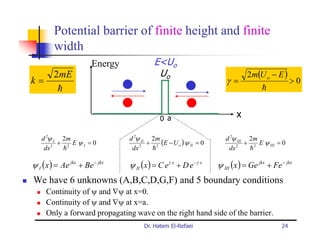
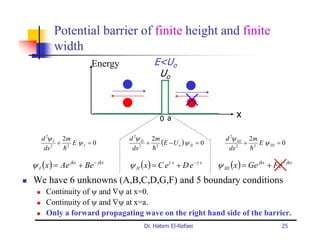
We have 6 unknowns (A,B,C,D,G,F) and 5 boundary conditions
     Continuity of ψ and ∇ψ at x=0.
     Continuity of ψ and ∇ψ at x=a.
     Only a forward propagating wave on the right hand side of the barrier.
 hatem@oilpeakinarabic.org            Dr. Hatem El-Refaei                                  24
Potential barrier of finite height and finite
        width
                        Energy            E<Uo
                                           Uo


                                             0 a                         x

   d 2ψ I 2m                     d 2ψ II 2m                          d 2ψ III 2m
         + 2 EψI = 0                    + 2 (E − U o ) ψ II = 0              + 2 E ψ III = 0
    dx 2  h                       dx 2   h                            dx 2    h

ψ I ( x ) = Ae jkx + Be − jkx    ψ II (x ) = C eγ x + D e −γ x    ψ III (x ) = Ge jkx + Fe − jkx
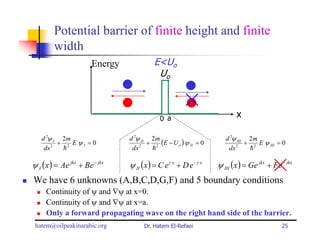
We have 6 unknowns (A,B,C,D,G,F) and 5 boundary conditions
     Continuity of ψ and ∇ψ at x=0.
     Continuity of ψ and ∇ψ at x=a.
     Only a forward propagating wave on the right hand side of the barrier.
 hatem@oilpeakinarabic.org            Dr. Hatem El-Refaei                                  25
Potential barrier of finite height and finite
        width
                        Energy            E<Uo
                                           Uo


                                             0 a                      x

   d 2ψ I 2m                     d 2ψ II 2m                       d 2ψ III 2m
         + 2 EψI = 0                    + 2 (E − U o ) ψ II = 0           + 2 E ψ III = 0
    dx 2  h                       dx 2   h                         dx 2    h

ψ I ( x ) = Ae jkx + Be − jkx    ψ II (x ) = C eγ x + D e −γ x     ψ III ( x ) = Ge jkx
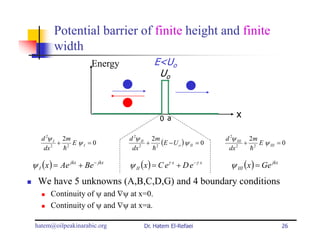
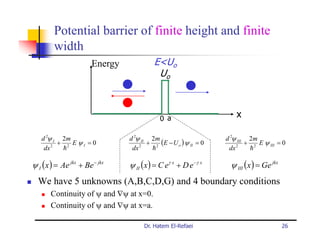
  We have 5 unknowns (A,B,C,D,G) and 4 boundary conditions
       Continuity of ψ and ∇ψ at x=0.
       Continuity of ψ and ∇ψ at x=a.

 hatem@oilpeakinarabic.org            Dr. Hatem El-Refaei                                 26
Potential barrier of finite height and finite
        width
                        Energy                  E<Uo
                                                 Uo


                                                   0 a                            x

   d 2ψ I 2m                           d 2ψ II 2m                           d 2ψ III 2m
         + 2 EψI = 0                          + 2 (E − U o ) ψ II = 0               + 2 E ψ III = 0
    dx 2  h                             dx 2   h                             dx 2    h

ψ I ( x ) = Ae jkx + Be − jkx          ψ II (x ) = C eγ x + D e −γ x            ψ III ( x ) = Ge jkx

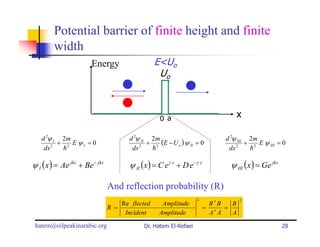
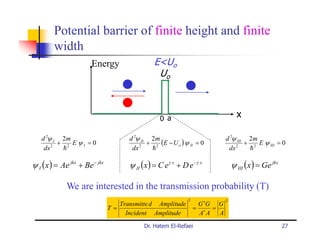
             We are interested in the transmission probability (T)
                                                              2             2
                                   Transmitte d Amplitude          G ∗G G
                                T=                                = ∗ =
                                     Incident Amplitude            A A  A
 hatem@oilpeakinarabic.org                  Dr. Hatem El-Refaei                                        27
Potential barrier of finite height and finite
        width
                        Energy                   E<Uo
                                                  Uo


                                                   0 a                        x

   d 2ψ I 2m                           d 2ψ II 2m                         d 2ψ III 2m
         + 2 EψI = 0                          + 2 (E − U o ) ψ II = 0             + 2 E ψ III = 0
    dx 2  h                             dx 2   h                           dx 2    h

ψ I ( x ) = Ae jkx + Be − jkx          ψ II (x ) = C eγ x + D e −γ x       ψ III ( x ) = Ge jkx

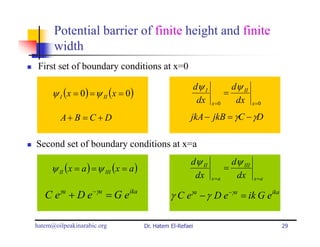
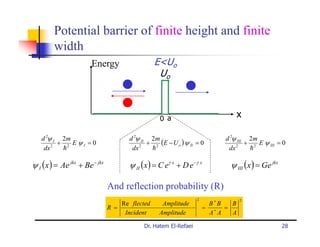
                                And reflection probability (R)
                                                                  2             2
                                    Re flected      Amplitude          B ∗B B
                                R =                                   = ∗ =
                                     Incident      Amplitude           A A  A

 hatem@oilpeakinarabic.org                  Dr. Hatem El-Refaei                                   28
Potential barrier of finite height and finite
      width
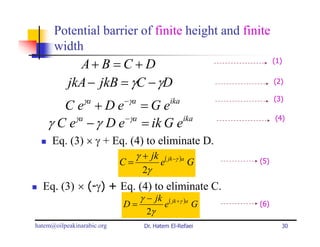
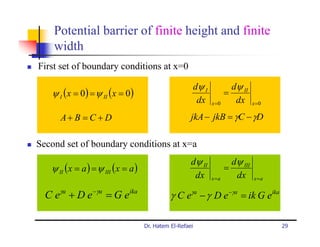
 First set of boundary conditions at x=0

                                                            dψ I            dψ II
     ψ I (x = 0) = ψ II (x = 0)                                           =
                                                             dx    x =0      dx      x =0

        A+ B = C + D                                    jkA − jkB = γC − γD

Second set of boundary conditions at x=a
                                                        dψ II               dψ III
     ψ II (x = a ) = ψ III (x = a )                                       =
                                                         dx        x =a      dx      x =a


   C eγa + D e −γa = G eika                     γ C eγa − γ D e −γa = ik G eika

hatem@oilpeakinarabic.org             Dr. Hatem El-Refaei                                   29
Potential barrier of finite height and finite
      width
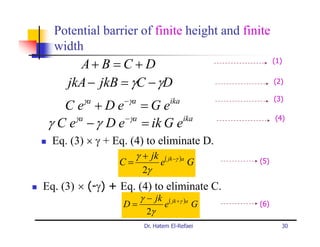
             A+ B = C + D                                      (1)


           jkA − jkB = γC − γD                                 (2)

                γa           −γa                               (3)
       C e +De =Ge                           ika

    γ C eγa − γ D e −γa = ik G eika                            (4)


     Eq. (3) × γ + Eq. (4) to eliminate D.
                               γ + jk ( jk −γ )a
                            C=       e           G       (5)
                                 2γ
  Eq. (3) × (-γ) + Eq. (4) to eliminate C.
                                γ − jk ( jk +γ )a
                             D=       e           G      (6)
                                  2γ
hatem@oilpeakinarabic.org          Dr. Hatem El-Refaei           30
Potential barrier of finite height and finite
      width
             A+ B = C + D                                                 (1)


           jkA − jkB = γC − γD                                            (2)

                γa            −γa                                         (3)
       C e +De =Ge                            ika

    γ C eγa − γ D e −γa = ik G eika                                       (4)

     Eq. (1) × jk + Eq. (2) to eliminate B
                     2 jkA = ( jk + γ )C + ( jk − γ ) D             (7)

 Substitute from eq. (5) and (6) into (7), we get an equation of A
 and G only.

     2 jkA =
              1
             2γ
                     [                                       ]
                (γ + jk )2 e( jk −γ )a − (γ − jk )2 e( jk +γ )a G           (8)

hatem@oilpeakinarabic.org           Dr. Hatem El-Refaei                     31
Transmission and Reflection Coefficients
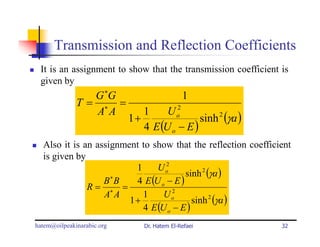
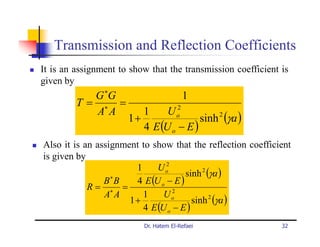
 It is an assignment to show that the transmission coefficient is
 given by
                G ∗G                            1
              T= ∗ =                        2
                AA             1     U
                            1+              o
                                              sinh 2 (γa )
                               4 E (U o − E )
  Also it is an assignment to show that the reflection coefficient
  is given by
                         1     U o2
                                        sinh 2 (γa )
                  B∗ B   4 E (U o − E )
              R= ∗ =
                  AA       1     U o2
                        1+                sinh 2 (γa )
                           4 E (U o − E )
hatem@oilpeakinarabic.org       Dr. Hatem El-Refaei            32
Transmission and Reflection Coefficients
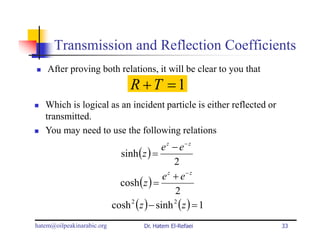
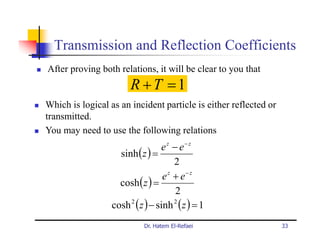
    After proving both relations, it will be clear to you that
                                  R +T =1
   Which is logical as an incident particle is either reflected or
   transmitted.
   You may need to use the following relations
                                            e z − e− z
                              sinh ( z ) =
                                                 2
                                             e z + e− z
                              cosh ( z ) =
                                                 2
                            cosh 2 ( z ) − sinh 2 ( z ) = 1
hatem@oilpeakinarabic.org             Dr. Hatem El-Refaei            33
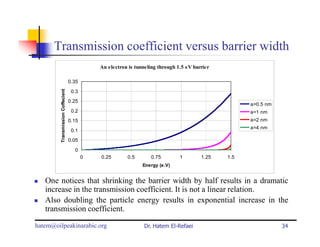
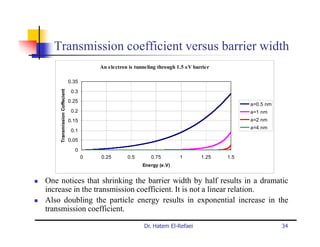
Transmission coefficient versus barrier width
                                              An electron is tunneling through 1.5 eV barrier

                                   0.35
         Transmission Coffecient


                                    0.3
                                   0.25
                                                                                                      a=0.5 nm
                                    0.2                                                               a=1 nm
                                   0.15                                                               a=2 nm
                                                                                                      a=4 nm
                                    0.1
                                   0.05

                                     0
                                          0   0.25       0.5       0.75         1        1.25   1.5
                                                                Energy (e.V)


   One notices that shrinking the barrier width by half results in a dramatic
   increase in the transmission coefficient. It is not a linear relation.
   Also doubling the particle energy results in exponential increase in the
   transmission coefficient.

hatem@oilpeakinarabic.org                                        Dr. Hatem El-Refaei                             34
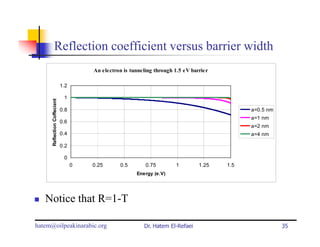
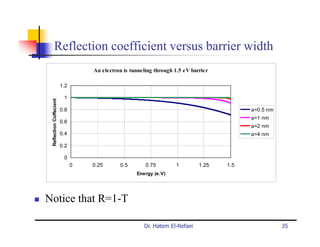
Reflection coefficient versus barrier width
                                        An electron is tunneling through 1.5 eV barrier

                              1.2

                               1
      Reflection Coffecient


                              0.8                                                               a=0.5 nm
                                                                                                a=1 nm
                              0.6
                                                                                                a=2 nm
                              0.4                                                               a=4 nm

                              0.2

                               0
                                    0   0.25      0.5        0.75        1         1.25   1.5
                                                         Energy (e.V)


   Notice that R=1-T

hatem@oilpeakinarabic.org                                   Dr. Hatem El-Refaei                            35
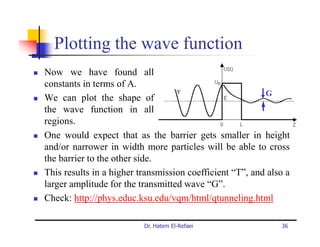
Plotting the wave function
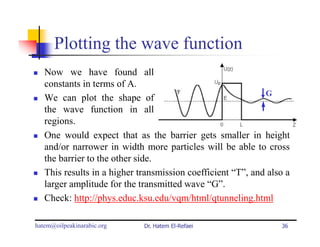
   Now we have found all
   constants in terms of A.
                                                             G
   We can plot the shape of
   the wave function in all
   regions.
   One would expect that as the barrier gets smaller in height
   and/or narrower in width more particles will be able to cross
   the barrier to the other side.
   This results in a higher transmission coefficient “T”, and also a
   larger amplitude for the transmitted wave “G”.
   Check: http://phys.educ.ksu.edu/vqm/html/qtunneling.html

hatem@oilpeakinarabic.org    Dr. Hatem El-Refaei                 36
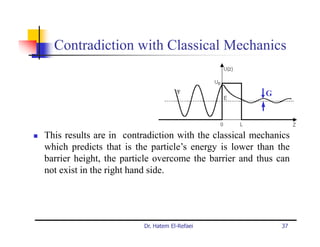
Contradiction with Classical Mechanics


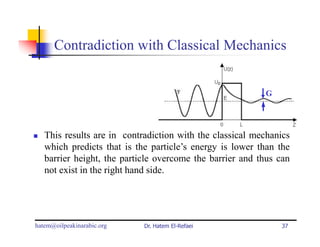
                                                          G


   This results are in contradiction with the classical mechanics
   which predicts that is the particle’s energy is lower than the
   barrier height, the particle overcome the barrier and thus can
   not exist in the right hand side.


hatem@oilpeakinarabic.org   Dr. Hatem El-Refaei               37
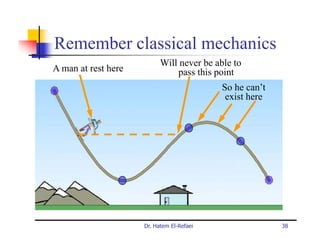
Remember classical mechanics
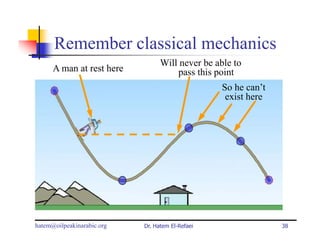
                                  Will never be able to
      A man at rest here              pass this point
                                                  So he can’t
                                                   exist here


hatem@oilpeakinarabic.org   Dr. Hatem El-Refaei                 38
Ain Shams University
Mathematics and Engineering Physics Department


            1st Year Electrical Engineering


                      Lecture 11
     Modern Physics and Quantum Mechanics Course


                 Dr. Hatem El-Refaei
Contents
Infinite barrier
Finite barrier
Quantum tunnelling


              Dr. Hatem El-Refaei   1
Note
All problems today are unbounded problem, i.e. the
particle is not confined in a certain region, so:
   We will not be able to do the normalization condition.
   Therefore, we will not be able to solve for all unknowns.
   Therefore, we will not get a characteristic equation.
   Therefore, energy levels are not quantized, and all energies
   are possible.
But still there are a lot of important characteristics to
understand and learn today.


                        Dr. Hatem El-Refaei                  2
Infinite barrier


     Dr. Hatem El-Refaei   3
Potential step of infinite height and infinite width

        Energy
                                               ∞


                          ∞
                  E

                                                   x
Since the barrier height is infinite, incident particles can’t
penetrate through it, and particles reflect back.
So, there is zero probability of finding the particle inside
the step barrier.
Here, the QM solution leads to the same classical solution.

                         Dr. Hatem El-Refaei                     4
Potential step of infinite height and infinite
       width

                 Energy, ψ
                                                                      ∞


                                                 ∞
       2mE
 k=
        h                          E

                                                                            x
         d ψ I 2m
           2                                            0
             2
               + 2 E ψI = 0
          dx    h
                                                                       U =∞
      ψ ( x ) = Ae      jkx
                              + Be   − jkx

                        E 
                 j  kx − t 
                                                E 
                                       j  − kx − t                  ψ (x ) = 0
Ψ (x, t ) = Ae          h 
                                + Be            h 


      Forward                    Backward
  propagating wave            propagating wave
                                                Dr. Hatem El-Refaei                5
Potential step of infinite height and infinite
     width

            Energy, ψ
                                                             ∞


                                        ∞
      2mE
k=                          E
       h
                                                                   x
      d ψ I 2m
        2                                   0
          2
            + 2 E ψI = 0
       dx    h
                                                              U =∞
 ψ ( x ) = Ae     jkx
                        + Be   − jkx


     ψ (x = 0 − ) = ψ (x = 0 + )                             ψ (x ) = 0
            A+ B = 0

                                       Dr. Hatem El-Refaei                6
Potential step of infinite height and infinite
 width

         Energy, ψ
                                                     ∞


                                ∞
    Sin(x)            E

                                                           x
   d ψ I 2m
     2                              0
       2
         + 2 E ψI = 0
    dx    h
             B = −A                                   U =∞
ψ (x ) = Ae jkx − Ae − jkx                           ψ (x ) = 0
ψ (x ) = A(e jkx − e − jkx )
  ψ ( x ) = 2 jA sin (kx )
                               Dr. Hatem El-Refaei                7
Potential step of infinite height and infinite
width

     Energy, ψ
                                             ∞


                        ∞
 Sin(x)          E

                                                 x
                            0
                     B = −A
                                                     2
                            Re flected Amplitude          B∗B
  Reflectivity           R=                              = ∗ =1
                             Incident Amplitude           A A

 All the incident particle stream is reflected back.
                       Dr. Hatem El-Refaei                    8
Potential step of infinite height and infinite
     width
          Energy, ψ
                                                        ∞


                                   ∞
     Sin(x)              E

                                                               x
                                       0
Since the barrier extends to infinity in the x direction, no particle can penetrate
through the whole barrier. From phenomenological understanding, as x→∞,
ψ→0.


                                  Dr. Hatem El-Refaei                          9
Finite barrier


    Dr. Hatem El-Refaei   10
Potential step of finite height and infinite
 width
       Energy
                    E<Uo

                                           ∞
                E
                                   Uo
                                               x
                          0


As the step height Uo gets smaller (but still E<Uo),
the penetration of the particles inside the step
increases, but finally no particles will succeed to
travel through the whole step to x→∞.
                     Dr. Hatem El-Refaei               11
Potential step of finite height and infinite
      width
     2mE     Energy                                                   2m(U o − E )
k=                               E<Uo                        α=                      >0
      h                                                                   h
                                                        ∞
                        E
                                                Uo
                                                                  x
                                       0
      d 2ψ I 2m                                   d 2ψ II 2m
          2
            + 2 EψI =0                                2
                                                         + 2 (E − U o ) ψ II = 0
       dx    h                                     dx     h
 ψ I ( x ) = Ae jkx + Be − jkx                   ψ II ( x ) = C e −α x + Deα x
     We have 4 unknowns (A,B,C, and D) and 3 equations:
        Finiteness of ψ at x=∞
        Continuity of ψ at x=0
        Continuity of ∇ψ at x=0
                                  Dr. Hatem El-Refaei                              12
Potential step of finite height and infinite
      width
     2mE     Energy                                                  2m(U o − E )
k=                               E<Uo                       α=                      >0
      h                                                                  h
                                                       ∞
                       E
                                               Uo
                                                                 x
                                      0
      d 2ψ I 2m                                  d 2ψ II 2m
          2
            + 2 EψI =0                               2
                                                        + 2 (E − U o ) ψ II = 0
       dx    h                                    dx     h
 ψ I ( x ) = Ae jkx + Be − jkx                  ψ II ( x ) = C e −α x + Deα x

     The condition that ψ(x) must be finite as x→∞, leads to D=0


                                 Dr. Hatem El-Refaei                              13
Potential step of finite height and infinite
      width
     2mE     Energy                                                   2m(U o − E )
k=                               E<Uo                        α=                      >0
      h                                                                   h
                                                       ∞
                       E
                                               Uo
                                                                  x
                                      0
      d 2ψ I 2m                                  d 2ψ II 2m
          2
            + 2 EψI =0                               2
                                                        + 2 (E − U o ) ψ II = 0
       dx    h                                    dx     h
 ψ I ( x ) = Ae jkx + Be − jkx                         ψ II (x ) = C e −α x

     The condition that ψ(x) must be finite as x→∞, leads to D=0


                                 Dr. Hatem El-Refaei                              14
Potential step of finite height and infinite
      width
     2mE     Energy                                                   2m(U o − E )
k=                               E<Uo                        α=                      >0
      h                                                                   h
                                                       ∞
                       E
                                               Uo
                                                                  x
                                      0
      d 2ψ I 2m                                  d 2ψ II 2m
          2
            + 2 EψI =0                               2
                                                        + 2 (E − U o ) ψ II = 0
       dx    h                                    dx     h
 ψ I ( x ) = Ae jkx + Be − jkx                         ψ II (x ) = C e −α x
     We have 3 unknowns (A,B,C) and 2 equations:
        Continuity of ψ
        Continuity of ∇ψ
     Thus, the best we can get is the ratio between parameters.
                                 Dr. Hatem El-Refaei                              15
Potential step of finite height and infinite
      width
     2mE      Energy                                                           2m(U o − E )
k=                               E<Uo                             α=                          >0
      h                                                                            h
                                                       ∞
                         E
                                               Uo
                                                                           x
 ψ I ( x ) = Ae jkx + Be − jkx        0
                                                       ψ II (x ) = C e −α x
     Continuity of ψ                                Continuity of dψ/dx
                                                     dψ I     dψ II
 ψ I ( x = 0) = ψ II (x = 0)                                           =
                                                           dx              dx
                                                    jk ( A − B ) = −α C
                                                                x =0              x =0
        A+ B = C
          1     α                                             1     α 
     A=    1 + j  C                                  B =       1 − j  C
          2     k                                             2     k 
                                 Dr. Hatem El-Refaei                                      16
Potential step of finite height and infinite
        width
       2mE      Energy                                                      2m(U o − E )
k=                                E<Uo                         α=                          >0
        h                                                                         h

                           E

                                        0
                    1        α                       1        α 
               A=        1+ j  C             B =          1− j  C
                    2        k                       2        k 

                                                                    α          α
                                                   2    1 −
                                                           ∗     j   1 +    j 
                             Re flected Amplitude  BB            k          k
     Reflectivity         R=                      = ∗ =                           =1
                              Incident Amplitude   AA            α          α
                                                        1 +     j  1 −     j 
                                                                 k          k


                                   Dr. Hatem El-Refaei                                 17
Potential step of finite height and infinite
   width
            Energy
                                           Uo
                                                       ∞
                                                C
                                                                x
                                      0
                                    1        α  jkx 1             α  − jkx
ψ I (x ) = Ae + Be
              jkx      − jkx
                                 = 1 + j Ce + 1 − j  Ce
                                    2         k        2          k
                         e jkx + e − jkx     α  e jkx − e − jkx 
           ψ I (x ) = C 
                                          + j C
                                                                 
                                                                   
                               2              k       2         
                             α                                  
                 C cos(kx ) − C sin (kx )                 x≤0 
        ψ (x ) =             k                                  
                 C e −α x                                  x ≥ 0
                                                                
                                 Dr. Hatem El-Refaei                             18
Potential step of finite height and infinite
    width
          Energy
                                      Uo
                                                  ∞
                                           C
                                                      x
                                 0

Since the barrier height is finite, particles can penetrate partially
in the vicinity of the potential step, and then they reflect back.
So, there is a finite probability of finding the particle in the
classically forbidden position.
Here, the QM solution is different from the classical one.


                            Dr. Hatem El-Refaei                  19
Potential step of finite height and infinite
 width
      Energy
                 E<Uo                      Case 3            2m(U o − E )
                                                    α=                      >0
                                           Case 2                h


                                       Case 2   ψ ( x ) = C e −α x
                                                         x
                          0
                                  Case 3

As the potential barrier height increases (Uo
increases) (from case 2 to case 3), α also increases,
and thus the exponential function dies quicker inside
the barrier. Thus it becomes less probable to find the
particle inside the barrier.
                     Dr. Hatem El-Refaei                                20
Potential step of finite height and infinite
    width
           Energy
                      E<Uo                               2m(U o − E )
                                                α=                      >0
                                                             h


                                               ψ ( x ) = C e −α x
                                                     x
                                0
If the barrier height (Uo) is kept constant, but the particle
energy increases (provided E<Uo), thus α decreases, and
the particle exponential function dies slower inside the
barrier. Hence, it becomes more probable to find the
particle in the vicinity of the barrier edge.
                         Dr. Hatem El-Refaei                       21
Tunneling through a potential
           barrier


           Dr. Hatem El-Refaei   22
Potential barrier of finite height and finite
    width
              Energy           E<Uo
                                Uo
                       E

                                                     x


A stream of particles incident on a finite width and height
potential barrier with E<Uo.
Part of the incident stream will succeed to penetrate through the
barrier and appear on the other side, this is the transmitted stream.
The other part will reflect back forming the reflected stream.
Note, a single particle doesn’t split into two.
                            Dr. Hatem El-Refaei                  23
Potential barrier of finite height and finite
        width
                        Energy            E<Uo
        2mE                                Uo                                2m(U o − E )
k=                                                                   γ=                         >0
         h                                                                         h


                                             0 a                         x

   d 2ψ I 2m                     d 2ψ II 2m                          d 2ψ III 2m
         + 2 EψI = 0                    + 2 (E − U o ) ψ II = 0              + 2 E ψ III = 0
    dx 2  h                       dx 2   h                            dx 2    h

ψ I ( x ) = Ae jkx + Be − jkx    ψ II (x ) = C eγ x + D e −γ x    ψ III (x ) = Ge jkx + Fe − jkx
We have 6 unknowns (A,B,C,D,G,F) and 5 boundary conditions
     Continuity of ψ and ∇ψ at x=0.
     Continuity of ψ and ∇ψ at x=a.
     Only a forward propagating wave on the right hand side of the barrier.
                                      Dr. Hatem El-Refaei                                  24
Potential barrier of finite height and finite
        width
                        Energy            E<Uo
                                           Uo


                                             0 a                         x

   d 2ψ I 2m                     d 2ψ II 2m                          d 2ψ III 2m
         + 2 EψI = 0                    + 2 (E − U o ) ψ II = 0              + 2 E ψ III = 0
    dx 2  h                       dx 2   h                            dx 2    h

ψ I ( x ) = Ae jkx + Be − jkx    ψ II (x ) = C eγ x + D e −γ x    ψ III (x ) = Ge jkx + Fe − jkx
We have 6 unknowns (A,B,C,D,G,F) and 5 boundary conditions
     Continuity of ψ and ∇ψ at x=0.
     Continuity of ψ and ∇ψ at x=a.
     Only a forward propagating wave on the right hand side of the barrier.
                                      Dr. Hatem El-Refaei                                  25
Potential barrier of finite height and finite
        width
                        Energy            E<Uo
                                           Uo


                                             0 a                      x

   d 2ψ I 2m                     d 2ψ II 2m                       d 2ψ III 2m
         + 2 EψI = 0                    + 2 (E − U o ) ψ II = 0           + 2 E ψ III = 0
    dx 2  h                       dx 2   h                         dx 2    h

ψ I ( x ) = Ae jkx + Be − jkx    ψ II (x ) = C eγ x + D e −γ x     ψ III ( x ) = Ge jkx
  We have 5 unknowns (A,B,C,D,G) and 4 boundary conditions
       Continuity of ψ and ∇ψ at x=0.
       Continuity of ψ and ∇ψ at x=a.

                                      Dr. Hatem El-Refaei                                 26
Potential barrier of finite height and finite
        width
                        Energy                  E<Uo
                                                 Uo


                                                   0 a                            x

   d 2ψ I 2m                           d 2ψ II 2m                           d 2ψ III 2m
         + 2 EψI = 0                          + 2 (E − U o ) ψ II = 0               + 2 E ψ III = 0
    dx 2  h                             dx 2   h                             dx 2    h

ψ I ( x ) = Ae jkx + Be − jkx          ψ II (x ) = C eγ x + D e −γ x            ψ III ( x ) = Ge jkx

             We are interested in the transmission probability (T)
                                                              2             2
                                   Transmitte d Amplitude          G ∗G G
                                T=                                = ∗ =
                                     Incident Amplitude            A A  A

                                            Dr. Hatem El-Refaei                                        27
Potential barrier of finite height and finite
        width
                        Energy                   E<Uo
                                                  Uo


                                                   0 a                        x

   d 2ψ I 2m                           d 2ψ II 2m                         d 2ψ III 2m
         + 2 EψI = 0                          + 2 (E − U o ) ψ II = 0             + 2 E ψ III = 0
    dx 2  h                             dx 2   h                           dx 2    h

ψ I ( x ) = Ae jkx + Be − jkx          ψ II (x ) = C eγ x + D e −γ x       ψ III ( x ) = Ge jkx

                                And reflection probability (R)
                                                                  2             2
                                    Re flected      Amplitude          B ∗B B
                                R =                                   = ∗ =
                                     Incident      Amplitude           A A  A

                                            Dr. Hatem El-Refaei                                   28
Potential barrier of finite height and finite
    width
First set of boundary conditions at x=0

                                                          dψ I            dψ II
   ψ I (x = 0) = ψ II (x = 0)                                           =
                                                           dx    x =0      dx      x =0

      A+ B = C + D                                    jkA − jkB = γC − γD

Second set of boundary conditions at x=a
                                                      dψ II               dψ III
   ψ II (x = a ) = ψ III (x = a )                                       =
                                                       dx        x =a      dx      x =a


  C eγa + D e −γa = G eika                    γ C eγa − γ D e −γa = ik G eika

                                    Dr. Hatem El-Refaei                                   29
Potential barrier of finite height and finite
  width
       A+ B = C + D                                 (1)


     jkA − jkB = γC − γD                            (2)

         γa       −γa                               (3)
    C e +De =Ge                   ika

      γa      − γa
 γ C e − γ D e = ik G e ika                         (4)


  Eq. (3) × γ + Eq. (4) to eliminate D.
                    γ + jk ( jk −γ )a
                 C=       e           G       (5)
                      2γ
Eq. (3) × (-γ) + Eq. (4) to eliminate C.
                     γ − jk ( jk +γ )a
                  D=       e           G      (6)
                       2γ
                        Dr. Hatem El-Refaei           30
Potential barrier of finite height and finite
    width
          A+ B = C + D                                                  (1)


        jkA − jkB = γC − γD                                             (2)

              γa            −γa                                         (3)
     C e +De =Ge                            ika

       γa      − γa
  γ C e − γ D e = ik G e ika                                            (4)

   Eq. (1) × jk + Eq. (2) to eliminate B
                   2 jkA = ( jk + γ )C + ( jk − γ ) D             (7)

Substitute from eq. (5) and (6) into (7), we get an equation of A
and G only.

   2 jkA =
            1
           2γ
                   [                                       ]
              (γ + jk )2 e( jk −γ )a − (γ − jk )2 e( jk +γ )a G           (8)

                                  Dr. Hatem El-Refaei                     31
Transmission and Reflection Coefficients
It is an assignment to show that the transmission coefficient is
given by
           G ∗G                           1
         T= ∗ =                       2
           AA            1     U
                      1+              o
                                        sinh 2 (γa )
                         4 E (U o − E )
Also it is an assignment to show that the reflection coefficient
is given by
                       1     U o2
                                      sinh 2 (γa )
                B∗ B   4 E (U o − E )
            R= ∗ =
                AA       1     U o2
                      1+                sinh 2 (γa )
                         4 E (U o − E )
                          Dr. Hatem El-Refaei                 32
Transmission and Reflection Coefficients
After proving both relations, it will be clear to you that
                        R +T =1
Which is logical as an incident particle is either reflected or
transmitted.
You may need to use the following relations
                                  e z − e− z
                    sinh ( z ) =
                                       2
                                   e z + e− z
                    cosh ( z ) =
                                       2
                  cosh 2 ( z ) − sinh 2 ( z ) = 1
                            Dr. Hatem El-Refaei                   33
Transmission coefficient versus barrier width
                                         An electron is tunneling through 1.5 eV barrier

                              0.35
    Transmission Coffecient


                               0.3
                              0.25
                                                                                                 a=0.5 nm
                               0.2                                                               a=1 nm
                              0.15                                                               a=2 nm
                                                                                                 a=4 nm
                               0.1
                              0.05

                                0
                                     0   0.25       0.5       0.75         1        1.25   1.5
                                                           Energy (e.V)


One notices that shrinking the barrier width by half results in a dramatic
increase in the transmission coefficient. It is not a linear relation.
Also doubling the particle energy results in exponential increase in the
transmission coefficient.

                                                            Dr. Hatem El-Refaei                             34
Reflection coefficient versus barrier width
                                   An electron is tunneling through 1.5 eV barrier

                         1.2

                          1
 Reflection Coffecient


                         0.8                                                               a=0.5 nm
                                                                                           a=1 nm
                         0.6
                                                                                           a=2 nm
                         0.4                                                               a=4 nm

                         0.2

                          0
                               0   0.25      0.5        0.75        1         1.25   1.5
                                                    Energy (e.V)


Notice that R=1-T

                                                       Dr. Hatem El-Refaei                            35
Plotting the wave function
Now we have found all
constants in terms of A.
                                                          G
We can plot the shape of
the wave function in all
regions.
One would expect that as the barrier gets smaller in height
and/or narrower in width more particles will be able to cross
the barrier to the other side.
This results in a higher transmission coefficient “T”, and also a
larger amplitude for the transmitted wave “G”.
Check: http://phys.educ.ksu.edu/vqm/html/qtunneling.html

                          Dr. Hatem El-Refaei                 36
Contradiction with Classical Mechanics


                                                       G


This results are in contradiction with the classical mechanics
which predicts that is the particle’s energy is lower than the
barrier height, the particle overcome the barrier and thus can
not exist in the right hand side.


                         Dr. Hatem El-Refaei               37
Remember classical mechanics
                           Will never be able to
A man at rest here             pass this point
                                           So he can’t
                                            exist here


                     Dr. Hatem El-Refaei                 38

Physics barriers and tunneling

  • 1.
    Ain Shams University Mathematicsand Engineering Physics Department Pre-Junior Communication Systems Engineering Students Lecture 11 Modern Physics and Quantum Mechanics Course (EPHS 240) 9 December 2009 Dr. Hatem El-Refaei
  • 2.
    Contents Infinite barrier Finite barrier Quantum tunnelling hatem@oilpeakinarabic.org Dr. Hatem El-Refaei 1
  • 3.
    Note All problems today are unbounded problem, i.e. the particle is not confined in a certain region, so: We will not be able to do the normalization condition. Therefore, we will not be able to solve for all unknowns. Therefore, we will not get a characteristic equation. Therefore, energy levels are not quantized, and all energies are possible. But still there are a lot of important characteristics to understand and learn today. hatem@oilpeakinarabic.org Dr. Hatem El-Refaei 2
  • 4.
  • 5.
    Potential step ofinfinite height and infinite width Energy ∞ ∞ E x Since the barrier height is infinite, incident particles can’t penetrate through it, and particles reflect back. So, there is zero probability of finding the particle inside the step barrier. Here, the QM solution leads to the same classical solution. hatem@oilpeakinarabic.org Dr. Hatem El-Refaei 4
  • 6.
    Potential step ofinfinite height and infinite width Energy, ψ ∞ ∞ 2mE k= h E x d ψ I 2m 2 0 2 + 2 E ψI = 0 dx h U =∞ ψ ( x ) = Ae jkx + Be − jkx  E  j  kx − t   E  j  − kx − t  ψ (x ) = 0 Ψ (x, t ) = Ae  h  + Be  h  Forward Backward propagating wave propagating wave hatem@oilpeakinarabic.org Dr. Hatem El-Refaei 5
  • 7.
    Potential step ofinfinite height and infinite width Energy, ψ ∞ ∞ 2mE k= E h x d ψ I 2m 2 0 2 + 2 E ψI = 0 dx h U =∞ ψ ( x ) = Ae jkx + Be − jkx ψ (x = 0 − ) = ψ (x = 0 + ) ψ (x ) = 0 A+ B = 0 hatem@oilpeakinarabic.org Dr. Hatem El-Refaei 6
  • 8.
    Potential step ofinfinite height and infinite width Energy, ψ ∞ ∞ Sin(x) E x d ψ I 2m 2 0 2 + 2 E ψI = 0 dx h B = −A U =∞ ψ (x ) = Ae jkx − Ae − jkx ψ (x ) = 0 ψ (x ) = A(e jkx − e − jkx ) ψ ( x ) = 2 jA sin (kx ) hatem@oilpeakinarabic.org Dr. Hatem El-Refaei 7
  • 9.
    Potential step ofinfinite height and infinite width Energy, ψ ∞ ∞ Sin(x) E x 0 B = −A 2 Re flected Amplitude B∗B Reflectivity R= = ∗ =1 Incident Amplitude A A All the incident particle stream is reflected back. hatem@oilpeakinarabic.org Dr. Hatem El-Refaei 8
  • 10.
    Potential step ofinfinite height and infinite width Energy, ψ ∞ ∞ Sin(x) E x 0 Since the barrier extends to infinity in the x direction, no particle can penetrate through the whole barrier. From phenomenological understanding, as x→∞, ψ→0. hatem@oilpeakinarabic.org Dr. Hatem El-Refaei 9
  • 11.
  • 12.
    Potential step offinite height and infinite width Energy E<Uo ∞ E Uo x 0 As the step height Uo gets smaller (but still E<Uo), the penetration of the particles inside the step increases, but finally no particles will succeed to travel through the whole step to x→∞. hatem@oilpeakinarabic.org Dr. Hatem El-Refaei 11
  • 13.
    Potential step offinite height and infinite width 2mE Energy 2m(U o − E ) k= E<Uo α= >0 h h ∞ E Uo x 0 d 2ψ I 2m d 2ψ II 2m 2 + 2 EψI =0 2 + 2 (E − U o ) ψ II = 0 dx h dx h ψ I ( x ) = Ae jkx + Be − jkx ψ II ( x ) = C e −α x + Deα x We have 4 unknowns (A,B,C, and D) and 3 equations: Finiteness of ψ at x=∞ Continuity of ψ at x=0 Continuity of ∇ψ at x=0 hatem@oilpeakinarabic.org Dr. Hatem El-Refaei 12
  • 14.
    Potential step offinite height and infinite width 2mE Energy 2m(U o − E ) k= E<Uo α= >0 h h ∞ E Uo x 0 d 2ψ I 2m d 2ψ II 2m 2 + 2 EψI =0 2 + 2 (E − U o ) ψ II = 0 dx h dx h ψ I ( x ) = Ae jkx + Be − jkx ψ II ( x ) = C e −α x + Deα x The condition that ψ(x) must be finite as x→∞, leads to D=0 hatem@oilpeakinarabic.org Dr. Hatem El-Refaei 13
  • 15.
    Potential step offinite height and infinite width 2mE Energy 2m(U o − E ) k= E<Uo α= >0 h h ∞ E Uo x 0 d 2ψ I 2m d 2ψ II 2m 2 + 2 EψI =0 2 + 2 (E − U o ) ψ II = 0 dx h dx h ψ I ( x ) = Ae jkx + Be − jkx ψ II (x ) = C e −α x The condition that ψ(x) must be finite as x→∞, leads to D=0 hatem@oilpeakinarabic.org Dr. Hatem El-Refaei 14
  • 16.
    Potential step offinite height and infinite width 2mE Energy 2m(U o − E ) k= E<Uo α= >0 h h ∞ E Uo x 0 d 2ψ I 2m d 2ψ II 2m 2 + 2 EψI =0 2 + 2 (E − U o ) ψ II = 0 dx h dx h ψ I ( x ) = Ae jkx + Be − jkx ψ II (x ) = C e −α x We have 3 unknowns (A,B,C) and 2 equations: Continuity of ψ Continuity of ∇ψ Thus, the best we can get is the ratio between parameters. hatem@oilpeakinarabic.org Dr. Hatem El-Refaei 15
  • 17.
    Potential step offinite height and infinite width 2mE Energy 2m(U o − E ) k= E<Uo α= >0 h h ∞ E Uo x ψ I ( x ) = Ae jkx + Be − jkx 0 ψ II (x ) = C e −α x Continuity of ψ Continuity of dψ/dx dψ I dψ II ψ I ( x = 0) = ψ II (x = 0) = dx dx jk ( A − B ) = −α C x =0 x =0 A+ B = C 1 α  1 α  A= 1 + j  C B = 1 − j  C 2 k  2 k  hatem@oilpeakinarabic.org Dr. Hatem El-Refaei 16
  • 18.
    Potential step offinite height and infinite width 2mE Energy 2m(U o − E ) k= E<Uo α= >0 h h E 0 1  α  1  α  A=  1+ j  C B =  1− j  C 2  k  2  k   α  α 2 1 − ∗ j  1 + j  Re flected Amplitude BB  k  k Reflectivity R= = ∗ = =1 Incident Amplitude AA  α  α 1 + j  1 − j   k  k hatem@oilpeakinarabic.org Dr. Hatem El-Refaei 17
  • 19.
    Potential step offinite height and infinite width Energy Uo ∞ C x 0 1 α  jkx 1  α  − jkx ψ I (x ) = Ae + Be jkx − jkx = 1 + j Ce + 1 − j  Ce 2 k 2 k  e jkx + e − jkx  α  e jkx − e − jkx  ψ I (x ) = C    + j C      2  k  2   α  C cos(kx ) − C sin (kx ) x≤0  ψ (x ) =  k  C e −α x x ≥ 0   hatem@oilpeakinarabic.org Dr. Hatem El-Refaei 18
  • 20.
    Potential step offinite height and infinite width Energy Uo ∞ C x 0 Since the barrier height is finite, particles can penetrate partially in the vicinity of the potential step, and then they reflect back. So, there is a finite probability of finding the particle in the classically forbidden position. Here, the QM solution is different from the classical one. hatem@oilpeakinarabic.org Dr. Hatem El-Refaei 19
  • 21.
    Potential step offinite height and infinite width Energy E<Uo Case 3 2m(U o − E ) α= >0 Case 2 h Case 2 ψ ( x ) = C e −α x x 0 Case 3 As the potential barrier height increases (Uo increases) (from case 2 to case 3), α also increases, and thus the exponential function dies quicker inside the barrier. Thus it becomes less probable to find the particle inside the barrier. hatem@oilpeakinarabic.org Dr. Hatem El-Refaei 20
  • 22.
    Potential step offinite height and infinite width Energy E<Uo 2m(U o − E ) α= >0 h ψ ( x ) = C e −α x x 0 If the barrier height (Uo) is kept constant, but the particle energy increases (provided E<Uo), thus α decreases, and the particle exponential function dies slower inside the barrier. Hence, it becomes more probable to find the particle in the vicinity of the barrier edge. hatem@oilpeakinarabic.org Dr. Hatem El-Refaei 21
  • 23.
    Tunneling through apotential barrier hatem@oilpeakinarabic.org Dr. Hatem El-Refaei 22
  • 24.
    Potential barrier offinite height and finite width Energy E<Uo Uo E x A stream of particles incident on a finite width and height potential barrier with E<Uo. Part of the incident stream will succeed to penetrate through the barrier and appear on the other side, this is the transmitted stream. The other part will reflect back forming the reflected stream. Note, a single particle doesn’t split into two. hatem@oilpeakinarabic.org Dr. Hatem El-Refaei 23
  • 25.
    Potential barrier offinite height and finite width Energy E<Uo 2mE Uo 2m(U o − E ) k= γ= >0 h h 0 a x d 2ψ I 2m d 2ψ II 2m d 2ψ III 2m + 2 EψI = 0 + 2 (E − U o ) ψ II = 0 + 2 E ψ III = 0 dx 2 h dx 2 h dx 2 h ψ I ( x ) = Ae jkx + Be − jkx ψ II (x ) = C eγ x + D e −γ x ψ III (x ) = Ge jkx + Fe − jkx We have 6 unknowns (A,B,C,D,G,F) and 5 boundary conditions Continuity of ψ and ∇ψ at x=0. Continuity of ψ and ∇ψ at x=a. Only a forward propagating wave on the right hand side of the barrier. hatem@oilpeakinarabic.org Dr. Hatem El-Refaei 24
  • 26.
    Potential barrier offinite height and finite width Energy E<Uo Uo 0 a x d 2ψ I 2m d 2ψ II 2m d 2ψ III 2m + 2 EψI = 0 + 2 (E − U o ) ψ II = 0 + 2 E ψ III = 0 dx 2 h dx 2 h dx 2 h ψ I ( x ) = Ae jkx + Be − jkx ψ II (x ) = C eγ x + D e −γ x ψ III (x ) = Ge jkx + Fe − jkx We have 6 unknowns (A,B,C,D,G,F) and 5 boundary conditions Continuity of ψ and ∇ψ at x=0. Continuity of ψ and ∇ψ at x=a. Only a forward propagating wave on the right hand side of the barrier. hatem@oilpeakinarabic.org Dr. Hatem El-Refaei 25
  • 27.
    Potential barrier offinite height and finite width Energy E<Uo Uo 0 a x d 2ψ I 2m d 2ψ II 2m d 2ψ III 2m + 2 EψI = 0 + 2 (E − U o ) ψ II = 0 + 2 E ψ III = 0 dx 2 h dx 2 h dx 2 h ψ I ( x ) = Ae jkx + Be − jkx ψ II (x ) = C eγ x + D e −γ x ψ III ( x ) = Ge jkx We have 5 unknowns (A,B,C,D,G) and 4 boundary conditions Continuity of ψ and ∇ψ at x=0. Continuity of ψ and ∇ψ at x=a. hatem@oilpeakinarabic.org Dr. Hatem El-Refaei 26
  • 28.
    Potential barrier offinite height and finite width Energy E<Uo Uo 0 a x d 2ψ I 2m d 2ψ II 2m d 2ψ III 2m + 2 EψI = 0 + 2 (E − U o ) ψ II = 0 + 2 E ψ III = 0 dx 2 h dx 2 h dx 2 h ψ I ( x ) = Ae jkx + Be − jkx ψ II (x ) = C eγ x + D e −γ x ψ III ( x ) = Ge jkx We are interested in the transmission probability (T) 2 2 Transmitte d Amplitude G ∗G G T= = ∗ = Incident Amplitude A A A hatem@oilpeakinarabic.org Dr. Hatem El-Refaei 27
  • 29.
    Potential barrier offinite height and finite width Energy E<Uo Uo 0 a x d 2ψ I 2m d 2ψ II 2m d 2ψ III 2m + 2 EψI = 0 + 2 (E − U o ) ψ II = 0 + 2 E ψ III = 0 dx 2 h dx 2 h dx 2 h ψ I ( x ) = Ae jkx + Be − jkx ψ II (x ) = C eγ x + D e −γ x ψ III ( x ) = Ge jkx And reflection probability (R) 2 2 Re flected Amplitude B ∗B B R = = ∗ = Incident Amplitude A A A hatem@oilpeakinarabic.org Dr. Hatem El-Refaei 28
  • 30.
    Potential barrier offinite height and finite width First set of boundary conditions at x=0 dψ I dψ II ψ I (x = 0) = ψ II (x = 0) = dx x =0 dx x =0 A+ B = C + D jkA − jkB = γC − γD Second set of boundary conditions at x=a dψ II dψ III ψ II (x = a ) = ψ III (x = a ) = dx x =a dx x =a C eγa + D e −γa = G eika γ C eγa − γ D e −γa = ik G eika hatem@oilpeakinarabic.org Dr. Hatem El-Refaei 29
  • 31.
    Potential barrier offinite height and finite width A+ B = C + D (1) jkA − jkB = γC − γD (2) γa −γa (3) C e +De =Ge ika γ C eγa − γ D e −γa = ik G eika (4) Eq. (3) × γ + Eq. (4) to eliminate D. γ + jk ( jk −γ )a C= e G (5) 2γ Eq. (3) × (-γ) + Eq. (4) to eliminate C. γ − jk ( jk +γ )a D= e G (6) 2γ hatem@oilpeakinarabic.org Dr. Hatem El-Refaei 30
  • 32.
    Potential barrier offinite height and finite width A+ B = C + D (1) jkA − jkB = γC − γD (2) γa −γa (3) C e +De =Ge ika γ C eγa − γ D e −γa = ik G eika (4) Eq. (1) × jk + Eq. (2) to eliminate B 2 jkA = ( jk + γ )C + ( jk − γ ) D (7) Substitute from eq. (5) and (6) into (7), we get an equation of A and G only. 2 jkA = 1 2γ [ ] (γ + jk )2 e( jk −γ )a − (γ − jk )2 e( jk +γ )a G (8) hatem@oilpeakinarabic.org Dr. Hatem El-Refaei 31
  • 33.
    Transmission and ReflectionCoefficients It is an assignment to show that the transmission coefficient is given by G ∗G 1 T= ∗ = 2 AA 1 U 1+ o sinh 2 (γa ) 4 E (U o − E ) Also it is an assignment to show that the reflection coefficient is given by 1 U o2 sinh 2 (γa ) B∗ B 4 E (U o − E ) R= ∗ = AA 1 U o2 1+ sinh 2 (γa ) 4 E (U o − E ) hatem@oilpeakinarabic.org Dr. Hatem El-Refaei 32
  • 34.
    Transmission and ReflectionCoefficients After proving both relations, it will be clear to you that R +T =1 Which is logical as an incident particle is either reflected or transmitted. You may need to use the following relations e z − e− z sinh ( z ) = 2 e z + e− z cosh ( z ) = 2 cosh 2 ( z ) − sinh 2 ( z ) = 1 hatem@oilpeakinarabic.org Dr. Hatem El-Refaei 33
  • 35.
    Transmission coefficient versusbarrier width An electron is tunneling through 1.5 eV barrier 0.35 Transmission Coffecient 0.3 0.25 a=0.5 nm 0.2 a=1 nm 0.15 a=2 nm a=4 nm 0.1 0.05 0 0 0.25 0.5 0.75 1 1.25 1.5 Energy (e.V) One notices that shrinking the barrier width by half results in a dramatic increase in the transmission coefficient. It is not a linear relation. Also doubling the particle energy results in exponential increase in the transmission coefficient. hatem@oilpeakinarabic.org Dr. Hatem El-Refaei 34
  • 36.
    Reflection coefficient versusbarrier width An electron is tunneling through 1.5 eV barrier 1.2 1 Reflection Coffecient 0.8 a=0.5 nm a=1 nm 0.6 a=2 nm 0.4 a=4 nm 0.2 0 0 0.25 0.5 0.75 1 1.25 1.5 Energy (e.V) Notice that R=1-T hatem@oilpeakinarabic.org Dr. Hatem El-Refaei 35
  • 37.
    Plotting the wavefunction Now we have found all constants in terms of A. G We can plot the shape of the wave function in all regions. One would expect that as the barrier gets smaller in height and/or narrower in width more particles will be able to cross the barrier to the other side. This results in a higher transmission coefficient “T”, and also a larger amplitude for the transmitted wave “G”. Check: http://phys.educ.ksu.edu/vqm/html/qtunneling.html hatem@oilpeakinarabic.org Dr. Hatem El-Refaei 36
  • 38.
    Contradiction with ClassicalMechanics G This results are in contradiction with the classical mechanics which predicts that is the particle’s energy is lower than the barrier height, the particle overcome the barrier and thus can not exist in the right hand side. hatem@oilpeakinarabic.org Dr. Hatem El-Refaei 37
  • 39.
    Remember classical mechanics Will never be able to A man at rest here pass this point So he can’t exist here hatem@oilpeakinarabic.org Dr. Hatem El-Refaei 38
  • 40.
    Ain Shams University Mathematicsand Engineering Physics Department 1st Year Electrical Engineering Lecture 11 Modern Physics and Quantum Mechanics Course Dr. Hatem El-Refaei
  • 41.
    Contents Infinite barrier Finite barrier Quantumtunnelling Dr. Hatem El-Refaei 1
  • 42.
    Note All problems todayare unbounded problem, i.e. the particle is not confined in a certain region, so: We will not be able to do the normalization condition. Therefore, we will not be able to solve for all unknowns. Therefore, we will not get a characteristic equation. Therefore, energy levels are not quantized, and all energies are possible. But still there are a lot of important characteristics to understand and learn today. Dr. Hatem El-Refaei 2
  • 43.
    Infinite barrier Dr. Hatem El-Refaei 3
  • 44.
    Potential step ofinfinite height and infinite width Energy ∞ ∞ E x Since the barrier height is infinite, incident particles can’t penetrate through it, and particles reflect back. So, there is zero probability of finding the particle inside the step barrier. Here, the QM solution leads to the same classical solution. Dr. Hatem El-Refaei 4
  • 45.
    Potential step ofinfinite height and infinite width Energy, ψ ∞ ∞ 2mE k= h E x d ψ I 2m 2 0 2 + 2 E ψI = 0 dx h U =∞ ψ ( x ) = Ae jkx + Be − jkx  E  j  kx − t   E  j  − kx − t  ψ (x ) = 0 Ψ (x, t ) = Ae  h  + Be  h  Forward Backward propagating wave propagating wave Dr. Hatem El-Refaei 5
  • 46.
    Potential step ofinfinite height and infinite width Energy, ψ ∞ ∞ 2mE k= E h x d ψ I 2m 2 0 2 + 2 E ψI = 0 dx h U =∞ ψ ( x ) = Ae jkx + Be − jkx ψ (x = 0 − ) = ψ (x = 0 + ) ψ (x ) = 0 A+ B = 0 Dr. Hatem El-Refaei 6
  • 47.
    Potential step ofinfinite height and infinite width Energy, ψ ∞ ∞ Sin(x) E x d ψ I 2m 2 0 2 + 2 E ψI = 0 dx h B = −A U =∞ ψ (x ) = Ae jkx − Ae − jkx ψ (x ) = 0 ψ (x ) = A(e jkx − e − jkx ) ψ ( x ) = 2 jA sin (kx ) Dr. Hatem El-Refaei 7
  • 48.
    Potential step ofinfinite height and infinite width Energy, ψ ∞ ∞ Sin(x) E x 0 B = −A 2 Re flected Amplitude B∗B Reflectivity R= = ∗ =1 Incident Amplitude A A All the incident particle stream is reflected back. Dr. Hatem El-Refaei 8
  • 49.
    Potential step ofinfinite height and infinite width Energy, ψ ∞ ∞ Sin(x) E x 0 Since the barrier extends to infinity in the x direction, no particle can penetrate through the whole barrier. From phenomenological understanding, as x→∞, ψ→0. Dr. Hatem El-Refaei 9
  • 50.
    Finite barrier Dr. Hatem El-Refaei 10
  • 51.
    Potential step offinite height and infinite width Energy E<Uo ∞ E Uo x 0 As the step height Uo gets smaller (but still E<Uo), the penetration of the particles inside the step increases, but finally no particles will succeed to travel through the whole step to x→∞. Dr. Hatem El-Refaei 11
  • 52.
    Potential step offinite height and infinite width 2mE Energy 2m(U o − E ) k= E<Uo α= >0 h h ∞ E Uo x 0 d 2ψ I 2m d 2ψ II 2m 2 + 2 EψI =0 2 + 2 (E − U o ) ψ II = 0 dx h dx h ψ I ( x ) = Ae jkx + Be − jkx ψ II ( x ) = C e −α x + Deα x We have 4 unknowns (A,B,C, and D) and 3 equations: Finiteness of ψ at x=∞ Continuity of ψ at x=0 Continuity of ∇ψ at x=0 Dr. Hatem El-Refaei 12
  • 53.
    Potential step offinite height and infinite width 2mE Energy 2m(U o − E ) k= E<Uo α= >0 h h ∞ E Uo x 0 d 2ψ I 2m d 2ψ II 2m 2 + 2 EψI =0 2 + 2 (E − U o ) ψ II = 0 dx h dx h ψ I ( x ) = Ae jkx + Be − jkx ψ II ( x ) = C e −α x + Deα x The condition that ψ(x) must be finite as x→∞, leads to D=0 Dr. Hatem El-Refaei 13
  • 54.
    Potential step offinite height and infinite width 2mE Energy 2m(U o − E ) k= E<Uo α= >0 h h ∞ E Uo x 0 d 2ψ I 2m d 2ψ II 2m 2 + 2 EψI =0 2 + 2 (E − U o ) ψ II = 0 dx h dx h ψ I ( x ) = Ae jkx + Be − jkx ψ II (x ) = C e −α x The condition that ψ(x) must be finite as x→∞, leads to D=0 Dr. Hatem El-Refaei 14
  • 55.
    Potential step offinite height and infinite width 2mE Energy 2m(U o − E ) k= E<Uo α= >0 h h ∞ E Uo x 0 d 2ψ I 2m d 2ψ II 2m 2 + 2 EψI =0 2 + 2 (E − U o ) ψ II = 0 dx h dx h ψ I ( x ) = Ae jkx + Be − jkx ψ II (x ) = C e −α x We have 3 unknowns (A,B,C) and 2 equations: Continuity of ψ Continuity of ∇ψ Thus, the best we can get is the ratio between parameters. Dr. Hatem El-Refaei 15
  • 56.
    Potential step offinite height and infinite width 2mE Energy 2m(U o − E ) k= E<Uo α= >0 h h ∞ E Uo x ψ I ( x ) = Ae jkx + Be − jkx 0 ψ II (x ) = C e −α x Continuity of ψ Continuity of dψ/dx dψ I dψ II ψ I ( x = 0) = ψ II (x = 0) = dx dx jk ( A − B ) = −α C x =0 x =0 A+ B = C 1 α  1 α  A= 1 + j  C B = 1 − j  C 2 k  2 k  Dr. Hatem El-Refaei 16
  • 57.
    Potential step offinite height and infinite width 2mE Energy 2m(U o − E ) k= E<Uo α= >0 h h E 0 1  α  1  α  A=  1+ j  C B =  1− j  C 2  k  2  k   α  α 2 1 − ∗ j  1 + j  Re flected Amplitude BB  k  k Reflectivity R= = ∗ = =1 Incident Amplitude AA  α  α 1 + j  1 − j   k  k Dr. Hatem El-Refaei 17
  • 58.
    Potential step offinite height and infinite width Energy Uo ∞ C x 0 1 α  jkx 1  α  − jkx ψ I (x ) = Ae + Be jkx − jkx = 1 + j Ce + 1 − j  Ce 2 k 2 k  e jkx + e − jkx  α  e jkx − e − jkx  ψ I (x ) = C    + j C      2  k  2   α  C cos(kx ) − C sin (kx ) x≤0  ψ (x ) =  k  C e −α x x ≥ 0   Dr. Hatem El-Refaei 18
  • 59.
    Potential step offinite height and infinite width Energy Uo ∞ C x 0 Since the barrier height is finite, particles can penetrate partially in the vicinity of the potential step, and then they reflect back. So, there is a finite probability of finding the particle in the classically forbidden position. Here, the QM solution is different from the classical one. Dr. Hatem El-Refaei 19
  • 60.
    Potential step offinite height and infinite width Energy E<Uo Case 3 2m(U o − E ) α= >0 Case 2 h Case 2 ψ ( x ) = C e −α x x 0 Case 3 As the potential barrier height increases (Uo increases) (from case 2 to case 3), α also increases, and thus the exponential function dies quicker inside the barrier. Thus it becomes less probable to find the particle inside the barrier. Dr. Hatem El-Refaei 20
  • 61.
    Potential step offinite height and infinite width Energy E<Uo 2m(U o − E ) α= >0 h ψ ( x ) = C e −α x x 0 If the barrier height (Uo) is kept constant, but the particle energy increases (provided E<Uo), thus α decreases, and the particle exponential function dies slower inside the barrier. Hence, it becomes more probable to find the particle in the vicinity of the barrier edge. Dr. Hatem El-Refaei 21
  • 62.
    Tunneling through apotential barrier Dr. Hatem El-Refaei 22
  • 63.
    Potential barrier offinite height and finite width Energy E<Uo Uo E x A stream of particles incident on a finite width and height potential barrier with E<Uo. Part of the incident stream will succeed to penetrate through the barrier and appear on the other side, this is the transmitted stream. The other part will reflect back forming the reflected stream. Note, a single particle doesn’t split into two. Dr. Hatem El-Refaei 23
  • 64.
    Potential barrier offinite height and finite width Energy E<Uo 2mE Uo 2m(U o − E ) k= γ= >0 h h 0 a x d 2ψ I 2m d 2ψ II 2m d 2ψ III 2m + 2 EψI = 0 + 2 (E − U o ) ψ II = 0 + 2 E ψ III = 0 dx 2 h dx 2 h dx 2 h ψ I ( x ) = Ae jkx + Be − jkx ψ II (x ) = C eγ x + D e −γ x ψ III (x ) = Ge jkx + Fe − jkx We have 6 unknowns (A,B,C,D,G,F) and 5 boundary conditions Continuity of ψ and ∇ψ at x=0. Continuity of ψ and ∇ψ at x=a. Only a forward propagating wave on the right hand side of the barrier. Dr. Hatem El-Refaei 24
  • 65.
    Potential barrier offinite height and finite width Energy E<Uo Uo 0 a x d 2ψ I 2m d 2ψ II 2m d 2ψ III 2m + 2 EψI = 0 + 2 (E − U o ) ψ II = 0 + 2 E ψ III = 0 dx 2 h dx 2 h dx 2 h ψ I ( x ) = Ae jkx + Be − jkx ψ II (x ) = C eγ x + D e −γ x ψ III (x ) = Ge jkx + Fe − jkx We have 6 unknowns (A,B,C,D,G,F) and 5 boundary conditions Continuity of ψ and ∇ψ at x=0. Continuity of ψ and ∇ψ at x=a. Only a forward propagating wave on the right hand side of the barrier. Dr. Hatem El-Refaei 25
  • 66.
    Potential barrier offinite height and finite width Energy E<Uo Uo 0 a x d 2ψ I 2m d 2ψ II 2m d 2ψ III 2m + 2 EψI = 0 + 2 (E − U o ) ψ II = 0 + 2 E ψ III = 0 dx 2 h dx 2 h dx 2 h ψ I ( x ) = Ae jkx + Be − jkx ψ II (x ) = C eγ x + D e −γ x ψ III ( x ) = Ge jkx We have 5 unknowns (A,B,C,D,G) and 4 boundary conditions Continuity of ψ and ∇ψ at x=0. Continuity of ψ and ∇ψ at x=a. Dr. Hatem El-Refaei 26
  • 67.
    Potential barrier offinite height and finite width Energy E<Uo Uo 0 a x d 2ψ I 2m d 2ψ II 2m d 2ψ III 2m + 2 EψI = 0 + 2 (E − U o ) ψ II = 0 + 2 E ψ III = 0 dx 2 h dx 2 h dx 2 h ψ I ( x ) = Ae jkx + Be − jkx ψ II (x ) = C eγ x + D e −γ x ψ III ( x ) = Ge jkx We are interested in the transmission probability (T) 2 2 Transmitte d Amplitude G ∗G G T= = ∗ = Incident Amplitude A A A Dr. Hatem El-Refaei 27
  • 68.
    Potential barrier offinite height and finite width Energy E<Uo Uo 0 a x d 2ψ I 2m d 2ψ II 2m d 2ψ III 2m + 2 EψI = 0 + 2 (E − U o ) ψ II = 0 + 2 E ψ III = 0 dx 2 h dx 2 h dx 2 h ψ I ( x ) = Ae jkx + Be − jkx ψ II (x ) = C eγ x + D e −γ x ψ III ( x ) = Ge jkx And reflection probability (R) 2 2 Re flected Amplitude B ∗B B R = = ∗ = Incident Amplitude A A A Dr. Hatem El-Refaei 28
  • 69.
    Potential barrier offinite height and finite width First set of boundary conditions at x=0 dψ I dψ II ψ I (x = 0) = ψ II (x = 0) = dx x =0 dx x =0 A+ B = C + D jkA − jkB = γC − γD Second set of boundary conditions at x=a dψ II dψ III ψ II (x = a ) = ψ III (x = a ) = dx x =a dx x =a C eγa + D e −γa = G eika γ C eγa − γ D e −γa = ik G eika Dr. Hatem El-Refaei 29
  • 70.
    Potential barrier offinite height and finite width A+ B = C + D (1) jkA − jkB = γC − γD (2) γa −γa (3) C e +De =Ge ika γa − γa γ C e − γ D e = ik G e ika (4) Eq. (3) × γ + Eq. (4) to eliminate D. γ + jk ( jk −γ )a C= e G (5) 2γ Eq. (3) × (-γ) + Eq. (4) to eliminate C. γ − jk ( jk +γ )a D= e G (6) 2γ Dr. Hatem El-Refaei 30
  • 71.
    Potential barrier offinite height and finite width A+ B = C + D (1) jkA − jkB = γC − γD (2) γa −γa (3) C e +De =Ge ika γa − γa γ C e − γ D e = ik G e ika (4) Eq. (1) × jk + Eq. (2) to eliminate B 2 jkA = ( jk + γ )C + ( jk − γ ) D (7) Substitute from eq. (5) and (6) into (7), we get an equation of A and G only. 2 jkA = 1 2γ [ ] (γ + jk )2 e( jk −γ )a − (γ − jk )2 e( jk +γ )a G (8) Dr. Hatem El-Refaei 31
  • 72.
    Transmission and ReflectionCoefficients It is an assignment to show that the transmission coefficient is given by G ∗G 1 T= ∗ = 2 AA 1 U 1+ o sinh 2 (γa ) 4 E (U o − E ) Also it is an assignment to show that the reflection coefficient is given by 1 U o2 sinh 2 (γa ) B∗ B 4 E (U o − E ) R= ∗ = AA 1 U o2 1+ sinh 2 (γa ) 4 E (U o − E ) Dr. Hatem El-Refaei 32
  • 73.
    Transmission and ReflectionCoefficients After proving both relations, it will be clear to you that R +T =1 Which is logical as an incident particle is either reflected or transmitted. You may need to use the following relations e z − e− z sinh ( z ) = 2 e z + e− z cosh ( z ) = 2 cosh 2 ( z ) − sinh 2 ( z ) = 1 Dr. Hatem El-Refaei 33
  • 74.
    Transmission coefficient versusbarrier width An electron is tunneling through 1.5 eV barrier 0.35 Transmission Coffecient 0.3 0.25 a=0.5 nm 0.2 a=1 nm 0.15 a=2 nm a=4 nm 0.1 0.05 0 0 0.25 0.5 0.75 1 1.25 1.5 Energy (e.V) One notices that shrinking the barrier width by half results in a dramatic increase in the transmission coefficient. It is not a linear relation. Also doubling the particle energy results in exponential increase in the transmission coefficient. Dr. Hatem El-Refaei 34
  • 75.
    Reflection coefficient versusbarrier width An electron is tunneling through 1.5 eV barrier 1.2 1 Reflection Coffecient 0.8 a=0.5 nm a=1 nm 0.6 a=2 nm 0.4 a=4 nm 0.2 0 0 0.25 0.5 0.75 1 1.25 1.5 Energy (e.V) Notice that R=1-T Dr. Hatem El-Refaei 35
  • 76.
    Plotting the wavefunction Now we have found all constants in terms of A. G We can plot the shape of the wave function in all regions. One would expect that as the barrier gets smaller in height and/or narrower in width more particles will be able to cross the barrier to the other side. This results in a higher transmission coefficient “T”, and also a larger amplitude for the transmitted wave “G”. Check: http://phys.educ.ksu.edu/vqm/html/qtunneling.html Dr. Hatem El-Refaei 36
  • 77.
    Contradiction with ClassicalMechanics G This results are in contradiction with the classical mechanics which predicts that is the particle’s energy is lower than the barrier height, the particle overcome the barrier and thus can not exist in the right hand side. Dr. Hatem El-Refaei 37
  • 78.
    Remember classical mechanics Will never be able to A man at rest here pass this point So he can’t exist here Dr. Hatem El-Refaei 38