 REPRESENTED BY
ABDUL SALIM
Govt. Engineering College,
Ajmer
B.Tech(Computer Science)
1st year(2nd semester)
Compton Effect
 Introduction
 Theory
 Compton Shift
 Direction of recoil electron
 Kinetic energy of recoil electron
 Experimental demonstration
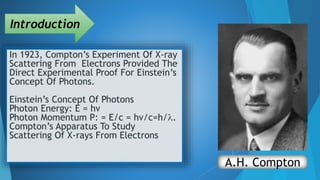
Introduction
In 1923, Compton’s Experiment Of X-ray
Scattering From Electrons Provided The
Direct Experimental Proof For Einstein’s
Concept Of Photons.
Einstein’s Concept Of Photons
Photon Energy: E = hv
Photon Momentum P: = E/c = hv/c=h/.
Compton’s Apparatus To Study
Scattering Of X-rays From Electrons
A.H. Compton
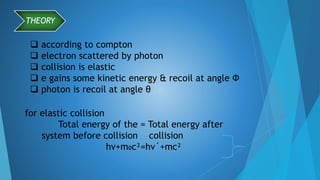
THEORY
for elastic collision
Total energy of the = Total energy after
system before collision collision
hv+m₀c²=hv´+mc²
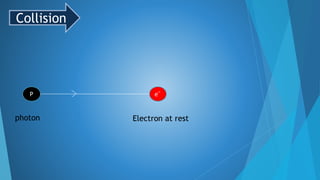
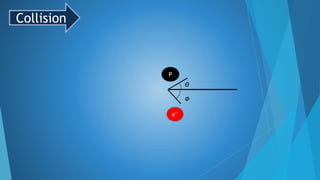
 according to compton
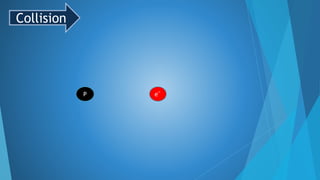
 electron scattered by photon
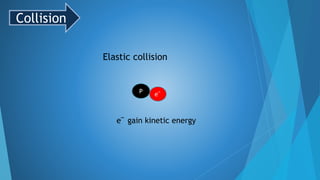
 collision is elastic
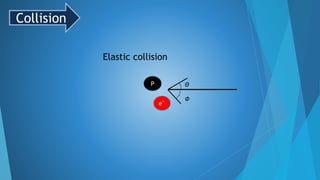
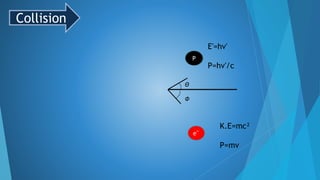
 e gains some kinetic energy & recoil at angle Ф
 photon is recoil at angle θ
e‾P
Collision
Electron at restphoton
e‾P
Collision
e‾P
Collision
Elastic collision
e‾ gain kinetic energy
e‾
P
Collision
Elastic collision
Θ
Ф
e‾
P
Collision
Θ
Ф
e‾
P
Collision
Θ
Ф
E′=hv′
P=hv′/c
K.E=mc²
P=mv
Derivation
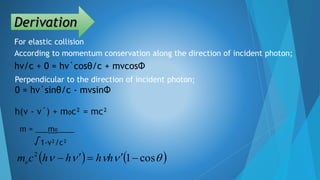
For elastic collision
According to momentum conservation along the direction of incident photon;
hv/c + 0 = hv´cosθ/c + mvcosΦ
Perpendicular to the direction of incident photon;
0 = hv´sinθ/c - mvsinΦ
h(v - v´) + m₀c² = mc²
m = ___m₀____
√1-v²/c²
    cos12
 hhhhcme
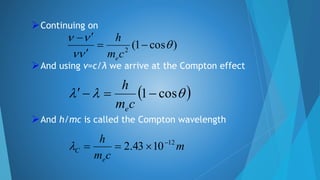
Continuing on
And using v=c/λ we arrive at the Compton effect
And h/mc is called the Compton wavelength
)cos1(2






cm
h
e
  cos1
cm
h
e
m
cm
h
e
C
12
1043.2 

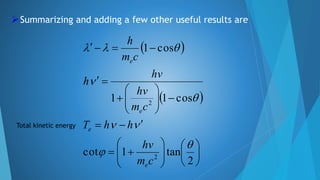
Summarizing and adding a few other useful results are
 
 























2
tan1cot
cos11
cos1
2
2






cm
hv
hhT
cm
hv
hv
h
cm
h
e
e
e
e
Total kinetic energy
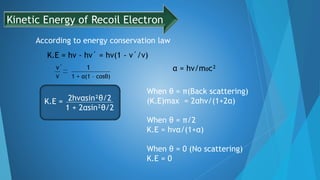
Kinetic Energy of Recoil Electron
According to energy conservation law
K.E = hv - hv´ = hv(1 - v´/v)
v´ 1
V 1 + α(1 – cosθ)
2hvαsin²θ/2
1 + 2αsin²θ/2
K.E =
α = hv/m₀c²
When θ = π(Back scattering)
(K.E)max = 2αhv/(1+2α)
When θ = π/2
K.E = hvα/(1+α)
When θ = 0 (No scattering)
K.E = 0
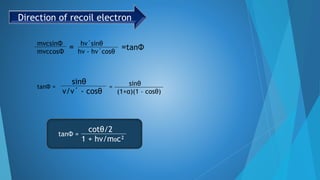
Direction of recoil electron
mvcsinΦ hv´sinθ
mvccosΦ hv - hv´cosθ
= =tanΦ
sinθ
v/v´ - cosθ
tanΦ = = sinθ
(1+α)(1 – cosθ)
cotθ/2
1 + hv/m₀c²
tanΦ =
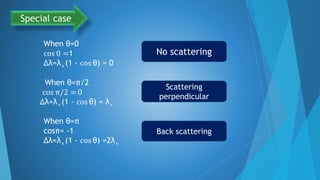
Special case
When θ=0
cos 0 =1
∆λ=λ˛(1 - cos θ) = 0
When θ=π/2
cos π/2 = 0
∆λ=λ˛(1 - cos θ) = λ˛
When θ=π
cosπ= -1
∆λ=λ˛(1 - cos θ) =2λ˛
No scattering
Scattering
perpendicular
Back scattering
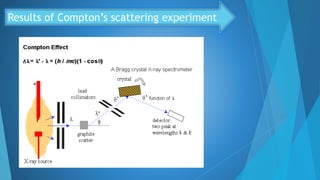
Results of Compton’s scattering experiment
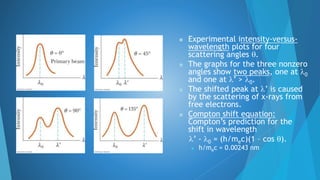
 Experimental intensity-versus-
wavelength plots for four
scattering angles .
 The graphs for the three nonzero
angles show two peaks, one at 0
and one at ’ > 0.
 The shifted peak at ’ is caused
by the scattering of x-rays from
free electrons.
 Compton shift equation:
Compton’s prediction for the
shift in wavelength
’ - 0 = (h/mec)(1 – cos ).
 h/mec = 0.00243 nm
Thank You

Compton effect

  • 1.
     REPRESENTED BY ABDULSALIM Govt. Engineering College, Ajmer B.Tech(Computer Science) 1st year(2nd semester) Compton Effect
  • 2.
     Introduction  Theory Compton Shift  Direction of recoil electron  Kinetic energy of recoil electron  Experimental demonstration
  • 3.
    Introduction In 1923, Compton’sExperiment Of X-ray Scattering From Electrons Provided The Direct Experimental Proof For Einstein’s Concept Of Photons. Einstein’s Concept Of Photons Photon Energy: E = hv Photon Momentum P: = E/c = hv/c=h/. Compton’s Apparatus To Study Scattering Of X-rays From Electrons A.H. Compton
  • 4.
    THEORY for elastic collision Totalenergy of the = Total energy after system before collision collision hv+m₀c²=hv´+mc²  according to compton  electron scattered by photon  collision is elastic  e gains some kinetic energy & recoil at angle Ф  photon is recoil at angle θ
  • 5.
  • 6.
  • 7.
  • 8.
  • 9.
  • 10.
  • 11.
    Derivation For elastic collision Accordingto momentum conservation along the direction of incident photon; hv/c + 0 = hv´cosθ/c + mvcosΦ Perpendicular to the direction of incident photon; 0 = hv´sinθ/c - mvsinΦ h(v - v´) + m₀c² = mc² m = ___m₀____ √1-v²/c²     cos12  hhhhcme
  • 12.
    Continuing on And usingv=c/λ we arrive at the Compton effect And h/mc is called the Compton wavelength )cos1(2       cm h e   cos1 cm h e m cm h e C 12 1043.2  
  • 13.
    Summarizing and addinga few other useful results are                            2 tan1cot cos11 cos1 2 2       cm hv hhT cm hv hv h cm h e e e e Total kinetic energy
  • 14.
    Kinetic Energy ofRecoil Electron According to energy conservation law K.E = hv - hv´ = hv(1 - v´/v) v´ 1 V 1 + α(1 – cosθ) 2hvαsin²θ/2 1 + 2αsin²θ/2 K.E = α = hv/m₀c² When θ = π(Back scattering) (K.E)max = 2αhv/(1+2α) When θ = π/2 K.E = hvα/(1+α) When θ = 0 (No scattering) K.E = 0
  • 15.
    Direction of recoilelectron mvcsinΦ hv´sinθ mvccosΦ hv - hv´cosθ = =tanΦ sinθ v/v´ - cosθ tanΦ = = sinθ (1+α)(1 – cosθ) cotθ/2 1 + hv/m₀c² tanΦ =
  • 16.
    Special case When θ=0 cos0 =1 ∆λ=λ˛(1 - cos θ) = 0 When θ=π/2 cos π/2 = 0 ∆λ=λ˛(1 - cos θ) = λ˛ When θ=π cosπ= -1 ∆λ=λ˛(1 - cos θ) =2λ˛ No scattering Scattering perpendicular Back scattering
  • 17.
    Results of Compton’sscattering experiment
  • 18.
     Experimental intensity-versus- wavelengthplots for four scattering angles .  The graphs for the three nonzero angles show two peaks, one at 0 and one at ’ > 0.  The shifted peak at ’ is caused by the scattering of x-rays from free electrons.  Compton shift equation: Compton’s prediction for the shift in wavelength ’ - 0 = (h/mec)(1 – cos ).  h/mec = 0.00243 nm
  • 19.