Simultaneously Integrated Boost
(SIB)
Presenter
Sehrish Inam
Contents
• Introduction
• What is SIB
• Why SIB not any other
• BED calculation
• Institutional study
• Results
• Conclusion
Introduction
• Approx. 50% of cancer patients receive radiotherapy
• Curative intent treatment is divided into different phases
depending on the histology of tumor.
• The established protocols help to decide total dose, fraction
size and number of phases.
• We use different treatment techniques like 2D planning 3D-
CRT, IMRT , SIB etc as per need.
What is SIB
• It is the intensity modulation that offers simultaneously treat
two or more volumes concurrently.
• Provides different daily dose per volume to PTV and GTV
simultaneously
• Reducing the no. of fractions.
• Increase the tumor control probability
• Manifests a greater biological effective dose BED.
Why SIB not any other?
• Two conventional interdependent plans are unable to
determine how both plans influence each other.
• PTV1 receives additional dose due to fields of boost plan.
• SIB provides different dose to both PTVs in a single
fraction.
• Reduces no. of fractions using BED
• Only one plan for complete treatment course.
• Overcome the drawbacks of convention radiation therapy.
Biological Effective Dose
•BED is an approximate quantity by which different
radiotherapy regimens may be compared.
•BED = nd [1+d/(α/β)]
where n = no. of fractions
d = dose per fraction
nd = total dose
Institutional study
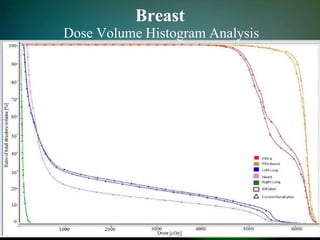
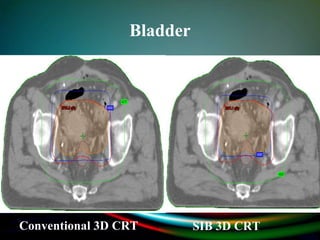
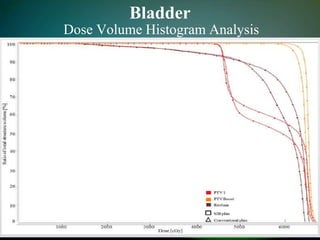
● We studied dosimetric comparison of SIB 3D-CRT with
conventional 3D CRT of sequential boost.
● Total 30 patients of brain breast and bladder were studied.
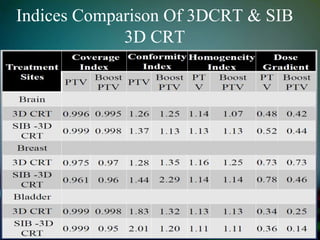
● Results were analyzed on the basis of
○ Coverage index
○ Conformity index
○ Homogeneity index
○ Dose gradient
○ OARs doses
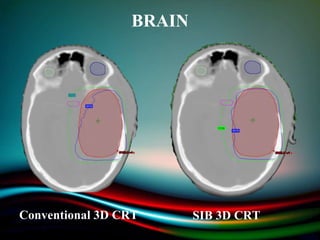
BRAIN
Conventional 3D CRT SIB 3D CRT
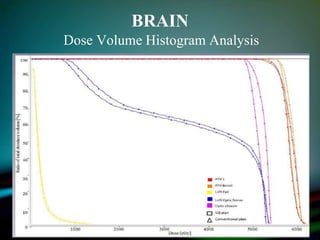
BRAIN
Dose Volume Histogram Analysis
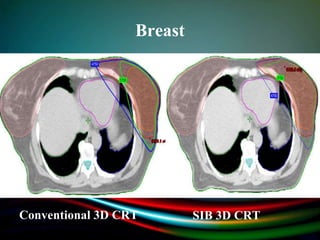
Breast
Conventional 3D CRT SIB 3D CRT
Breast
Dose Volume Histogram Analysis
Bladder
Conventional 3D CRT SIB 3D CRT
Bladder
Dose Volume Histogram Analysis
Indices Comparison Of 3DCRT & SIB
3D CRT
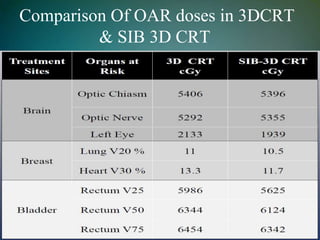
Comparison Of OAR doses in 3DCRT
& SIB 3D CRT
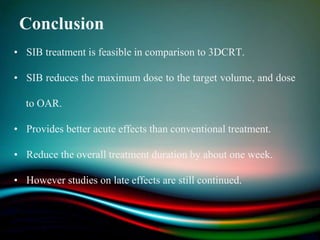
Conclusion
• SIB treatment is feasible in comparison to 3DCRT.
• SIB reduces the maximum dose to the target volume, and dose
to OAR.
• Provides better acute effects than conventional treatment.
• Reduce the overall treatment duration by about one week.
• However studies on late effects are still continued.
Sib.si

Sib.si

  • 1.
  • 2.
    Contents • Introduction • Whatis SIB • Why SIB not any other • BED calculation • Institutional study • Results • Conclusion
  • 3.
    Introduction • Approx. 50%of cancer patients receive radiotherapy • Curative intent treatment is divided into different phases depending on the histology of tumor. • The established protocols help to decide total dose, fraction size and number of phases. • We use different treatment techniques like 2D planning 3D- CRT, IMRT , SIB etc as per need.
  • 4.
    What is SIB •It is the intensity modulation that offers simultaneously treat two or more volumes concurrently. • Provides different daily dose per volume to PTV and GTV simultaneously • Reducing the no. of fractions. • Increase the tumor control probability • Manifests a greater biological effective dose BED.
  • 5.
    Why SIB notany other? • Two conventional interdependent plans are unable to determine how both plans influence each other. • PTV1 receives additional dose due to fields of boost plan. • SIB provides different dose to both PTVs in a single fraction. • Reduces no. of fractions using BED • Only one plan for complete treatment course. • Overcome the drawbacks of convention radiation therapy.
  • 6.
    Biological Effective Dose •BEDis an approximate quantity by which different radiotherapy regimens may be compared. •BED = nd [1+d/(α/β)] where n = no. of fractions d = dose per fraction nd = total dose
  • 7.
    Institutional study ● Westudied dosimetric comparison of SIB 3D-CRT with conventional 3D CRT of sequential boost. ● Total 30 patients of brain breast and bladder were studied. ● Results were analyzed on the basis of ○ Coverage index ○ Conformity index ○ Homogeneity index ○ Dose gradient ○ OARs doses
  • 8.
  • 9.
  • 10.
  • 11.
  • 12.
  • 13.
  • 14.
    Indices Comparison Of3DCRT & SIB 3D CRT
  • 15.
    Comparison Of OARdoses in 3DCRT & SIB 3D CRT
  • 16.
    Conclusion • SIB treatmentis feasible in comparison to 3DCRT. • SIB reduces the maximum dose to the target volume, and dose to OAR. • Provides better acute effects than conventional treatment. • Reduce the overall treatment duration by about one week. • However studies on late effects are still continued.