PHOTOELECTRIC EFFECT
( XII PHYSICS)
Presented by: Sehrish Inam
Lecturer Physics
TABLE OF CONTENTS
 Introduction
 Review of wave parameters
 Results of Photoelectric effect
 Classical theory consequences
 Experimental results of Photoelectric effect
 Einstein’s explanation of Photoelectric effect
 Einstein’s Photoelectric equation.
2
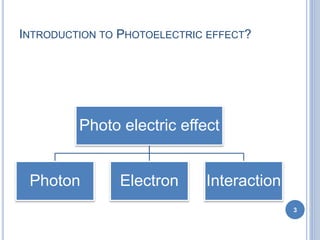
INTRODUCTION TO PHOTOELECTRIC EFFECT?
Photo electric effect
Photon Electron Interaction
3
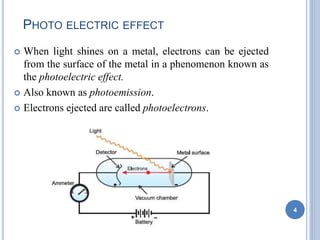
PHOTO ELECTRIC EFFECT
 When light shines on a metal, electrons can be ejected
from the surface of the metal in a phenomenon known as
the photoelectric effect.
 Also known as photoemission.
 Electrons ejected are called photoelectrons.
4
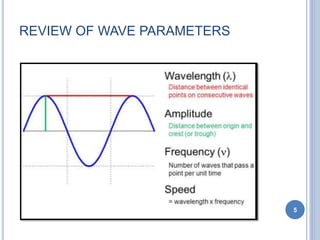
REVIEW OF WAVE PARAMETERS
5
RESULTS OF PHOTOELECTRIC
EFFECT
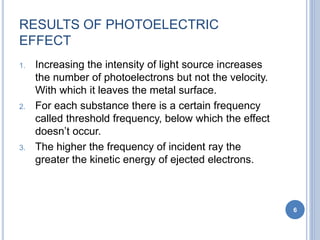
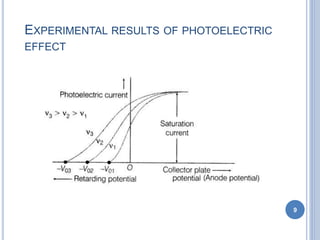
1. Increasing the intensity of light source increases
the number of photoelectrons but not the velocity.
With which it leaves the metal surface.
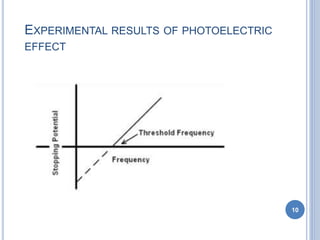
2. For each substance there is a certain frequency
called threshold frequency, below which the effect
doesn’t occur.
3. The higher the frequency of incident ray the
greater the kinetic energy of ejected electrons.
6
CLASSICAL THEORY CONSEQUENCES
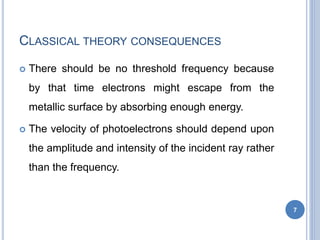
 There should be no threshold frequency because
by that time electrons might escape from the
metallic surface by absorbing enough energy.
 The velocity of photoelectrons should depend upon
the amplitude and intensity of the incident ray rather
than the frequency.
7
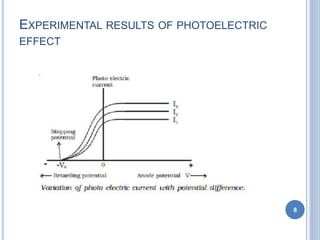
EXPERIMENTAL RESULTS OF PHOTOELECTRIC
EFFECT
8
EXPERIMENTAL RESULTS OF PHOTOELECTRIC
EFFECT
9
EXPERIMENTAL RESULTS OF PHOTOELECTRIC
EFFECT
10
EINSTEIN’S EXPLANATION
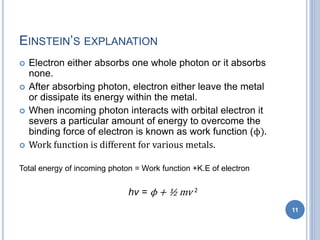
 Electron either absorbs one whole photon or it absorbs
none.
 After absorbing photon, electron either leave the metal
or dissipate its energy within the metal.
 When incoming photon interacts with orbital electron it
severs a particular amount of energy to overcome the
binding force of electron is known as work function (ϕ).
 Work function is different for various metals.
Total energy of incoming photon = Work function +K.E of electron
hν = ϕ + ½ mv 2
11
EINSTEIN'S PHOTOELECTRIC EQUATION.
Total energy of incoming photon = Work function +K.E of electron
hν = ϕ + ½ mv 2
Φ = hν0
hν = hν0 + ½ mv 2
hν - hν0 = ½ mv 2
Since K.E = ½ mv 2 = V0 e
hν - hν0 = V0 e
h(ν - ν0 ) = V0 e 12
13

2nd year physics photoelectric effect

  • 1.
    PHOTOELECTRIC EFFECT ( XIIPHYSICS) Presented by: Sehrish Inam Lecturer Physics
  • 2.
    TABLE OF CONTENTS Introduction  Review of wave parameters  Results of Photoelectric effect  Classical theory consequences  Experimental results of Photoelectric effect  Einstein’s explanation of Photoelectric effect  Einstein’s Photoelectric equation. 2
  • 3.
    INTRODUCTION TO PHOTOELECTRICEFFECT? Photo electric effect Photon Electron Interaction 3
  • 4.
    PHOTO ELECTRIC EFFECT When light shines on a metal, electrons can be ejected from the surface of the metal in a phenomenon known as the photoelectric effect.  Also known as photoemission.  Electrons ejected are called photoelectrons. 4
  • 5.
    REVIEW OF WAVEPARAMETERS 5
  • 6.
    RESULTS OF PHOTOELECTRIC EFFECT 1.Increasing the intensity of light source increases the number of photoelectrons but not the velocity. With which it leaves the metal surface. 2. For each substance there is a certain frequency called threshold frequency, below which the effect doesn’t occur. 3. The higher the frequency of incident ray the greater the kinetic energy of ejected electrons. 6
  • 7.
    CLASSICAL THEORY CONSEQUENCES There should be no threshold frequency because by that time electrons might escape from the metallic surface by absorbing enough energy.  The velocity of photoelectrons should depend upon the amplitude and intensity of the incident ray rather than the frequency. 7
  • 8.
    EXPERIMENTAL RESULTS OFPHOTOELECTRIC EFFECT 8
  • 9.
    EXPERIMENTAL RESULTS OFPHOTOELECTRIC EFFECT 9
  • 10.
    EXPERIMENTAL RESULTS OFPHOTOELECTRIC EFFECT 10
  • 11.
    EINSTEIN’S EXPLANATION  Electroneither absorbs one whole photon or it absorbs none.  After absorbing photon, electron either leave the metal or dissipate its energy within the metal.  When incoming photon interacts with orbital electron it severs a particular amount of energy to overcome the binding force of electron is known as work function (ϕ).  Work function is different for various metals. Total energy of incoming photon = Work function +K.E of electron hν = ϕ + ½ mv 2 11
  • 12.
    EINSTEIN'S PHOTOELECTRIC EQUATION. Totalenergy of incoming photon = Work function +K.E of electron hν = ϕ + ½ mv 2 Φ = hν0 hν = hν0 + ½ mv 2 hν - hν0 = ½ mv 2 Since K.E = ½ mv 2 = V0 e hν - hν0 = V0 e h(ν - ν0 ) = V0 e 12
  • 13.