Particle
properties
of
waves
TOPICS:
Photoelectric effect
Quantum theory of light
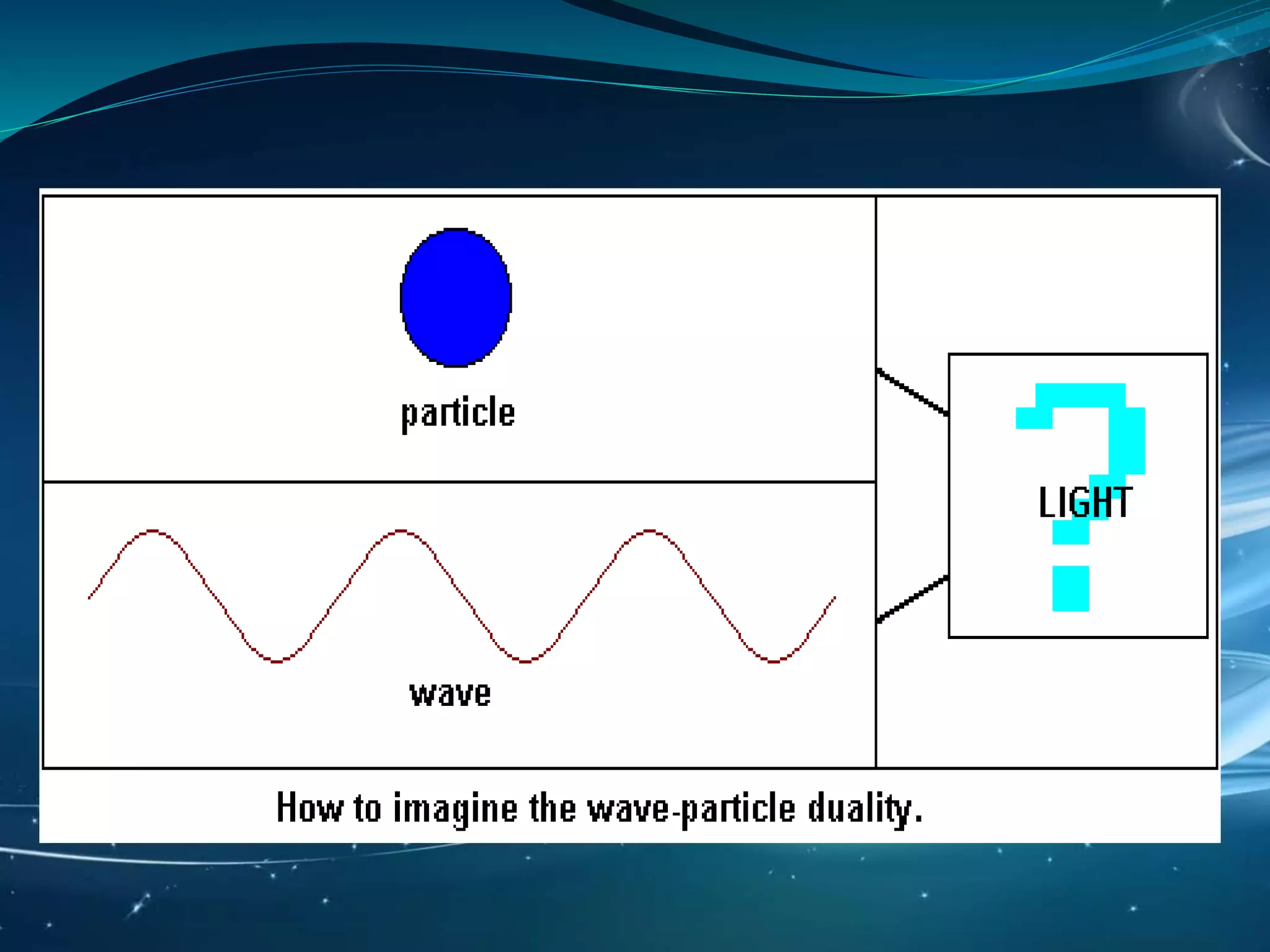
Wave particle duality
X-rays
Compton effect
Photons and gravity
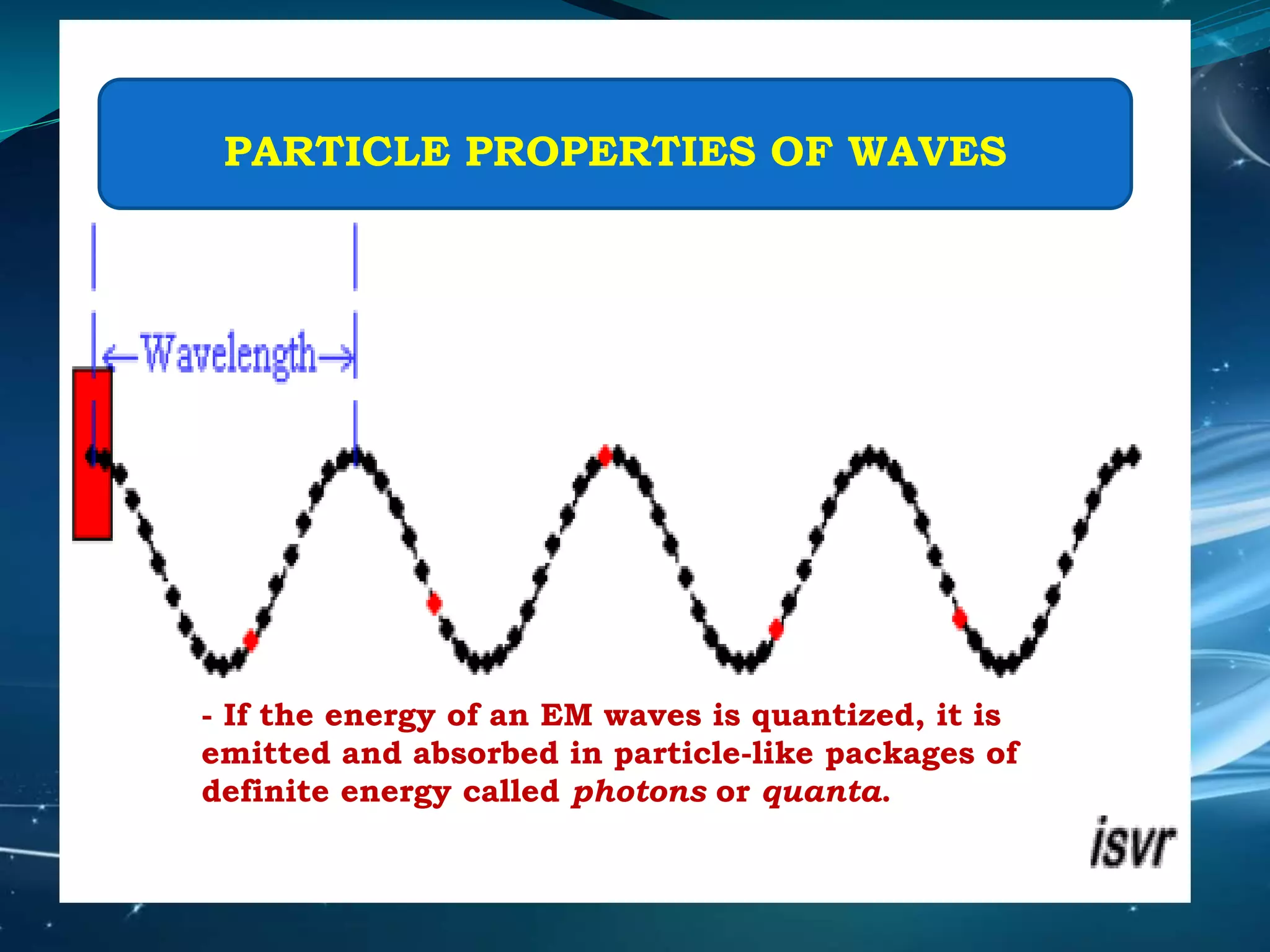
- If the energy of an EM waves is quantized, it is
emitted and absorbed in particle-like packages of
definite energy called photons or quanta.
PARTICLE PROPERTIES OF WAVES
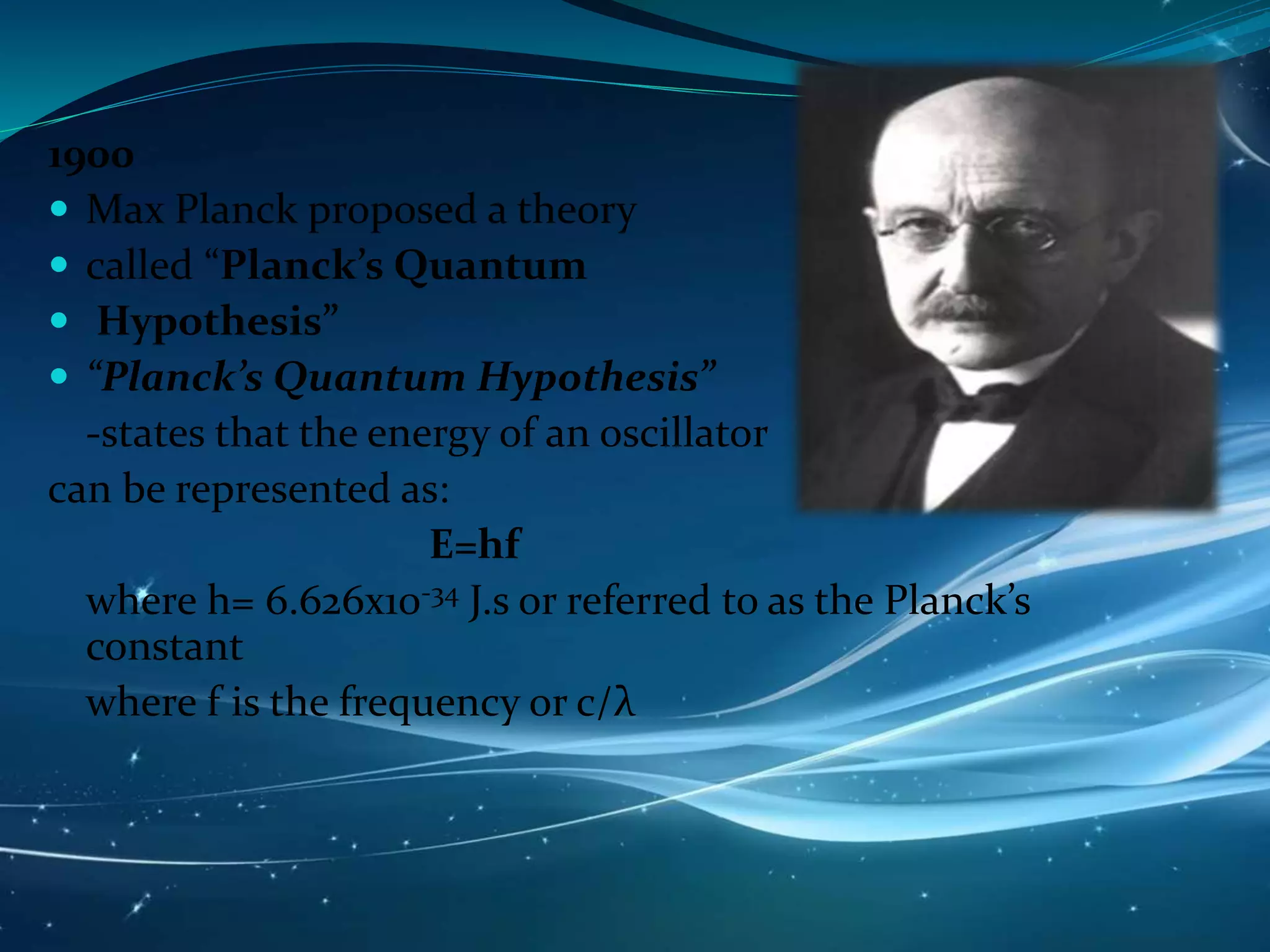
1900
 Max Planck proposed a theory
 called “Planck’s Quantum
 Hypothesis”
 “Planck’s Quantum Hypothesis”
-states that the energy of an oscillator
can be represented as:
E=hf
where h= 6.626x10⁻³⁴ J.s or referred to as the Planck’s
constant
where f is the frequency or c/λ
1887
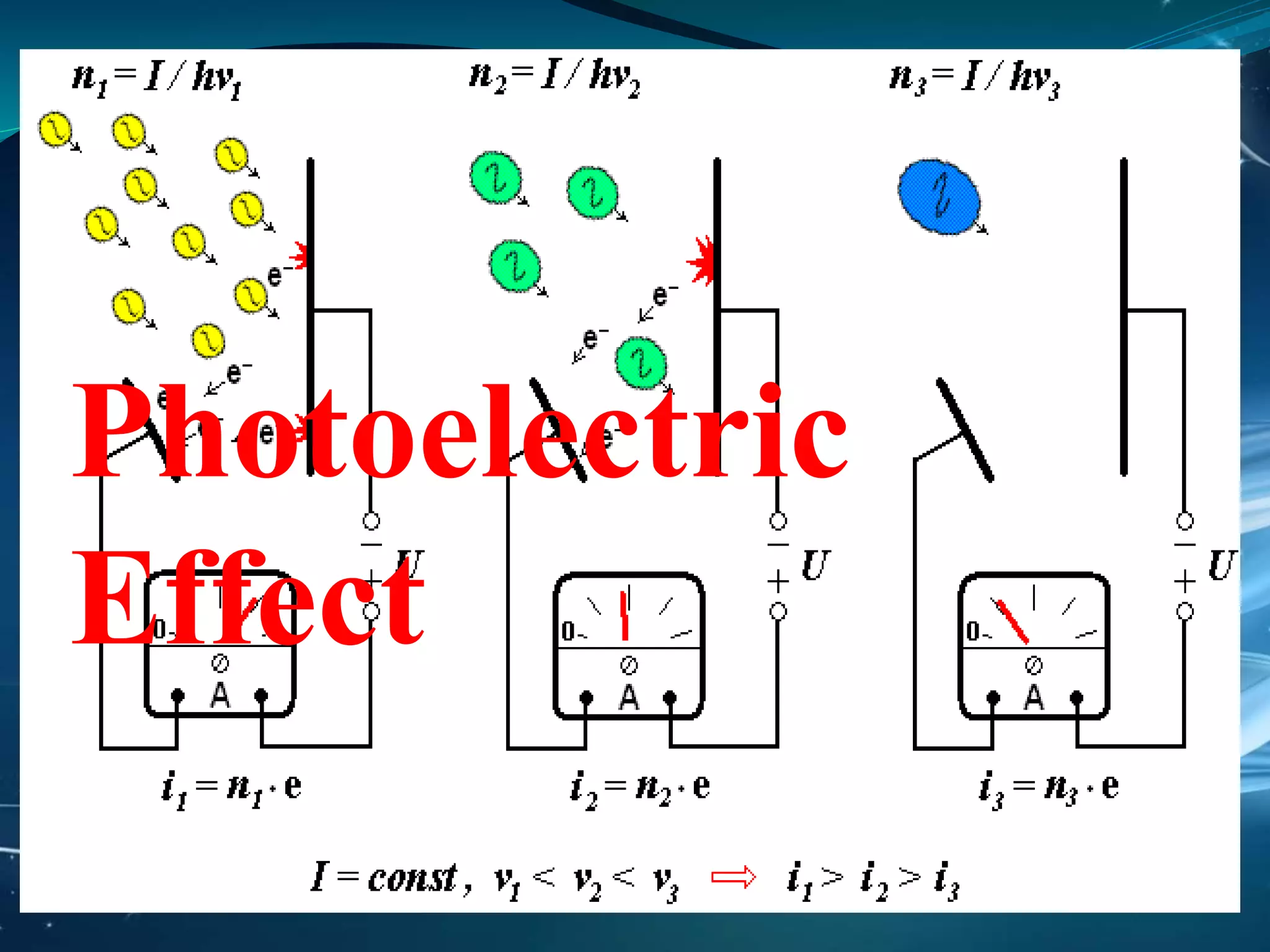
 Heinrich Hertz first observed this phenomenon
-He defined this as the emission of electrons when light
strikes a metal surface.
-When light strikes a metal surface, some electrons near
the surface absorbed enough energy to overcome the
attraction of the positive ions in the metal and escape
into surrounding space.
Photoelectric
Effect
1886-1900
 Wilhelm Hallwachs and Philip Lenard found that
when light fell on the cathode of the material no
photoelectron were emitted unless the frequency of
the light is greater than the minimum value which we
call threshold frequency.
1905
 Albert Einstein developed a correct analysis about
photoelectric effect.
-He suggested that we should think of light as a particle
instead of a wave
-He explain further about his theory by representing it
quantitatively
-He applied conservation of energy to find that the
maximum KE for an emitted electron is the energy hf
gained from a photon minus the work function
hf=Ekinmax+hv0
hf- hv0 = Ekinmax
Problem:
 Calculate the maximum KE of electrons emitted by the
photoelectric effect from a potassium (K) metal
surface with work function of 2.0 eV by ultraviolet
photons with wavelength 350 nm.
Bird’s Eyeview
Conditions to be remembered in the Photoelectric
Effect
 The maximum KE of the photoelectric effect depends on the
frequency of light
 The KE are not dependent on the intensity of light
 There is a threshold frequency which depends on the material.
Light frequency below the TF cannot produce electrons
 The number of photoelectrons produced in the process is
proportional to the intensity of light; higher the intensity, higher
the number of photoelectrons
 Photoelectrons are ejected immediately after the
material is illuminated
QUANTUM THEORY
OF
LIGHT
Quantum theory of
light says that light is
composed of tiny particles
aka “photons”, which
exhibit wave like properties
as well
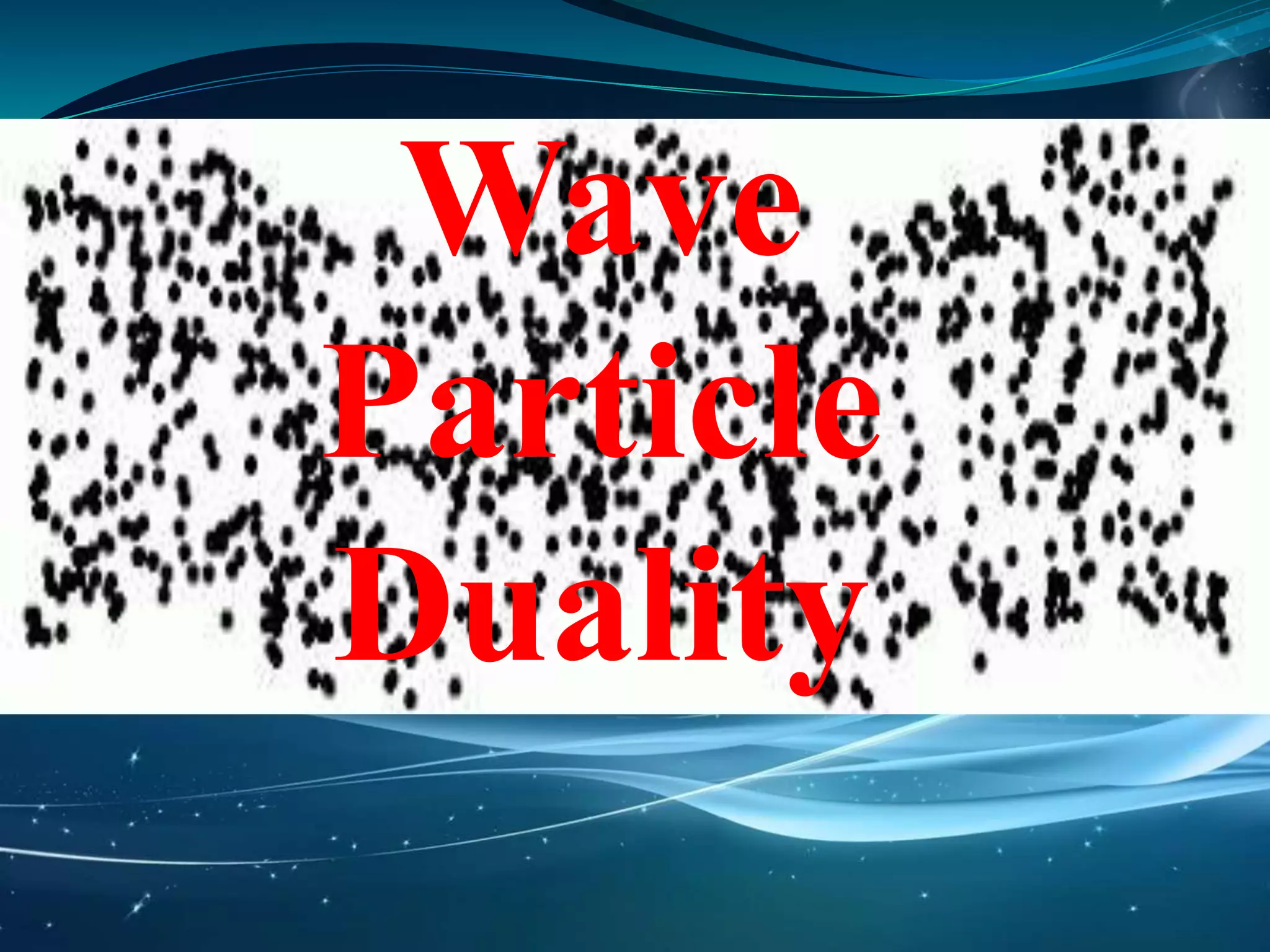
Wave
Particle
Duality
Is light a particle with mass and
substance ?
or
Is it just a wave travelling
through space ?
Around 1700, Isaac Newton concluded that light was a
group of particle and then around the same time there
were other scientists who thought that light is a wave.
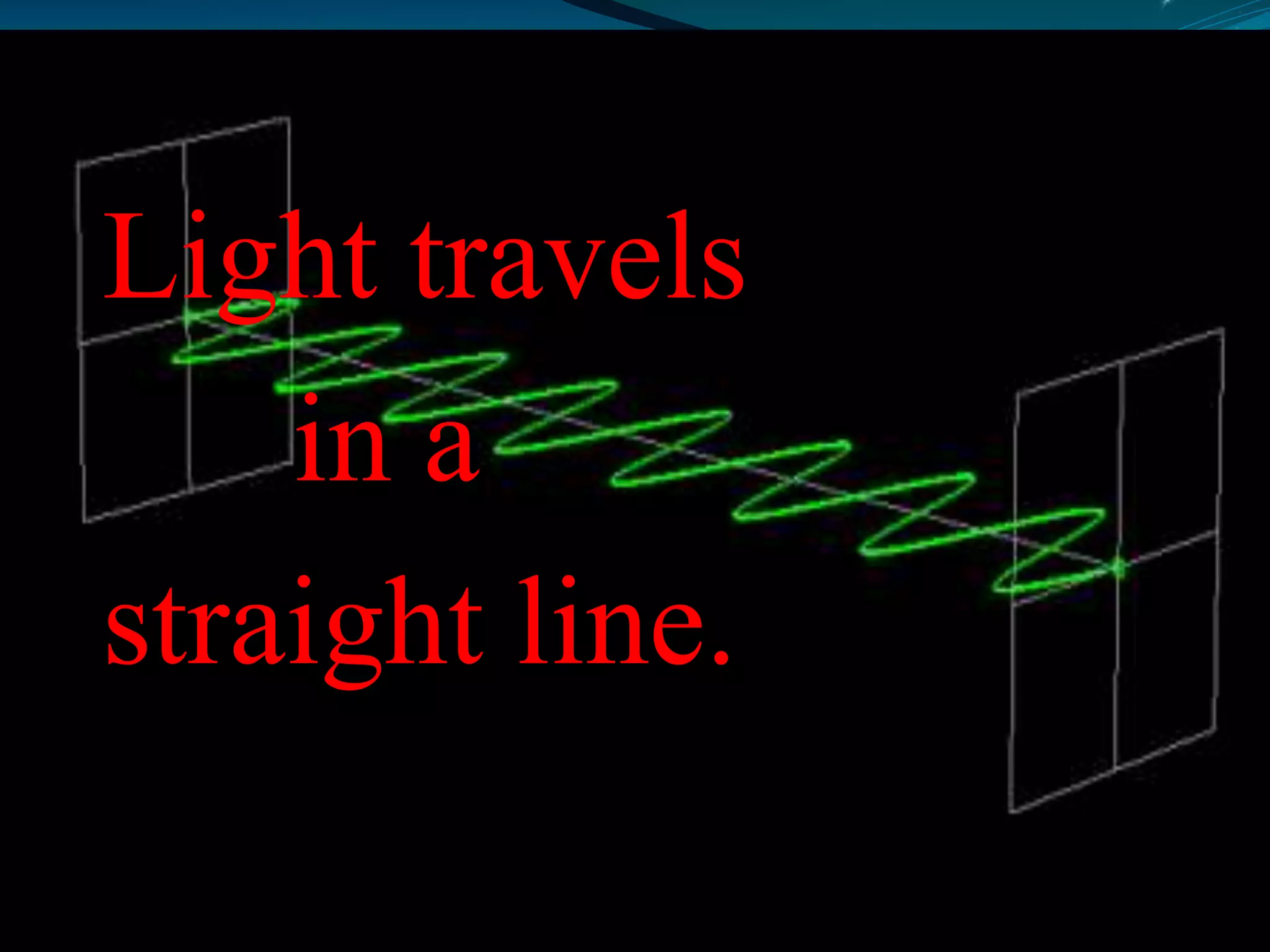
Light travels
in a
straight line.
The corpuscular theory, however cannot explain wave-
like light phenomena such as diffraction and
interference and vice versa.
LIGHT :
wave or Particle ?
Light that is visible infrared and ultraviolet
light is usually described as though it is a wave.
Famous scientist like
Einstein, Hertz and
de Broglie had to put
their heads together.
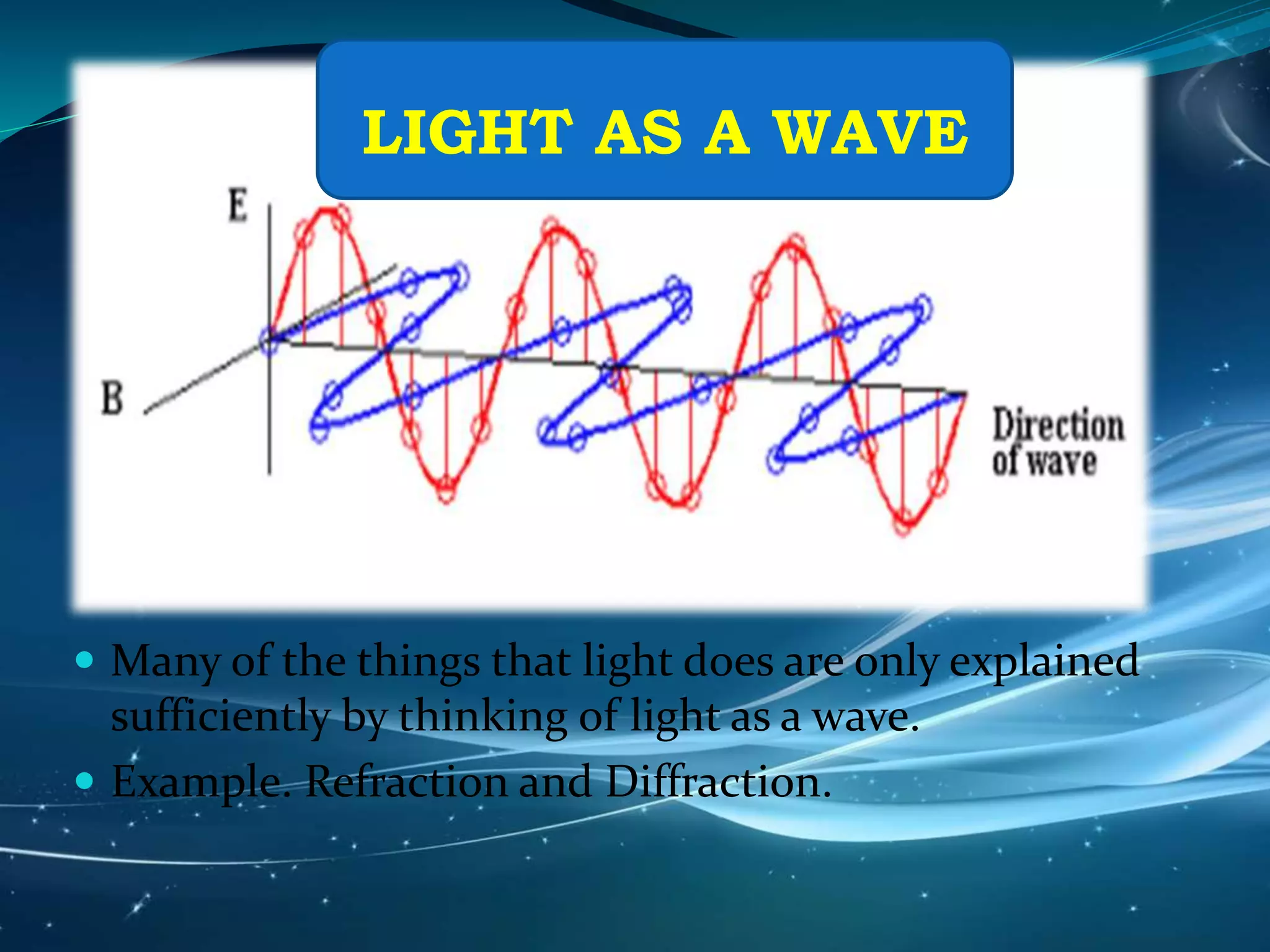
 Many of the things that light does are only explained
sufficiently by thinking of light as a wave.
 Example. Refraction and Diffraction.
LIGHT AS A WAVE
 Photoelectric effect which describes the way electrons are
excited and emitted from matter when they absorb energy
from light.
 In 1887, heinrich hertz observed that a charged object
would create a bigger, faster spark if it was treated with
ultraviolet light.
LIGHT AS A PARTICLE
 Scientists showed that electrons really could be
knocked out of a metal in response to a beam of light.
 The more energy the electrons
could absorb, the more
energy they could use to jump
out.
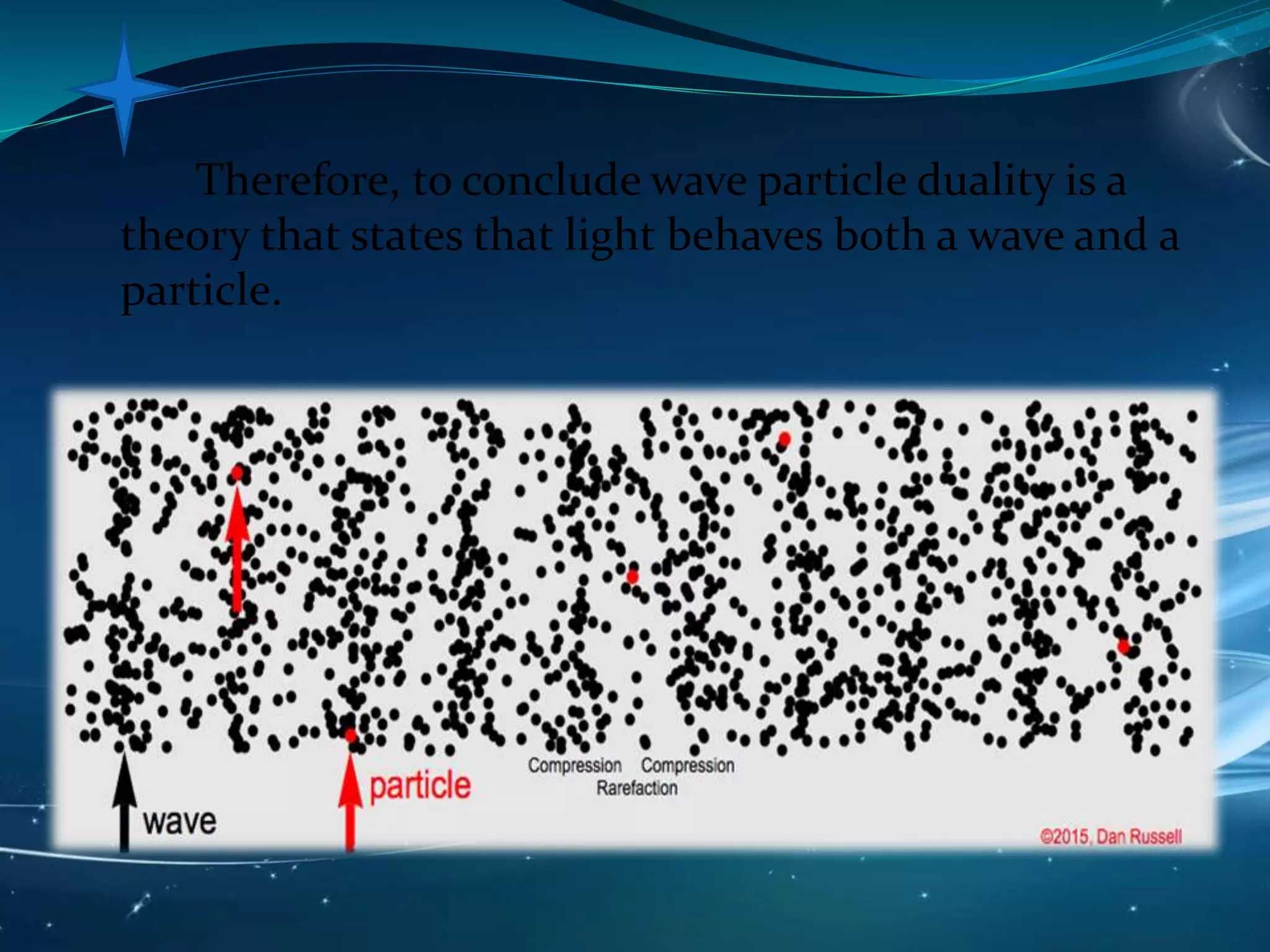
Therefore, to conclude wave particle duality is a
theory that states that light behaves both a wave and a
particle.
X-RAY
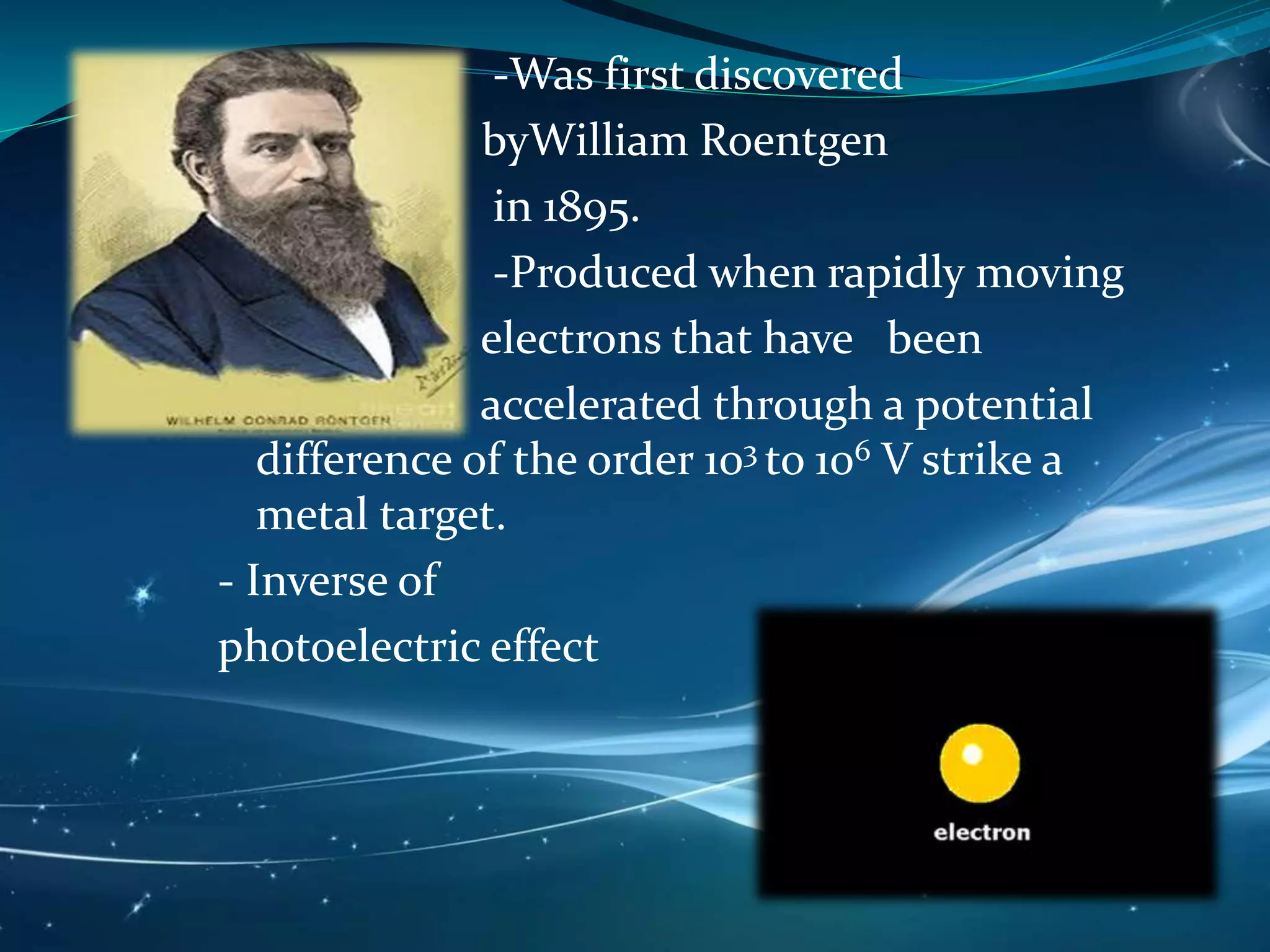
-Was first discovered
byWilliam Roentgen
in 1895.
-Produced when rapidly moving
electrons that have been
accelerated through a potential
difference of the order 103 to 106 V strike a
metal target.
- Inverse of
photoelectric effect
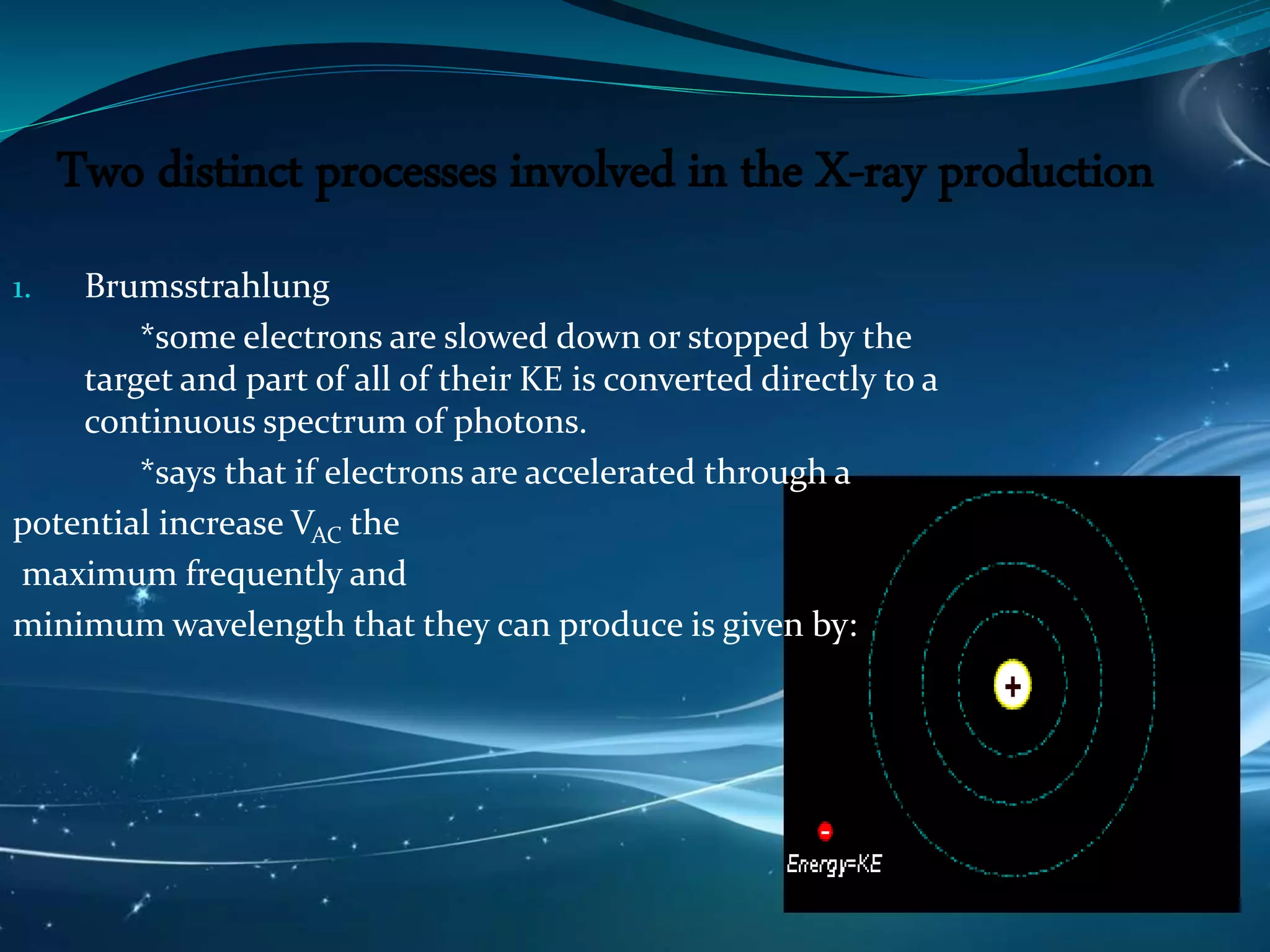
Two distinct processes involved in the X-ray production
1. Brumsstrahlung
*some electrons are slowed down or stopped by the
target and part of all of their KE is converted directly to a
continuous spectrum of photons.
*says that if electrons are accelerated through a
potential increase VAC the
maximum frequently and
minimum wavelength that they can produce is given by:
eVAC = hfmax = hc/λmin
This equation says that the most energetic photon
(highest frequency and shortest wavelength) is
produced when all the electrons KE goes to produce
one photon or energy of a photon.
2. Focuses on the x-ray spectrum at characteristics f and
λ that do depend on the target material.
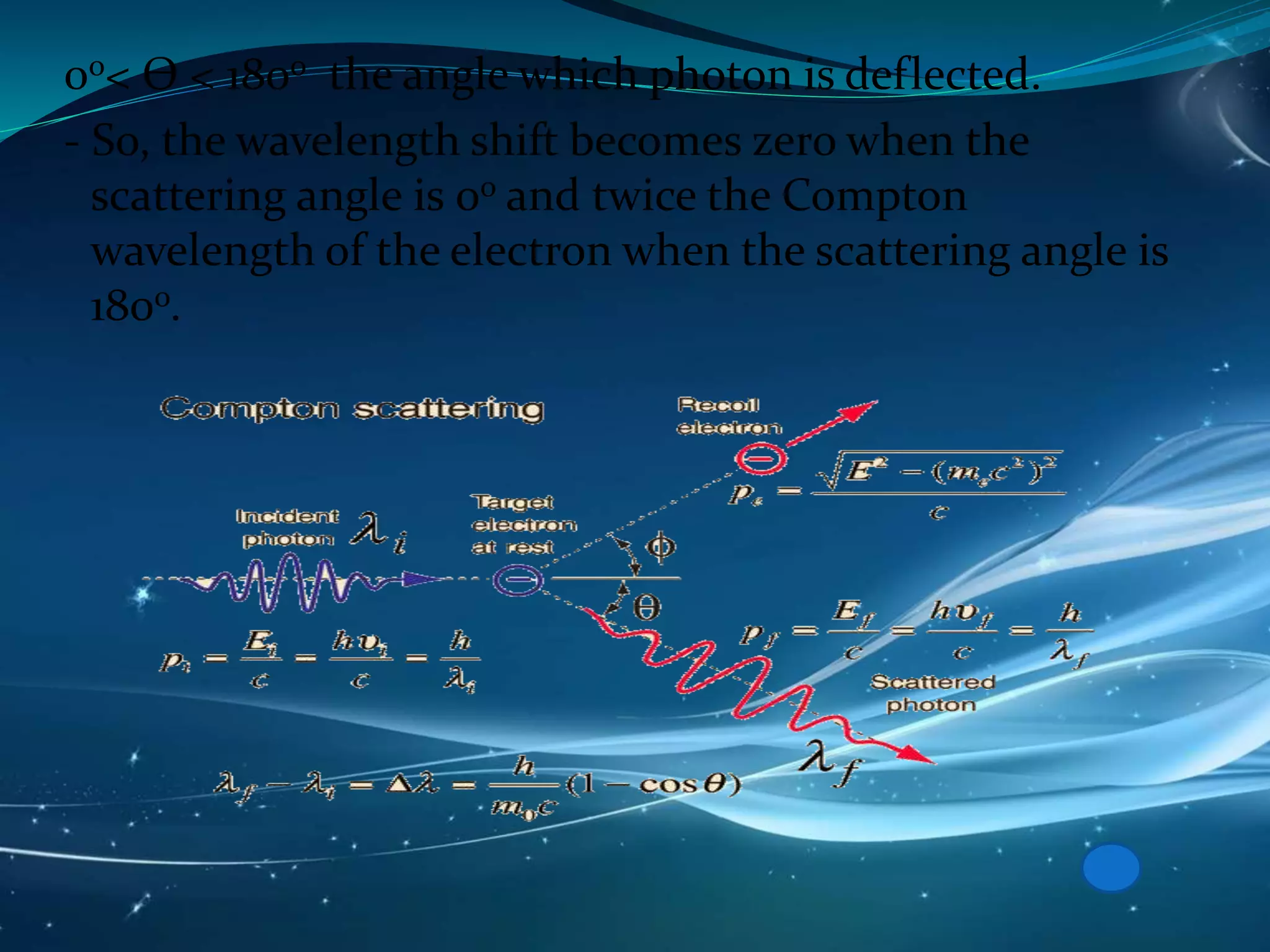
- Compton Effect is the inelastic scattering of high energy
photons by loosely bound electrons or free charged
particles. In this effect, the photon transfers part of its
energy and momentum to the charged particle.
- The Compton effect (also called Compton scattering)
is the result of high-energy photon
colliding with the target ,
which releases loosely
bound electrons from the
outer shell of the atom
or shell .
Compton Effect was first
demonstrated in 1923 by
Arthur Holly Compton
(1892-1962).
- He explained this result
of the basis of photon
theory as incident
photons colliding with the electrons of the material,
 Where:
 is the rest mass of the electron
 is the Planck`s constant
 C is the speed of light
 is the incident photon
 ` is the scattered photon
 is the scattering angle
h/(moc) - compton wavelength of the electron
- equal to 2.42x10⁻¹²m or .002426 nm
PHOTOELECTRIC EFFECT
VS.
COMPTON EFFECT
A low-energy phenomenon A mid-energy
Photon delivers its total amount of
energy to a single electron
The photon transfers part of its
energy to a single electron
This effect was explained by Albert
Einstein
This effect was explained by Arthur
Compton
The photon disappears after the
interaction
The wavelength of the scattered
photon is higher than that of the
incident photon
0o< Ѳ < 180o the angle which photon is deflected.
- So, the wavelength shift becomes zero when the
scattering angle is 0o and twice the Compton
wavelength of the electron when the scattering angle is
180o.
Example:
X-rays wavelength of .140 nm are scattered from a very
thin slice of carbon. What will be the wavelength of x-
rays scattered at a.)0o , b.) 90o , c.) 180o ?
a.) for Ѳ = 0o
cosѲ = 1 and 1- cosѲ = 0
Solution:
 b.) for Ѳ = 90o
cosѲ = 0 an
 1- cosѲ = 1
= 0.140 nm + 2.4x10⁻¹²m
= 0.142nm
 for Ѳ = 180o
cosѲ = -1
1- cosѲ = 2
= 0.140nm + 2.4x10⁻¹²m
= 0.145nm
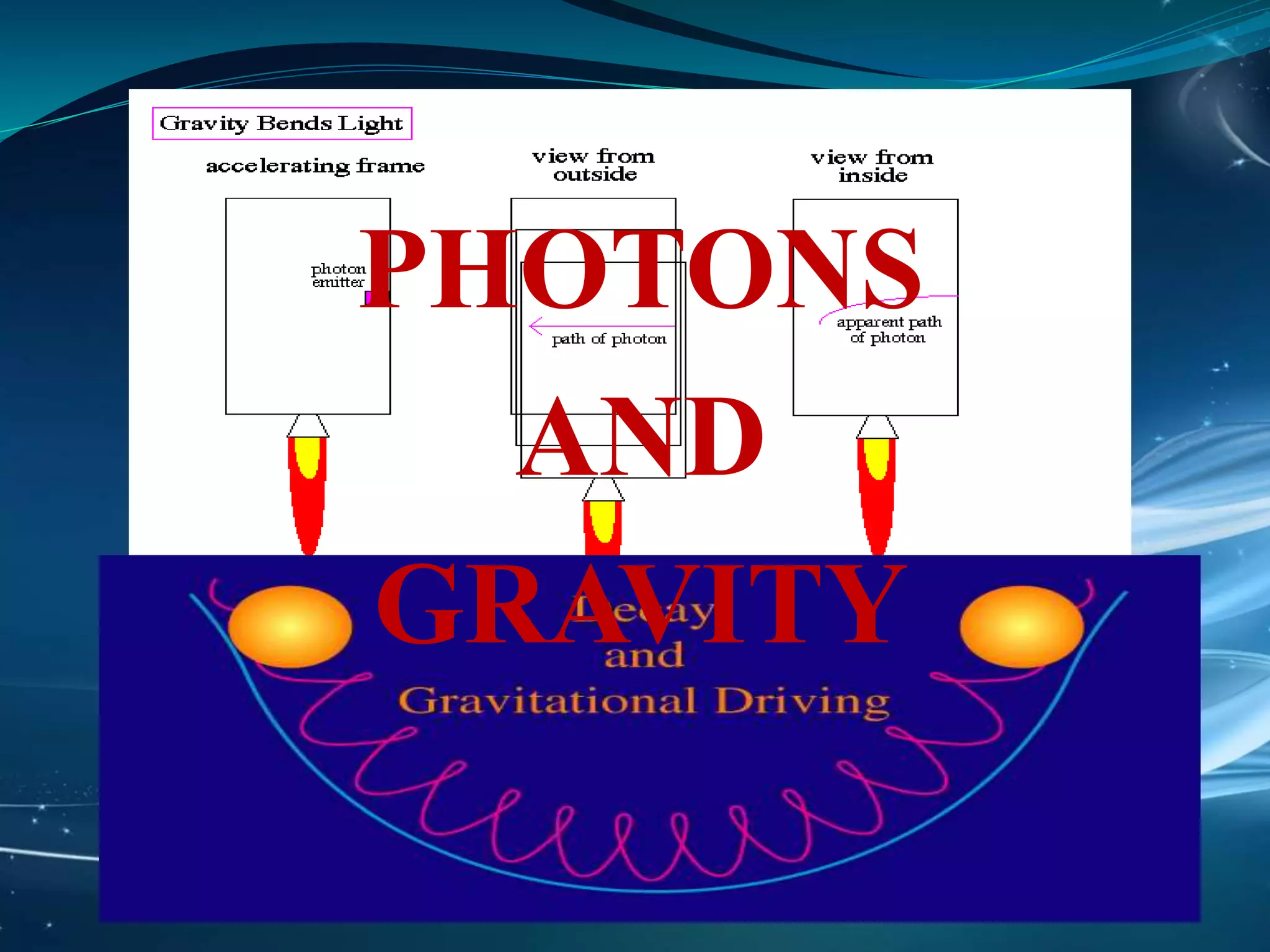
PHOTONS
AND
GRAVITY
PHOTONS
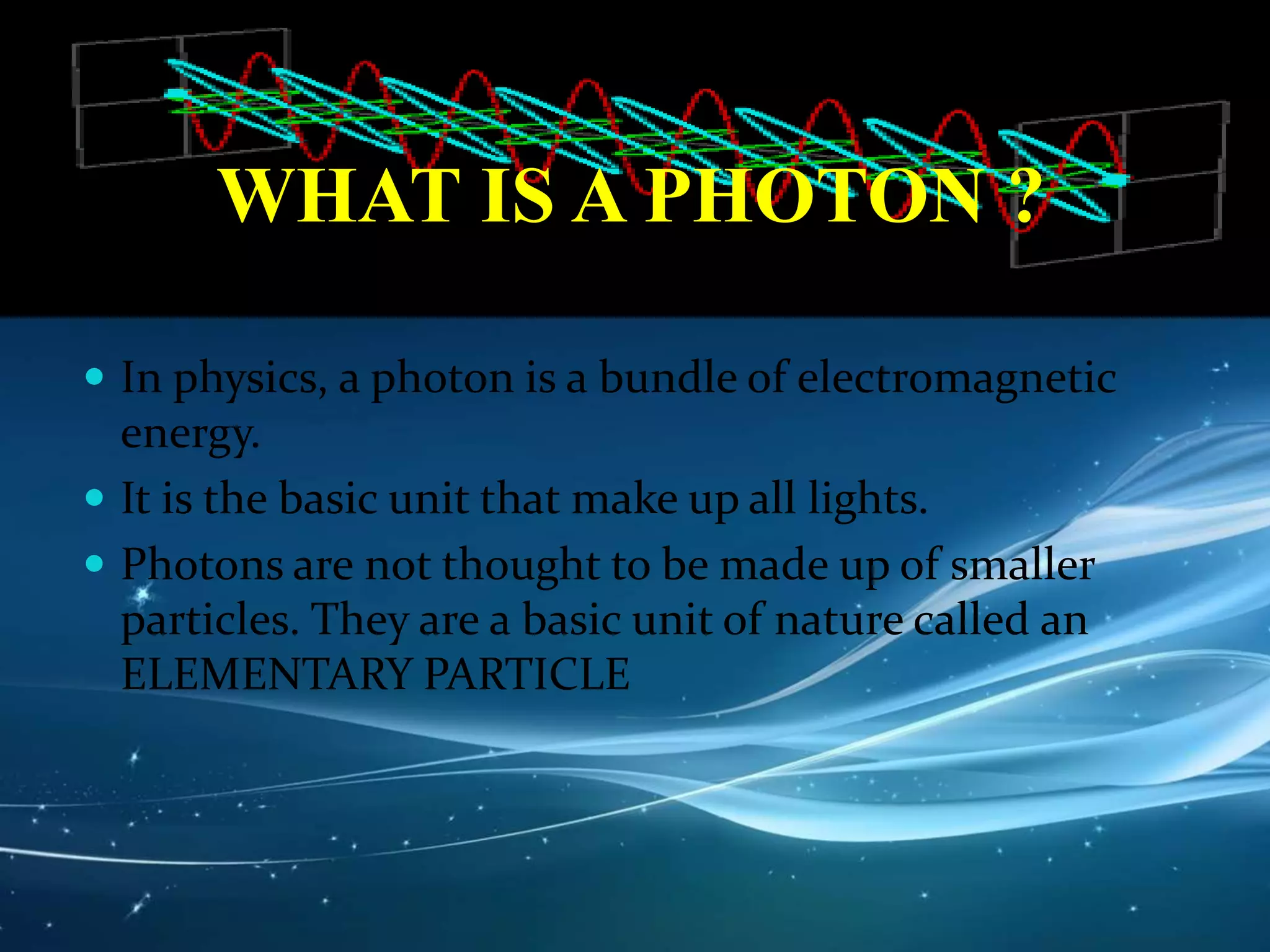
WHAT IS A PHOTON ?
 In physics, a photon is a bundle of electromagnetic
energy.
 It is the basic unit that make up all lights.
 Photons are not thought to be made up of smaller
particles. They are a basic unit of nature called an
ELEMENTARY PARTICLE
PROPERTIES OF A PHOTON
 They have zero mass
 They have no electric charge
 They are stable
 They carry energy and momentum which are dependent on
the frequency.
 They can have interactions with other particles such as
electron.
 They can be destroyed or created by many natural
processes.
 When in empty space, they travel at the speed of light.
FACTS ABOUT PHOTONS
 Not only lights is made up of photons, but all
electromagnetic energy.
 It was scientist Gilbert N. Lewis who first used the
word “photon”.
 Photons are always electrically neutral.
 Photons do not decay on their own.
GRAVITY
 It is hypothesized that gravity also have wave-particle
duality.
 Some scientist theorized that gravity is caused by
particle called “graviton” and it simply move the
medium or vacuum as gravitational wave.
Particle Properties of Wave

Particle Properties of Wave

  • 1.
  • 2.
    TOPICS: Photoelectric effect Quantum theoryof light Wave particle duality X-rays Compton effect Photons and gravity
  • 4.
    - If theenergy of an EM waves is quantized, it is emitted and absorbed in particle-like packages of definite energy called photons or quanta. PARTICLE PROPERTIES OF WAVES
  • 5.
    1900  Max Planckproposed a theory  called “Planck’s Quantum  Hypothesis”  “Planck’s Quantum Hypothesis” -states that the energy of an oscillator can be represented as: E=hf where h= 6.626x10⁻³⁴ J.s or referred to as the Planck’s constant where f is the frequency or c/λ
  • 6.
    1887  Heinrich Hertzfirst observed this phenomenon -He defined this as the emission of electrons when light strikes a metal surface. -When light strikes a metal surface, some electrons near the surface absorbed enough energy to overcome the attraction of the positive ions in the metal and escape into surrounding space.
  • 7.
  • 8.
    1886-1900  Wilhelm Hallwachsand Philip Lenard found that when light fell on the cathode of the material no photoelectron were emitted unless the frequency of the light is greater than the minimum value which we call threshold frequency.
  • 9.
    1905  Albert Einsteindeveloped a correct analysis about photoelectric effect. -He suggested that we should think of light as a particle instead of a wave -He explain further about his theory by representing it quantitatively -He applied conservation of energy to find that the maximum KE for an emitted electron is the energy hf gained from a photon minus the work function hf=Ekinmax+hv0 hf- hv0 = Ekinmax
  • 10.
    Problem:  Calculate themaximum KE of electrons emitted by the photoelectric effect from a potassium (K) metal surface with work function of 2.0 eV by ultraviolet photons with wavelength 350 nm.
  • 11.
    Bird’s Eyeview Conditions tobe remembered in the Photoelectric Effect  The maximum KE of the photoelectric effect depends on the frequency of light  The KE are not dependent on the intensity of light  There is a threshold frequency which depends on the material. Light frequency below the TF cannot produce electrons  The number of photoelectrons produced in the process is proportional to the intensity of light; higher the intensity, higher the number of photoelectrons  Photoelectrons are ejected immediately after the material is illuminated
  • 12.
  • 13.
    Quantum theory of lightsays that light is composed of tiny particles aka “photons”, which exhibit wave like properties as well
  • 14.
  • 15.
    Is light aparticle with mass and substance ? or Is it just a wave travelling through space ?
  • 16.
    Around 1700, IsaacNewton concluded that light was a group of particle and then around the same time there were other scientists who thought that light is a wave.
  • 17.
  • 18.
    The corpuscular theory,however cannot explain wave- like light phenomena such as diffraction and interference and vice versa.
  • 19.
    LIGHT : wave orParticle ?
  • 20.
    Light that isvisible infrared and ultraviolet light is usually described as though it is a wave.
  • 21.
    Famous scientist like Einstein,Hertz and de Broglie had to put their heads together.
  • 22.
     Many ofthe things that light does are only explained sufficiently by thinking of light as a wave.  Example. Refraction and Diffraction. LIGHT AS A WAVE
  • 23.
     Photoelectric effectwhich describes the way electrons are excited and emitted from matter when they absorb energy from light.  In 1887, heinrich hertz observed that a charged object would create a bigger, faster spark if it was treated with ultraviolet light. LIGHT AS A PARTICLE
  • 24.
     Scientists showedthat electrons really could be knocked out of a metal in response to a beam of light.  The more energy the electrons could absorb, the more energy they could use to jump out.
  • 25.
    Therefore, to concludewave particle duality is a theory that states that light behaves both a wave and a particle.
  • 26.
  • 27.
    -Was first discovered byWilliamRoentgen in 1895. -Produced when rapidly moving electrons that have been accelerated through a potential difference of the order 103 to 106 V strike a metal target. - Inverse of photoelectric effect
  • 28.
    Two distinct processesinvolved in the X-ray production 1. Brumsstrahlung *some electrons are slowed down or stopped by the target and part of all of their KE is converted directly to a continuous spectrum of photons. *says that if electrons are accelerated through a potential increase VAC the maximum frequently and minimum wavelength that they can produce is given by:
  • 29.
    eVAC = hfmax= hc/λmin This equation says that the most energetic photon (highest frequency and shortest wavelength) is produced when all the electrons KE goes to produce one photon or energy of a photon. 2. Focuses on the x-ray spectrum at characteristics f and λ that do depend on the target material.
  • 31.
    - Compton Effectis the inelastic scattering of high energy photons by loosely bound electrons or free charged particles. In this effect, the photon transfers part of its energy and momentum to the charged particle. - The Compton effect (also called Compton scattering) is the result of high-energy photon colliding with the target , which releases loosely bound electrons from the outer shell of the atom or shell .
  • 32.
    Compton Effect wasfirst demonstrated in 1923 by Arthur Holly Compton (1892-1962). - He explained this result of the basis of photon theory as incident photons colliding with the electrons of the material,
  • 33.
     Where:  isthe rest mass of the electron  is the Planck`s constant  C is the speed of light  is the incident photon  ` is the scattered photon  is the scattering angle
  • 34.
    h/(moc) - comptonwavelength of the electron - equal to 2.42x10⁻¹²m or .002426 nm
  • 35.
    PHOTOELECTRIC EFFECT VS. COMPTON EFFECT Alow-energy phenomenon A mid-energy Photon delivers its total amount of energy to a single electron The photon transfers part of its energy to a single electron This effect was explained by Albert Einstein This effect was explained by Arthur Compton The photon disappears after the interaction The wavelength of the scattered photon is higher than that of the incident photon
  • 36.
    0o< Ѳ <180o the angle which photon is deflected. - So, the wavelength shift becomes zero when the scattering angle is 0o and twice the Compton wavelength of the electron when the scattering angle is 180o.
  • 37.
    Example: X-rays wavelength of.140 nm are scattered from a very thin slice of carbon. What will be the wavelength of x- rays scattered at a.)0o , b.) 90o , c.) 180o ? a.) for Ѳ = 0o cosѲ = 1 and 1- cosѲ = 0 Solution:
  • 38.
     b.) forѲ = 90o cosѲ = 0 an  1- cosѲ = 1 = 0.140 nm + 2.4x10⁻¹²m = 0.142nm
  • 39.
     for Ѳ= 180o cosѲ = -1 1- cosѲ = 2 = 0.140nm + 2.4x10⁻¹²m = 0.145nm
  • 40.
  • 41.
  • 42.
    WHAT IS APHOTON ?  In physics, a photon is a bundle of electromagnetic energy.  It is the basic unit that make up all lights.  Photons are not thought to be made up of smaller particles. They are a basic unit of nature called an ELEMENTARY PARTICLE
  • 43.
    PROPERTIES OF APHOTON  They have zero mass  They have no electric charge  They are stable  They carry energy and momentum which are dependent on the frequency.  They can have interactions with other particles such as electron.  They can be destroyed or created by many natural processes.  When in empty space, they travel at the speed of light.
  • 44.
    FACTS ABOUT PHOTONS Not only lights is made up of photons, but all electromagnetic energy.  It was scientist Gilbert N. Lewis who first used the word “photon”.  Photons are always electrically neutral.  Photons do not decay on their own.
  • 45.
  • 46.
     It ishypothesized that gravity also have wave-particle duality.  Some scientist theorized that gravity is caused by particle called “graviton” and it simply move the medium or vacuum as gravitational wave.