
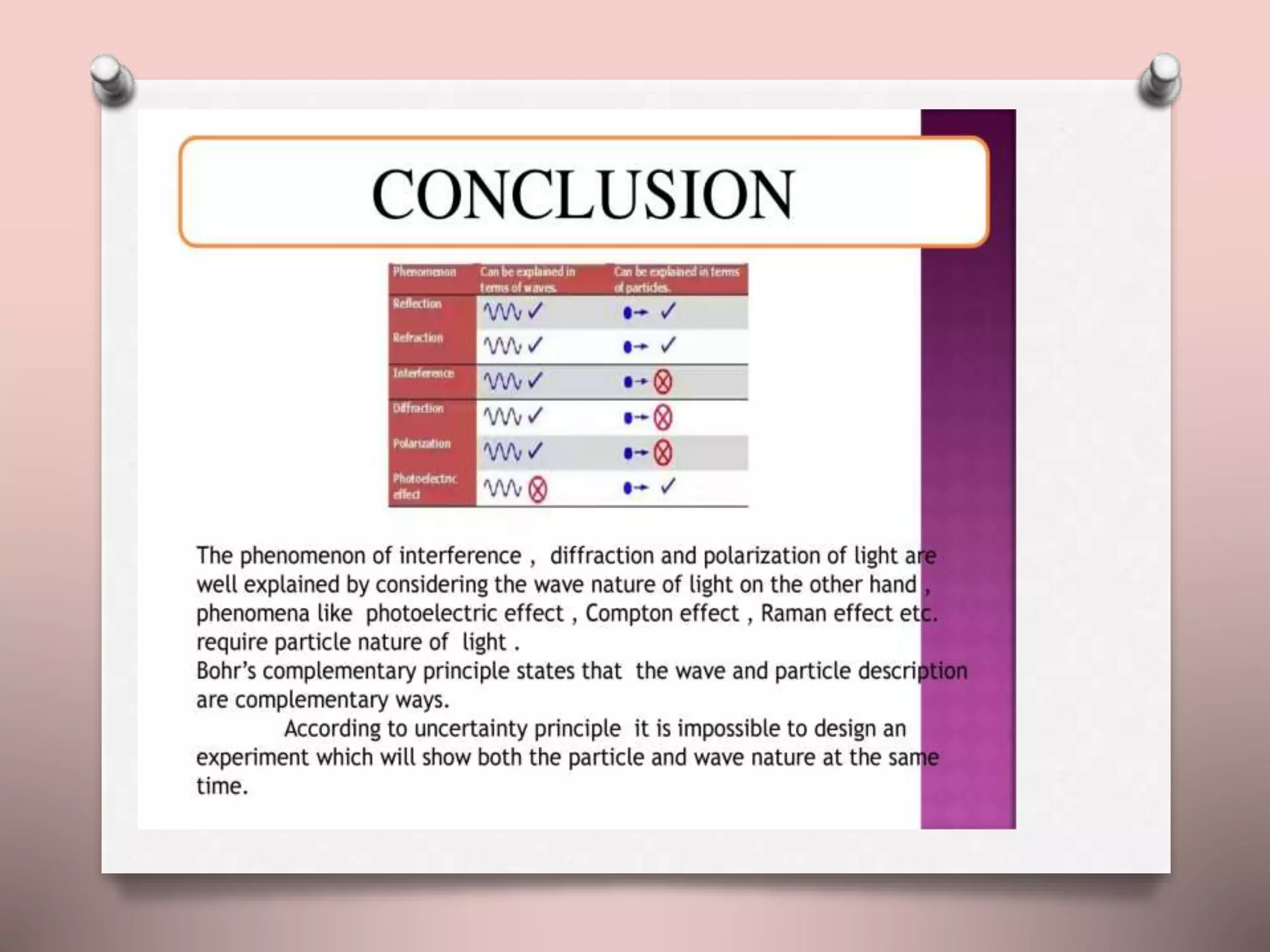
Wave-particle duality postulates that all particles exhibit both wave and particle properties under different experimental conditions. Historically, debates centered around whether light was a wave or particle. Key experiments and theorists helped establish the dual nature of light and matter, including:
- Einstein showing light has particle-like photons; Compton effect confirming this.
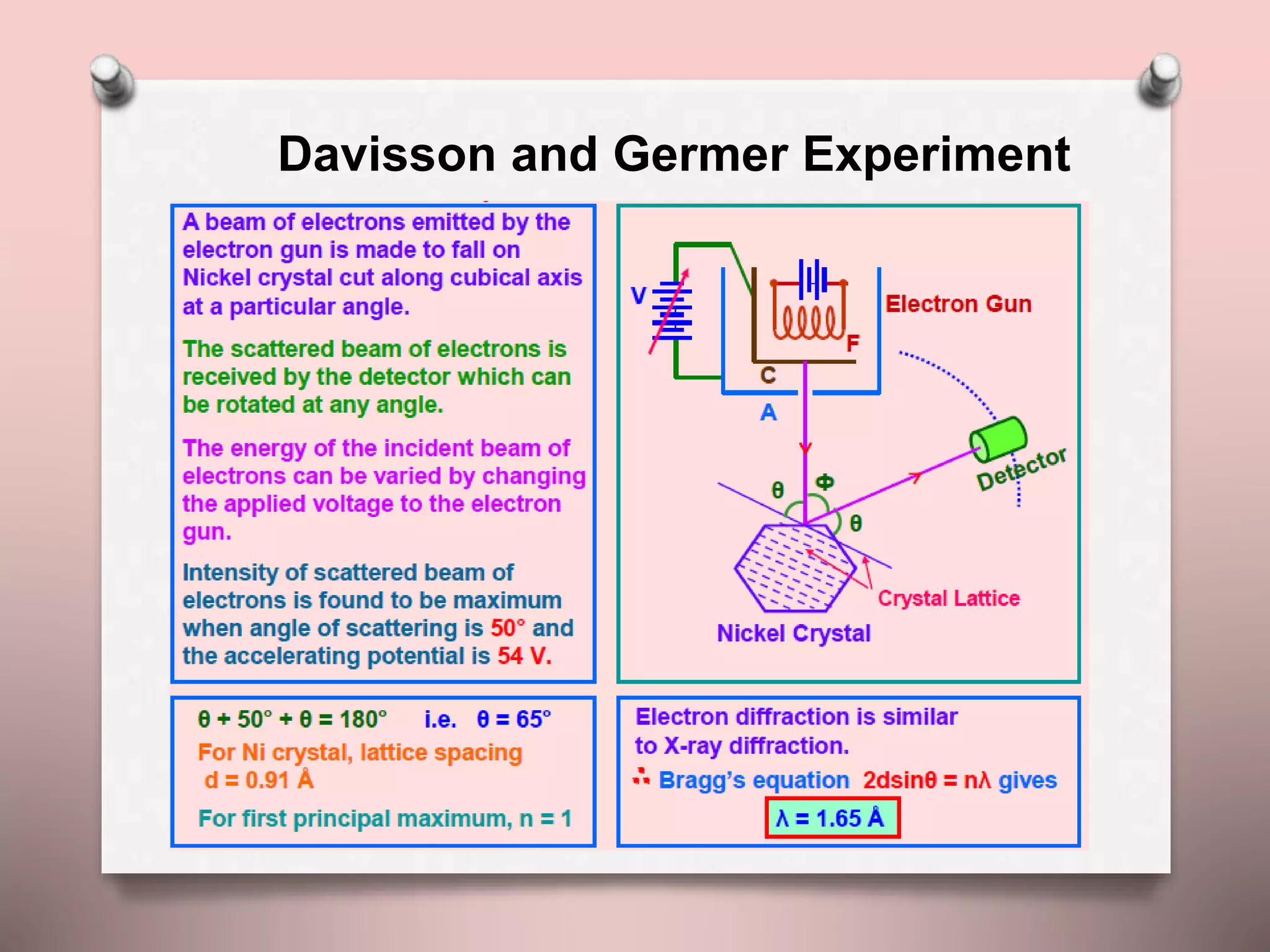
- De Broglie proposing electrons and matter have wave properties like wavelength and frequency. Davisson and Germer experimentally verified the wave nature of electrons.
- The double slit experiment demonstrated the wave behavior of electrons through an interference pattern, shocking as electrons were considered particles. This supported matter having wave-particle duality.
O For morethan 2000 years, people debated: is light a
wave or particle?
O The first to publicly hypothesize about the nature of
light, proposing that light is a disturbance in the
element air was Aristotle
O Newton (1700s) – light = stream of particles
(“corpuscles”); Huygens = wave theory.
O Albert Einstein first showed (1905) that light, which
had been considered a form of electromagnetic
waves, must also be thought of as particle-like,
localized in packets of discrete energy.
O The observations of the Compton effect (1922) by
American physicist Arthur Holly Compton could be
explained only if light had a wave-particle duality.
5.
O French physicistLouis de Broglie proposed
(1924) that electrons and other discrete bits of
matter, which until then had been conceived only
as material particles, also have wave properties
such as wavelength and frequency.
O Later (1927) the wave nature of electrons was
experimentally established by American
physicists Clinton Davisson and Lester Germer
and independently by English physicist George
Paget Thomson.
O An understanding of the complementary relation
between the wave aspects and the particle
aspects of the same phenomenon was
announced by Danish physicist Niels Bohr in
1928 .
6.
Basic Idea
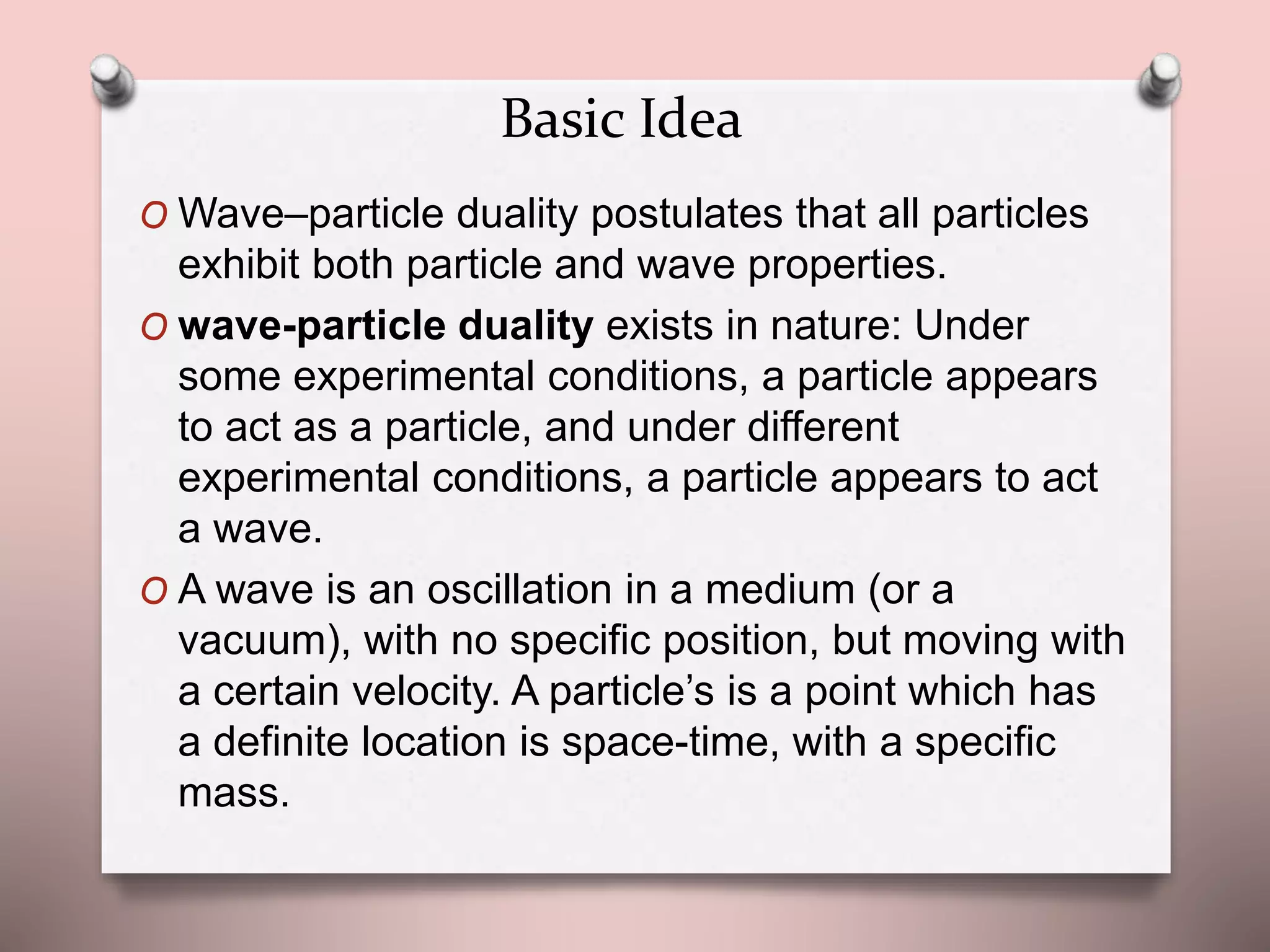
O Wave–particleduality postulates that all particles
exhibit both particle and wave properties.
O wave-particle duality exists in nature: Under
some experimental conditions, a particle appears
to act as a particle, and under different
experimental conditions, a particle appears to act
a wave.
O A wave is an oscillation in a medium (or a
vacuum), with no specific position, but moving with
a certain velocity. A particle’s is a point which has
a definite location is space-time, with a specific
mass.
9.
The Particle natureof EM radiation
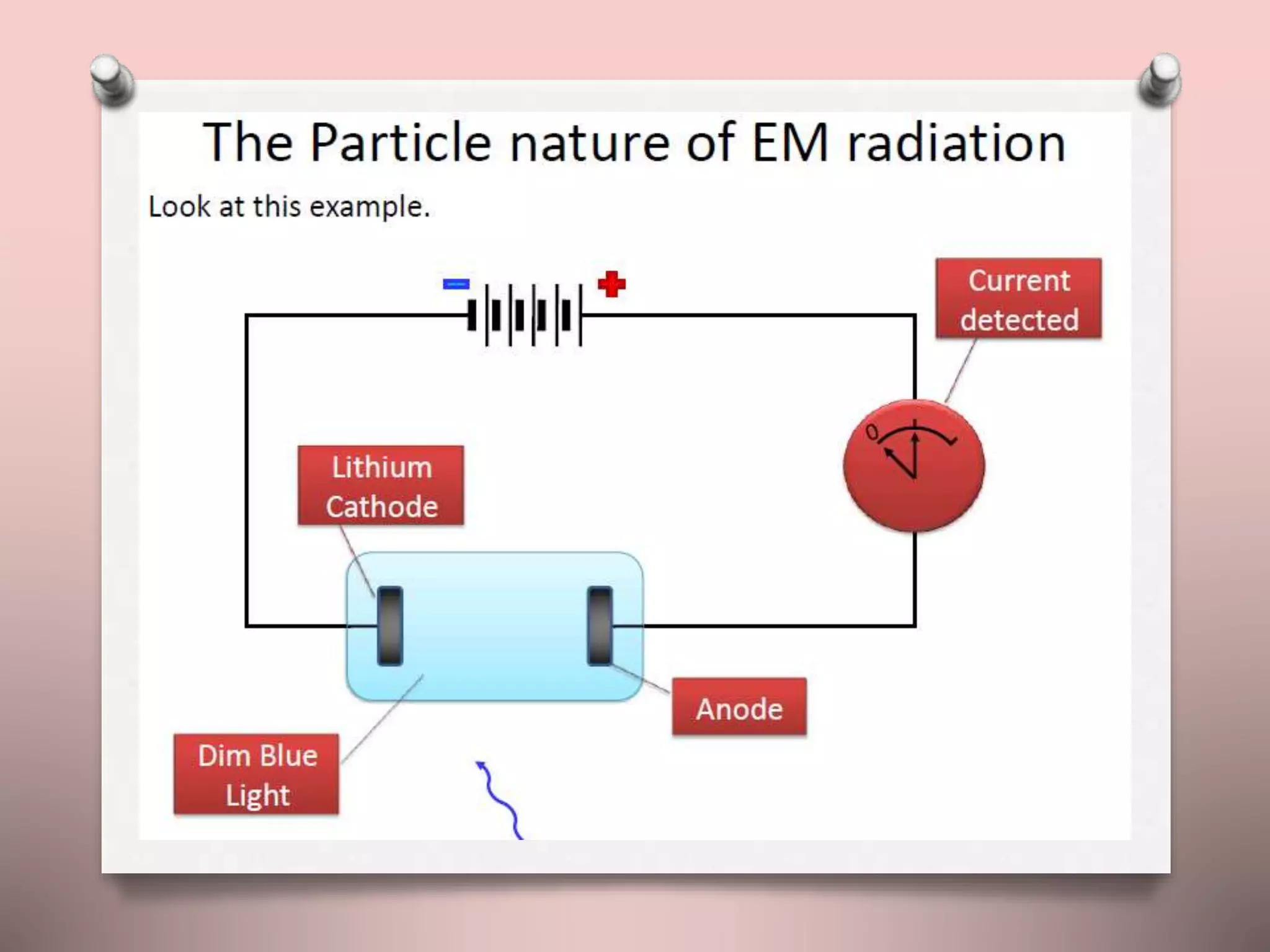
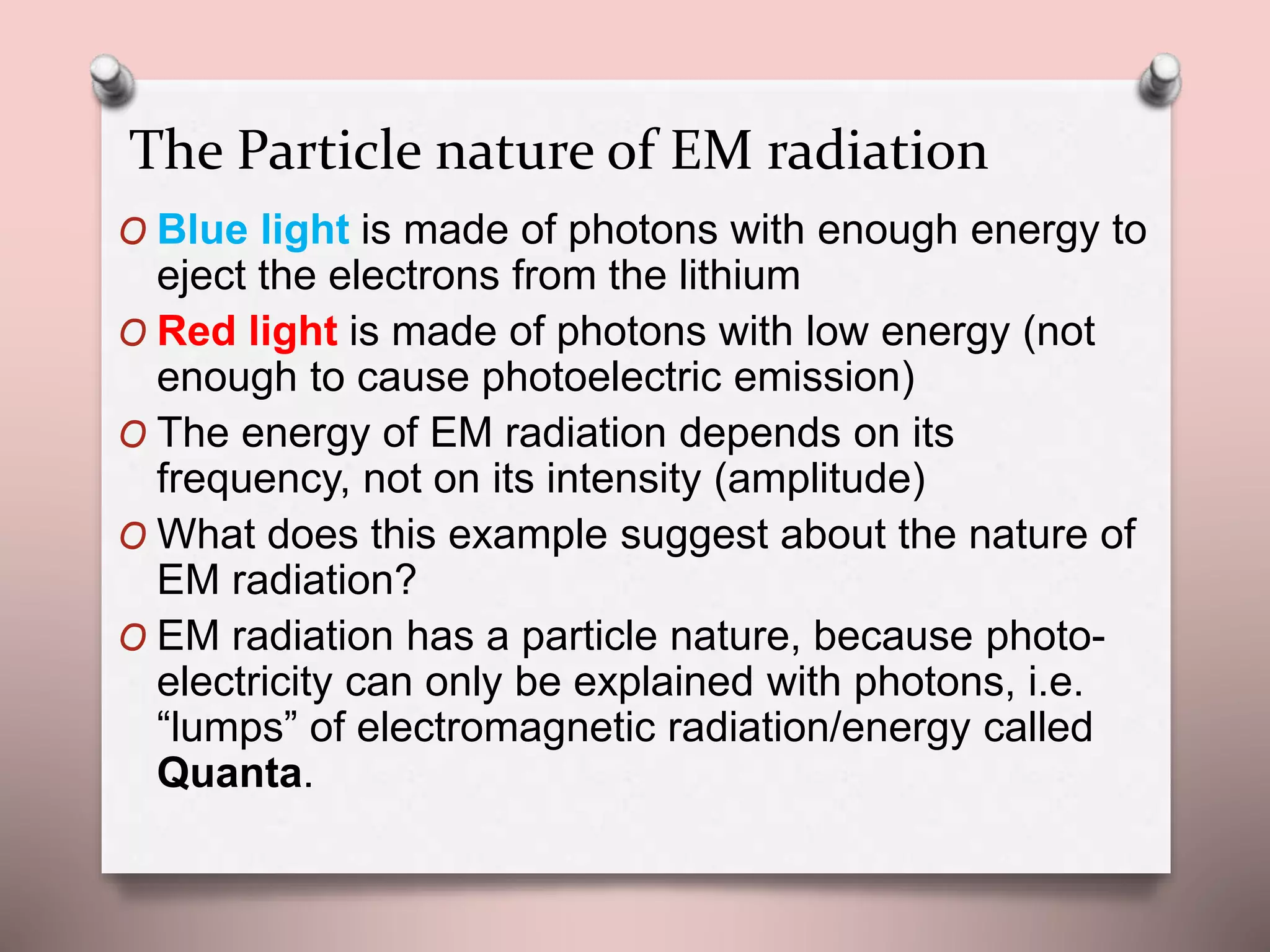
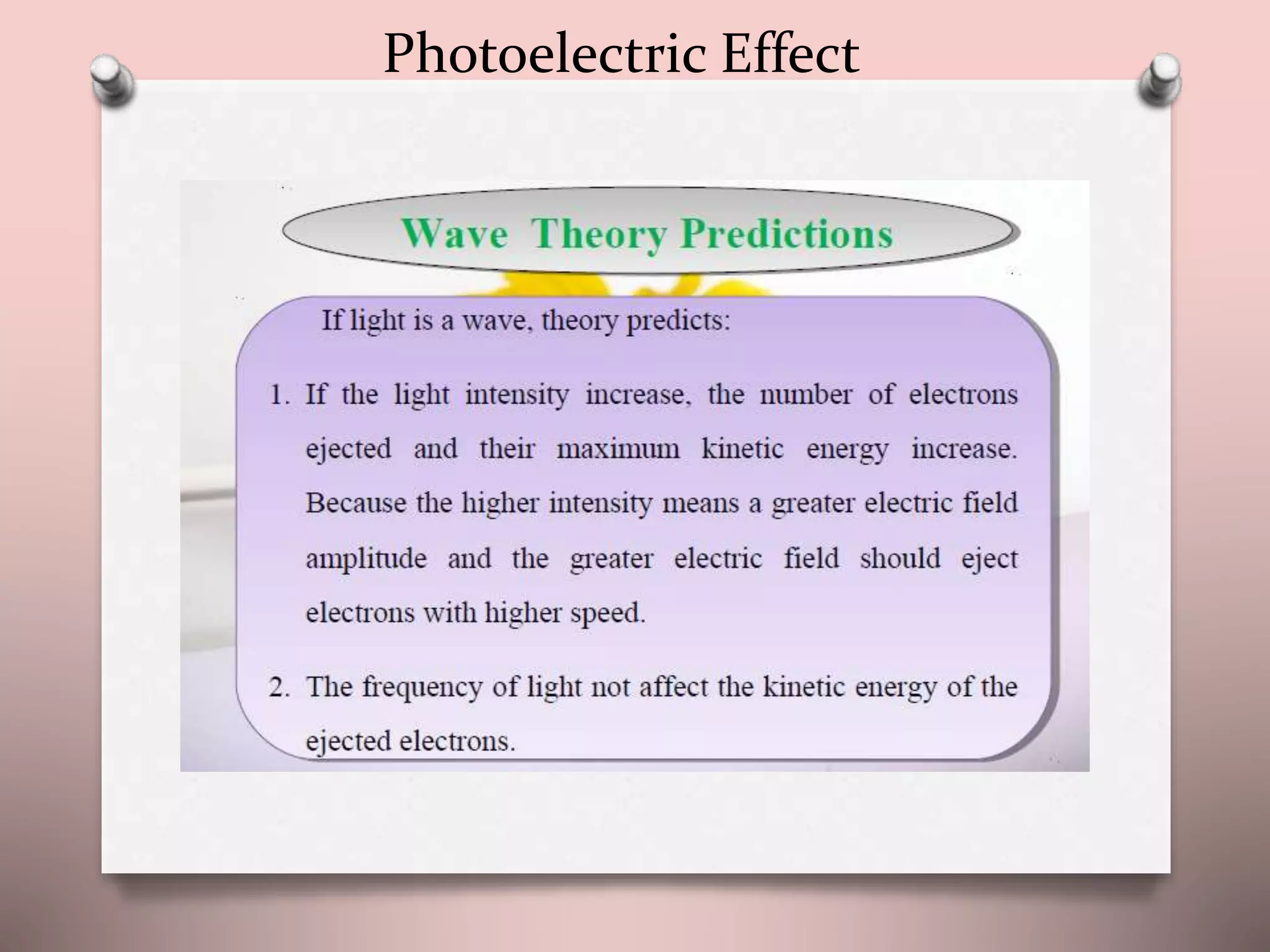
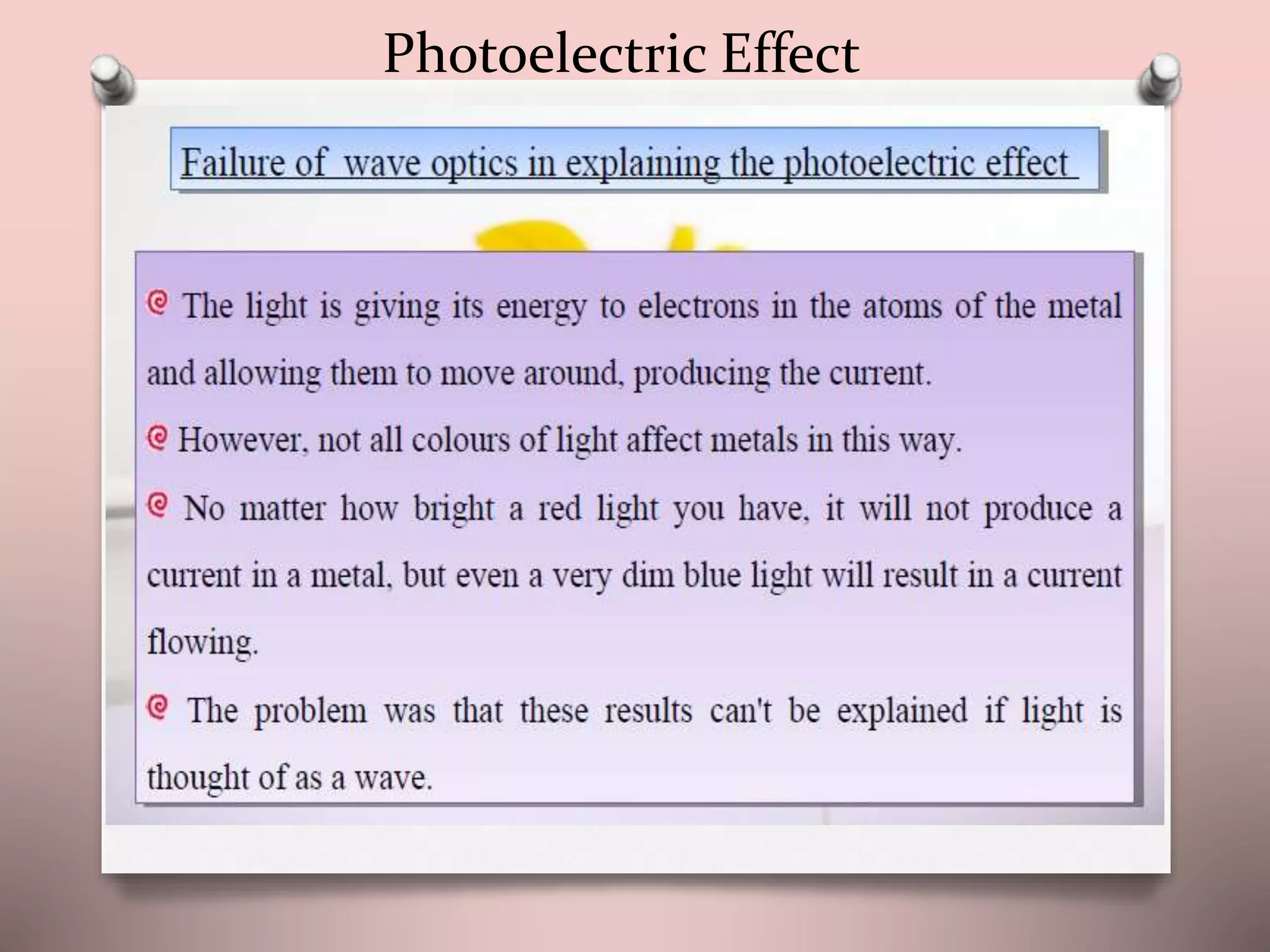
O Blue light is made of photons with enough energy to
eject the electrons from the lithium
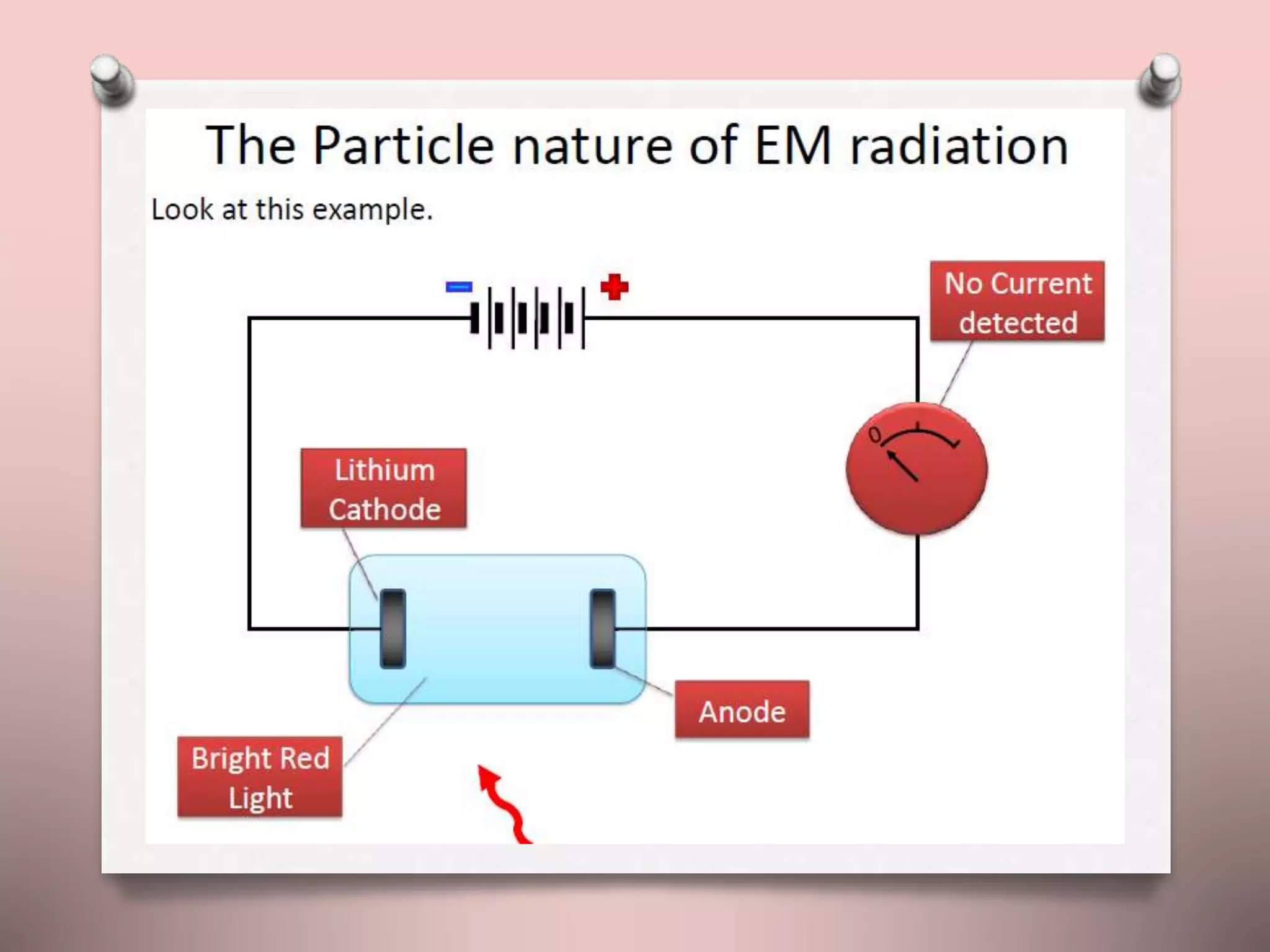
O Red light is made of photons with low energy (not
enough to cause photoelectric emission)
O The energy of EM radiation depends on its
frequency, not on its intensity (amplitude)
O What does this example suggest about the nature of
EM radiation?
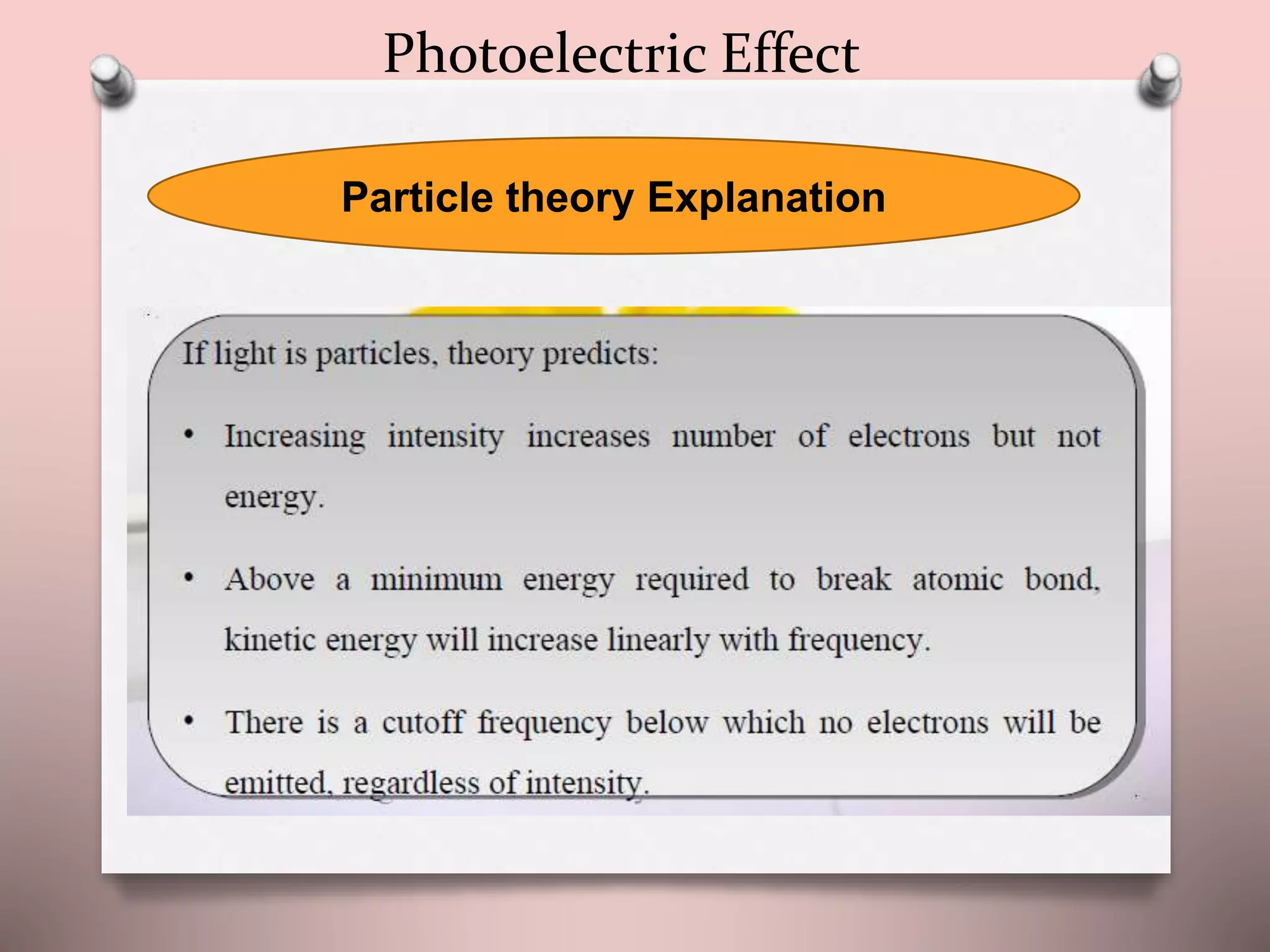
O EM radiation has a particle nature, because photo-
electricity can only be explained with photons, i.e.
“lumps” of electromagnetic radiation/energy called
Quanta.
10.
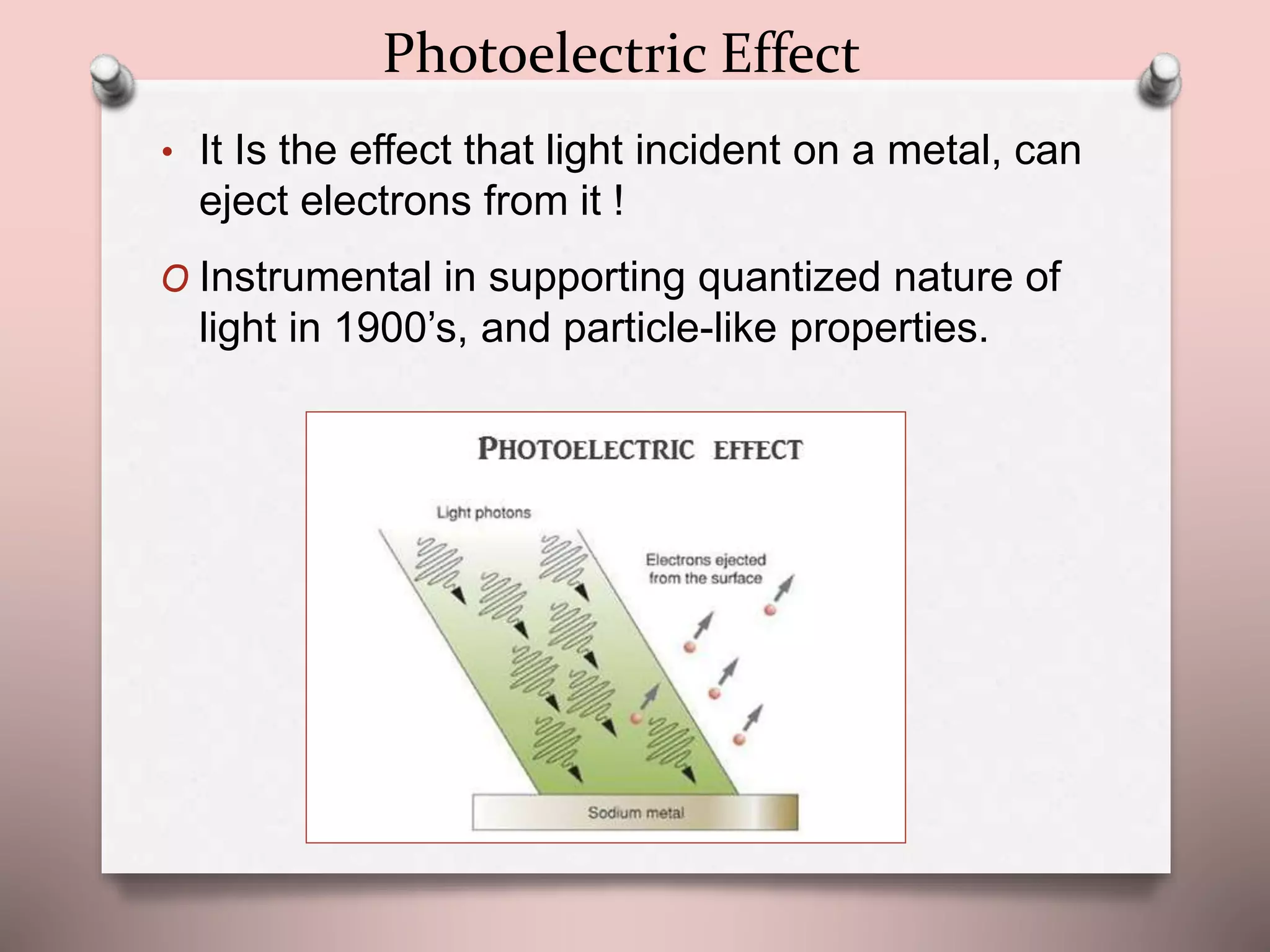
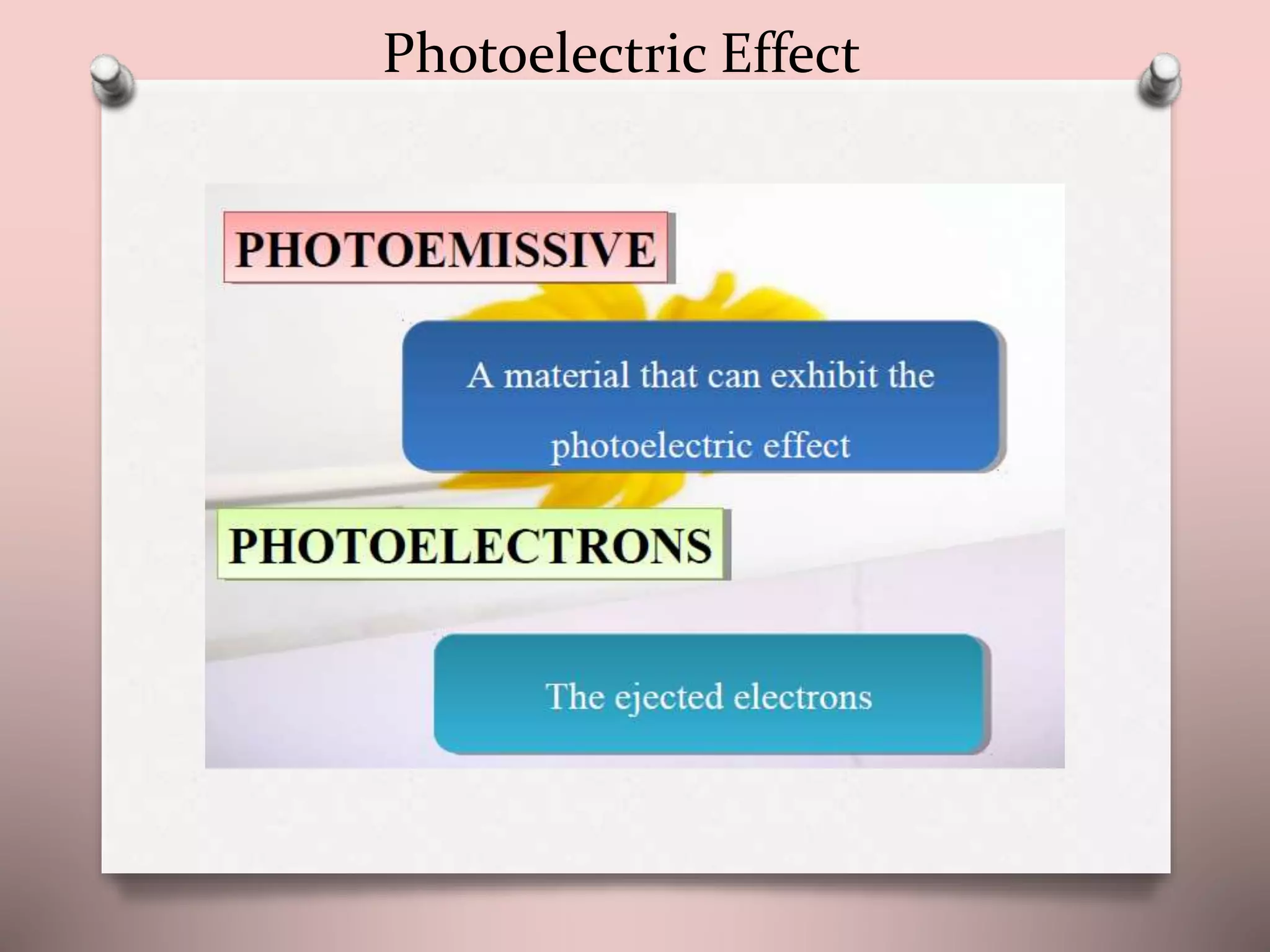
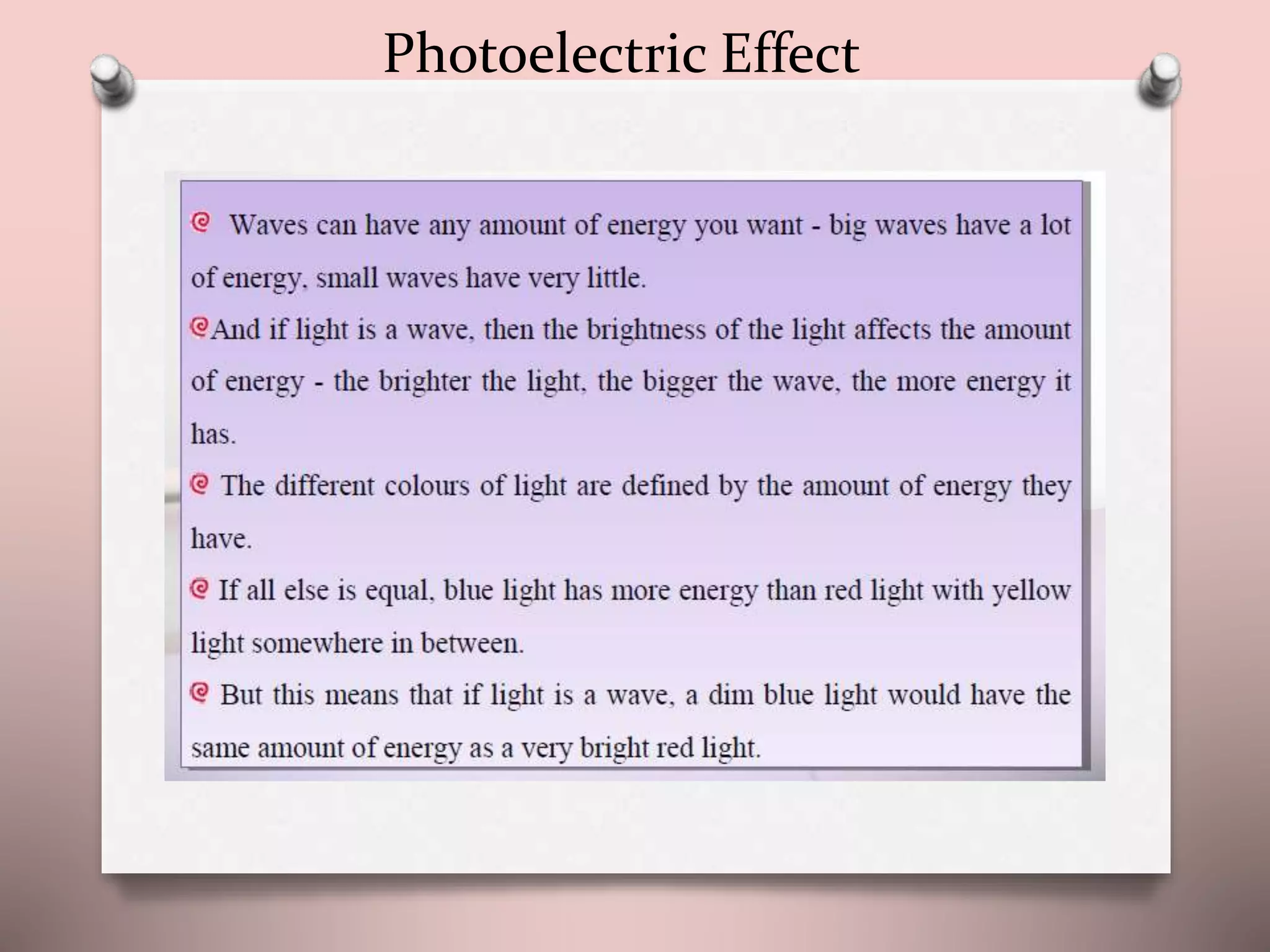
Photoelectric Effect
• ItIs the effect that light incident on a metal, can
eject electrons from it !
O Instrumental in supporting quantized nature of
light in 1900’s, and particle-like properties.
The Wave natureof electrons
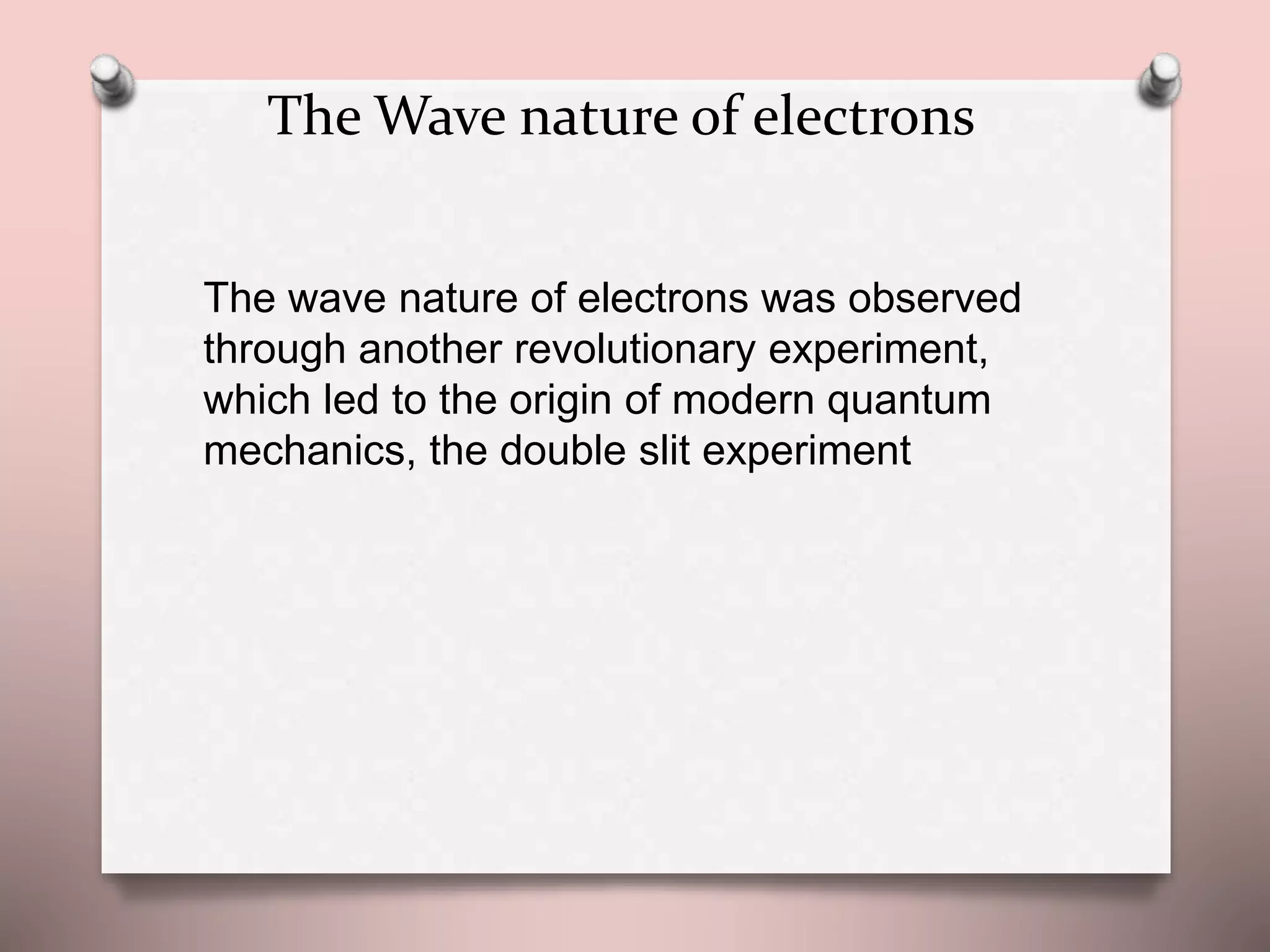
The wave nature of electrons was observed
through another revolutionary experiment,
which led to the origin of modern quantum
mechanics, the double slit experiment
17.
Interference of light
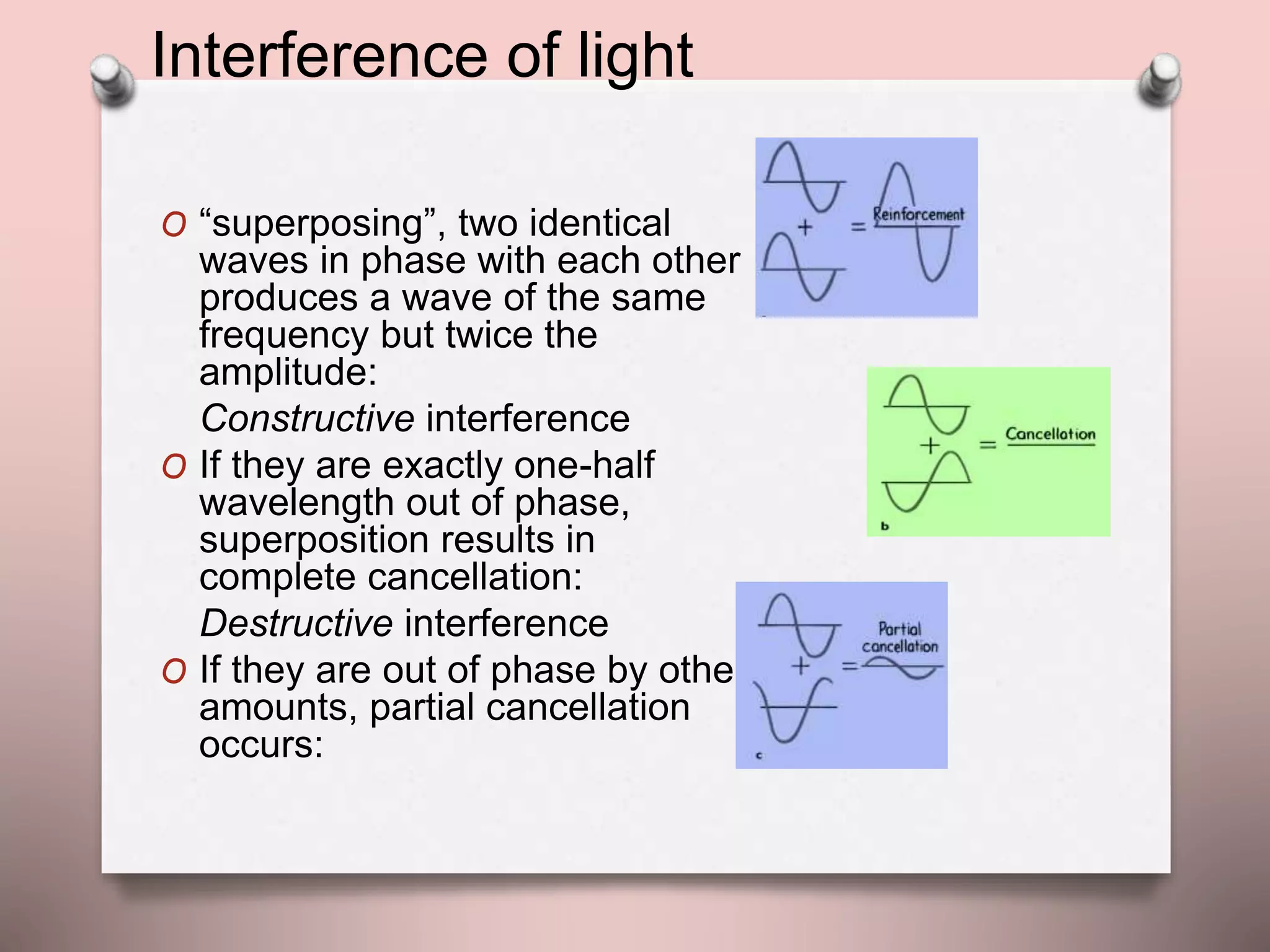
O“superposing”, two identical
waves in phase with each other
produces a wave of the same
frequency but twice the
amplitude:
Constructive interference
O If they are exactly one-half
wavelength out of phase,
superposition results in
complete cancellation:
Destructive interference
O If they are out of phase by other
amounts, partial cancellation
occurs:
18.
A beam ofelectrons is passed through the
slits, and is observed by the screen placed
behind it. The shocking result is that instead
of there being two blobs/heaps of several
electrons right behind the two slits, instead
an interference pattern of light and dark
bands is observed. This is exactly what we
would expect from a wave, but why was this
observed in the case of electrons? The most
logical reasoning - the electron had wave-like
nature.
Interference of light
young’s double slit experiment
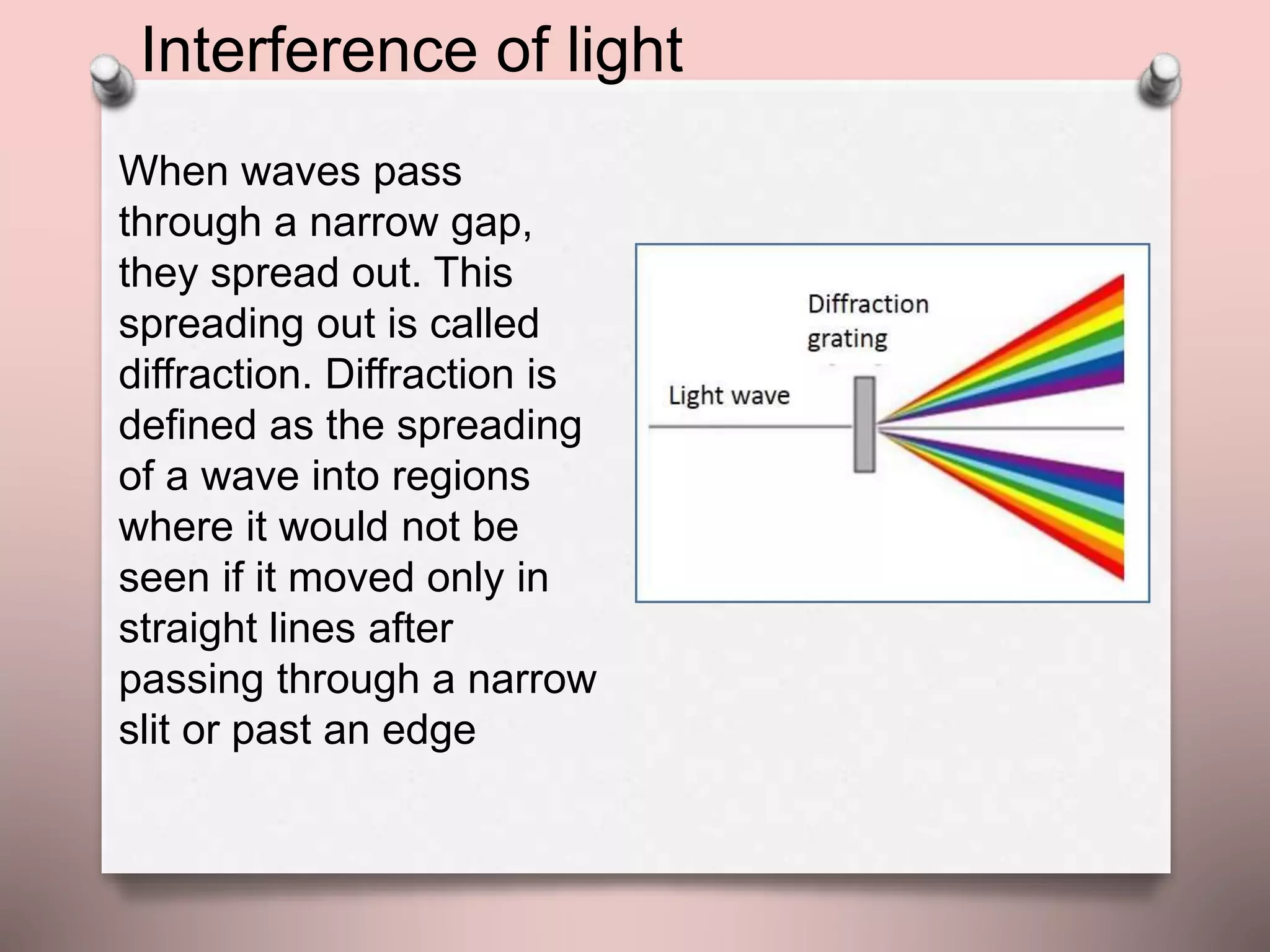
When waves pass
througha narrow gap,
they spread out. This
spreading out is called
diffraction. Diffraction is
defined as the spreading
of a wave into regions
where it would not be
seen if it moved only in
straight lines after
passing through a narrow
slit or past an edge
Interference of light
21.
• Light behaveslike a wave when travelling from a
source to the place where it is detected.
-- cannot explain interference pattern using
particles, since a stream of particles coming through
each slit would come through independently of one
another, striking the screen in two localized regions.
No fringe pattern.
• Light behaves as a particle (photon) when it is
being emitted or when being absorbed at a detector
e.g. photoelectric effect, or absorption by a
photographic film (next slide)
23.
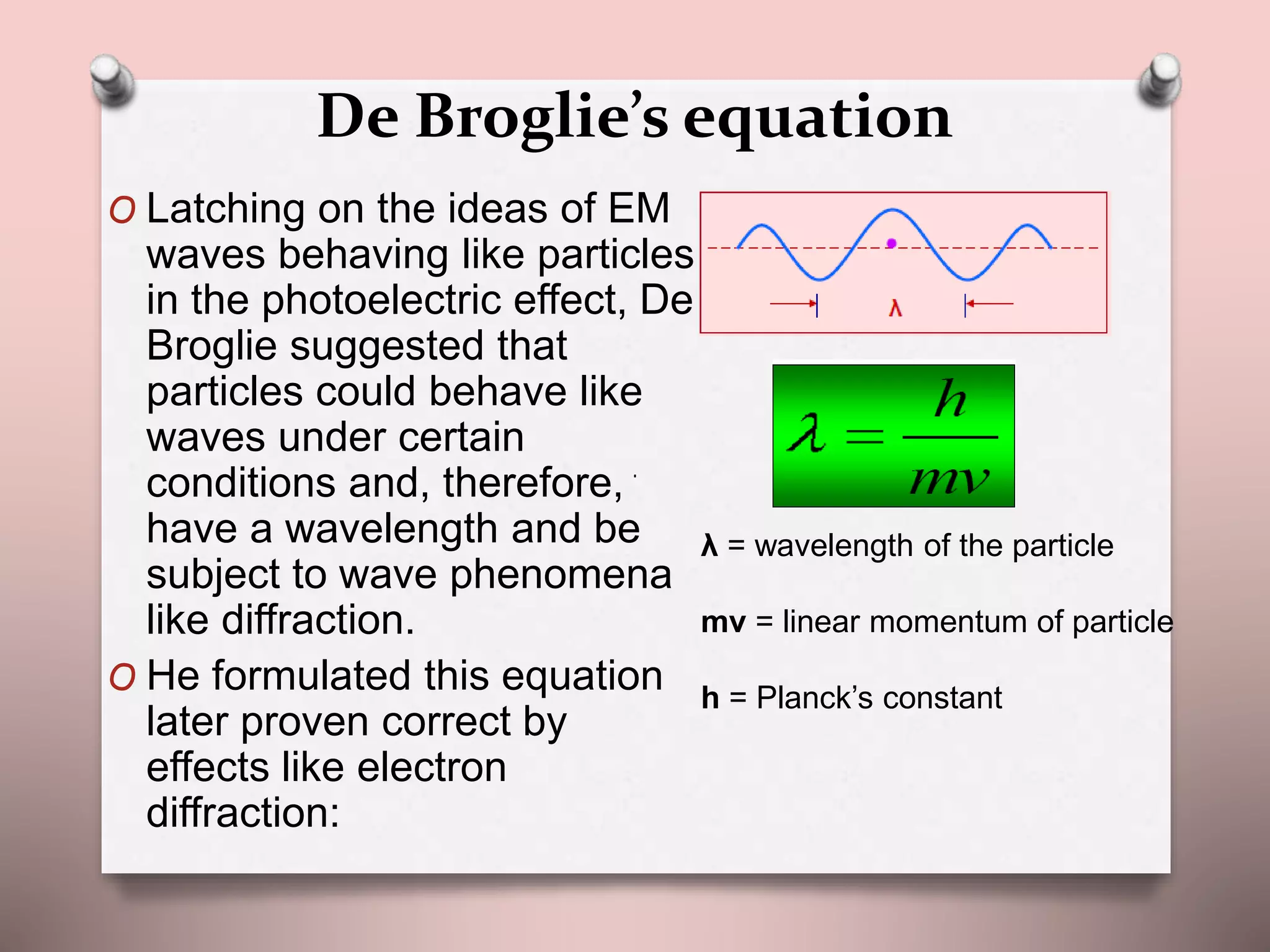
De Broglie’s equation
OLatching on the ideas of EM
waves behaving like particles
in the photoelectric effect, De
Broglie suggested that
particles could behave like
waves under certain
conditions and, therefore,
have a wavelength and be
subject to wave phenomena
like diffraction.
O He formulated this equation
later proven correct by
effects like electron
diffraction:
λ = wavelength of the particle
mv = linear momentum of particle
h = Planck’s constant
24.
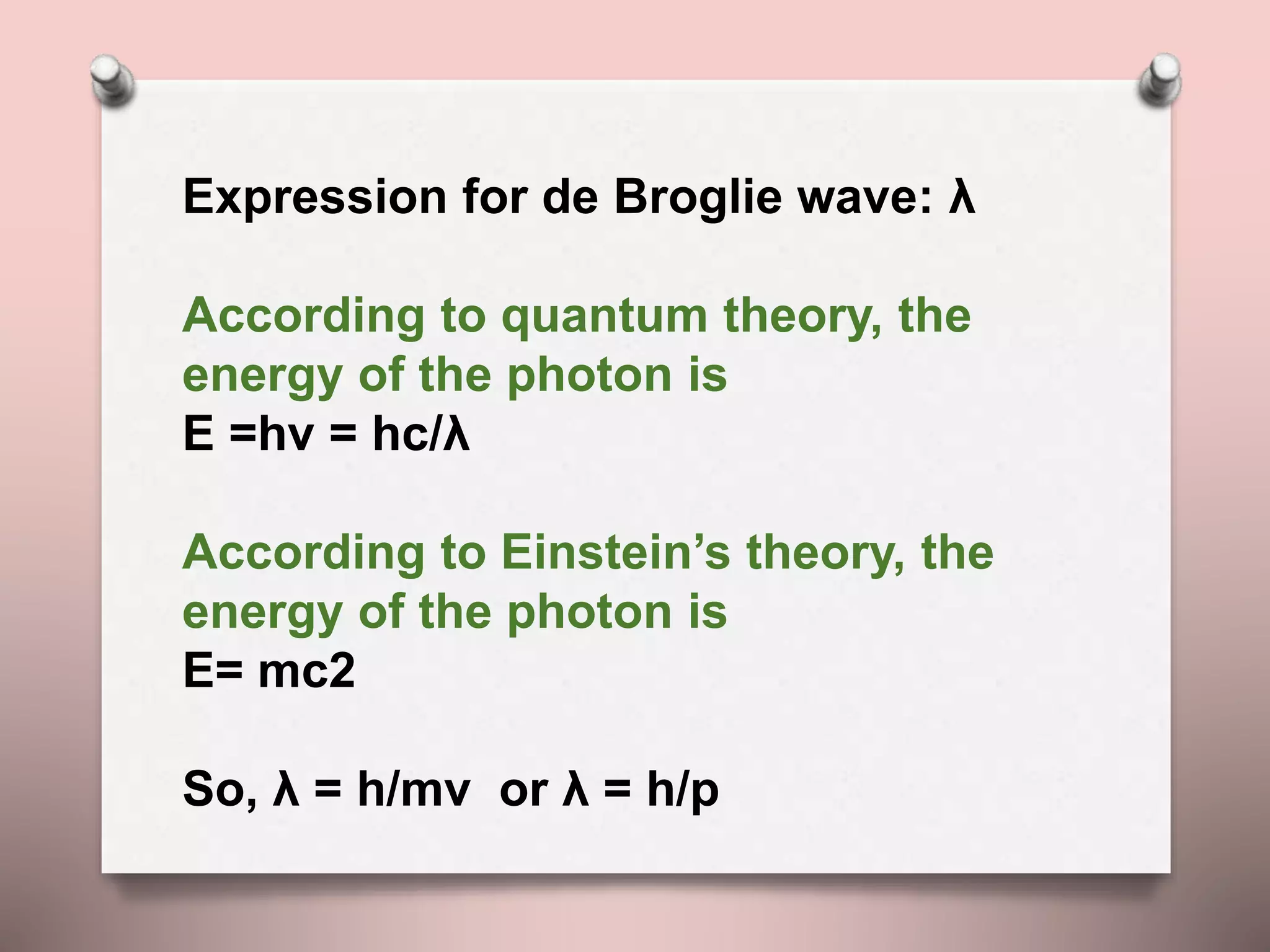
Expression for deBroglie wave: λ
According to quantum theory, the
energy of the photon is
E =hν = hc/λ
According to Einstein’s theory, the
energy of the photon is
E= mc2
So, λ = h/mv or λ = h/p
25.
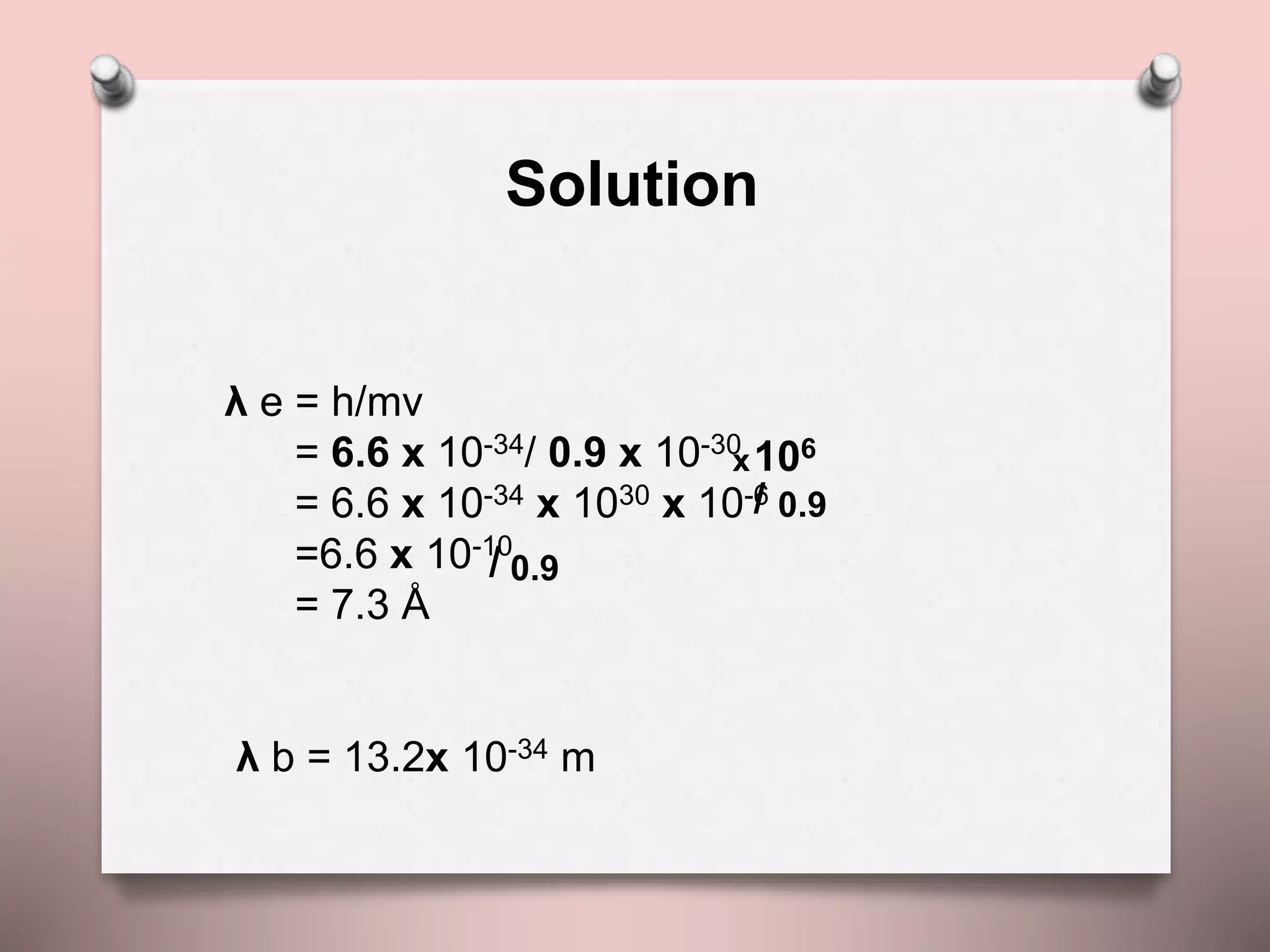
Work out thewavelength of an electron
of mass 0.9 x 10⁻³⁰ kg travelling at a
speed of 106 m/s, and a tennis ball of
mass 0.05 kg travelling at a speed of 10
m/s.
h= 6.6 x 10⁻³⁴
Joule seconds
26.
λ e =h/mv
= 6.6 x 10⁻³⁴/ 0.9 x 10-30
= 6.6 x 10-34 x 1030 x 10-6
=6.6 x 10-10
= 7.3 Å
λ b = 13.2x 10-34 m
x106
/ 0.9
/ 0.9
Solution