

Bulk Transport Across
Biomembrane
Prepared by:
Abdallah M. Youssof
PhD Student, College of
Pharmacy, KSU
ayoussof@ksu.edu.sa
2
OUTLINES
I. Goals
II. Introduction
III. Endocytosis
IV. Exocytosis
V. Conclusions
VII. Questions
3
I. Goals of the this lecture
By the end of this lecture you will be able to:
1. Define endocytosis and exocytosis
2. Compare between different endocytosis processes
3. Explain with examples some diseases associated with
malfunction of bulk transport
4. Answer MCQs on bulk transport
4
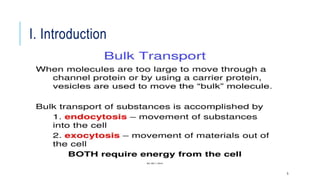
I. Introduction
5
II. Endocytosis
6
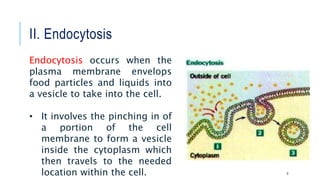
Endocytosis occurs when the
plasma membrane envelops
food particles and liquids into
a vesicle to take into the cell.
• It involves the pinching in of
a portion of the cell
membrane to form a vesicle
inside the cytoplasm which
then travels to the needed
location within the cell.
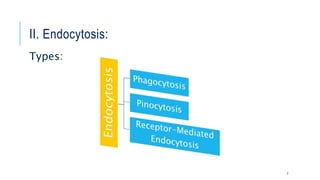
II. Endocytosis:
7
Types:
II. Endocytosis
8
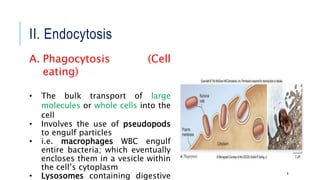
A. Phagocytosis (Cell
eating)
• The bulk transport of large
molecules or whole cells into the
cell
• Involves the use of pseudopods
to engulf particles
• i.e. macrophages WBC engulf
entire bacteria; which eventually
encloses them in a vesicle within
the cell’s cytoplasm
• Lysosomes containing digestive
II. Endocytosis
9
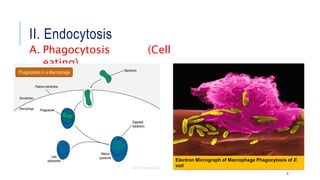
A. Phagocytosis (Cell
eating)
Electron Micrograph of Macrophage Phagocytosis of E.
coli
II. Endocytosis
10
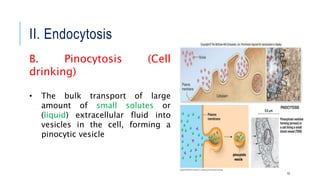
B. Pinocytosis (Cell
drinking)
• The bulk transport of large
amount of small solutes or
(liquid) extracellular fluid into
vesicles in the cell, forming a
pinocytic vesicle
II. Endocytosis
11
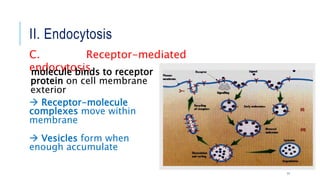
C. Receptor-mediated
endocytosismolecule binds to receptor
protein on cell membrane
exterior
 Receptor-molecule
complexes move within
membrane
 Vesicles form when
enough accumulate
II. Endocytosis
12
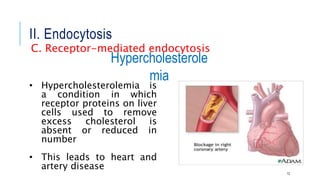
• Hypercholesterolemia is
a condition in which
receptor proteins on liver
cells used to remove
excess cholesterol is
absent or reduced in
number
• This leads to heart and
artery disease
Hypercholesterole
mia
C. Receptor-mediated endocytosis
III. Exocytosis
13
Exocytosis occurs to move large amounts
of a material out of the cell in a process
which is the reverse of endocytosis
• Some cells produce substances for export like
proteins (i.e. hormones, enzymes)
III. Exocytosis
14
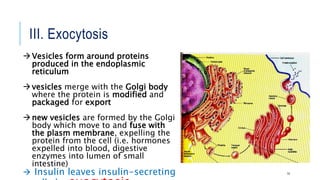
Vesicles form around proteins
produced in the endoplasmic
reticulum
vesicles merge with the Golgi body
where the protein is modified and
packaged for export
new vesicles are formed by the Golgi
body which move to and fuse with
the plasm membrane, expelling the
protein from the cell (i.e. hormones
expelled into blood, digestive
enzymes into lumen of small
intestine)
 Insulin leaves insulin-secreting
IV. Conclusions
• Bulk transport occurs for large molecules/quantities need
to be transported into/out of the cell (i.e. proteins,
bacteria, viruses, liposomes and micelles)
• Phagocytosis is known as cell eating, while pinocytosis as
cell drinking
• Exocytosis is the reverse of endocytosis
• Insulin and cholesterol are transported by receptor-
15
V. Questions
16
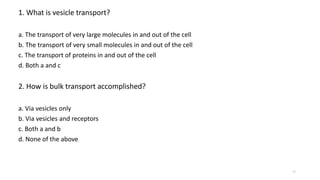
1. What is vesicle transport?
a. The transport of very large molecules in and out of the cell
b. The transport of very small molecules in and out of the cell
c. The transport of proteins in and out of the cell
d. Both a and c
2. How is bulk transport accomplished?
a. Via vesicles only
b. Via vesicles and receptors
c. Both a and b
d. None of the above
17
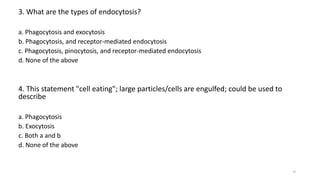
3. What are the types of endocytosis?
a. Phagocytosis and exocytosis
b. Phagocytosis, and receptor-mediated endocytosis
c. Phagocytosis, pinocytosis, and receptor-mediated endocytosis
d. None of the above
4. This statement "cell eating"; large particles/cells are engulfed; could be used to
describe
a. Phagocytosis
b. Exocytosis
c. Both a and b
d. None of the above
18
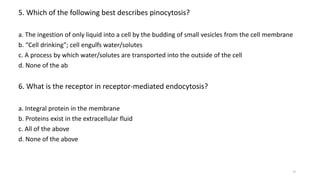
5. Which of the following best describes pinocytosis?
a. The ingestion of only liquid into a cell by the budding of small vesicles from the cell membrane
b. “Cell drinking"; cell engulfs water/solutes
c. A process by which water/solutes are transported into the outside of the cell
d. None of the ab
6. What is the receptor in receptor-mediated endocytosis?
a. Integral protein in the membrane
b. Proteins exist in the extracellular fluid
c. All of the above
d. None of the above
19
7. An example (s) of receptor-mediated endocytosis
a. Insulin
b. Cholesterol
c. Low density lipoproteins
d. All of the above
8. Why is bulk transport a form of active transport? Because
a. Energy is not needed for breaking and reforming of the membrane
b. Energy is needed for breaking and reforming of the membrane
c. Molecules move from area of high concentration to area of low concentration
d. None of the above
20
9. Regarding exocytosis, which of the following is/are correct?
a. The process by which a substance is released from the cell
b. Vesicles transport the substance to the cell surface and then fuses with the cell membrane
c. To transport substances into the cell
d. Both a and b
10. Bulk transport can be defined as
a. A para-cellular transport
b. A transcellular transport
c. All of the above
d. None of the above
21
22
23

Bulk / Vesicle Transport

  • 1.
    Bulk Transport Across Biomembrane Preparedby: Abdallah M. Youssof PhD Student, College of Pharmacy, KSU ayoussof@ksu.edu.sa
  • 2.
  • 3.
    OUTLINES I. Goals II. Introduction III.Endocytosis IV. Exocytosis V. Conclusions VII. Questions 3
  • 4.
    I. Goals ofthe this lecture By the end of this lecture you will be able to: 1. Define endocytosis and exocytosis 2. Compare between different endocytosis processes 3. Explain with examples some diseases associated with malfunction of bulk transport 4. Answer MCQs on bulk transport 4
  • 5.
  • 6.
    II. Endocytosis 6 Endocytosis occurswhen the plasma membrane envelops food particles and liquids into a vesicle to take into the cell. • It involves the pinching in of a portion of the cell membrane to form a vesicle inside the cytoplasm which then travels to the needed location within the cell.
  • 7.
  • 8.
    II. Endocytosis 8 A. Phagocytosis(Cell eating) • The bulk transport of large molecules or whole cells into the cell • Involves the use of pseudopods to engulf particles • i.e. macrophages WBC engulf entire bacteria; which eventually encloses them in a vesicle within the cell’s cytoplasm • Lysosomes containing digestive
  • 9.
    II. Endocytosis 9 A. Phagocytosis(Cell eating) Electron Micrograph of Macrophage Phagocytosis of E. coli
  • 10.
    II. Endocytosis 10 B. Pinocytosis(Cell drinking) • The bulk transport of large amount of small solutes or (liquid) extracellular fluid into vesicles in the cell, forming a pinocytic vesicle
  • 11.
    II. Endocytosis 11 C. Receptor-mediated endocytosismoleculebinds to receptor protein on cell membrane exterior  Receptor-molecule complexes move within membrane  Vesicles form when enough accumulate
  • 12.
    II. Endocytosis 12 • Hypercholesterolemiais a condition in which receptor proteins on liver cells used to remove excess cholesterol is absent or reduced in number • This leads to heart and artery disease Hypercholesterole mia C. Receptor-mediated endocytosis
  • 13.
    III. Exocytosis 13 Exocytosis occursto move large amounts of a material out of the cell in a process which is the reverse of endocytosis • Some cells produce substances for export like proteins (i.e. hormones, enzymes)
  • 14.
    III. Exocytosis 14 Vesicles formaround proteins produced in the endoplasmic reticulum vesicles merge with the Golgi body where the protein is modified and packaged for export new vesicles are formed by the Golgi body which move to and fuse with the plasm membrane, expelling the protein from the cell (i.e. hormones expelled into blood, digestive enzymes into lumen of small intestine)  Insulin leaves insulin-secreting
  • 15.
    IV. Conclusions • Bulktransport occurs for large molecules/quantities need to be transported into/out of the cell (i.e. proteins, bacteria, viruses, liposomes and micelles) • Phagocytosis is known as cell eating, while pinocytosis as cell drinking • Exocytosis is the reverse of endocytosis • Insulin and cholesterol are transported by receptor- 15
  • 16.
  • 17.
    1. What isvesicle transport? a. The transport of very large molecules in and out of the cell b. The transport of very small molecules in and out of the cell c. The transport of proteins in and out of the cell d. Both a and c 2. How is bulk transport accomplished? a. Via vesicles only b. Via vesicles and receptors c. Both a and b d. None of the above 17
  • 18.
    3. What arethe types of endocytosis? a. Phagocytosis and exocytosis b. Phagocytosis, and receptor-mediated endocytosis c. Phagocytosis, pinocytosis, and receptor-mediated endocytosis d. None of the above 4. This statement "cell eating"; large particles/cells are engulfed; could be used to describe a. Phagocytosis b. Exocytosis c. Both a and b d. None of the above 18
  • 19.
    5. Which ofthe following best describes pinocytosis? a. The ingestion of only liquid into a cell by the budding of small vesicles from the cell membrane b. “Cell drinking"; cell engulfs water/solutes c. A process by which water/solutes are transported into the outside of the cell d. None of the ab 6. What is the receptor in receptor-mediated endocytosis? a. Integral protein in the membrane b. Proteins exist in the extracellular fluid c. All of the above d. None of the above 19
  • 20.
    7. An example(s) of receptor-mediated endocytosis a. Insulin b. Cholesterol c. Low density lipoproteins d. All of the above 8. Why is bulk transport a form of active transport? Because a. Energy is not needed for breaking and reforming of the membrane b. Energy is needed for breaking and reforming of the membrane c. Molecules move from area of high concentration to area of low concentration d. None of the above 20
  • 21.
    9. Regarding exocytosis,which of the following is/are correct? a. The process by which a substance is released from the cell b. Vesicles transport the substance to the cell surface and then fuses with the cell membrane c. To transport substances into the cell d. Both a and b 10. Bulk transport can be defined as a. A para-cellular transport b. A transcellular transport c. All of the above d. None of the above 21
  • 22.
  • 23.

Editor's Notes

  • #2 Our lecture today is about
  • #13 It is a condition characterized by the absence or low availability of receptor proteins located on liver cells which are used to remove excess cholesterol