Membrane Structure and Function
Plasma MembraneThe membrane at the boundary of every cell.Functions as a selective barrier for the passage of materials in and out of cells.
Membrane CompositionLipidsProteins
Fluid Mosaic ModelRefers to the way the lipids and proteins behave in a membrane.
“Fluid”Refers to the lipid bilayer.Molecules are not bonded together, so are free to shift. Must remain "fluid" for membranes to function.
“Mosaic”Proteins: float in a sea of lipids.Proteins form a collage or mosaic pattern that shifts over time.
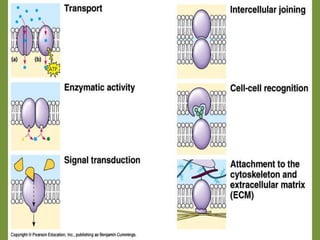
Protein Function in MembranesTransport.Enzymatic activity.Receptor sites for signals.Cell adhesion.Cell-cell recognition.Attachment to the cytoskeleton.
Types of Membrane ProteinsIntegral - inserted into the lipid bilayer.Peripheral - not embedded in the lipid bilayer, but are attached to the membrane surface.
Membranes are BifacialThe lipid composition of the two layers is different.The proteins have specific orientations.  Carbohydrates are found only on the outer surface.
QuestionHow do materials get across a cell's membrane?
ProblemsLipid bilayer is hydrophobic.  Hydrophilic materials don't cross easily. Large molecules don't cross easily.  Too big to get through the membrane.
Mechanisms1.  Passive Transport2.  Active Transport
Passive TransportMovement across membranes that does NOT require cellular energy.
Types of Passive Transport1.  Diffusion2.  Osmosis3.  Facilitated Diffusion
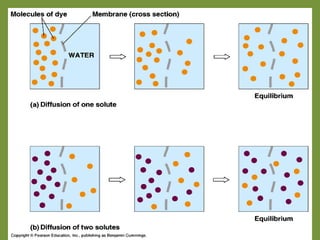
DiffusionThe net movement of atoms, ions or molecules down a concentration gradient.Movement is from:             	High          Low
EquilibriumWhen the concentration is equal on both sides.  There is no net movement of materials.
Factors that Effect Diffusion1.  Concentration2.  Temperature3.  Pressure4.  Particle size5.  Mixing
OsmosisDiffusion of water.Water moving from an area if its high concentration to an area of its low concentration.No cell energy is used.
TonicityThe concentration of water relative to a cell. 1.  Isotonic (same)2.  Hypotonic (below)3.  Hypertonic (above)
Isotonic Isosmotic solution.Cell and water are equal in solute concentration.No net movement of water in or out of the cell.No change in cell size.
HypotonicHypoosmotic solutionCell's water is lower than the outside water (more solutes).Water moves into the cell. Cell swells, may burst or the cell is turgid.
HypertonicHyperosmotic solutionCell's water is higher than the outside water (less solutes)Water moves out of the cell. Cell shrinks or plasmolysis occurs.
Facilitated DiffusionTransport protein that helps materials through the cell membrane. Doesn't require energy (ATP).Works on a downhill concentration gradient.
Active TransportMovement across membranes that DOES require cellular energy.
Types of Active Transport1.  Carrier-Mediated 2.  Endocytosis3.  Exocytosis
Carrier-Mediated TransportGeneral term for the active transport of materials into cells AGAINST the concentration gradient.Movement is:   			low       high
Examples1. Na+- K+ pump2. Electrogenic or H+ pumps3. Cotransport
ExocytosisMoves bulk material out of cells.Example - secretion of enzymes.
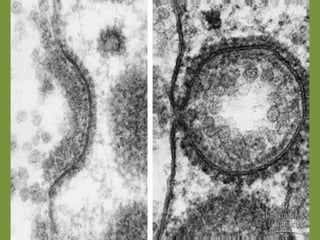
EndocytosisMoves bulk materials into cells.Several types known.
Types1.  Pinocytosis - liquids2.  Phagocytosis - solids3.  Receptor Mediated - uses receptors to "catch" specific kinds of molecules.
The Cell Membrane

The Cell Membrane