OBJECTIVES:
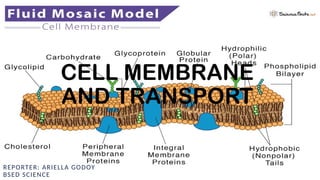
• Understand thestructure of the cell membrane
• Differentiate between passive and active transport
• Explain how the membrane maintains homeostasis
• Predict substance movement based on concentration gradients
3.
PHOSPHOLIPID
BILAYER
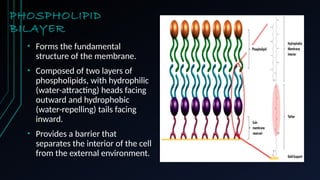
• Forms thefundamental
structure of the membrane.
• Composed of two layers of
phospholipids, with hydrophilic
(water-attracting) heads facing
outward and hydrophobic
(water-repelling) tails facing
inward.
• Provides a barrier that
separates the interior of the cell
from the external environment. Category 1 Category 2 Category 3 Category 4
0
1
2
3
4
5
6
Series 1 Series 2 Series 3
4.
PROTEINS
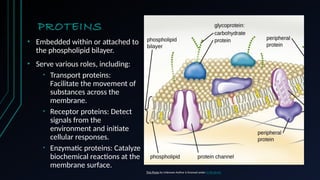
• Embedded withinor attached to
the phospholipid bilayer.
• Serve various roles, including:
• Transport proteins:
Facilitate the movement of
substances across the
membrane.
• Receptor proteins: Detect
signals from the
environment and initiate
cellular responses.
• Enzymatic proteins: Catalyze
biochemical reactions at the
membrane surface.
Task 1
Task 2
Task 3
This Photo by Unknown Author is licensed under CC BY-SA-NC
5.
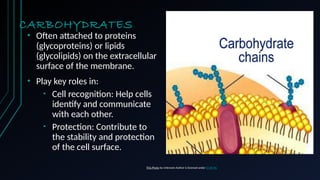
CARBOHYDRATES
• Often attachedto proteins
(glycoproteins) or lipids
(glycolipids) on the extracellular
surface of the membrane.
• Play key roles in:
• Cell recognition: Help cells
identify and communicate
with each other.
• Protection: Contribute to
the stability and protection
of the cell surface.
G
r
o
u
p
2
9
5
Class 2 76 8
8
Class 3 84
9
0
This Photo by Unknown Author is licensed under CC BY-NC
6.
ADD A SLIDETITLE - 1
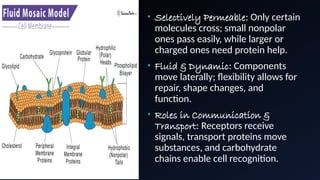
• Selectively Permeable: Only certain
molecules cross; small nonpolar
ones pass easily, while larger or
charged ones need protein help.
• Fluid & Dynamic: Components
move laterally; flexibility allows for
repair, shape changes, and
function.
• Roles in Communication &
Transport: Receptors receive
signals, transport proteins move
substances, and carbohydrate
chains enable cell recognition.
7.
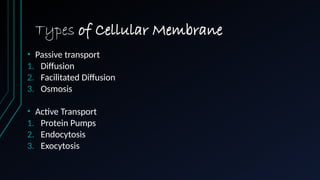
Types of CellularMembrane
• Passive transport
1. Diffusion
2. Facilitated Diffusion
3. Osmosis
• Active Transport
1. Protein Pumps
2. Endocytosis
3. Exocytosis
8.
PASSIVE TRANSPORT
• Movementof substances without energy input, driven by
concentration gradients.
• Molecules move randomly
• Molecules spread out from an area of high concentration
to an area of low concentration
9.
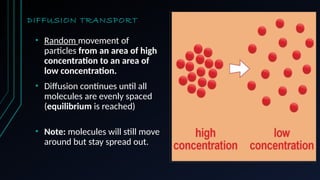
DIFFUSION TRANSPORT
• Randommovement of
particles from an area of high
concentration to an area of
low concentration.
• Diffusion continues until all
molecules are evenly spaced
(equilibrium is reached)
• Note: molecules will still move
around but stay spread out.
10.
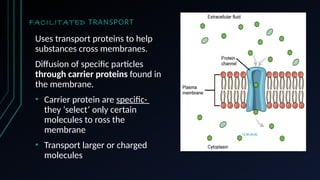
FACILITATED TRANSPORT
Uses transportproteins to help
substances cross membranes.
Diffusion of specific particles
through carrier proteins found in
the membrane.
• Carrier protein are specific-
they ‘select’ only certain
molecules to ross the
membrane
• Transport larger or charged
molecules
This Photo by Unknown Author is licensed under CC BY-SA-NC
11.
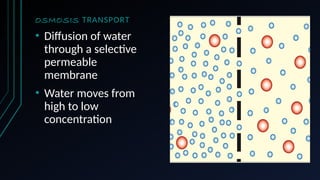
OSMOSIS TRANSPORT
• Diffusionof water
through a selective
permeable
membrane
• Water moves from
high to low
concentration
OSMOSIS AND TONICITY
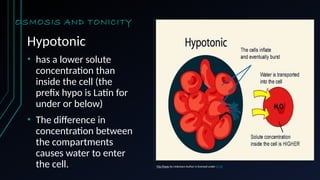
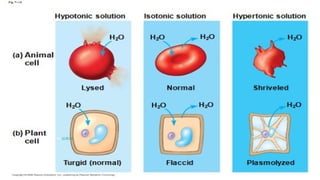
Hypotonic
•has a lower solute
concentration than
inside the cell (the
prefix hypo is Latin for
under or below)
• The difference in
concentration between
the compartments
causes water to enter
the cell. This Photo by Unknown Author is licensed under CC BY
14.
OSMOSIS AND
TONICITY
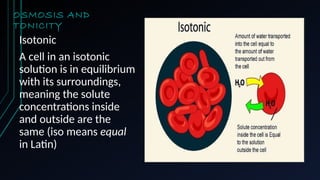
Isotonic
A cellin an isotonic
solution is in equilibrium
with its surroundings,
meaning the solute
concentrations inside
and outside are the
same (iso means equal
in Latin)
15.
OSMOTIC AND TONICITY
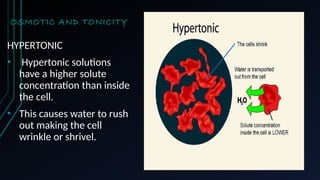
HYPERTONIC
•Hypertonic solutions
have a higher solute
concentration than inside
the cell.
• This causes water to rush
out making the cell
wrinkle or shrivel.
16.
This Photo byUnknown Author is licensed under CC BY-SA
17.
ACTIVE TRANSPORT
• Requiresenergy (ATP) to move substances against
their concentration gradient.
• Actively moves molecules to where they are needed
• Movement from an area of low concentration to an
area of high concentration
18.
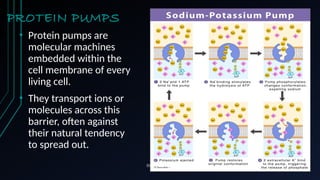
PROTEIN PUMPS
• Proteinpumps are
molecular machines
embedded within the
cell membrane of every
living cell.
• They transport ions or
molecules across this
barrier, often against
their natural tendency
to spread out.
This Photo by Unknown Author is licensed under CC BY
19.
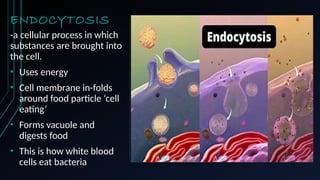
ENDOCYTOSIS
-a cellular processin which
substances are brought into
the cell.
• Uses energy
• Cell membrane in-folds
around food particle ‘cell
eating’
• Forms vacuole and
digests food
• This is how white blood
cells eat bacteria
20.
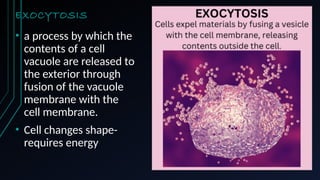
EXOCYTOSIS
• a processby which the
contents of a cell
vacuole are released to
the exterior through
fusion of the vacuole
membrane with the
cell membrane.
• Cell changes shape-
requires energy This Photo by Unknown Author is licensed under CC BY
21.
IMPORTANCE IN HOMEOSTASIS
•Maintains Internal Balance -The cell membrane
regulates what enters and leaves the cell, keeping the
internal environment stable.Ensures optimal
conditions for enzymes and cellular processes to
function properly.
• Controls Nutrient and Waste Flow-Allows essential
nutrients (like glucose, oxygen) to enter.Facilitates
removal of waste products (like carbon dioxide,
toxins).Prevents harmful substances from entering.
This Photo by Unknown Author is licensed under CC BY
22.
IMPORTANCE IN HOMEOSTASIS
•Responds to External Changes-Contains receptor
proteins that detect signals from the environment
(e.g., hormones, chemicals).Enables the cell to adapt
and react (e.g., opening channels, activating
transporters).Helps maintain dynamic equilibrium
despite fluctuating conditions.
This Photo by Unknown Author is licensed under CC BY