Rabbia Yousaf
(Pharm-D)
Rashid Latif College of Pharmacy
Diencephalon
The caudal (posterior) part of the forebrain, containing the
epithalamus, thalamus, hypothalamus, and ventral thalamus
and the third ventricle.
 The diencephalon can be divided into four major
parts:
 (1) the thalamus
 (2) the subthalamus
 (3) the epithalamus
 (4) the hypothalamus
THALAMUS
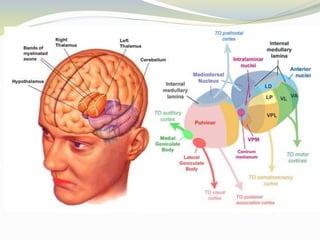
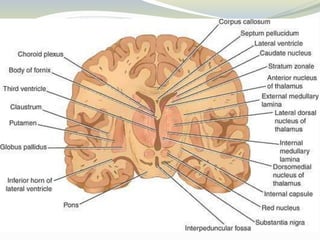
 The thalamus is a large, egg-shaped mass of gray
matter that forms the major part of the diencephalon.
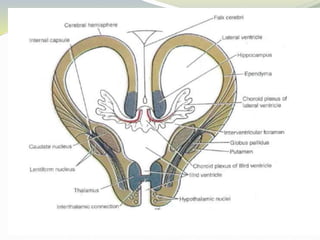
 There are two thalami, and one is situated on each side
of the third ventricle .
 The anterior end of the thalamus is narrow and
rounded and forms the posterior boundary of the
interventricular foramen.
 The posterior end is expanded to form the pulvinar,
which overhangs the superior colliculus.
 The inferior surface is continuous with the tegmentum
of the midbrain.
 The medial surface of the thalamus forms part of the
lateral wall of the third ventricle and is usually
connected to the opposite thalamus by a band of gray
matter the interthalamic connection (interthalamic
adhesion).
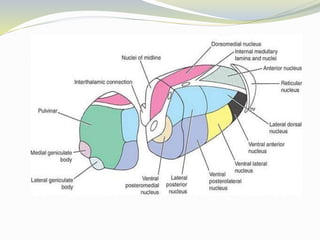
Subdivisions of the Thalamus
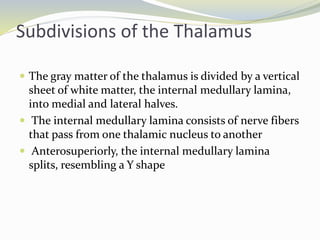
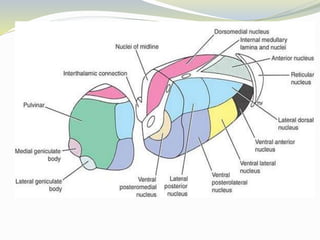
 The gray matter of the thalamus is divided by a vertical
sheet of white matter, the internal medullary lamina,
into medial and lateral halves.
 The internal medullary lamina consists of nerve fibers
that pass from one thalamic nucleus to another
 Anterosuperiorly, the internal medullary lamina
splits, resembling a Y shape
 The thalamus thus is subdivided into three main
parts;
 the anterior part lies between the limbs of the Y
 the medial and lateral parts lie on the sides of the
stem of the Y .
 Each of the three parts of the thalamus contains a
group of thalamic nuclei .
 Moreover, smaller nuclear groups are situated within
the internal medullary lamina, and some are located
on the medial and lateral surfaces of the thalamus.
Anterior Part
 The anterior part of the thalamus contains the
anterior thalamic nuclei.
 They receive the mammillothalamic tract from the
mammillary nuclei.
 These anterior thalamic nuclei also receive reciprocal
connections with the cingulate gyrus and
hypothalamus.
 The function of the anterior thalamic nuclei is closely
associated with that of the limbic system and is
concerned with emotional tone and the mechanisms
of recent memory.
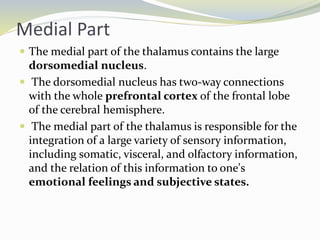
Medial Part
 The medial part of the thalamus contains the large
dorsomedial nucleus.
 The dorsomedial nucleus has two-way connections
with the whole prefrontal cortex of the frontal lobe
of the cerebral hemisphere.
 The medial part of the thalamus is responsible for the
integration of a large variety of sensory information,
including somatic, visceral, and olfactory information,
and the relation of this information to one's
emotional feelings and subjective states.
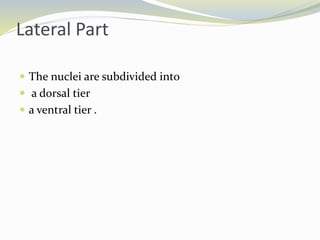
Lateral Part
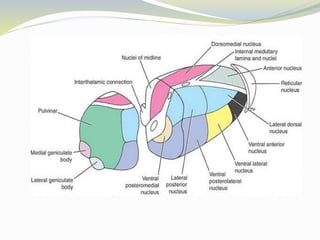
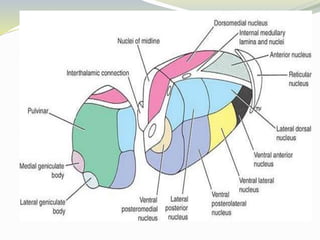
 The nuclei are subdivided into
 a dorsal tier
 a ventral tier .
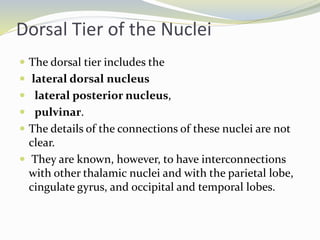
Dorsal Tier of the Nuclei
 The dorsal tier includes the
 lateral dorsal nucleus
 lateral posterior nucleus,
 pulvinar.
 The details of the connections of these nuclei are not
clear.
 They are known, however, to have interconnections
with other thalamic nuclei and with the parietal lobe,
cingulate gyrus, and occipital and temporal lobes.
Ventral Tier of the Nuclei
 The ventral tier consists of the following nuclei in a
craniocaudal sequence:
 Ventral anterior nucleus
 This nucleus is connected to the reticular formation,
the substantia nigra and the corpus striatum.
 it probably influences the activities of the motor
cortex.
 Ventral lateral nucleus.
 This nucleus has connections similar to those of the
ventral anterior nucleus but, in addition, has a major
input from the cerebellum .
 Here again, this thalamic nucleus probably influences
motor activity.
Ventral posterior nucleus.
 This nucleus is subdivided into the
 ventral posteromedial nucleus
 ventral posterolateral nucleus
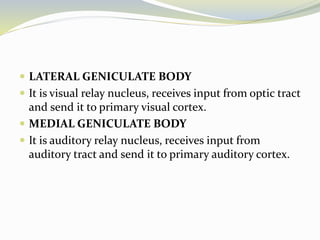
 LATERAL GENICULATE BODY
 It is visual relay nucleus, receives input from optic tract
and send it to primary visual cortex.
 MEDIAL GENICULATE BODY
 It is auditory relay nucleus, receives input from
auditory tract and send it to primary auditory cortex.
Function of Thalamus
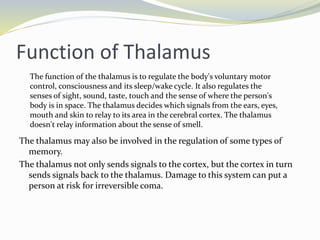
The thalamus may also be involved in the regulation of some types of
memory.
The thalamus not only sends signals to the cortex, but the cortex in turn
sends signals back to the thalamus. Damage to this system can put a
person at risk for irreversible coma.
The function of the thalamus is to regulate the body's voluntary motor
control, consciousness and its sleep/wake cycle. It also regulates the
senses of sight, sound, taste, touch and the sense of where the person's
body is in space. The thalamus decides which signals from the ears, eyes,
mouth and skin to relay to its area in the cerebral cortex. The thalamus
doesn't relay information about the sense of smell.
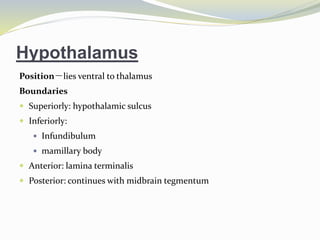
Hypothalamus
Position-lies ventral to thalamus
Boundaries
 Superiorly: hypothalamic sulcus
 Inferiorly:
 Infundibulum
 mamillary body
 Anterior: lamina terminalis
 Posterior: continues with midbrain tegmentum
Subdivisions
 Preoptic region
 Supraoptic region
 Tuberal region
 Mamillary region
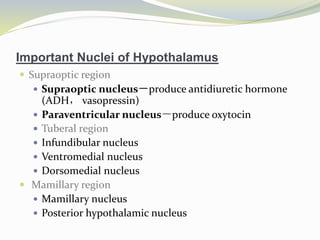
Important Nuclei of Hypothalamus
 Supraoptic region
 Supraoptic nucleus-produce antidiuretic hormone
(ADH, vasopressin)
 Paraventricular nucleus-produce oxytocin
 Tuberal region
 Infundibular nucleus
 Ventromedial nucleus
 Dorsomedial nucleus
 Mamillary region
 Mamillary nucleus
 Posterior hypothalamic nucleus
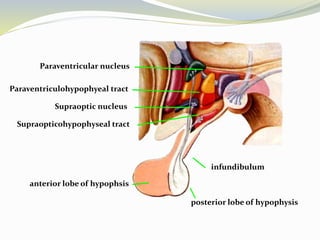
Paraventricular nucleus
Supraoptic nucleus
Paraventriculohypophyeal tract
Supraopticohypophyseal tract
infundibulum
posterior lobe of hypophysis
anterior lobe of hypophsis
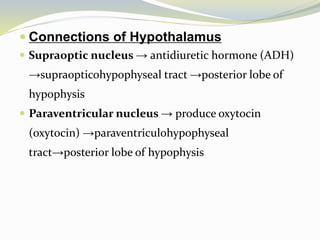
 Connections of Hypothalamus
 Supraoptic nucleus → antidiuretic hormone (ADH)
→supraopticohypophyseal tract →posterior lobe of
hypophysis
 Paraventricular nucleus → produce oxytocin
(oxytocin) →paraventriculohypophyseal
tract→posterior lobe of hypophysis
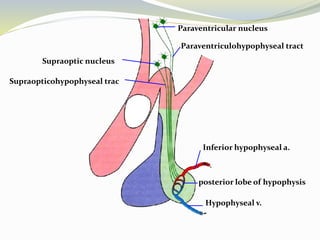
Paraventricular nucleus
Paraventriculohypophyseal tract
Supraoptic nucleus
Supraopticohypophyseal trac
posterior lobe of hypophysis
Inferior hypophyseal a.
Hypophyseal v.
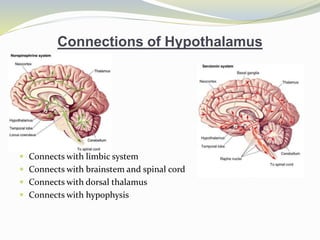
Connections of Hypothalamus
 Connects with limbic system
 Connects with brainstem and spinal cord
 Connects with dorsal thalamus
 Connects with hypophysis
Functions of Hypothalamus
 Autonomic control
 Endocrine control
 Temperature regulation
 Regulation of food and water intake
 Emotion and behavior
 Control of circadian rhythms

Diencephlon

  • 1.
  • 2.
    Diencephalon The caudal (posterior)part of the forebrain, containing the epithalamus, thalamus, hypothalamus, and ventral thalamus and the third ventricle.  The diencephalon can be divided into four major parts:  (1) the thalamus  (2) the subthalamus  (3) the epithalamus  (4) the hypothalamus
  • 3.
    THALAMUS  The thalamusis a large, egg-shaped mass of gray matter that forms the major part of the diencephalon.  There are two thalami, and one is situated on each side of the third ventricle .  The anterior end of the thalamus is narrow and rounded and forms the posterior boundary of the interventricular foramen.  The posterior end is expanded to form the pulvinar, which overhangs the superior colliculus.
  • 5.
     The inferiorsurface is continuous with the tegmentum of the midbrain.  The medial surface of the thalamus forms part of the lateral wall of the third ventricle and is usually connected to the opposite thalamus by a band of gray matter the interthalamic connection (interthalamic adhesion).
  • 7.
    Subdivisions of theThalamus  The gray matter of the thalamus is divided by a vertical sheet of white matter, the internal medullary lamina, into medial and lateral halves.  The internal medullary lamina consists of nerve fibers that pass from one thalamic nucleus to another  Anterosuperiorly, the internal medullary lamina splits, resembling a Y shape
  • 10.
     The thalamusthus is subdivided into three main parts;  the anterior part lies between the limbs of the Y  the medial and lateral parts lie on the sides of the stem of the Y .  Each of the three parts of the thalamus contains a group of thalamic nuclei .  Moreover, smaller nuclear groups are situated within the internal medullary lamina, and some are located on the medial and lateral surfaces of the thalamus.
  • 11.
    Anterior Part  Theanterior part of the thalamus contains the anterior thalamic nuclei.  They receive the mammillothalamic tract from the mammillary nuclei.  These anterior thalamic nuclei also receive reciprocal connections with the cingulate gyrus and hypothalamus.  The function of the anterior thalamic nuclei is closely associated with that of the limbic system and is concerned with emotional tone and the mechanisms of recent memory.
  • 13.
    Medial Part  Themedial part of the thalamus contains the large dorsomedial nucleus.  The dorsomedial nucleus has two-way connections with the whole prefrontal cortex of the frontal lobe of the cerebral hemisphere.  The medial part of the thalamus is responsible for the integration of a large variety of sensory information, including somatic, visceral, and olfactory information, and the relation of this information to one's emotional feelings and subjective states.
  • 14.
    Lateral Part  Thenuclei are subdivided into  a dorsal tier  a ventral tier .
  • 15.
    Dorsal Tier ofthe Nuclei  The dorsal tier includes the  lateral dorsal nucleus  lateral posterior nucleus,  pulvinar.  The details of the connections of these nuclei are not clear.  They are known, however, to have interconnections with other thalamic nuclei and with the parietal lobe, cingulate gyrus, and occipital and temporal lobes.
  • 16.
    Ventral Tier ofthe Nuclei  The ventral tier consists of the following nuclei in a craniocaudal sequence:  Ventral anterior nucleus  This nucleus is connected to the reticular formation, the substantia nigra and the corpus striatum.  it probably influences the activities of the motor cortex.
  • 17.
     Ventral lateralnucleus.  This nucleus has connections similar to those of the ventral anterior nucleus but, in addition, has a major input from the cerebellum .  Here again, this thalamic nucleus probably influences motor activity.
  • 19.
    Ventral posterior nucleus. This nucleus is subdivided into the  ventral posteromedial nucleus  ventral posterolateral nucleus
  • 20.
     LATERAL GENICULATEBODY  It is visual relay nucleus, receives input from optic tract and send it to primary visual cortex.  MEDIAL GENICULATE BODY  It is auditory relay nucleus, receives input from auditory tract and send it to primary auditory cortex.
  • 22.
    Function of Thalamus Thethalamus may also be involved in the regulation of some types of memory. The thalamus not only sends signals to the cortex, but the cortex in turn sends signals back to the thalamus. Damage to this system can put a person at risk for irreversible coma. The function of the thalamus is to regulate the body's voluntary motor control, consciousness and its sleep/wake cycle. It also regulates the senses of sight, sound, taste, touch and the sense of where the person's body is in space. The thalamus decides which signals from the ears, eyes, mouth and skin to relay to its area in the cerebral cortex. The thalamus doesn't relay information about the sense of smell.
  • 25.
    Hypothalamus Position-lies ventral tothalamus Boundaries  Superiorly: hypothalamic sulcus  Inferiorly:  Infundibulum  mamillary body  Anterior: lamina terminalis  Posterior: continues with midbrain tegmentum
  • 26.
    Subdivisions  Preoptic region Supraoptic region  Tuberal region  Mamillary region
  • 27.
    Important Nuclei ofHypothalamus  Supraoptic region  Supraoptic nucleus-produce antidiuretic hormone (ADH, vasopressin)  Paraventricular nucleus-produce oxytocin  Tuberal region  Infundibular nucleus  Ventromedial nucleus  Dorsomedial nucleus  Mamillary region  Mamillary nucleus  Posterior hypothalamic nucleus
  • 28.
    Paraventricular nucleus Supraoptic nucleus Paraventriculohypophyealtract Supraopticohypophyseal tract infundibulum posterior lobe of hypophysis anterior lobe of hypophsis
  • 29.
     Connections ofHypothalamus  Supraoptic nucleus → antidiuretic hormone (ADH) →supraopticohypophyseal tract →posterior lobe of hypophysis  Paraventricular nucleus → produce oxytocin (oxytocin) →paraventriculohypophyseal tract→posterior lobe of hypophysis
  • 30.
    Paraventricular nucleus Paraventriculohypophyseal tract Supraopticnucleus Supraopticohypophyseal trac posterior lobe of hypophysis Inferior hypophyseal a. Hypophyseal v.
  • 31.
    Connections of Hypothalamus Connects with limbic system  Connects with brainstem and spinal cord  Connects with dorsal thalamus  Connects with hypophysis
  • 32.
    Functions of Hypothalamus Autonomic control  Endocrine control  Temperature regulation  Regulation of food and water intake  Emotion and behavior  Control of circadian rhythms