TETRACYCLINES
(ANTIBIOTICS)
BY
KENCHA SWATHI
ASSISTANT PROFESSOR
DEPT.OF MEDICINAL CHEMISTRY
ADITYA BIPER
BANGALORE
TETRACYCLINES
• Tetracyclines are octahydro napthacene derivatives which are bacteriostatic and
broad spectrum antibiotics that kills various types of infections caused by both gram
+ve and gram –ve microorganisms.
• TETRA =four ,CYCLINES = cyclic compounds
• Tetracyclines have been introduced 50 years ago as broad spectrum antibiotics.
• They are biosynthesized from CH₃COOH AND C₃H₇COOH units in the
microorganisms.
• They are active against both gram +ve and gram –ve bacteria.
• Tetracyclines are available for oral route and parentral route.
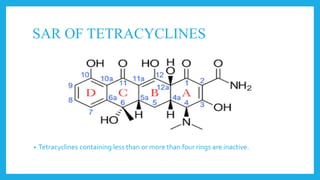
SAR OF TETRACYCLINES
• Tetracyclines containing less than or more than four rings are inactive.
• Conversion of amide group at 2nd position decreases the activity.
• Keto-enol tautomerism between C₂ and C₃ is very important for biological activity.
• Modification of –OH group at 3rd position leads to no activity.
• Dehydration at 5a position leads to no activity.
• Epimerisation at 4th position shows no activity.
• Substitution at 5th position gives hydrophilic nature of the drug.
• Dimethyl aminogroup at 4th position shows good activity.
• =CH₂ group at 6th position increases antibacterial activity.
• Elimination of –OH group at 6th position increases lipophilicity Eg:Doxycycline
• Electron donating or electron withdrawing group at 7th position increases
antibacterial activity.
• D ring should be always aromatic
• Changes in D ring leads to biological inactivation.
• Addition of any amino group substitution at 9th position leads to new class of
antibiotics.
• Tetracycline ring is most important for antibacterial activity.
CLASSIFICATION
According to duration of action:
1. Long acting tetracyclines (12- 16 hrs)
Doxycline, minocycline, Meclocycline
2. Intermediate acting tetracyclines (8-12 hrs)
Demeclocycline, methacycline
3. Short acting tetracyclines (6-8 hrs)
Tetracycline, chlortetracycline, Oxytetracycline
Tetracyclines are obtained from various species of streptomyces bacteria by
fermentation technology.
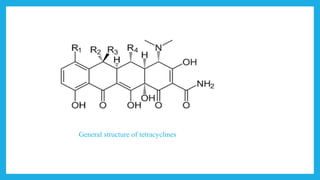
General structure of tetracyclines
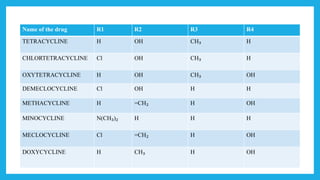
Name of the drug R1 R2 R3 R4
TETRACYCLINE H OH CH₃ H
CHLORTETRACYCLINE Cl OH CH₃ H
OXYTETRACYCLINE H OH CH₃ OH
DEMECLOCYCLINE Cl OH H H
METHACYCLINE H =CH₂ H OH
MINOCYCLINE N(CH₃)₂ H H H
MECLOCYCLINE Cl =CH₂ H OH
DOXYCYCLINE H CH₃ H OH
MECHANISM OF ACTION
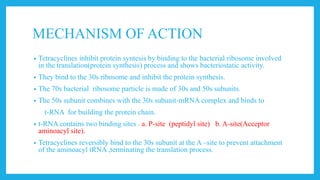
• Tetracyclines inhibit protein syntesis by binding to the bacterial ribosome involved
in the translation(protein synthesis) process and shows bacteriostatic activity.
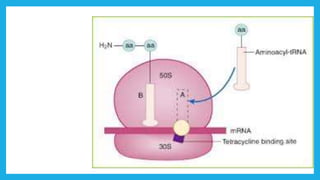
• They bind to the 30s ribosome and inhibit the protein synthesis.
• The 70s bacterial ribosome particle is made of 30s and 50s subunits.
• The 50s subunit combines with the 30s subunit-mRNA complex and binds to
t-RNA for building the protein chain.
• t-RNA contains two binding sites . a. P-site (peptidyl site) b. A-site(Acceptor
aminoacyl site).
• Tetracyclines reversibly bind to the 30s subunit at the A –site to prevent attachment
of the aminoacyl tRNA ,terminating the translation process.
TETRACYCLINES-USES
• Tetracyclines are broad spectrum antibiotics used to treat various types of
infections.
• To treat eye infections.
• Tetracyclines are low cost alternative antibiotics.
• Recently, tetracyclines are used to treat cancer patients.
• To treat respiratory infections,ear,intestine and sinus
• To treat gonorrhea
• Tetracyclines are not used to treat viral infections.
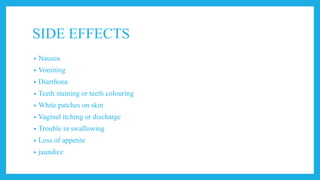
SIDE EFFECTS
• Nausea
• Vomiting
• Diarrhoea
• Teeth staining or teeth colouring
• White patches on skin
• Vaginal itching or discharge
• Trouble in swallowing
• Loss of appetite
• jaundice
PRECAUTIONS TO BE TAKEN WHILE
USING TETRACYCLINES
• Complete the course of prescription
• Pregnant women should avoid tetracyclines
• Take on empty stomach with plenty of water
• Tetracyclines should not taken with milk, antacids and iron.
• Avoid exposure to sun
• Tetracyclines should not be given to Children below 8 years
• Tetracyclines passes through breast milk and affect the bones and teeth in babies.
REFERENCES
• K.Illango ,P.Valentina .,Textbook of Medicinal chemistry-vol-II
• Wilson and Gisvold’s textbook of organic ,medical and pharmaceutical chemistry.
• Principles of medicinal chemistry by Kadam
• Textbook of Medicinal chemistry by Ashutoshkar
Tetracyclines
Tetracyclines

Tetracyclines

  • 1.
  • 2.
    TETRACYCLINES • Tetracyclines areoctahydro napthacene derivatives which are bacteriostatic and broad spectrum antibiotics that kills various types of infections caused by both gram +ve and gram –ve microorganisms. • TETRA =four ,CYCLINES = cyclic compounds • Tetracyclines have been introduced 50 years ago as broad spectrum antibiotics. • They are biosynthesized from CH₃COOH AND C₃H₇COOH units in the microorganisms. • They are active against both gram +ve and gram –ve bacteria. • Tetracyclines are available for oral route and parentral route.
  • 3.
    SAR OF TETRACYCLINES •Tetracyclines containing less than or more than four rings are inactive.
  • 4.
    • Conversion ofamide group at 2nd position decreases the activity. • Keto-enol tautomerism between C₂ and C₃ is very important for biological activity. • Modification of –OH group at 3rd position leads to no activity. • Dehydration at 5a position leads to no activity. • Epimerisation at 4th position shows no activity. • Substitution at 5th position gives hydrophilic nature of the drug. • Dimethyl aminogroup at 4th position shows good activity. • =CH₂ group at 6th position increases antibacterial activity.
  • 5.
    • Elimination of–OH group at 6th position increases lipophilicity Eg:Doxycycline • Electron donating or electron withdrawing group at 7th position increases antibacterial activity. • D ring should be always aromatic • Changes in D ring leads to biological inactivation. • Addition of any amino group substitution at 9th position leads to new class of antibiotics. • Tetracycline ring is most important for antibacterial activity.
  • 6.
    CLASSIFICATION According to durationof action: 1. Long acting tetracyclines (12- 16 hrs) Doxycline, minocycline, Meclocycline 2. Intermediate acting tetracyclines (8-12 hrs) Demeclocycline, methacycline 3. Short acting tetracyclines (6-8 hrs) Tetracycline, chlortetracycline, Oxytetracycline Tetracyclines are obtained from various species of streptomyces bacteria by fermentation technology.
  • 7.
    General structure oftetracyclines
  • 8.
    Name of thedrug R1 R2 R3 R4 TETRACYCLINE H OH CH₃ H CHLORTETRACYCLINE Cl OH CH₃ H OXYTETRACYCLINE H OH CH₃ OH DEMECLOCYCLINE Cl OH H H METHACYCLINE H =CH₂ H OH MINOCYCLINE N(CH₃)₂ H H H MECLOCYCLINE Cl =CH₂ H OH DOXYCYCLINE H CH₃ H OH
  • 9.
    MECHANISM OF ACTION •Tetracyclines inhibit protein syntesis by binding to the bacterial ribosome involved in the translation(protein synthesis) process and shows bacteriostatic activity. • They bind to the 30s ribosome and inhibit the protein synthesis. • The 70s bacterial ribosome particle is made of 30s and 50s subunits. • The 50s subunit combines with the 30s subunit-mRNA complex and binds to t-RNA for building the protein chain. • t-RNA contains two binding sites . a. P-site (peptidyl site) b. A-site(Acceptor aminoacyl site). • Tetracyclines reversibly bind to the 30s subunit at the A –site to prevent attachment of the aminoacyl tRNA ,terminating the translation process.
  • 11.
    TETRACYCLINES-USES • Tetracyclines arebroad spectrum antibiotics used to treat various types of infections. • To treat eye infections. • Tetracyclines are low cost alternative antibiotics. • Recently, tetracyclines are used to treat cancer patients. • To treat respiratory infections,ear,intestine and sinus • To treat gonorrhea • Tetracyclines are not used to treat viral infections.
  • 12.
    SIDE EFFECTS • Nausea •Vomiting • Diarrhoea • Teeth staining or teeth colouring • White patches on skin • Vaginal itching or discharge • Trouble in swallowing • Loss of appetite • jaundice
  • 13.
    PRECAUTIONS TO BETAKEN WHILE USING TETRACYCLINES • Complete the course of prescription • Pregnant women should avoid tetracyclines • Take on empty stomach with plenty of water • Tetracyclines should not taken with milk, antacids and iron. • Avoid exposure to sun • Tetracyclines should not be given to Children below 8 years • Tetracyclines passes through breast milk and affect the bones and teeth in babies.
  • 14.
    REFERENCES • K.Illango ,P.Valentina.,Textbook of Medicinal chemistry-vol-II • Wilson and Gisvold’s textbook of organic ,medical and pharmaceutical chemistry. • Principles of medicinal chemistry by Kadam • Textbook of Medicinal chemistry by Ashutoshkar