TETRACYCLINES
DR. SHILPA SUDHAKAR HARAK
Tetracycline
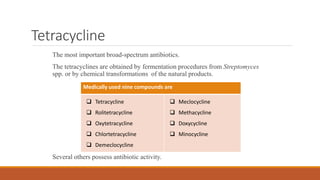
The most important broad-spectrum antibiotics.
The tetracyclines are obtained by fermentation procedures from Streptomyces
spp. or by chemical transformations of the natural products.
Several others possess antibiotic activity.
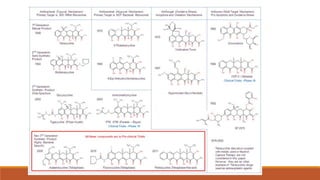
Medically used nine compounds are
 Tetracycline
 Rolitetracycline
 Oxytetracycline
 Chlortetracycline
 Demeclocycline
 Meclocycline
 Methacycline
 Doxycycline
 Minocycline
Tetracyclines MOA
MOA
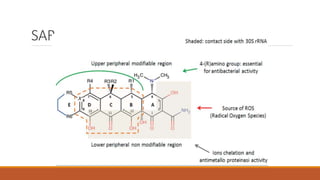
Tetracyclines have strong binding properties with metal ions which attributes to
their antibacterial properties.
They are specific inhibitors of bacterial protein synthesis.
They bind to the 30S ribosomal subunit and, thereby, prevent the binding of
aminoacyl tRNA to the mRNA–ribosome complex.
Both the binding of aminoacyl tRNA and the binding of tetracyclines at the
ribosomal binding site require magnesium ions.
Tetracyclines also bind to mammalian ribosomes but with lower affinities, and
they apparently do not achieve sufficient intracellular concentrations to interfere
with protein synthesis.
The selective toxicity of the tetracyclines toward bacteria depends strongly on
the self destructive capacity of bacterial cells to concentrate these agents in the
cell.
MOA
Tetracyclines enter bacterial cells by two processes: passive diffusion and active transport.
The active uptake of tetracyclines by bacterial cells is an energy dependent process that requires
adenosine triphosphate (ATP) and magnesium ions.
Three biochemically distinct mechanisms of resistance to tetracyclines have been described in bacteria:
1. Efflux mediated by transmembrane-spanning, active-transport proteins that reduces the
intracellular tetracycline concentration;
2. Ribosomal protection, in which the bacterial protein synthesis apparatus is rendered resistant to the
action of tetracyclines by an inducible cytoplasmic protein; and
3. Enzymatic oxidation:
Efflux mediated by plasmid or chromosomal protein and ribosomal protection mediated by the
chromosomal protein determinants are the most frequently encountered and most clinically significant
resistance mechanisms for tetracyclines.
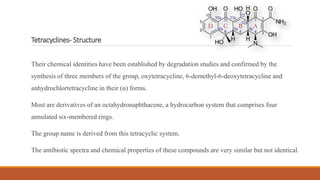
Tetracyclines- Structure
Their chemical identities have been established by degradation studies and confirmed by the
synthesis of three members of the group, oxytetracycline, 6-demethyl-6-deoxytetracycline and
anhydrochlortetracycline in their (α) forms.
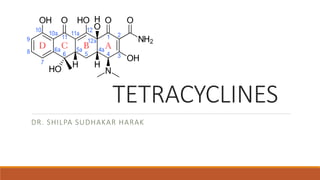
Most are derivatives of an octahydronaphthacene, a hydrocarbon system that comprises four
annulated six-membered rings.
The group name is derived from this tetracyclic system.
The antibiotic spectra and chemical properties of these compounds are very similar but not identical.
Tetracyclines- Structure
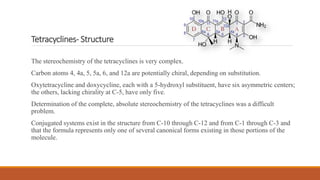
The stereochemistry of the tetracyclines is very complex.
Carbon atoms 4, 4a, 5, 5a, 6, and 12a are potentially chiral, depending on substitution.
Oxytetracycline and doxycycline, each with a 5-hydroxyl substituent, have six asymmetric centers;
the others, lacking chirality at C-5, have only five.
Determination of the complete, absolute stereochemistry of the tetracyclines was a difficult
problem.
Conjugated systems exist in the structure from C-10 through C-12 and from C-1 through C-3 and
that the formula represents only one of several canonical forms existing in those portions of the
molecule.
Tetracyclines- Structure
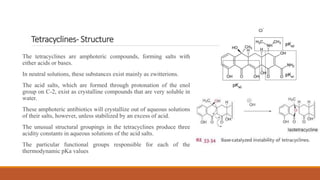
The tetracyclines are amphoteric compounds, forming salts with
either acids or bases.
In neutral solutions, these substances exist mainly as zwitterions.
The acid salts, which are formed through protonation of the enol
group on C-2, exist as crystalline compounds that are very soluble in
water.
These amphoteric antibiotics will crystallize out of aqueous solutions
of their salts, however, unless stabilized by an excess of acid.
The unusual structural groupings in the tetracyclines produce three
acidity constants in aqueous solutions of the acid salts.
The particular functional groups responsible for each of the
thermodynamic pKa values
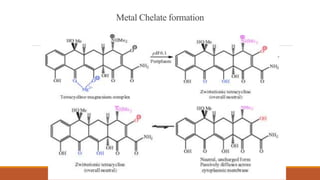
Metal Chelate formation
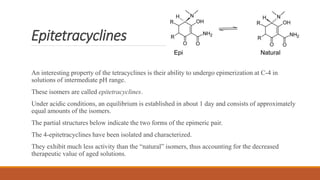
Epitetracyclines
An interesting property of the tetracyclines is their ability to undergo epimerization at C-4 in
solutions of intermediate pH range.
These isomers are called epitetracyclines.
Under acidic conditions, an equilibrium is established in about 1 day and consists of approximately
equal amounts of the isomers.
The partial structures below indicate the two forms of the epimeric pair.
The 4-epitetracyclines have been isolated and characterized.
They exhibit much less activity than the “natural” isomers, thus accounting for the decreased
therapeutic value of aged solutions.
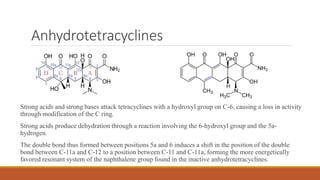
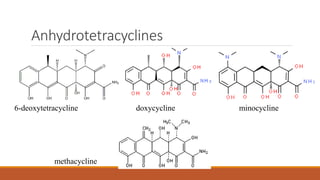
Anhydrotetracyclines
Strong acids and strong bases attack tetracyclines with a hydroxyl group on C-6, causing a loss in activity
through modification of the C ring.
Strong acids produce dehydration through a reaction involving the 6-hydroxyl group and the 5a-
hydrogen.
The double bond thus formed between positions 5a and 6 induces a shift in the position of the double
bond between C-11a and C-12 to a position between C-11 and C-11a, forming the more energetically
favored resonant system of the naphthalene group found in the inactive anhydrotetracyclines.
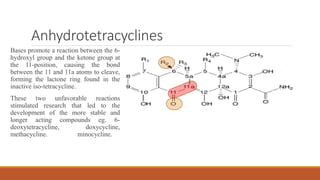
Anhydrotetracyclines
Bases promote a reaction between the 6-
hydroxyl group and the ketone group at
the 11-position, causing the bond
between the 11 and 11a atoms to cleave,
forming the lactone ring found in the
inactive iso-tetracycline.
These two unfavorable reactions
stimulated research that led to the
development of the more stable and
longer acting compounds eg. 6-
deoxytetracycline, doxycycline,
methacycline. minocycline.
Anhydrotetracyclines
6-deoxytetracycline doxycycline minocycline
methacycline .
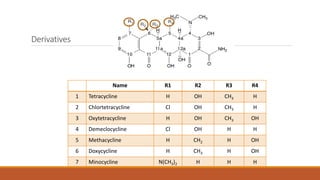
Derivatives
Name R1 R2 R3 R4
1 Tetracycline H OH CH3 H
2 Chlortetracycline Cl OH CH3 H
3 Oxytetracycline H OH CH3 OH
4 Demeclocycline Cl OH H H
5 Methacycline H CH2 H OH
6 Doxycycline H CH3 H OH
7 Minocycline N(CH3)2 H H H
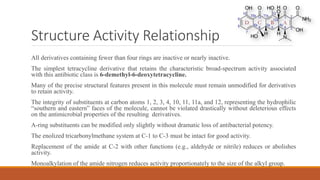
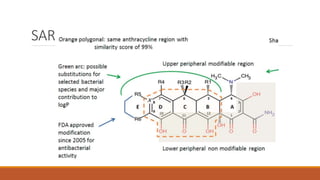
Structure Activity Relationship
All derivatives containing fewer than four rings are inactive or nearly inactive.
The simplest tetracycline derivative that retains the characteristic broad-spectrum activity associated
with this antibiotic class is 6-demethyl-6-deoxytetracycline.
Many of the precise structural features present in this molecule must remain unmodified for derivatives
to retain activity.
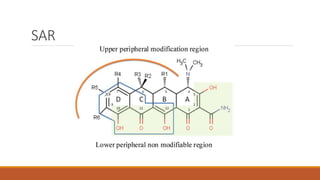
The integrity of substituents at carbon atoms 1, 2, 3, 4, 10, 11, 11a, and 12, representing the hydrophilic
“southern and eastern” faces of the molecule, cannot be violated drastically without deleterious effects
on the antimicrobial properties of the resulting derivatives.
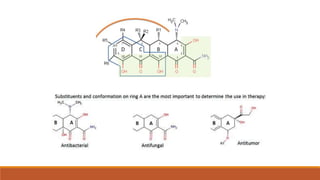
A-ring substituents can be modified only slightly without dramatic loss of antibacterial potency.
The enolized tricarbonylmethane system at C-1 to C-3 must be intact for good activity.
Replacement of the amide at C-2 with other functions (e.g., aldehyde or nitrile) reduces or abolishes
activity.
Monoalkylation of the amide nitrogen reduces activity proportionately to the size of the alkyl group.
SAR
SAR
SAR
Spectrum of Activity
The tetracyclines have the broadest spectrum of activity of any known antibacterial agents.
They are active against a wide range of Gram-positive and Gram-negative bacteria, spirochetes,
mycoplasma, rickettsiae, and chlamydiae.
Their bacteriostatic action, however, is a disadvantage in the treatment of life-threatening infections such
as septicemia, endocarditis, and meningitis;
Because of incomplete absorption and their effectiveness against the natural bacterial flora of the
intestine, tetracyclines may induce superinfections caused by the pathogenic yeast Candida albicans.
Resistance to tetracyclines among both Gram-positive and Gram-negative bacteria is relatively common.
Superinfections caused by resistant S. aureus and P. aeruginosa have resulted from the use of these agents
over time.
Parenteral tetracyclines may cause severe liver damage, especially when given in excessive dosage to
pregnant women or to patients with impaired renal function.
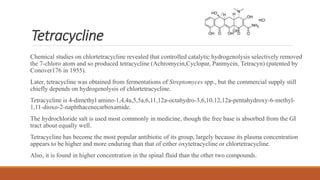
Tetracycline
Chemical studies on chlortetracycline revealed that controlled catalytic hydrogenolysis selectively removed
the 7-chloro atom and so produced tetracycline (Achromycin,Cyclopar, Panmycin, Tetracyn) (patented by
Conover176 in 1955).
Later, tetracycline was obtained from fermentations of Streptomyces spp., but the commercial supply still
chiefly depends on hydrogenolysis of chlortetracycline.
Tetracycline is 4-dimethyl amino-1,4,4a,5,5a,6,11,12a-octahydro-3,6,10,12,12a-pentahydroxy-6-methyl-
1,11-dioxo-2-naphthacenecarboxamide.
The hydrochloride salt is used most commonly in medicine, though the free base is absorbed from the GI
tract about equally well.
Tetracycline has become the most popular antibiotic of its group, largely because its plasma concentration
appears to be higher and more enduring than that of either oxytetracycline or chlortetracycline.
Also, it is found in higher concentration in the spinal fluid than the other two compounds.
Combinations of tetracycline
Several combinations of tetracycline with agents that increase the rate and the height of plasma
concentrations are on the market.
One such adjuvant is magnesium chloride hexahydrate (Panmycin).
Also, an insoluble tetracycline phosphate complex (Tetrex) is made by mixing a solution of
tetracycline, usually as the hydrochloride, with a solution of sodium metaphosphate.
These agents enhance plasma concentrations over those obtained when tetracycline hydrochloride
alone is administered orally.
Aluminum–calcium gluconates complexed with some tetracyclines have on plasma concentrations
when administered orally, intramuscularly, or intravenously.
Such complexes enhanced plasma levels in dogs when injected but not when given orally.
The tetracyclines can form stable chelate complexes with metal ions such as calcium and magnesium,
which retard absorption from the GI tract.
Rolitetracycline
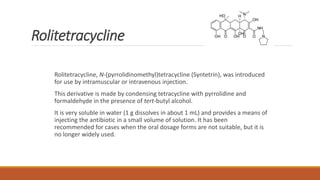
Rolitetracycline, N-(pyrrolidinomethyl)tetracycline (Syntetrin), was introduced
for use by intramuscular or intravenous injection.
This derivative is made by condensing tetracycline with pyrrolidine and
formaldehyde in the presence of tert-butyl alcohol.
It is very soluble in water (1 g dissolves in about 1 mL) and provides a means of
injecting the antibiotic in a small volume of solution. It has been
recommended for cases when the oral dosage forms are not suitable, but it is
no longer widely used.

Tetracyclines Medicinal Chemistry

  • 1.
  • 2.
    Tetracycline The most importantbroad-spectrum antibiotics. The tetracyclines are obtained by fermentation procedures from Streptomyces spp. or by chemical transformations of the natural products. Several others possess antibiotic activity. Medically used nine compounds are  Tetracycline  Rolitetracycline  Oxytetracycline  Chlortetracycline  Demeclocycline  Meclocycline  Methacycline  Doxycycline  Minocycline
  • 3.
  • 4.
    MOA Tetracyclines have strongbinding properties with metal ions which attributes to their antibacterial properties. They are specific inhibitors of bacterial protein synthesis. They bind to the 30S ribosomal subunit and, thereby, prevent the binding of aminoacyl tRNA to the mRNA–ribosome complex. Both the binding of aminoacyl tRNA and the binding of tetracyclines at the ribosomal binding site require magnesium ions. Tetracyclines also bind to mammalian ribosomes but with lower affinities, and they apparently do not achieve sufficient intracellular concentrations to interfere with protein synthesis. The selective toxicity of the tetracyclines toward bacteria depends strongly on the self destructive capacity of bacterial cells to concentrate these agents in the cell.
  • 5.
    MOA Tetracyclines enter bacterialcells by two processes: passive diffusion and active transport. The active uptake of tetracyclines by bacterial cells is an energy dependent process that requires adenosine triphosphate (ATP) and magnesium ions. Three biochemically distinct mechanisms of resistance to tetracyclines have been described in bacteria: 1. Efflux mediated by transmembrane-spanning, active-transport proteins that reduces the intracellular tetracycline concentration; 2. Ribosomal protection, in which the bacterial protein synthesis apparatus is rendered resistant to the action of tetracyclines by an inducible cytoplasmic protein; and 3. Enzymatic oxidation: Efflux mediated by plasmid or chromosomal protein and ribosomal protection mediated by the chromosomal protein determinants are the most frequently encountered and most clinically significant resistance mechanisms for tetracyclines.
  • 6.
    Tetracyclines- Structure Their chemicalidentities have been established by degradation studies and confirmed by the synthesis of three members of the group, oxytetracycline, 6-demethyl-6-deoxytetracycline and anhydrochlortetracycline in their (α) forms. Most are derivatives of an octahydronaphthacene, a hydrocarbon system that comprises four annulated six-membered rings. The group name is derived from this tetracyclic system. The antibiotic spectra and chemical properties of these compounds are very similar but not identical.
  • 7.
    Tetracyclines- Structure The stereochemistryof the tetracyclines is very complex. Carbon atoms 4, 4a, 5, 5a, 6, and 12a are potentially chiral, depending on substitution. Oxytetracycline and doxycycline, each with a 5-hydroxyl substituent, have six asymmetric centers; the others, lacking chirality at C-5, have only five. Determination of the complete, absolute stereochemistry of the tetracyclines was a difficult problem. Conjugated systems exist in the structure from C-10 through C-12 and from C-1 through C-3 and that the formula represents only one of several canonical forms existing in those portions of the molecule.
  • 8.
    Tetracyclines- Structure The tetracyclinesare amphoteric compounds, forming salts with either acids or bases. In neutral solutions, these substances exist mainly as zwitterions. The acid salts, which are formed through protonation of the enol group on C-2, exist as crystalline compounds that are very soluble in water. These amphoteric antibiotics will crystallize out of aqueous solutions of their salts, however, unless stabilized by an excess of acid. The unusual structural groupings in the tetracyclines produce three acidity constants in aqueous solutions of the acid salts. The particular functional groups responsible for each of the thermodynamic pKa values
  • 9.
  • 10.
    Epitetracyclines An interesting propertyof the tetracyclines is their ability to undergo epimerization at C-4 in solutions of intermediate pH range. These isomers are called epitetracyclines. Under acidic conditions, an equilibrium is established in about 1 day and consists of approximately equal amounts of the isomers. The partial structures below indicate the two forms of the epimeric pair. The 4-epitetracyclines have been isolated and characterized. They exhibit much less activity than the “natural” isomers, thus accounting for the decreased therapeutic value of aged solutions.
  • 11.
    Anhydrotetracyclines Strong acids andstrong bases attack tetracyclines with a hydroxyl group on C-6, causing a loss in activity through modification of the C ring. Strong acids produce dehydration through a reaction involving the 6-hydroxyl group and the 5a- hydrogen. The double bond thus formed between positions 5a and 6 induces a shift in the position of the double bond between C-11a and C-12 to a position between C-11 and C-11a, forming the more energetically favored resonant system of the naphthalene group found in the inactive anhydrotetracyclines.
  • 12.
    Anhydrotetracyclines Bases promote areaction between the 6- hydroxyl group and the ketone group at the 11-position, causing the bond between the 11 and 11a atoms to cleave, forming the lactone ring found in the inactive iso-tetracycline. These two unfavorable reactions stimulated research that led to the development of the more stable and longer acting compounds eg. 6- deoxytetracycline, doxycycline, methacycline. minocycline.
  • 13.
  • 14.
    Derivatives Name R1 R2R3 R4 1 Tetracycline H OH CH3 H 2 Chlortetracycline Cl OH CH3 H 3 Oxytetracycline H OH CH3 OH 4 Demeclocycline Cl OH H H 5 Methacycline H CH2 H OH 6 Doxycycline H CH3 H OH 7 Minocycline N(CH3)2 H H H
  • 15.
    Structure Activity Relationship Allderivatives containing fewer than four rings are inactive or nearly inactive. The simplest tetracycline derivative that retains the characteristic broad-spectrum activity associated with this antibiotic class is 6-demethyl-6-deoxytetracycline. Many of the precise structural features present in this molecule must remain unmodified for derivatives to retain activity. The integrity of substituents at carbon atoms 1, 2, 3, 4, 10, 11, 11a, and 12, representing the hydrophilic “southern and eastern” faces of the molecule, cannot be violated drastically without deleterious effects on the antimicrobial properties of the resulting derivatives. A-ring substituents can be modified only slightly without dramatic loss of antibacterial potency. The enolized tricarbonylmethane system at C-1 to C-3 must be intact for good activity. Replacement of the amide at C-2 with other functions (e.g., aldehyde or nitrile) reduces or abolishes activity. Monoalkylation of the amide nitrogen reduces activity proportionately to the size of the alkyl group.
  • 16.
  • 17.
  • 18.
  • 21.
    Spectrum of Activity Thetetracyclines have the broadest spectrum of activity of any known antibacterial agents. They are active against a wide range of Gram-positive and Gram-negative bacteria, spirochetes, mycoplasma, rickettsiae, and chlamydiae. Their bacteriostatic action, however, is a disadvantage in the treatment of life-threatening infections such as septicemia, endocarditis, and meningitis; Because of incomplete absorption and their effectiveness against the natural bacterial flora of the intestine, tetracyclines may induce superinfections caused by the pathogenic yeast Candida albicans. Resistance to tetracyclines among both Gram-positive and Gram-negative bacteria is relatively common. Superinfections caused by resistant S. aureus and P. aeruginosa have resulted from the use of these agents over time. Parenteral tetracyclines may cause severe liver damage, especially when given in excessive dosage to pregnant women or to patients with impaired renal function.
  • 22.
    Tetracycline Chemical studies onchlortetracycline revealed that controlled catalytic hydrogenolysis selectively removed the 7-chloro atom and so produced tetracycline (Achromycin,Cyclopar, Panmycin, Tetracyn) (patented by Conover176 in 1955). Later, tetracycline was obtained from fermentations of Streptomyces spp., but the commercial supply still chiefly depends on hydrogenolysis of chlortetracycline. Tetracycline is 4-dimethyl amino-1,4,4a,5,5a,6,11,12a-octahydro-3,6,10,12,12a-pentahydroxy-6-methyl- 1,11-dioxo-2-naphthacenecarboxamide. The hydrochloride salt is used most commonly in medicine, though the free base is absorbed from the GI tract about equally well. Tetracycline has become the most popular antibiotic of its group, largely because its plasma concentration appears to be higher and more enduring than that of either oxytetracycline or chlortetracycline. Also, it is found in higher concentration in the spinal fluid than the other two compounds.
  • 23.
    Combinations of tetracycline Severalcombinations of tetracycline with agents that increase the rate and the height of plasma concentrations are on the market. One such adjuvant is magnesium chloride hexahydrate (Panmycin). Also, an insoluble tetracycline phosphate complex (Tetrex) is made by mixing a solution of tetracycline, usually as the hydrochloride, with a solution of sodium metaphosphate. These agents enhance plasma concentrations over those obtained when tetracycline hydrochloride alone is administered orally. Aluminum–calcium gluconates complexed with some tetracyclines have on plasma concentrations when administered orally, intramuscularly, or intravenously. Such complexes enhanced plasma levels in dogs when injected but not when given orally. The tetracyclines can form stable chelate complexes with metal ions such as calcium and magnesium, which retard absorption from the GI tract.
  • 24.
    Rolitetracycline Rolitetracycline, N-(pyrrolidinomethyl)tetracycline (Syntetrin),was introduced for use by intramuscular or intravenous injection. This derivative is made by condensing tetracycline with pyrrolidine and formaldehyde in the presence of tert-butyl alcohol. It is very soluble in water (1 g dissolves in about 1 mL) and provides a means of injecting the antibiotic in a small volume of solution. It has been recommended for cases when the oral dosage forms are not suitable, but it is no longer widely used.