4.1. HISTORYAND INTRODUCTION
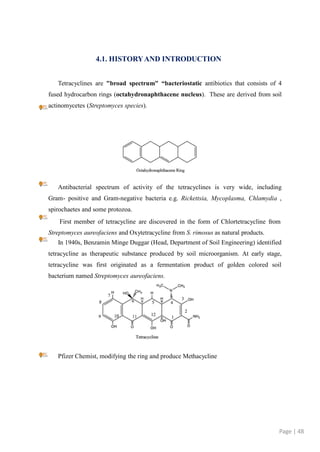
Tetracyclines are "broad spectrum" “bacteriostatic antibiotics that consists of 4
fused hydrocarbon rings (octahydronaphthacene nucleus). These are derived from soil
actinomycetes (Streptomyces species).
Antibacterial spectrum of activity of the tetracyclines is very wide, including
Gram- positive and Gram-negative bacteria e.g. Rickettsia, Mycoplasma, Chlamydia ,
spirochaetes and some protozoa.
First member of tetracycline are discovered in the form of Chlortetracycline from
Streptomyces aureofaciens and Oxytetracycline from S. rimosus as natural products.
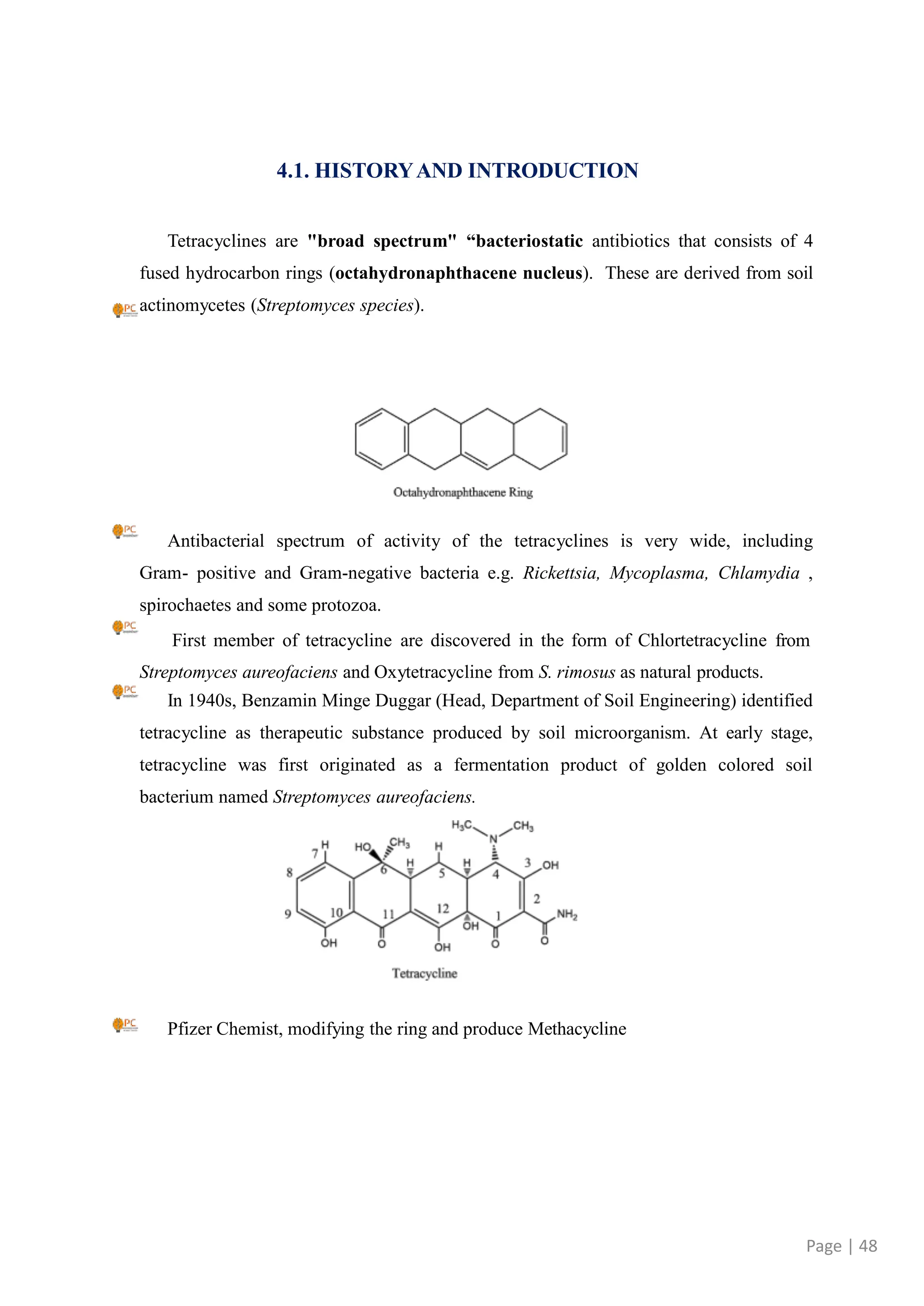
In 1940s, Benzamin Minge Duggar (Head, Department of Soil Engineering) identified
tetracycline as therapeutic substance produced by soil microorganism. At early stage,
tetracycline was first originated as a fermentation product of golden colored soil
bacterium named Streptomyces aureofaciens.
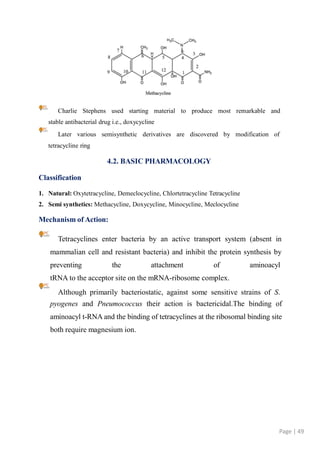
Pfizer Chemist, modifying the ring and produce Methacycline
Page | 48
Charlie Stephens used starting material to produce most remarkable and
stable antibacterial drug i.e., doxycycline
Later various semisynthetic derivatives are discovered by modification of
tetracycline ring
4.2. BASIC PHARMACOLOGY
Classification
1. Natural: Oxytetracycline, Demeclocycline, Chlortetracycline Tetracycline
2. Semi synthetics: Methacycline, Doxycycline, Minocycline, Meclocycline
Mechanism of Action:
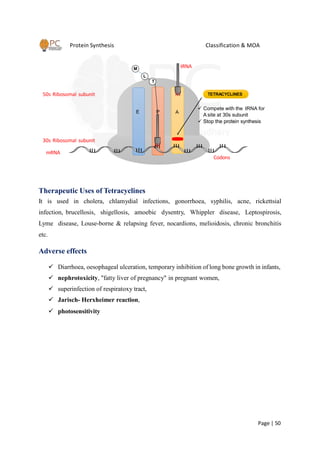
Tetracyclines enter bacteria by an active transport system (absent in
mammalian cell and resistant bacteria) and inhibit the protein synthesis by
preventing the attachment of aminoacyl
tRNA to the acceptor site on the mRNA-ribosome complex.
Although primarily bacteriostatic, against some sensitive strains of S.
pyogenes and Pneumococcus their action is bactericidal.The binding of
aminoacyl t-RNA and the binding of tetracyclines at the ribosomal binding site
both require magnesium ion.
Page | 49
Protein Synthesis
M tRNA
L
T
Classification & MOA
50s Ribosomal subunit
30s Ribosomal subunit
E P A
TETRACYCLINES
 Compete with the tRNA for
A site at 30s subunit
 Stop the protein synthesis
mRNA
Codons
Therapeutic Uses of Tetracyclines
It is used in cholera, chlamydial infections, gonorrhoea, syphilis, acne, rickettsial
infection, brucellosis, shigellosis, amoebic dysentry, Whippler disease, Leptospirosis,
Lyme disease, Louse-borne & relapsing fever, nocardions, melioidosis, chronic bronchitis
etc.
Adverse effects
 Diarrhoea, oesophageal ulceration, temporary inhibition of long bone growth in infants,
 nephrotoxicity, "fatty liver of pregnancy" in pregnant women,
 superinfection of respiratoxy tract,
 Jarisch- Herxheimer reaction,
 photosensitivity
Page | 50
4.3. StructuralActivity Relationship of Tetracycline
Page | 51
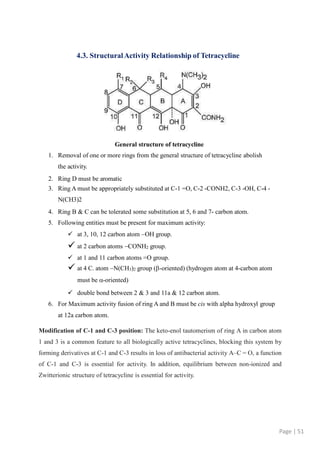
General structure of tetracycline
1. Removal of one or more rings from the general structure of tetracycline abolish
the activity.
2. Ring D must be aromatic
3. Ring A must be appropriately substituted at C-1 =O, C-2 -CONH2, C-3 -OH, C-4 -
N(CH3)2
4. Ring B & C can be tolerated some substitution at 5, 6 and 7- carbon atom.
5. Following entities must be present for maximum activity:
 at 3, 10, 12 carbon atom OH group.
 at 2 carbon atoms CONH2 group.
 at 1 and 11 carbon atoms =O group.
 at 4 C. atom N(CH3)2 group (-oriented) (hydrogen atom at 4-carbon atom
must be -oriented)
 double bond between 2 & 3 and 11a & 12 carbon atom.
6. For Maximum activity fusion of ring A and B must be cis with alpha hydroxyl group
at 12a carbon atom.
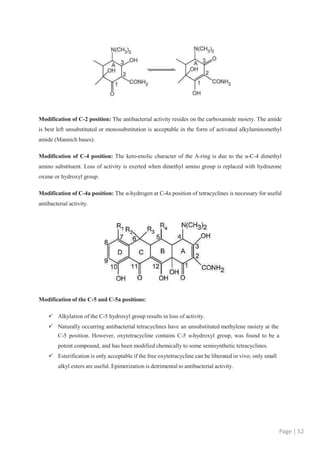
Modification of C-1 and C-3 position: The keto-enol tautomerism of ring A in carbon atom
1 and 3 is a common feature to all biologically active tetracyclines, blocking this system by
forming derivatives at C-1 and C-3 results in loss of antibacterial activity A–C = O, a function
of C-1 and C-3 is essential for activity. In addition, equilibrium between non-ionized and
Zwitterionic structure of tetracycline is essential for activity.
Modification of C-2 position: The antibacterial activity resides on the carboxamide moiety. The amide
is best left unsubstituted or monosubstitution is acceptable in the form of activated alkylaminomethyl
amide (Mannich bases).
Modification of C-4 position: The keto-enolic character of the A-ring is due to the α-C-4 dimethyl
amino substituent. Loss of activity is exerted when dimethyl amino group is replaced with hydrazone
oxime or hydroxyl group.
Modification of C-4a position: The α-hydrogen at C-4a position of tetracyclines is necessary for useful
antibacterial activity.
Modification of the C-5 and C-5a positions:
 Alkylation of the C-5 hydroxyl group results in loss of activity.
 Naturally occurring antibacterial tetracyclines have an unsubstituted methylene moiety at the
C-5 position. However, oxytetracycline contains C-5 α-hydroxyl group, was found to be a
potent compound, and has been modified chemically to some semisynthetic tetracyclines.
 Esterification is only acceptable if the free oxytetracycline can be liberated in vivo; only small
alkyl esters are useful. Epimerization is detrimental to antibacterial activity.
Page | 52
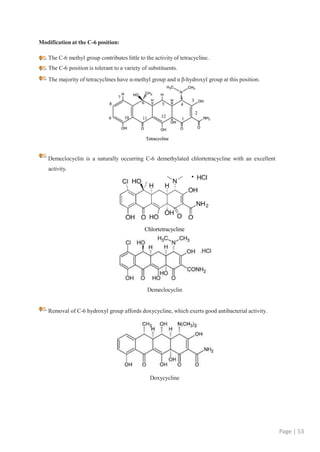
Modification at the C-6 position:
The C-6 methyl group contributes little to the activity of tetracycline.
The C-6 position is tolerant to a variety of substituents.
The majority of tetracyclines have α-methyl group and α β-hydroxyl group at this position.
Demeclocyclin is a naturally occurring C-6 demethylated chlortetracycline with an excellent
activity.
Chlortetracycline
Demeclocyclin
Removal of C-6 hydroxyl group affords doxycycline, which exerts good antibacterial activity.
Doxycycline
Page | 53
C-7 and C-9 substituents:
The nature of the aromatic D-ring predisposes the C-7 position to electrophilic substitution. Substitution
with electron withdrawing group such as nitro and halogen groups are introduced in some C-7
tetracyclines, which produces the most potent of all the tetracyclines in vitro, but their are compounds
are potentially toxic and carcinogenic. The C-7 acetoxy, azido, and hydroxyl tetracyclines are inferior
in terms of antibacterial activity.
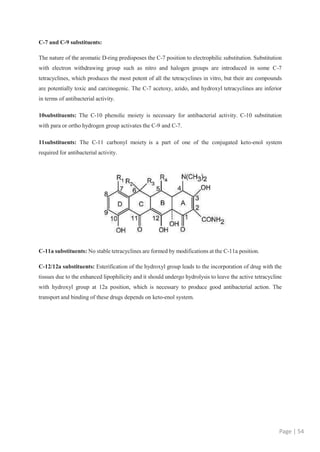
10substituents: The C-10 phenolic moiety is necessary for antibacterial activity. C-10 substitution
with para or ortho hydrogen group activates the C-9 and C-7.
11substituents: The C-11 carbonyl moiety is a part of one of the conjugated keto-enol system
required for antibacterial activity.
Page | 54
C-11a substituents: No stable tetracyclines are formed by modifications at the C-11a position.
C-12/12a substituents: Esterification of the hydroxyl group leads to the incorporation of drug with the
tissues due to the enhanced lipophilicity and it should undergo hydrolysis to leave the active tetracycline
with hydroxyl group at 12a position, which is necessary to produce good antibacterial action. The
transport and binding of these drugs depends on keto-enol system.
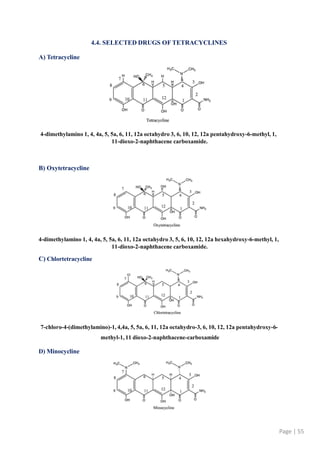
4.4. SELECTED DRUGS OF TETRACYCLINES
A) Tetracycline
Page | 55
4-dimethylamino 1, 4, 4a, 5, 5a, 6, 11, 12a octahydro 3, 6, 10, 12, 12a pentahydroxy-6-methyl, 1,
11-dioxo-2-naphthacene carboxamide.
B) Oxytetracycline
4-dimethylamino 1, 4, 4a, 5, 5a, 6, 11, 12a octahydro 3, 5, 6, 10, 12, 12a hexahydroxy-6-methyl, 1,
11-dioxo-2-naphthacene carboxamide.
C) Chlortetracycline
7-chloro-4-(dimethylamino)-1, 4,4a, 5, 5a, 6, 11, 12a octahydro-3, 6, 10, 12, 12a pentahydroxy-6-
methyl-1, 11 dioxo-2-naphthacene-carboxamide
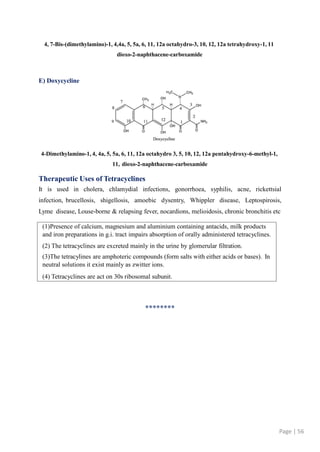
D) Minocycline
(1)Presence of calcium, magnesium and aluminium containing antacids, milk products
and iron preparations in g.i. tract impairs absorption of orally administered tetracyclines.
(2) The tetracyclines are excreted mainly in the urine by glomerular filtration.
(3)The tetracylines are amphoteric compounds (form salts with either acids or bases). In
neutral solutions it exist mainly as zwitter ions.
(4) Tetracyclines are act on 30s ribosomal subunit.
Page | 56
4, 7-Bis-(dimethylamino)-1, 4,4a, 5, 5a, 6, 11, 12a octahydro-3, 10, 12, 12a tetrahydroxy-1, 11
dioxo-2-naphthacene-carboxamide
E) Doxycycline
4-Dimethylamino-1, 4, 4a, 5, 5a, 6, 11, 12a octahydro 3, 5, 10, 12, 12a pentahydroxy-6-methyl-1,
11, dioxo-2-naphthacene-carboxamide
Therapeutic Uses of Tetracyclines
It is used in cholera, chlamydial infections, gonorrhoea, syphilis, acne, rickettsial
infection, brucellosis, shigellosis, amoebic dysentry, Whippler disease, Leptospirosis,
Lyme disease, Louse-borne & relapsing fever, nocardions, melioidosis, chronic bronchitis etc
********

Tetracycline-Medicinal-Chemistry.7 semester

  • 1.
    4.1. HISTORYAND INTRODUCTION Tetracyclinesare "broad spectrum" “bacteriostatic antibiotics that consists of 4 fused hydrocarbon rings (octahydronaphthacene nucleus). These are derived from soil actinomycetes (Streptomyces species). Antibacterial spectrum of activity of the tetracyclines is very wide, including Gram- positive and Gram-negative bacteria e.g. Rickettsia, Mycoplasma, Chlamydia , spirochaetes and some protozoa. First member of tetracycline are discovered in the form of Chlortetracycline from Streptomyces aureofaciens and Oxytetracycline from S. rimosus as natural products. In 1940s, Benzamin Minge Duggar (Head, Department of Soil Engineering) identified tetracycline as therapeutic substance produced by soil microorganism. At early stage, tetracycline was first originated as a fermentation product of golden colored soil bacterium named Streptomyces aureofaciens. Pfizer Chemist, modifying the ring and produce Methacycline Page | 48
  • 2.
    Charlie Stephens usedstarting material to produce most remarkable and stable antibacterial drug i.e., doxycycline Later various semisynthetic derivatives are discovered by modification of tetracycline ring 4.2. BASIC PHARMACOLOGY Classification 1. Natural: Oxytetracycline, Demeclocycline, Chlortetracycline Tetracycline 2. Semi synthetics: Methacycline, Doxycycline, Minocycline, Meclocycline Mechanism of Action: Tetracyclines enter bacteria by an active transport system (absent in mammalian cell and resistant bacteria) and inhibit the protein synthesis by preventing the attachment of aminoacyl tRNA to the acceptor site on the mRNA-ribosome complex. Although primarily bacteriostatic, against some sensitive strains of S. pyogenes and Pneumococcus their action is bactericidal.The binding of aminoacyl t-RNA and the binding of tetracyclines at the ribosomal binding site both require magnesium ion. Page | 49
  • 3.
    Protein Synthesis M tRNA L T Classification& MOA 50s Ribosomal subunit 30s Ribosomal subunit E P A TETRACYCLINES  Compete with the tRNA for A site at 30s subunit  Stop the protein synthesis mRNA Codons Therapeutic Uses of Tetracyclines It is used in cholera, chlamydial infections, gonorrhoea, syphilis, acne, rickettsial infection, brucellosis, shigellosis, amoebic dysentry, Whippler disease, Leptospirosis, Lyme disease, Louse-borne & relapsing fever, nocardions, melioidosis, chronic bronchitis etc. Adverse effects  Diarrhoea, oesophageal ulceration, temporary inhibition of long bone growth in infants,  nephrotoxicity, "fatty liver of pregnancy" in pregnant women,  superinfection of respiratoxy tract,  Jarisch- Herxheimer reaction,  photosensitivity Page | 50
  • 5.
    4.3. StructuralActivity Relationshipof Tetracycline Page | 51 General structure of tetracycline 1. Removal of one or more rings from the general structure of tetracycline abolish the activity. 2. Ring D must be aromatic 3. Ring A must be appropriately substituted at C-1 =O, C-2 -CONH2, C-3 -OH, C-4 - N(CH3)2 4. Ring B & C can be tolerated some substitution at 5, 6 and 7- carbon atom. 5. Following entities must be present for maximum activity:  at 3, 10, 12 carbon atom OH group.  at 2 carbon atoms CONH2 group.  at 1 and 11 carbon atoms =O group.  at 4 C. atom N(CH3)2 group (-oriented) (hydrogen atom at 4-carbon atom must be -oriented)  double bond between 2 & 3 and 11a & 12 carbon atom. 6. For Maximum activity fusion of ring A and B must be cis with alpha hydroxyl group at 12a carbon atom. Modification of C-1 and C-3 position: The keto-enol tautomerism of ring A in carbon atom 1 and 3 is a common feature to all biologically active tetracyclines, blocking this system by forming derivatives at C-1 and C-3 results in loss of antibacterial activity A–C = O, a function of C-1 and C-3 is essential for activity. In addition, equilibrium between non-ionized and Zwitterionic structure of tetracycline is essential for activity.
  • 6.
    Modification of C-2position: The antibacterial activity resides on the carboxamide moiety. The amide is best left unsubstituted or monosubstitution is acceptable in the form of activated alkylaminomethyl amide (Mannich bases). Modification of C-4 position: The keto-enolic character of the A-ring is due to the α-C-4 dimethyl amino substituent. Loss of activity is exerted when dimethyl amino group is replaced with hydrazone oxime or hydroxyl group. Modification of C-4a position: The α-hydrogen at C-4a position of tetracyclines is necessary for useful antibacterial activity. Modification of the C-5 and C-5a positions:  Alkylation of the C-5 hydroxyl group results in loss of activity.  Naturally occurring antibacterial tetracyclines have an unsubstituted methylene moiety at the C-5 position. However, oxytetracycline contains C-5 α-hydroxyl group, was found to be a potent compound, and has been modified chemically to some semisynthetic tetracyclines.  Esterification is only acceptable if the free oxytetracycline can be liberated in vivo; only small alkyl esters are useful. Epimerization is detrimental to antibacterial activity. Page | 52
  • 7.
    Modification at theC-6 position: The C-6 methyl group contributes little to the activity of tetracycline. The C-6 position is tolerant to a variety of substituents. The majority of tetracyclines have α-methyl group and α β-hydroxyl group at this position. Demeclocyclin is a naturally occurring C-6 demethylated chlortetracycline with an excellent activity. Chlortetracycline Demeclocyclin Removal of C-6 hydroxyl group affords doxycycline, which exerts good antibacterial activity. Doxycycline Page | 53
  • 8.
    C-7 and C-9substituents: The nature of the aromatic D-ring predisposes the C-7 position to electrophilic substitution. Substitution with electron withdrawing group such as nitro and halogen groups are introduced in some C-7 tetracyclines, which produces the most potent of all the tetracyclines in vitro, but their are compounds are potentially toxic and carcinogenic. The C-7 acetoxy, azido, and hydroxyl tetracyclines are inferior in terms of antibacterial activity. 10substituents: The C-10 phenolic moiety is necessary for antibacterial activity. C-10 substitution with para or ortho hydrogen group activates the C-9 and C-7. 11substituents: The C-11 carbonyl moiety is a part of one of the conjugated keto-enol system required for antibacterial activity. Page | 54 C-11a substituents: No stable tetracyclines are formed by modifications at the C-11a position. C-12/12a substituents: Esterification of the hydroxyl group leads to the incorporation of drug with the tissues due to the enhanced lipophilicity and it should undergo hydrolysis to leave the active tetracycline with hydroxyl group at 12a position, which is necessary to produce good antibacterial action. The transport and binding of these drugs depends on keto-enol system.
  • 9.
    4.4. SELECTED DRUGSOF TETRACYCLINES A) Tetracycline Page | 55 4-dimethylamino 1, 4, 4a, 5, 5a, 6, 11, 12a octahydro 3, 6, 10, 12, 12a pentahydroxy-6-methyl, 1, 11-dioxo-2-naphthacene carboxamide. B) Oxytetracycline 4-dimethylamino 1, 4, 4a, 5, 5a, 6, 11, 12a octahydro 3, 5, 6, 10, 12, 12a hexahydroxy-6-methyl, 1, 11-dioxo-2-naphthacene carboxamide. C) Chlortetracycline 7-chloro-4-(dimethylamino)-1, 4,4a, 5, 5a, 6, 11, 12a octahydro-3, 6, 10, 12, 12a pentahydroxy-6- methyl-1, 11 dioxo-2-naphthacene-carboxamide D) Minocycline
  • 10.
    (1)Presence of calcium,magnesium and aluminium containing antacids, milk products and iron preparations in g.i. tract impairs absorption of orally administered tetracyclines. (2) The tetracyclines are excreted mainly in the urine by glomerular filtration. (3)The tetracylines are amphoteric compounds (form salts with either acids or bases). In neutral solutions it exist mainly as zwitter ions. (4) Tetracyclines are act on 30s ribosomal subunit. Page | 56 4, 7-Bis-(dimethylamino)-1, 4,4a, 5, 5a, 6, 11, 12a octahydro-3, 10, 12, 12a tetrahydroxy-1, 11 dioxo-2-naphthacene-carboxamide E) Doxycycline 4-Dimethylamino-1, 4, 4a, 5, 5a, 6, 11, 12a octahydro 3, 5, 10, 12, 12a pentahydroxy-6-methyl-1, 11, dioxo-2-naphthacene-carboxamide Therapeutic Uses of Tetracyclines It is used in cholera, chlamydial infections, gonorrhoea, syphilis, acne, rickettsial infection, brucellosis, shigellosis, amoebic dysentry, Whippler disease, Leptospirosis, Lyme disease, Louse-borne & relapsing fever, nocardions, melioidosis, chronic bronchitis etc ********