Tetracyclines
a class of Antibiotics
By: Samruddhi S. Khonde
 Asst. Professor
 P. R. Patil Institute of Pharmacy, Talegaon (S.P.)
2
Tetracyclines
 Tetracyclines are a class of broad-spectrum
antibiotics that are effective against a wide
range of Gram-positive and Gram-negative
bacteria, as well as some atypical pathogens.
 Originating from the Streptomyces species, they
have been crucial in treating bacterial infections
since their discovery in the 1940s.
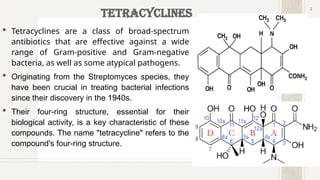
 Their four-ring structure, essential for their
biological activity, is a key characteristic of these
compounds. The name "tetracycline" refers to the
compound's four-ring structure.
2
3
History of Tetracyclines
3
 Tetracyclines are broad-spectrum antibiotics, originating from the Streptomyces
species, effective against various Gram-positive and Gram-negative bacteria
and some atypical pathogens.
 Discovered in the 1940s, they have been crucial in treating bacterial infections
due to their four-ring structure.
 The introduction of tetracyclines marked a significant advancement in
antibiotic therapy, leading to the development of derivatives like doxycycline
and minocycline.
 These antibiotics quickly gained popularity due to their broad spectrum of
activity against both Gram-positive and Gram-negative bacteria, as well as
atypical pathogens.
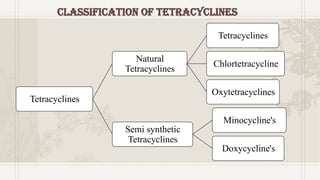
Classification of Tetracyclines
Tetracyclines
Natural
Tetracyclines
Tetracyclines
Chlortetracycline
Oxytetracyclines
Semi synthetic
Tetracyclines
Minocycline's
Doxycycline's
5
Classification of Tetracyclines
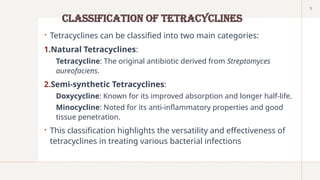
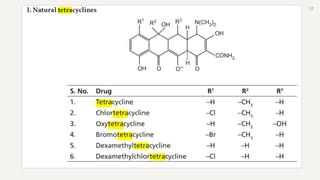
 Tetracyclines can be classified into two main categories:
1.Natural Tetracyclines:
Tetracycline: The original antibiotic derived from Streptomyces
aureofaciens.
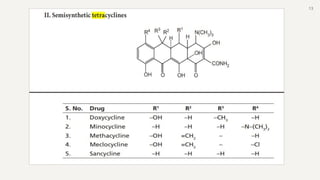
2.Semi-synthetic Tetracyclines:
Doxycycline: Known for its improved absorption and longer half-life.
Minocycline: Noted for its anti-inflammatory properties and good
tissue penetration.
 This classification highlights the versatility and effectiveness of
tetracyclines in treating various bacterial infections
6
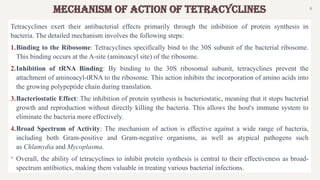
Tetracyclines exert their antibacterial effects primarily through the inhibition of protein synthesis in
bacteria. The detailed mechanism involves the following steps:
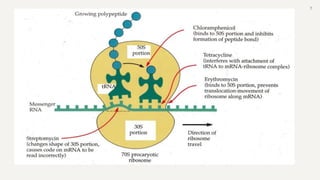
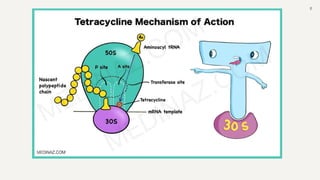
1.Binding to the Ribosome: Tetracyclines specifically bind to the 30S subunit of the bacterial ribosome.
This binding occurs at the A-site (aminoacyl site) of the ribosome.
2.Inhibition of tRNA Binding: By binding to the 30S ribosomal subunit, tetracyclines prevent the
attachment of aminoacyl-tRNA to the ribosome. This action inhibits the incorporation of amino acids into
the growing polypeptide chain during translation.
3.Bacteriostatic Effect: The inhibition of protein synthesis is bacteriostatic, meaning that it stops bacterial
growth and reproduction without directly killing the bacteria. This allows the host's immune system to
eliminate the bacteria more effectively.
4.Broad Spectrum of Activity: The mechanism of action is effective against a wide range of bacteria,
including both Gram-positive and Gram-negative organisms, as well as atypical pathogens such
as Chlamydia and Mycoplasma.
 Overall, the ability of tetracyclines to inhibit protein synthesis is central to their effectiveness as broad-
spectrum antibiotics, making them valuable in treating various bacterial infections.
Mechanism of Action of Tetracyclines
7
8
9
Structure Activity Relationship of Tetracyclines
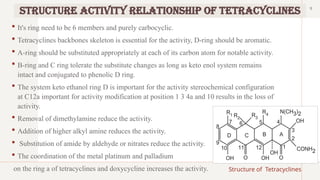
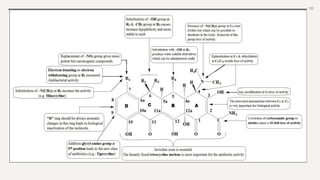
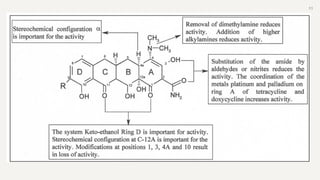
 It's ring need to be 6 members and purely carbocyclic.
 Tetracyclines backbones skeleton is essential for the activity, D-ring should be aromatic.
 A-ring should be substituted appropriately at each of its carbon atom for notable activity.
 B-ring and C ring tolerate the substitute changes as long as keto enol system remains
intact and conjugated to phenolic D ring.
 The system keto ethanol ring D is important for the activity stereochemical configuration
at C12a important for activity modification at position 1 3 4a and 10 results in the loss of
activity.
 Removal of dimethylamine reduce the activity.
 Addition of higher alkyl amine reduces the activity.
 Substitution of amide by aldehyde or nitrates reduce the activity.
 The coordination of the metal platinum and palladium
on the ring a of tetracyclines and doxycycline increases the activity. Structure of Tetracyclines
10
11
12
13
14
Thank You

Tetracyclines: A Comprehensive Overview.

  • 1.
    Tetracyclines a class ofAntibiotics By: Samruddhi S. Khonde  Asst. Professor  P. R. Patil Institute of Pharmacy, Talegaon (S.P.)
  • 2.
    2 Tetracyclines  Tetracyclines area class of broad-spectrum antibiotics that are effective against a wide range of Gram-positive and Gram-negative bacteria, as well as some atypical pathogens.  Originating from the Streptomyces species, they have been crucial in treating bacterial infections since their discovery in the 1940s.  Their four-ring structure, essential for their biological activity, is a key characteristic of these compounds. The name "tetracycline" refers to the compound's four-ring structure. 2
  • 3.
    3 History of Tetracyclines 3 Tetracyclines are broad-spectrum antibiotics, originating from the Streptomyces species, effective against various Gram-positive and Gram-negative bacteria and some atypical pathogens.  Discovered in the 1940s, they have been crucial in treating bacterial infections due to their four-ring structure.  The introduction of tetracyclines marked a significant advancement in antibiotic therapy, leading to the development of derivatives like doxycycline and minocycline.  These antibiotics quickly gained popularity due to their broad spectrum of activity against both Gram-positive and Gram-negative bacteria, as well as atypical pathogens.
  • 4.
  • 5.
    5 Classification of Tetracyclines Tetracyclines can be classified into two main categories: 1.Natural Tetracyclines: Tetracycline: The original antibiotic derived from Streptomyces aureofaciens. 2.Semi-synthetic Tetracyclines: Doxycycline: Known for its improved absorption and longer half-life. Minocycline: Noted for its anti-inflammatory properties and good tissue penetration.  This classification highlights the versatility and effectiveness of tetracyclines in treating various bacterial infections
  • 6.
    6 Tetracyclines exert theirantibacterial effects primarily through the inhibition of protein synthesis in bacteria. The detailed mechanism involves the following steps: 1.Binding to the Ribosome: Tetracyclines specifically bind to the 30S subunit of the bacterial ribosome. This binding occurs at the A-site (aminoacyl site) of the ribosome. 2.Inhibition of tRNA Binding: By binding to the 30S ribosomal subunit, tetracyclines prevent the attachment of aminoacyl-tRNA to the ribosome. This action inhibits the incorporation of amino acids into the growing polypeptide chain during translation. 3.Bacteriostatic Effect: The inhibition of protein synthesis is bacteriostatic, meaning that it stops bacterial growth and reproduction without directly killing the bacteria. This allows the host's immune system to eliminate the bacteria more effectively. 4.Broad Spectrum of Activity: The mechanism of action is effective against a wide range of bacteria, including both Gram-positive and Gram-negative organisms, as well as atypical pathogens such as Chlamydia and Mycoplasma.  Overall, the ability of tetracyclines to inhibit protein synthesis is central to their effectiveness as broad- spectrum antibiotics, making them valuable in treating various bacterial infections. Mechanism of Action of Tetracyclines
  • 7.
  • 8.
  • 9.
    9 Structure Activity Relationshipof Tetracyclines  It's ring need to be 6 members and purely carbocyclic.  Tetracyclines backbones skeleton is essential for the activity, D-ring should be aromatic.  A-ring should be substituted appropriately at each of its carbon atom for notable activity.  B-ring and C ring tolerate the substitute changes as long as keto enol system remains intact and conjugated to phenolic D ring.  The system keto ethanol ring D is important for the activity stereochemical configuration at C12a important for activity modification at position 1 3 4a and 10 results in the loss of activity.  Removal of dimethylamine reduce the activity.  Addition of higher alkyl amine reduces the activity.  Substitution of amide by aldehyde or nitrates reduce the activity.  The coordination of the metal platinum and palladium on the ring a of tetracyclines and doxycycline increases the activity. Structure of Tetracyclines
  • 10.
  • 11.
  • 12.
  • 13.
  • 14.
  • 15.