



![O
O2N
CH3
N
H
O
N-[2-(4-Nitrophenyl)-2-
oxoethyl]acetamide
O
O2N
N
H
OH
O
CH3
N-[3-Hydroxy-1-(4-nitrophenyl)-1-
oxopropan-2-yl]acetamide
(CH3COO)2O
Acetylation
HCHO
OH-
Aluminium
isopropoxide
Meerwin pondroff
reduction](https://image.slidesharecdn.com/11antibiotics-chloramphenicol-231205082247-94c9ca43/85/Chloramphenicol-25-320.jpg)
![OH
O2N
N
H
O
CH3
OH
N-[(1S)-1,3-Dihydroxy-1
-(4-nitrophenyl)propan-
2-yl]acetamide
OH
O2N
NH2
OH OH
O2N
N
H
OH
O
Cl
Cl
HCl
H2O
Hydrolysis
Racemic
modification with
D-camphor
sulphonic acid
Cl2CHCOCl
Chloro acetyl
chloride
(1R)-2-amino-1-(4-nitro
phenyl)propane-1,3-diol Chloramphenicol](https://image.slidesharecdn.com/11antibiotics-chloramphenicol-231205082247-94c9ca43/85/Chloramphenicol-26-320.jpg)


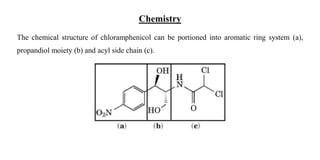
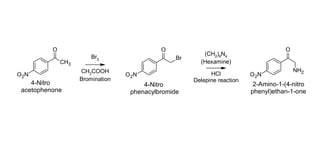
This document summarizes information about the antibiotic chloramphenicol. It was first isolated from Streptomyces venezuelae in 1947 and its chemical structure was identified in 1949, making it the first antibiotic synthesized instead of extracted. Chloramphenicol binds to the bacterial ribosome and inhibits bacterial protein synthesis, leading to its bacteriostatic effects. It has therapeutic uses for serious infections but is not recommended for minor infections due to risks of bone marrow suppression. The chemistry, mechanisms of action, synthesis, and structure-activity relationships of chloramphenicol and its derivatives are described.


