
Exploration of leadership speeches and vision of the leader
Data Analysis
The present study was designed to explore the leadership speeches and vision regarding their
journey. The qualitative technique was adopted to examine prescribed speeches. The
investigator analyses 40 speeches of chairpersons/CEOs across the world. These respondents
were associated to the several fields such as social media, technology, energy, business, law,
computer, software, industrial, food, snacks, beverages, banking, commerce, electronics,
sports, trading, IT, services, manufacturing, and sports.
The qualitative data were collected through thematic analysis of selected content. The interview
protocols have been treated under themes and sub-themes coding process. The major themes
have been used in NVivo v. 12 software to identify and explain in depth explanation of
respondents in series of pattern. The aforementioned thematic codes were used to analyses the
gathered qualitative data. The researcher adopted comparative analysis technique to uncover
participants point of views, experiences, and perception underneath their speeches. The basic
thematic nodes were derived from content analysis. The following list of major codes (3) and
sub-codes (40) was used for qualitative analysis:
A. Choices of words
Authenticity, challenges, development, effective, failure, integrity, motivation,
persuasion, positivity, purpose, responsible, strategic thinking, success, transformation,
and trustworthiness
B. Visionary Leadership
Consistency, environmental, experience, future, green energy, hope, innovation, long-
term, next generation, our vision, and teamwork.
C. Cultural articulation
All of us, collectively, democratic, everyone, mine/my, my experience, my hard work,
our culture, our efforts, our founders, our organization, our proud, and together.
The collected qualitative data have been coded for fruther analysis. The gathered data was
analyzed through NVivo 12. “Qualitative data requires a systematic process for analysing,
gathering, arranging, and modification of data or information” (Cohen et al., 2017). In this
study, nodding is applied to develop parent codes and child codes for further analyses. All the
nodes based on specified codes were organized and assessed by the triggers (Fraenkel et al.,
2016). The researcher applied hierarchy chart compared by item codes, word frequency, word
hierarchy, matrix coding, and their thematic visualization. The biasness in interpretation and
explanation of qualitative analysis was minimized through evidence-based transcription
collected from participants. The participants were classified under the cases of classifications
(social media, technology, energy, business, law, computer, software, industrial, food, snacks,
beverages, banking, commerce, electronics, sports, trading, IT, services, manufacturing, and
sports). The transcripts were organized cases wise in MS word application. The researcher
applied arrangement, coding, sub codes setting, analyses, and their visualization based on
coded speeches/content. The qualitative analysis is done by the researcher. All the content of
speeches were transformed in visual form as they were recorded. A range of themes including
child themes were analysed through NVivo version 12 software. The technique of analyses
applied through NVivo were frequency-based word cloud, hierarchy chart nodes compared by
item codes, word hierarchy, node clusters, and coding by item. The results are presented in
graphs/figures in the following pages.
Results
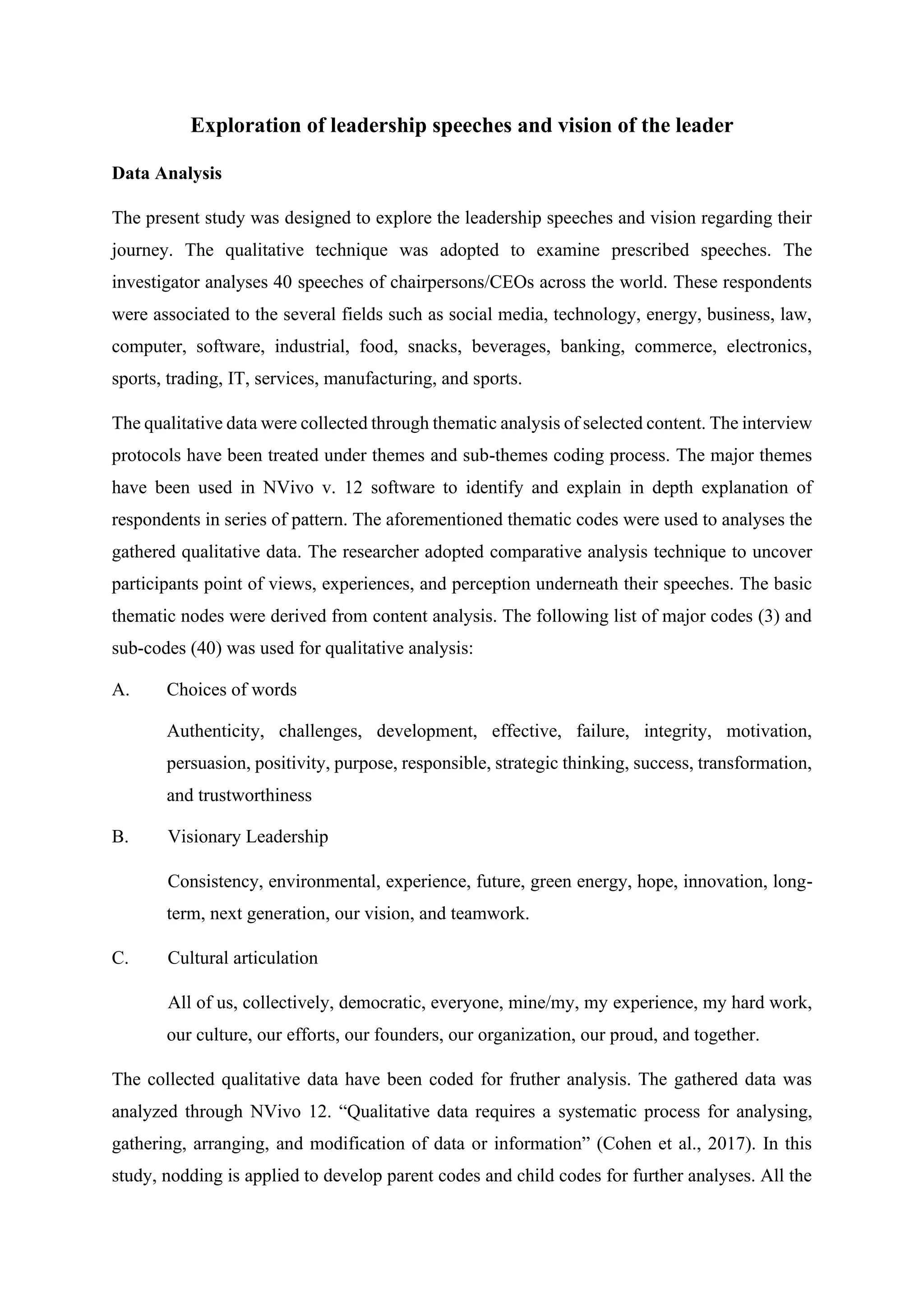
Figure 1
Word Cloud Frequency
In the figure 1, Word Tag Cloud based on word frequently per first 1000 words were
used on different patterns, is displayed. A collective visualization depicts major repeated
words. It can be observed that the words “people, today, world, company, like, time, years,
one, business, technology, change, and first” gained more attentions in speeches by the
speakers in comparison to other words.
Research Question 1: Can leaders be classified based on their choice of words?
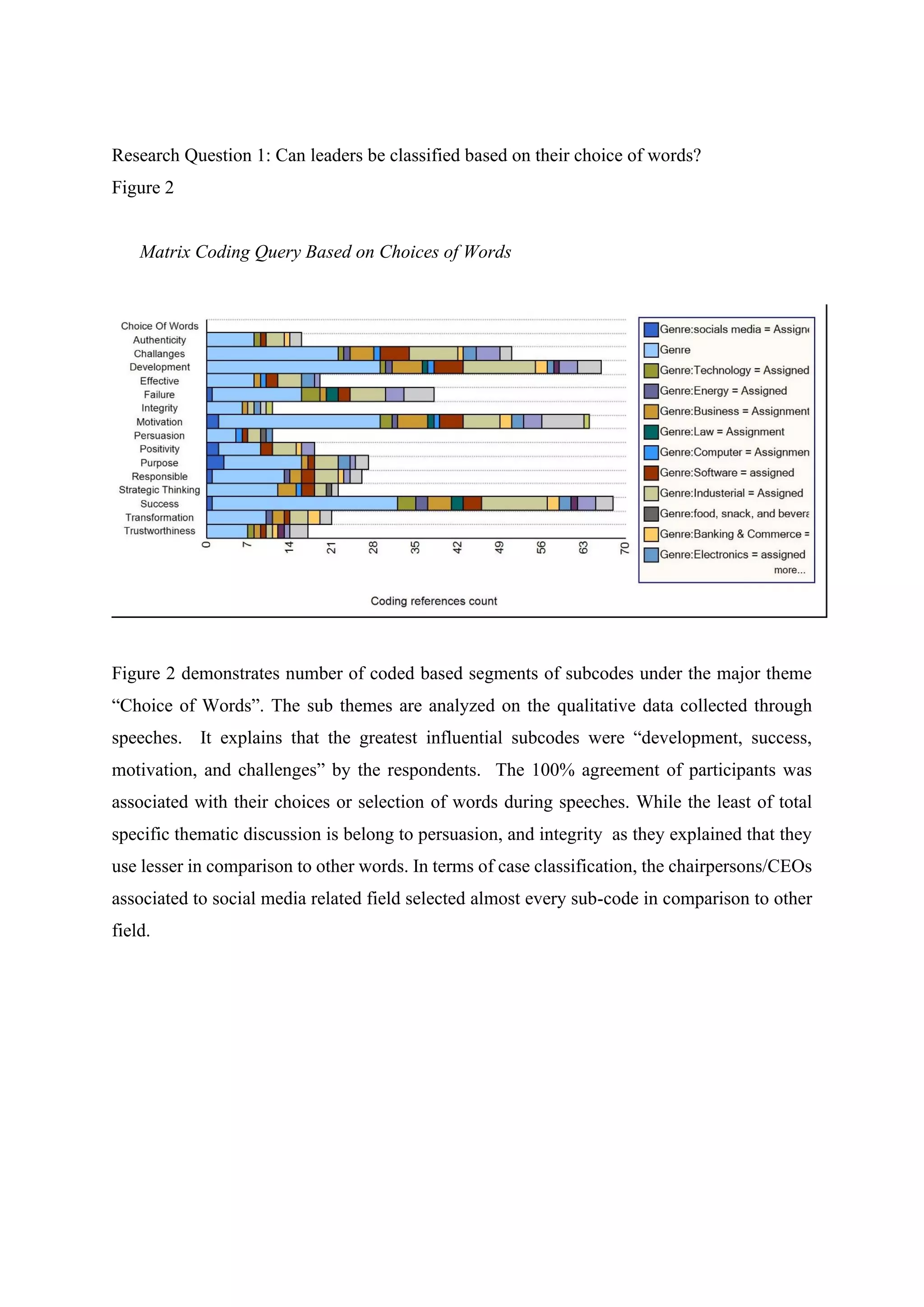
Figure 2
Matrix Coding Query Based on Choices of Words
Figure 2 demonstrates number of coded based segments of subcodes under the major theme
“Choice of Words”. The sub themes are analyzed on the qualitative data collected through
speeches. It explains that the greatest influential subcodes were “development, success,
motivation, and challenges” by the respondents. The 100% agreement of participants was
associated with their choices or selection of words during speeches. While the least of total
specific thematic discussion is belong to persuasion, and integrity as they explained that they
use lesser in comparison to other words. In terms of case classification, the chairpersons/CEOs
associated to social media related field selected almost every sub-code in comparison to other
field.
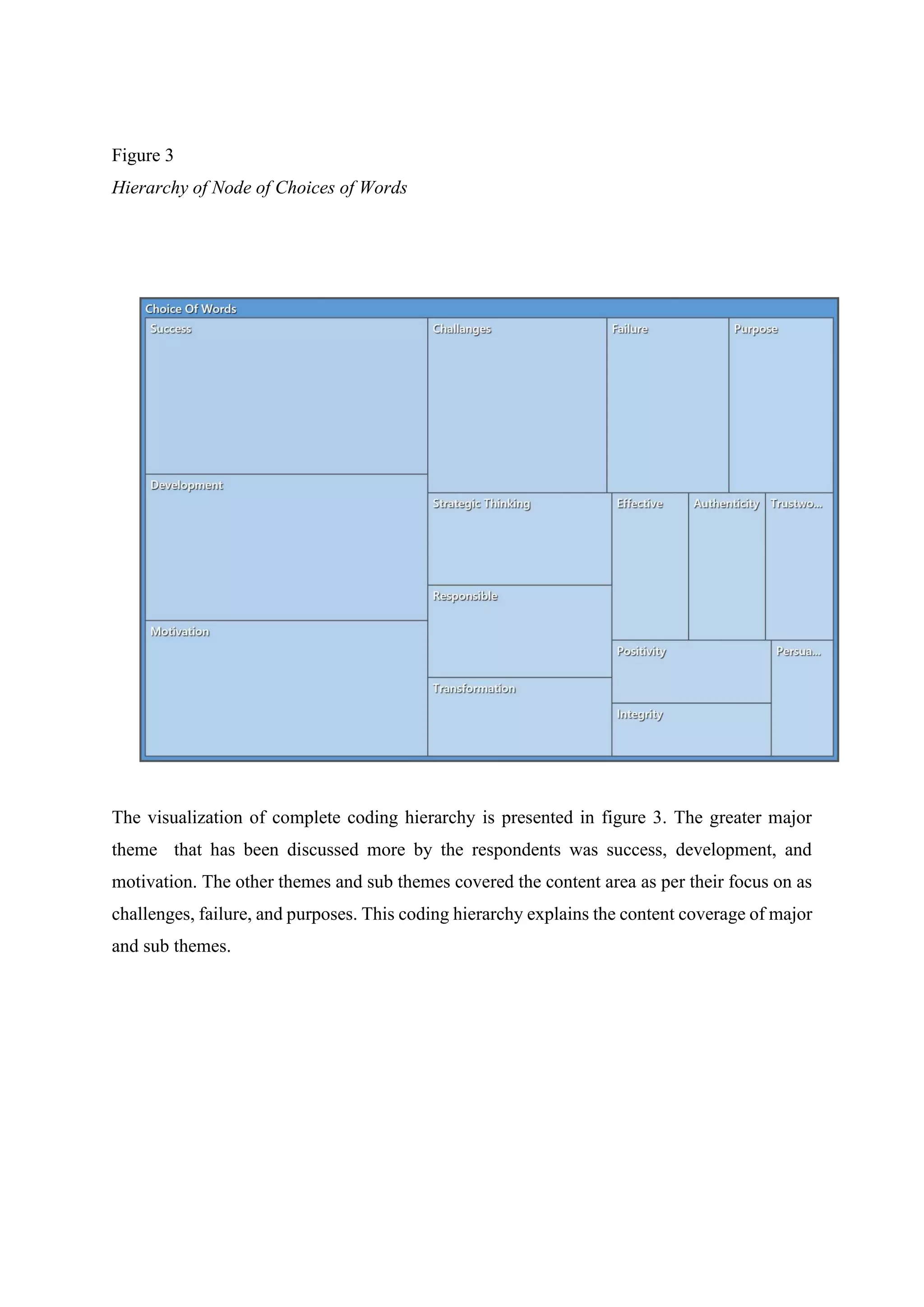
Figure 3
Hierarchy of Node of Choices of Words
The visualization of complete coding hierarchy is presented in figure 3. The greater major
theme that has been discussed more by the respondents was success, development, and
motivation. The other themes and sub themes covered the content area as per their focus on as
challenges, failure, and purposes. This coding hierarchy explains the content coverage of major
and sub themes.
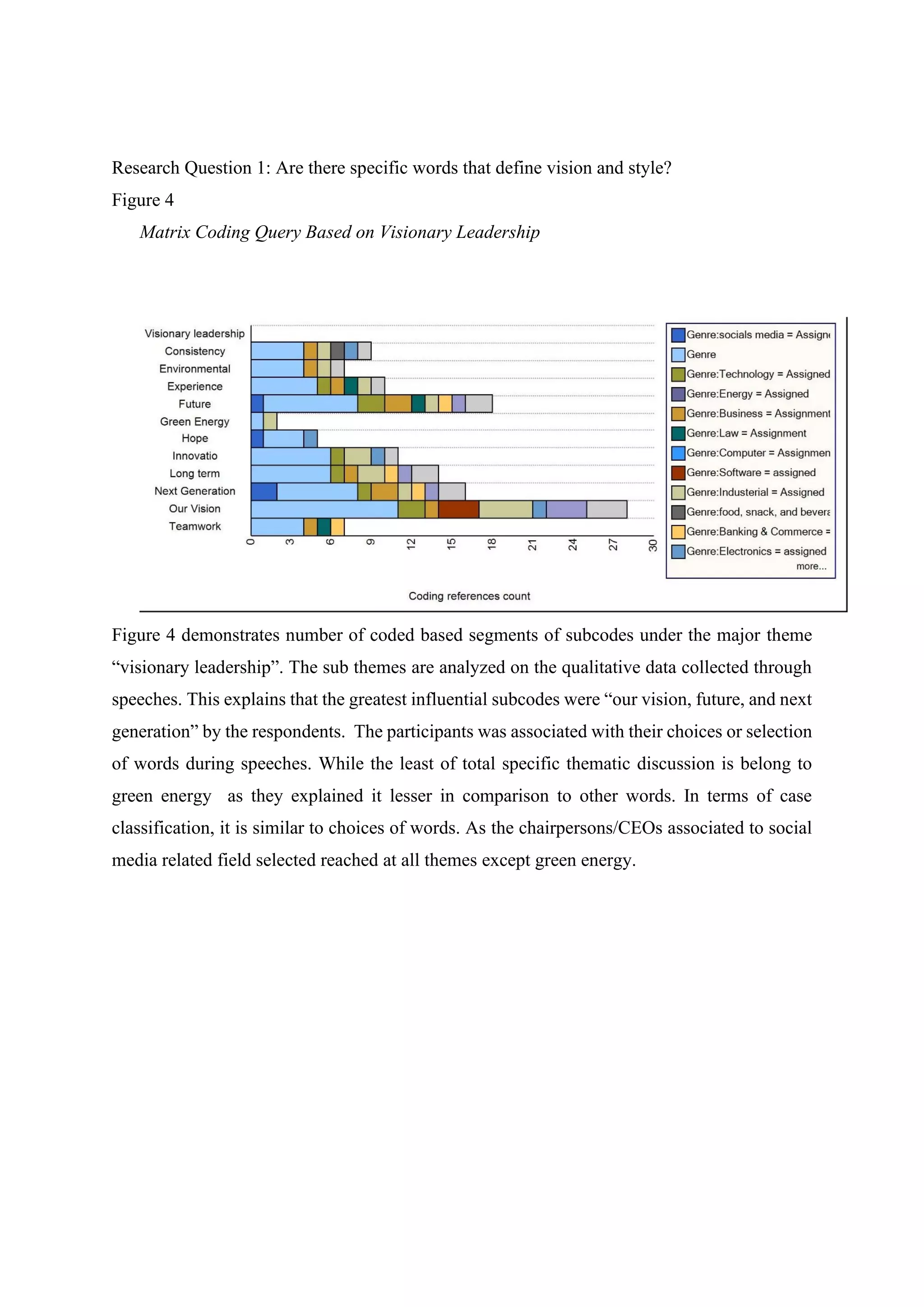
Research Question 1: Are there specific words that define vision and style?
Figure 4
Matrix Coding Query Based on Visionary Leadership
Figure 4 demonstrates number of coded based segments of subcodes under the major theme
“visionary leadership”. The sub themes are analyzed on the qualitative data collected through
speeches. This explains that the greatest influential subcodes were “our vision, future, and next
generation” by the respondents. The participants was associated with their choices or selection
of words during speeches. While the least of total specific thematic discussion is belong to
green energy as they explained it lesser in comparison to other words. In terms of case
classification, it is similar to choices of words. As the chairpersons/CEOs associated to social
media related field selected reached at all themes except green energy.
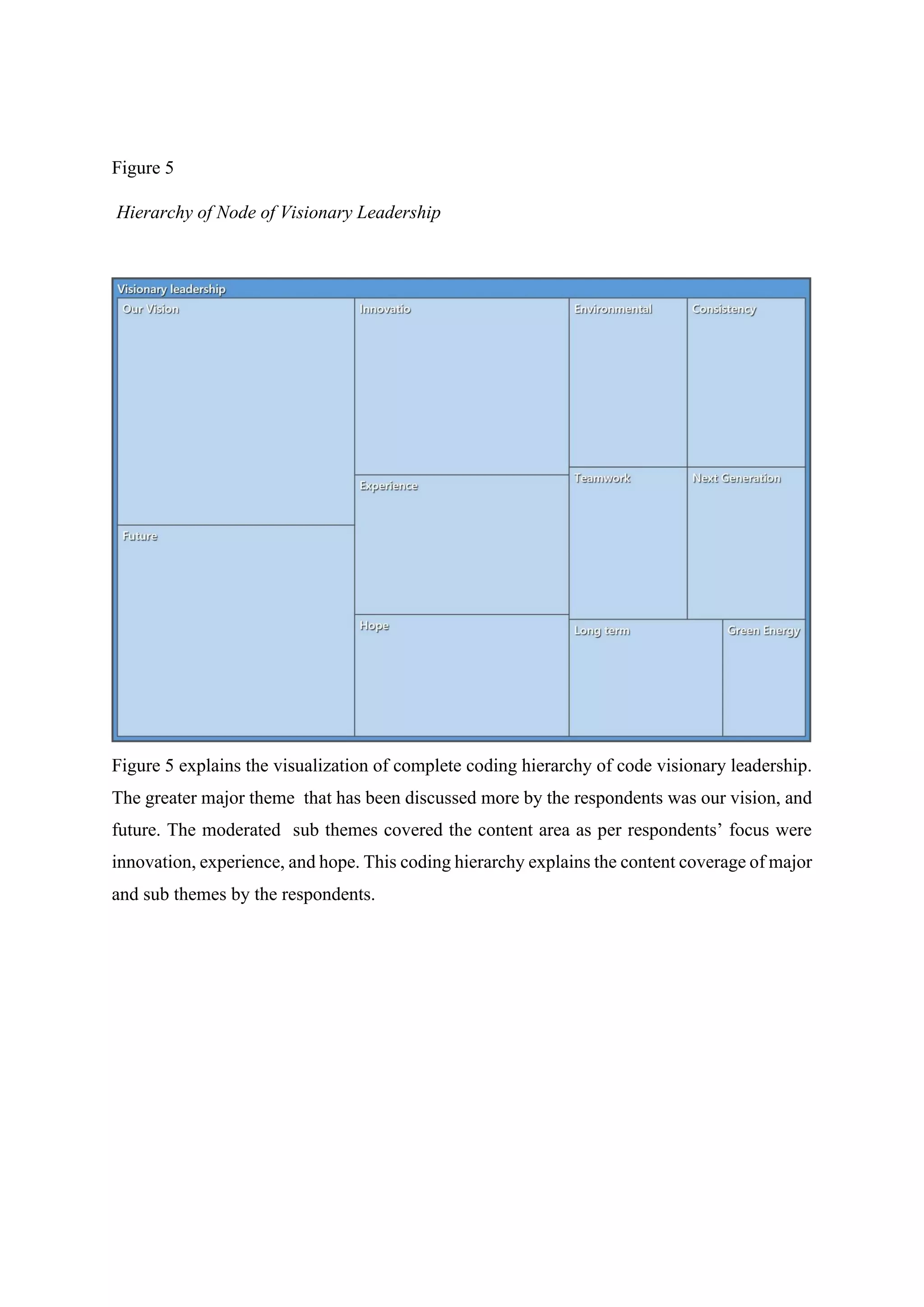
Figure 5
Hierarchy of Node of Visionary Leadership
Figure 5 explains the visualization of complete coding hierarchy of code visionary leadership.
The greater major theme that has been discussed more by the respondents was our vision, and
future. The moderated sub themes covered the content area as per respondents’ focus were
innovation, experience, and hope. This coding hierarchy explains the content coverage of major
and sub themes by the respondents.
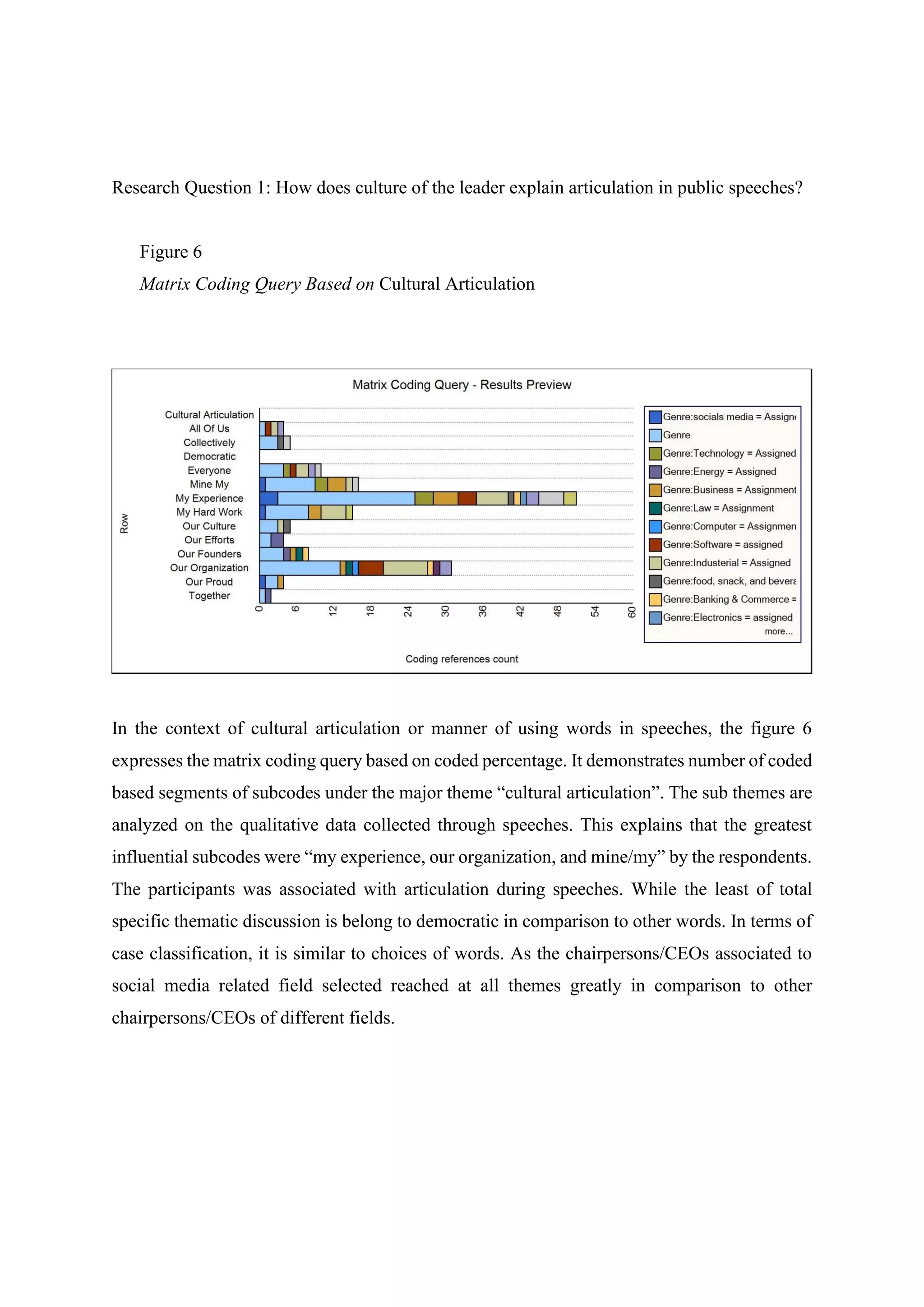
Research Question 1: How does culture of the leader explain articulation in public speeches?
Figure 6
Matrix Coding Query Based on Cultural Articulation
In the context of cultural articulation or manner of using words in speeches, the figure 6
expresses the matrix coding query based on coded percentage. It demonstrates number of coded
based segments of subcodes under the major theme “cultural articulation”. The sub themes are
analyzed on the qualitative data collected through speeches. This explains that the greatest
influential subcodes were “my experience, our organization, and mine/my” by the respondents.
The participants was associated with articulation during speeches. While the least of total
specific thematic discussion is belong to democratic in comparison to other words. In terms of
case classification, it is similar to choices of words. As the chairpersons/CEOs associated to
social media related field selected reached at all themes greatly in comparison to other
chairpersons/CEOs of different fields.
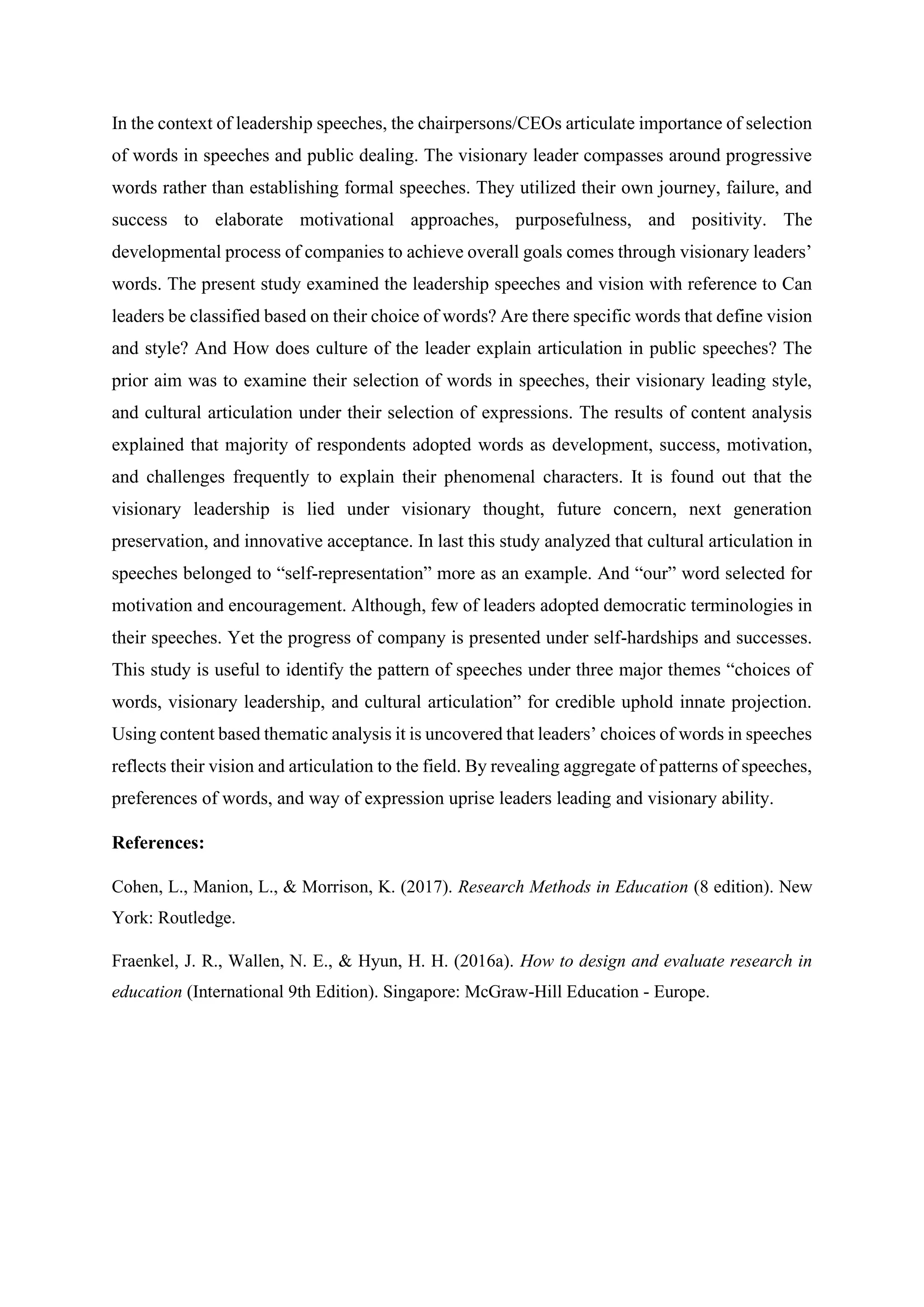
Figure 7
Hierarchy of Node of Cultural Articulation
The hierarchy of codes and sub codes related to cultural articulation explains the visualization
of complete coding hierarchy of code (figure 7). The greater major theme that has been
discussed more by the respondents were my experience and our organization. A sense of self
and organizational motivation is found under these sub-themes. The moderated sub themes
covered the content area as per respondents’ focus were my/mine, my hard word, and our
efforts. This coding hierarchy explains the content coverage of major and sub themes by the
respondents. It can be noted that the participants described their own journey in terms of
explaining their motives. As majority of respondents used sub-themes of mine/my, my
experience, my hard word, more that our organization, our efforts, everyone, collectively, our
culture, and our founders.
Findings
In the context of leadership speeches, the chairpersons/CEOs articulate importance of selection
of words in speeches and public dealing. The visionary leader compasses around progressive
words rather than establishing formal speeches. They utilized their own journey, failure, and
success to elaborate motivational approaches, purposefulness, and positivity. The
developmental process of companies to achieve overall goals comes through visionary leaders’
words. The present study examined the leadership speeches and vision with reference to Can
leaders be classified based on their choice of words? Are there specific words that define vision
and style? And How does culture of the leader explain articulation in public speeches? The
prior aim was to examine their selection of words in speeches, their visionary leading style,
and cultural articulation under their selection of expressions. The results of content analysis
explained that majority of respondents adopted words as development, success, motivation,
and challenges frequently to explain their phenomenal characters. It is found out that the
visionary leadership is lied under visionary thought, future concern, next generation
preservation, and innovative acceptance. In last this study analyzed that cultural articulation in
speeches belonged to “self-representation” more as an example. And “our” word selected for
motivation and encouragement. Although, few of leaders adopted democratic terminologies in
their speeches. Yet the progress of company is presented under self-hardships and successes.
This study is useful to identify the pattern of speeches under three major themes “choices of
words, visionary leadership, and cultural articulation” for credible uphold innate projection.
Using content based thematic analysis it is uncovered that leaders’ choices of words in speeches
reflects their vision and articulation to the field. By revealing aggregate of patterns of speeches,
preferences of words, and way of expression uprise leaders leading and visionary ability.
References:
Cohen, L., Manion, L., & Morrison, K. (2017). Research Methods in Education (8 edition). New
York: Routledge.
Fraenkel, J. R., Wallen, N. E., & Hyun, H. H. (2016a). How to design and evaluate research in
education (International 9th Edition). Singapore: McGraw-Hill Education - Europe.
Qualitative analysis/cluster analysis/NVivo analysis /content analysis Interpretation

Qualitative analysis/cluster analysis/NVivo analysis /content analysis Interpretation

  • 1.
    Exploration of leadershipspeeches and vision of the leader Data Analysis The present study was designed to explore the leadership speeches and vision regarding their journey. The qualitative technique was adopted to examine prescribed speeches. The investigator analyses 40 speeches of chairpersons/CEOs across the world. These respondents were associated to the several fields such as social media, technology, energy, business, law, computer, software, industrial, food, snacks, beverages, banking, commerce, electronics, sports, trading, IT, services, manufacturing, and sports. The qualitative data were collected through thematic analysis of selected content. The interview protocols have been treated under themes and sub-themes coding process. The major themes have been used in NVivo v. 12 software to identify and explain in depth explanation of respondents in series of pattern. The aforementioned thematic codes were used to analyses the gathered qualitative data. The researcher adopted comparative analysis technique to uncover participants point of views, experiences, and perception underneath their speeches. The basic thematic nodes were derived from content analysis. The following list of major codes (3) and sub-codes (40) was used for qualitative analysis: A. Choices of words Authenticity, challenges, development, effective, failure, integrity, motivation, persuasion, positivity, purpose, responsible, strategic thinking, success, transformation, and trustworthiness B. Visionary Leadership Consistency, environmental, experience, future, green energy, hope, innovation, long- term, next generation, our vision, and teamwork. C. Cultural articulation All of us, collectively, democratic, everyone, mine/my, my experience, my hard work, our culture, our efforts, our founders, our organization, our proud, and together. The collected qualitative data have been coded for fruther analysis. The gathered data was analyzed through NVivo 12. “Qualitative data requires a systematic process for analysing, gathering, arranging, and modification of data or information” (Cohen et al., 2017). In this study, nodding is applied to develop parent codes and child codes for further analyses. All the
  • 2.
    nodes based onspecified codes were organized and assessed by the triggers (Fraenkel et al., 2016). The researcher applied hierarchy chart compared by item codes, word frequency, word hierarchy, matrix coding, and their thematic visualization. The biasness in interpretation and explanation of qualitative analysis was minimized through evidence-based transcription collected from participants. The participants were classified under the cases of classifications (social media, technology, energy, business, law, computer, software, industrial, food, snacks, beverages, banking, commerce, electronics, sports, trading, IT, services, manufacturing, and sports). The transcripts were organized cases wise in MS word application. The researcher applied arrangement, coding, sub codes setting, analyses, and their visualization based on coded speeches/content. The qualitative analysis is done by the researcher. All the content of speeches were transformed in visual form as they were recorded. A range of themes including child themes were analysed through NVivo version 12 software. The technique of analyses applied through NVivo were frequency-based word cloud, hierarchy chart nodes compared by item codes, word hierarchy, node clusters, and coding by item. The results are presented in graphs/figures in the following pages.
  • 3.
    Results Figure 1 Word CloudFrequency In the figure 1, Word Tag Cloud based on word frequently per first 1000 words were used on different patterns, is displayed. A collective visualization depicts major repeated words. It can be observed that the words “people, today, world, company, like, time, years, one, business, technology, change, and first” gained more attentions in speeches by the speakers in comparison to other words.
  • 4.
    Research Question 1:Can leaders be classified based on their choice of words? Figure 2 Matrix Coding Query Based on Choices of Words Figure 2 demonstrates number of coded based segments of subcodes under the major theme “Choice of Words”. The sub themes are analyzed on the qualitative data collected through speeches. It explains that the greatest influential subcodes were “development, success, motivation, and challenges” by the respondents. The 100% agreement of participants was associated with their choices or selection of words during speeches. While the least of total specific thematic discussion is belong to persuasion, and integrity as they explained that they use lesser in comparison to other words. In terms of case classification, the chairpersons/CEOs associated to social media related field selected almost every sub-code in comparison to other field.
  • 5.
    Figure 3 Hierarchy ofNode of Choices of Words The visualization of complete coding hierarchy is presented in figure 3. The greater major theme that has been discussed more by the respondents was success, development, and motivation. The other themes and sub themes covered the content area as per their focus on as challenges, failure, and purposes. This coding hierarchy explains the content coverage of major and sub themes.
  • 6.
    Research Question 1:Are there specific words that define vision and style? Figure 4 Matrix Coding Query Based on Visionary Leadership Figure 4 demonstrates number of coded based segments of subcodes under the major theme “visionary leadership”. The sub themes are analyzed on the qualitative data collected through speeches. This explains that the greatest influential subcodes were “our vision, future, and next generation” by the respondents. The participants was associated with their choices or selection of words during speeches. While the least of total specific thematic discussion is belong to green energy as they explained it lesser in comparison to other words. In terms of case classification, it is similar to choices of words. As the chairpersons/CEOs associated to social media related field selected reached at all themes except green energy.
  • 7.
    Figure 5 Hierarchy ofNode of Visionary Leadership Figure 5 explains the visualization of complete coding hierarchy of code visionary leadership. The greater major theme that has been discussed more by the respondents was our vision, and future. The moderated sub themes covered the content area as per respondents’ focus were innovation, experience, and hope. This coding hierarchy explains the content coverage of major and sub themes by the respondents.
  • 8.
    Research Question 1:How does culture of the leader explain articulation in public speeches? Figure 6 Matrix Coding Query Based on Cultural Articulation In the context of cultural articulation or manner of using words in speeches, the figure 6 expresses the matrix coding query based on coded percentage. It demonstrates number of coded based segments of subcodes under the major theme “cultural articulation”. The sub themes are analyzed on the qualitative data collected through speeches. This explains that the greatest influential subcodes were “my experience, our organization, and mine/my” by the respondents. The participants was associated with articulation during speeches. While the least of total specific thematic discussion is belong to democratic in comparison to other words. In terms of case classification, it is similar to choices of words. As the chairpersons/CEOs associated to social media related field selected reached at all themes greatly in comparison to other chairpersons/CEOs of different fields.
  • 9.
    Figure 7 Hierarchy ofNode of Cultural Articulation The hierarchy of codes and sub codes related to cultural articulation explains the visualization of complete coding hierarchy of code (figure 7). The greater major theme that has been discussed more by the respondents were my experience and our organization. A sense of self and organizational motivation is found under these sub-themes. The moderated sub themes covered the content area as per respondents’ focus were my/mine, my hard word, and our efforts. This coding hierarchy explains the content coverage of major and sub themes by the respondents. It can be noted that the participants described their own journey in terms of explaining their motives. As majority of respondents used sub-themes of mine/my, my experience, my hard word, more that our organization, our efforts, everyone, collectively, our culture, and our founders. Findings
  • 10.
    In the contextof leadership speeches, the chairpersons/CEOs articulate importance of selection of words in speeches and public dealing. The visionary leader compasses around progressive words rather than establishing formal speeches. They utilized their own journey, failure, and success to elaborate motivational approaches, purposefulness, and positivity. The developmental process of companies to achieve overall goals comes through visionary leaders’ words. The present study examined the leadership speeches and vision with reference to Can leaders be classified based on their choice of words? Are there specific words that define vision and style? And How does culture of the leader explain articulation in public speeches? The prior aim was to examine their selection of words in speeches, their visionary leading style, and cultural articulation under their selection of expressions. The results of content analysis explained that majority of respondents adopted words as development, success, motivation, and challenges frequently to explain their phenomenal characters. It is found out that the visionary leadership is lied under visionary thought, future concern, next generation preservation, and innovative acceptance. In last this study analyzed that cultural articulation in speeches belonged to “self-representation” more as an example. And “our” word selected for motivation and encouragement. Although, few of leaders adopted democratic terminologies in their speeches. Yet the progress of company is presented under self-hardships and successes. This study is useful to identify the pattern of speeches under three major themes “choices of words, visionary leadership, and cultural articulation” for credible uphold innate projection. Using content based thematic analysis it is uncovered that leaders’ choices of words in speeches reflects their vision and articulation to the field. By revealing aggregate of patterns of speeches, preferences of words, and way of expression uprise leaders leading and visionary ability. References: Cohen, L., Manion, L., & Morrison, K. (2017). Research Methods in Education (8 edition). New York: Routledge. Fraenkel, J. R., Wallen, N. E., & Hyun, H. H. (2016a). How to design and evaluate research in education (International 9th Edition). Singapore: McGraw-Hill Education - Europe.