TEST DEVELOPMENT AND
EVALUATION (6462)
DEVELOPING ALTERNATE TECHNIQUES-I
Department of Secondary Teacher Education
ALLAMA IQBAL OPEN UNIVERSITY, ISLAMABAD
OBJECTIVES OF THE UNIT
After studying this unit, the students will have ability to demonstrate.
 • understand the process of classroom observation.
 • create a proper plan to carry out the process of observation
 • derive results from the process of observation
 • explain classroom projects and implement in their classrooms
 • describe different types and phases of projects
 • assess the projects and use that information for project evaluation
 • design different tasks and tests
 • elucidate methods of calculating reliability.
6.1 CLASSROOM OBSERVATION
6.1.1 Classroom Observations: Purpose and Significance
6.1.2 Planning and Preparing for Observation
 Artifacts
 Direct record
 Written record
6.1.3 Typical Observation Formats
 Narrative recording
 A-B-C
 Scatter Plot
 Task Engagement and academic participation
 Task Engagement
 Event Recording
 Deriving Results from the Observation by Developing Rubrics
6.1.4 Making Decision on the Basis of Observation Results
OBSERVATION
According to Gardner (1975), observation is the selection, provocation, recording and encoding of that
set of behaviours and settings concerning organism “in situ’ which are consistent with empirical aims.”
Observation is a visual method of gathering information on activities: of what happens, what your object
(students) of study does or how it behaves.
Characteristics of Observation
1. Observation is at once a physical as well as mental activity.
2. Observation is selective and purposeful.
3. Scientific observation is systematic
4. Observation is specific
5. Scientific observation is objective and quantitative.
6. The record of observation is immediately.
7.It determines reality from the perspective of observed person himself.
Dr. HJ(hinansari23@gmail.com/@AksEAina)
OBSERVATION
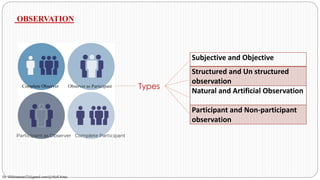
Types
Complete Observer Observer as Participant
Participant as Observer Complete Participant
Subjective and Objective
Structured and Un structured
observation
Natural and Artificial Observation
Participant and Non-participant
observation
Dr. HJ(hinansari23@gmail.com/@AksEAina)
6.2 CLASSROOM PROJECTS
6.2.1 Definition of Project
Project is defined as a whole-hearted purposeful activity proceeding in a social environment. It is a
willingly taken responsibility which involves constructive effort to achieve the desired objective. A project
is an in-depth study of a particular topic that one or more children can undertake for a certain period of
time. Projects are multifaceted tasks involving exigent questions to be answered, demanding from learners
to design, solve problems, make appropriate decisions and investigate to explore.
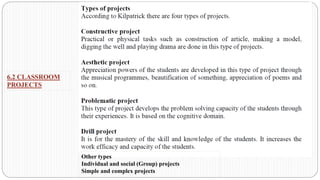
6.2 CLASSROOM
PROJECTS
Other types
Individual and social (Group) projects
Simple and complex projects
6.2.2 Tasks Versus Tests
It is common observation that teachers, educators, educational managers,
administrators and students use educational terms without differentiating their
meaning and applicability. Tasks and tests are also being used in educational
dialogues, discussions and in written materials. Tasks are such activities where
learners have multiple opportunities to practice the required knowledge and skills over
a longer period of time. Working on tasks, students are allowed to learn and revise
content multiple times. For example, homework is an example of task to be completed
at home as an extension of learning activities of classroom. As end result of the tasks,
teachers can have an in-depth overview of students’ progress on the tasks performed.
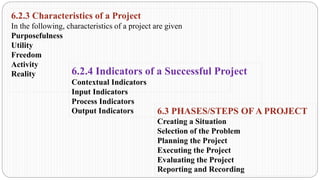
6.2.3 Characteristics of a Project
In the following, characteristics of a project are given
Purposefulness
Utility
Freedom
Activity
Reality 6.2.4 Indicators of a Successful Project
Contextual Indicators
Input Indicators
Process Indicators
Output Indicators 6.3 PHASES/STEPS OF A PROJECT
Creating a Situation
Selection of the Problem
Planning the Project
Executing the Project
Evaluating the Project
Reporting and Recording
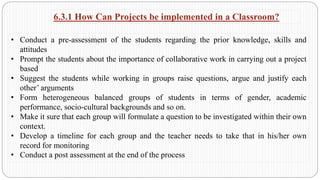
6.3.1 How Can Projects be implemented in a Classroom?
• Conduct a pre-assessment of the students regarding the prior knowledge, skills and
attitudes
• Prompt the students about the importance of collaborative work in carrying out a project
based
• Suggest the students while working in groups raise questions, argue and justify each
other’ arguments
• Form heterogeneous balanced groups of students in terms of gender, academic
performance, socio-cultural backgrounds and so on.
• Make it sure that each group will formulate a question to be investigated within their own
context.
• Develop a timeline for each group and the teacher needs to take that in his/her own
record for monitoring
• Conduct a post assessment at the end of the process
Department of Secondary Teacher Education
ALLAMA IQBAL OPEN UNIVERSITY, ISLAMABAD
Dr. Hina Jalal
hinansari23@gmail.com

TEST DEVELOPMENT AND EVALUATION (6462)

  • 1.
    TEST DEVELOPMENT AND EVALUATION(6462) DEVELOPING ALTERNATE TECHNIQUES-I Department of Secondary Teacher Education ALLAMA IQBAL OPEN UNIVERSITY, ISLAMABAD
  • 2.
    OBJECTIVES OF THEUNIT After studying this unit, the students will have ability to demonstrate.  • understand the process of classroom observation.  • create a proper plan to carry out the process of observation  • derive results from the process of observation  • explain classroom projects and implement in their classrooms  • describe different types and phases of projects  • assess the projects and use that information for project evaluation  • design different tasks and tests  • elucidate methods of calculating reliability.
  • 3.
    6.1 CLASSROOM OBSERVATION 6.1.1Classroom Observations: Purpose and Significance 6.1.2 Planning and Preparing for Observation  Artifacts  Direct record  Written record 6.1.3 Typical Observation Formats  Narrative recording  A-B-C  Scatter Plot  Task Engagement and academic participation  Task Engagement  Event Recording  Deriving Results from the Observation by Developing Rubrics 6.1.4 Making Decision on the Basis of Observation Results
  • 4.
    OBSERVATION According to Gardner(1975), observation is the selection, provocation, recording and encoding of that set of behaviours and settings concerning organism “in situ’ which are consistent with empirical aims.” Observation is a visual method of gathering information on activities: of what happens, what your object (students) of study does or how it behaves. Characteristics of Observation 1. Observation is at once a physical as well as mental activity. 2. Observation is selective and purposeful. 3. Scientific observation is systematic 4. Observation is specific 5. Scientific observation is objective and quantitative. 6. The record of observation is immediately. 7.It determines reality from the perspective of observed person himself. Dr. HJ(hinansari23@gmail.com/@AksEAina)
  • 5.
    OBSERVATION Types Complete Observer Observeras Participant Participant as Observer Complete Participant Subjective and Objective Structured and Un structured observation Natural and Artificial Observation Participant and Non-participant observation Dr. HJ(hinansari23@gmail.com/@AksEAina)
  • 6.
    6.2 CLASSROOM PROJECTS 6.2.1Definition of Project Project is defined as a whole-hearted purposeful activity proceeding in a social environment. It is a willingly taken responsibility which involves constructive effort to achieve the desired objective. A project is an in-depth study of a particular topic that one or more children can undertake for a certain period of time. Projects are multifaceted tasks involving exigent questions to be answered, demanding from learners to design, solve problems, make appropriate decisions and investigate to explore.
  • 7.
    6.2 CLASSROOM PROJECTS Other types Individualand social (Group) projects Simple and complex projects
  • 8.
    6.2.2 Tasks VersusTests It is common observation that teachers, educators, educational managers, administrators and students use educational terms without differentiating their meaning and applicability. Tasks and tests are also being used in educational dialogues, discussions and in written materials. Tasks are such activities where learners have multiple opportunities to practice the required knowledge and skills over a longer period of time. Working on tasks, students are allowed to learn and revise content multiple times. For example, homework is an example of task to be completed at home as an extension of learning activities of classroom. As end result of the tasks, teachers can have an in-depth overview of students’ progress on the tasks performed.
  • 9.
    6.2.3 Characteristics ofa Project In the following, characteristics of a project are given Purposefulness Utility Freedom Activity Reality 6.2.4 Indicators of a Successful Project Contextual Indicators Input Indicators Process Indicators Output Indicators 6.3 PHASES/STEPS OF A PROJECT Creating a Situation Selection of the Problem Planning the Project Executing the Project Evaluating the Project Reporting and Recording
  • 10.
    6.3.1 How CanProjects be implemented in a Classroom? • Conduct a pre-assessment of the students regarding the prior knowledge, skills and attitudes • Prompt the students about the importance of collaborative work in carrying out a project based • Suggest the students while working in groups raise questions, argue and justify each other’ arguments • Form heterogeneous balanced groups of students in terms of gender, academic performance, socio-cultural backgrounds and so on. • Make it sure that each group will formulate a question to be investigated within their own context. • Develop a timeline for each group and the teacher needs to take that in his/her own record for monitoring • Conduct a post assessment at the end of the process
  • 11.
    Department of SecondaryTeacher Education ALLAMA IQBAL OPEN UNIVERSITY, ISLAMABAD Dr. Hina Jalal hinansari23@gmail.com