Assessment
Assessment
Assessment
Assessment
By:
By: Mekuria
Mekuria Mekonnen
Mekonnen (
(BSc
BSc,
, MSc
MSc, BA, MA)
, BA, MA)
March, 2024

 What is your
What is your expectation
expectation from this training?
from this training?

 _________________________________________
_________________________________________
_________________________________________
_________________________________________
_________________________________________
_________________________________________

 What do you think should be observed as
What do you think should be observed as
ground rules
ground rules during this training?
during this training?

 _________________________________________
_________________________________________
_________________________________________
_________________________________________

 At the end of the training, the trainees will be
At the end of the training, the trainees will be
able to:
able to:
 defines basic terms related with educational
assessment
assessment
 differentiates between formative and summative
assessment
 prepares a table of specification
 constructs classroom test that consists different
item types

 Part I: Meaning of basic terms in educational
Part I: Meaning of basic terms in educational
testing
testing

 Part II: Continuous assessment
Part II: Continuous assessment

 Part III: Planning and constructing classroom
Part III: Planning and constructing classroom
test
test

 Part IV: Giving feedback
Part IV: Giving feedback

 Interactive
Interactive

 Bilingual
Bilingual

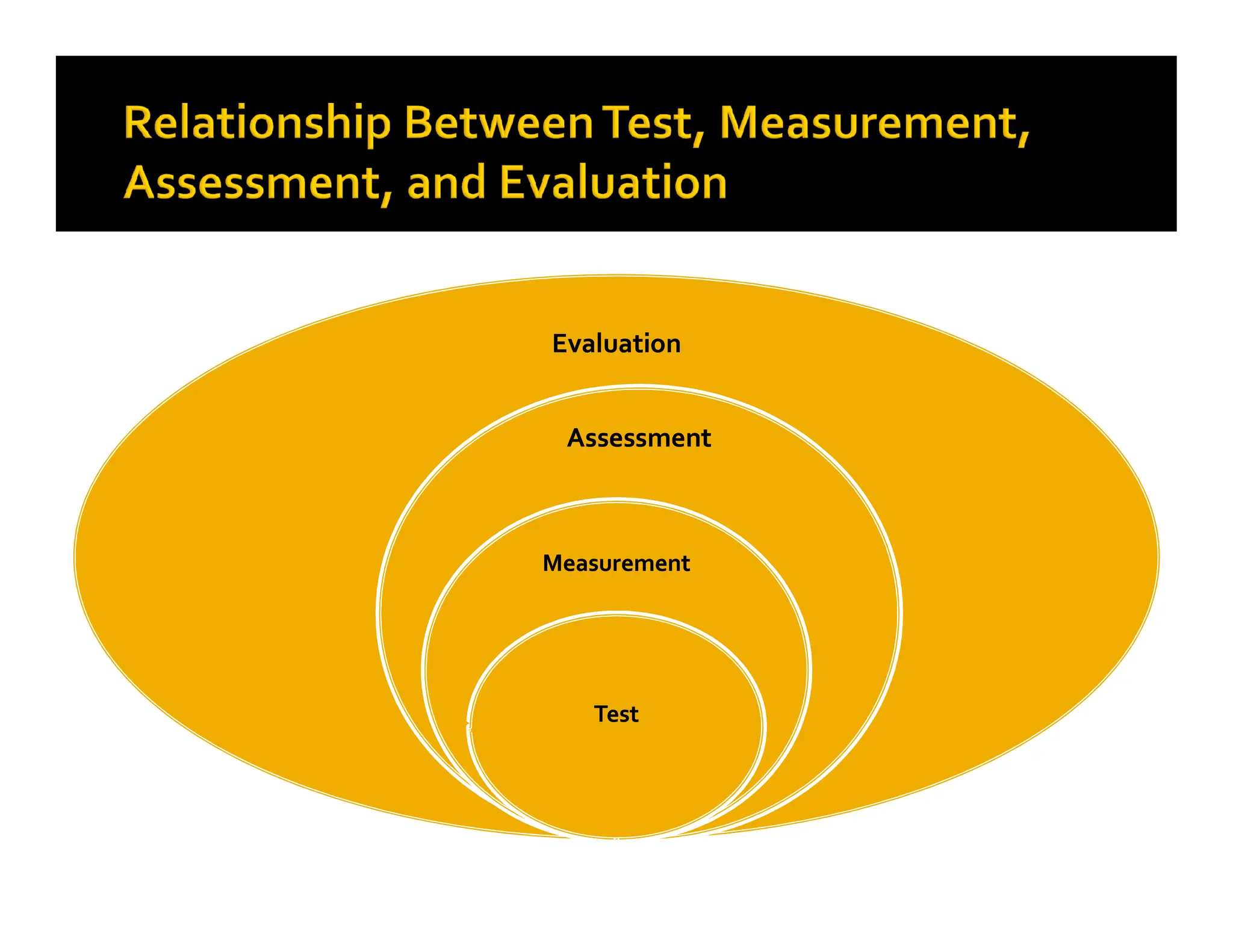
 Test, Measurement,Assessment, and
Test, Measurement,Assessment, and
Evaluation
Evaluation
Activity 1
Activity 1
Activity 1
Activity 1

 What do we mean by
What do we mean byTest, Measurement,
Test, Measurement,
Assessment, and Evaluation? What is their
difference?
difference?



 Share your thoughts with your colleagues
Share your thoughts with your colleagues

 Set of
Set of questions
questions answered by the students
answered by the students

 Is an
Is an instrument
instrument for measuring a sample of
for measuring a sample of
behavior
behavior

 Written test/Paper
Written test/Paper-
-and
and-
-pencil tests
pencil tests

 Require the student to respond to the test items by
Require the student to respond to the test items by writing
writing

 Require the student to respond to the test items by
Require the student to respond to the test items by writing
writing
the answers
the answers

 Oral tests
Oral tests

 Questioning and answering are done
Questioning and answering are done orally
orally

 Performance tests
Performance tests

 Assessment that evaluates
Assessment that evaluates actual
actual student performance
student performance

 Types:
Types:

 Products
Products: drawings, science experiments, etc
: drawings, science experiments, etc

 Behavior
Behavior:Time trials to run a mile etc
:Time trials to run a mile etc

 Assigning a number value
Assigning a number value for the traits of the
for the traits of the
student assessed
student assessed

 System of
System of quantifying
quantifying student achievement or
student achievement or

 System of
System of quantifying
quantifying student achievement or
student achievement or
performance
performance

 Obtaining information in a quantitative form using
Obtaining information in a quantitative form using
measuring devices
measuring devices such as test, observation,
such as test, observation, group
group
work, project work, presentation etc

 Process of
Process of collecting, interpreting and
collecting, interpreting and
synthesizing information
synthesizing information to aid in decision
to aid in decision-
-
making
making
making
making

 The data is collected using quizzes, tests,
The data is collected using quizzes, tests,
examinations, discussions with students, interviews,
home works, class works, observations, and project
works
works

 Systematic process of
Systematic process of determining
determining the extent
the extent
to which instructional objectives are achieved
by students
by students
by students
by students

 It is the value
It is the value judgment
judgment aspect of the
aspect of the
assessment process in education

 Assigning
Assigning grades
grades

 Systematic process of determining the extent
Systematic process of determining the extent
to which instructional objectives are achieved
by students
by students
by students
by students

 The value judgment aspect of the assessment
The value judgment aspect of the assessment
process in education
Evaluation
Evaluation
Assessment
Assessment
Measurement
Measurement
Test
Test
Activity II
Activity II

 What is continuous assessment (CA)?
What is continuous assessment (CA)?

 Types of CA?What is their difference?
Types of CA?What is their difference?

 Types of CA?What is their difference?
Types of CA?What is their difference?

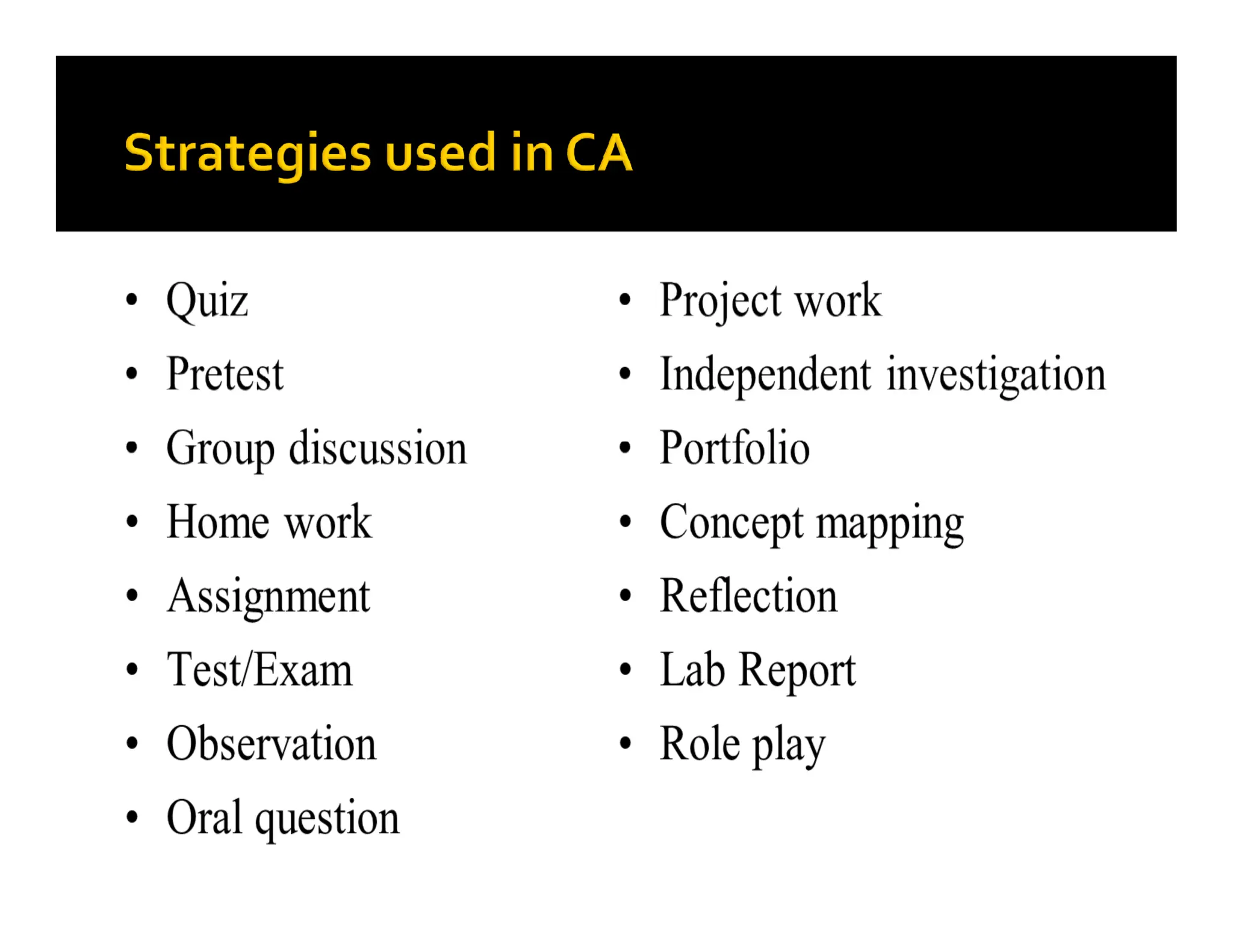
 Strategies that used
Strategies that used in CA
in CA?
?

 Continual
Continual process
process of
of gathering
gathering information
information about
about
students’
students’ behavior
behavior,
, instruction
instruction,
, and
and classroom
classroom
climate
climate
climate
climate

 Refers
Refers to
to conducting
conducting assessment
assessment frequently
frequently to
to
determine
determine:
:

 What
What students
students might
might do
do to
to improve
improve their
their learning
learning

 What
What teachers
teachers might
might do
do to
to improve
improve their
their teaching
teaching

 How
How well
well students
students are
are achieving
achieving the
the learning
learning
outcomes
outcomes

 CA
CA is
is an
an ongoing
ongoing process
process as
as part
part of
of instruction
instruction

 Uses
Uses for
for evaluating
evaluating students’
students’ learning
learning and
and as
as
well
well teacher’s
teacher’s teaching
teaching fairly
fairly and
and accurately
accurately
well
well teacher’s
teacher’s teaching
teaching fairly
fairly and
and accurately
accurately

 CA
CA includes
includes formative
formative and
and summative
summative
assessment
assessment

 FCA
FCA is
is an
an ongoing
ongoing assessment
assessment of
of the
the
student’s
student’s achievement
achievement while
while the
the instructional
instructional
program
program is
is in
in process
process

 Occurs
Occurs before
before and
and during
during instruction
instruction to
to guide
guide
learning
learning &
& teaching
teaching
Occurs
Occurs before
before and
and during
during instruction
instruction to
to guide
guide
learning
learning &
& teaching
teaching

 The teacher gives
The teacher gives feedback
feedback to the students
to the students
on how to improve their learning

 FCA uses oral questioning,
FCA uses oral questioning, classwork
classwork and
and
homework, quizzes, short tests, assignments,
projects etc.
projects etc.

 FCA mostly
FCA mostly informal assessment
informal assessment

 Are
Are teachers’
teachers’ spontaneous,
spontaneous, day
day to
to day
day
observation
observation of
of student
student performances
performances

 Examples
Examples

 Verbal
Verbal
Verbal
Verbal

 Asking
Asking questions
questions

 Listening
Listening to
to students
students discussion
discussion

 Conducting
Conducting student
student conference
conference

 Nonverbal
Nonverbal

 Observing
Observing
▪
▪ Student body language
Student body language
▪
▪ Task performances etc
Task performances etc

 SCA occurs at the
SCA occurs at the end of instruction
end of instruction to
to evaluate
evaluate
students’ achievement of
students’ achievement of objectives
objectives.
.

 Refers to assigning a
Refers to assigning a grade
grade for student's
for student's

 Refers to assigning a
Refers to assigning a grade
grade for student's
for student's
achievement at the end of a quarter/semester

 It uses unit tests, mid tests, final exams,
It uses unit tests, mid tests, final exams,
standardized tests, research works, etc.

 Mostly
Mostly formal
formal and is used to assign grades
and is used to assign grades

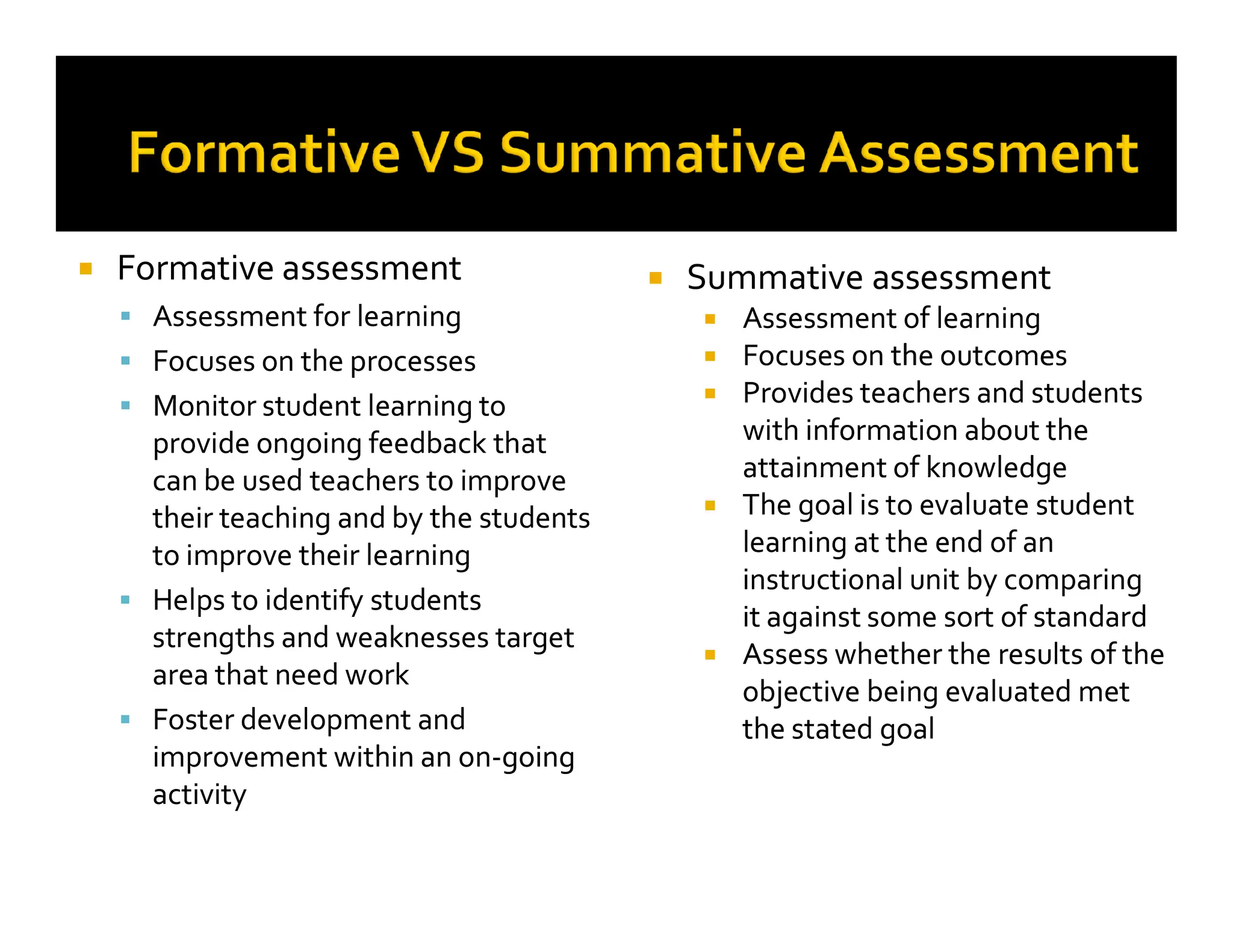
 Formative assessment
Formative assessment

 Assessment for learning
Assessment for learning

 Focuses on the processes
Focuses on the processes

 Monitor student learning to
Monitor student learning to
provide ongoing feedback that
can be used teachers to improve

 Summative assessment
Summative assessment

 Assessment of learning
Assessment of learning

 Focuses
Focuses on the outcomes
on the outcomes

 Provides teachers and students
Provides teachers and students
with information about the
attainment of knowledge
can be used teachers to improve
their teaching and by the students
to improve their learning

 Helps to identify students
Helps to identify students
strengths and weaknesses target
area that need work
area that need work

 Foster development and
Foster development and
improvement within an on
improvement within an on-
-going
going
activity
activity
attainment of knowledge

 The goal is to evaluate student
The goal is to evaluate student
learning at the end of an
instructional unit by comparing
it against some sort of standard

 Assess whether the results of the
Assess whether the results of the
objective being evaluated met
the stated goal
the stated goal

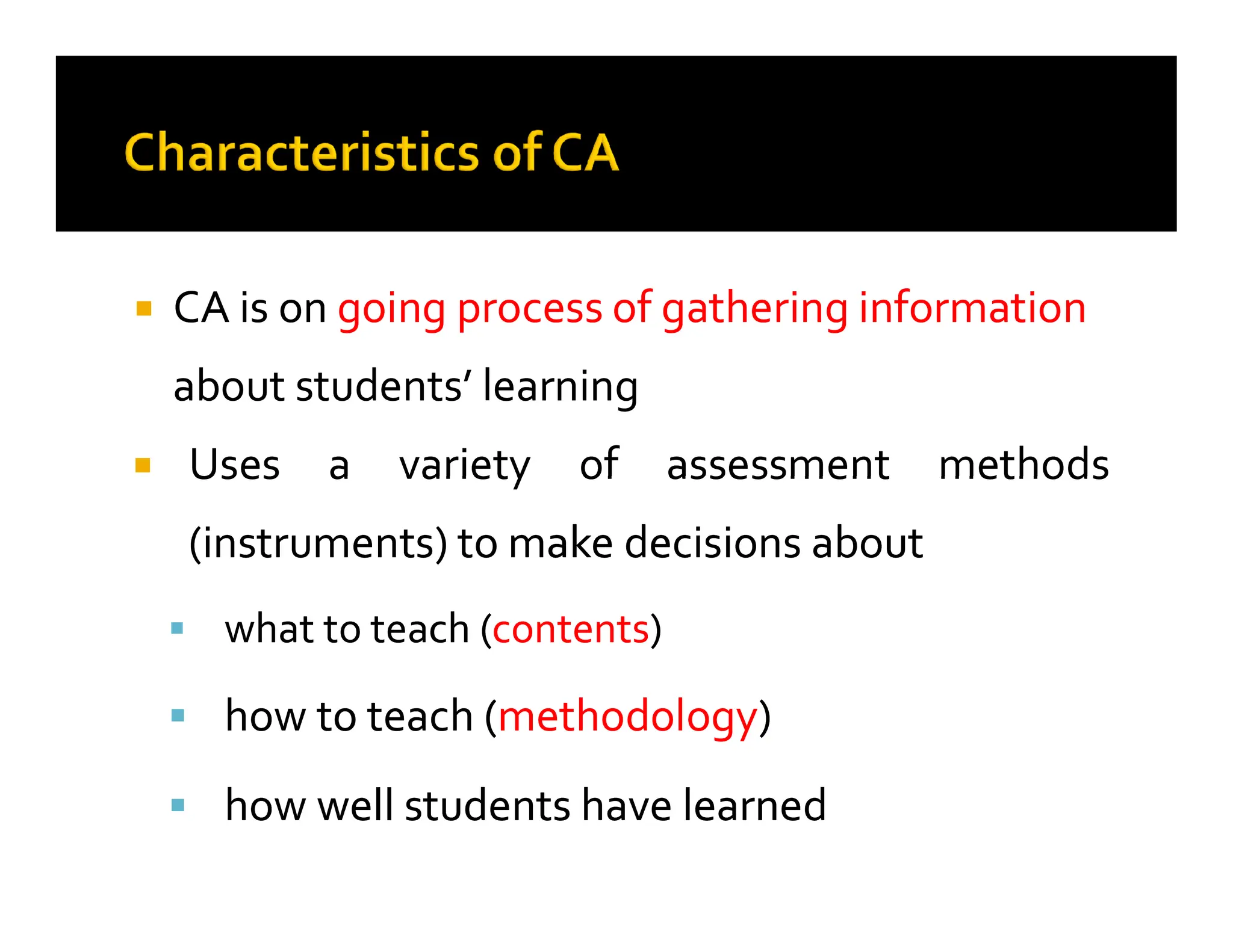
 CA is on
CA is on going process of gathering information
going process of gathering information
about students’ learning

 Uses
Uses a
a variety
variety of
of assessment
assessment methods
methods

 Uses
Uses a
a variety
variety of
of assessment
assessment methods
methods
(instruments)
(instruments) to
to make
make decisions
decisions about
about

 what
what to
to teach
teach (
(contents
contents)
)

 how
how to
to teach
teach (
(methodology
methodology)
)

 how
how well
well students
students have
have learned
learned
 CA
CA is
is accompanied
accompanied with
with provision
provision of
of timely
timely
feedback
feedback /immediate
/immediate (ideal)
(ideal)

 As
As soon
soon as
as possible
possible:
:Test
Test on
on Friday
Friday,
, result
result on
on Monday
Monday (next
(next best)
best)

 As
As soon
soon as
as possible
possible:
:Test
Test on
on Friday
Friday,
, result
result on
on Monday
Monday (next
(next best)
best)

 Latest
Latest possible
possible:
:Test
Test on
on Friday
Friday,
, result
result on
on next
next Friday
Friday

 Poor
Poor practice
practice:
: result
result after
after two
two weeks
weeks and
and later
later

 CA
CA is
is aligned
aligned with
with curriculum
curriculum objectives
objectives
 CA
CA shall
shall be
be given
given :
:

 Before
Before instruction
instruction:
: What
What students
students already
already know
know

 A
A class
class discussion
discussion lead
lead by
by the
the teacher
teacher during
during which
which s/he
s/he makes
makes
notes
notes.
.
notes
notes.
.

 During
During instruction
instruction :
: How
How well
well are
are students
students learning?
learning?

 by
by using
using methods
methods such
such as
as oral
oral question
question,
, class
class works,
works, quizzes
quizzes
and
and etc
etc.
.

 After
After instruction
instruction:
: What
What students
students have
have learned
learned from
from the
the
current
current lessons
lessons

 Assignments,
Assignments, project
project work,
work, test
test,
, etc,
etc,.
.
 Test
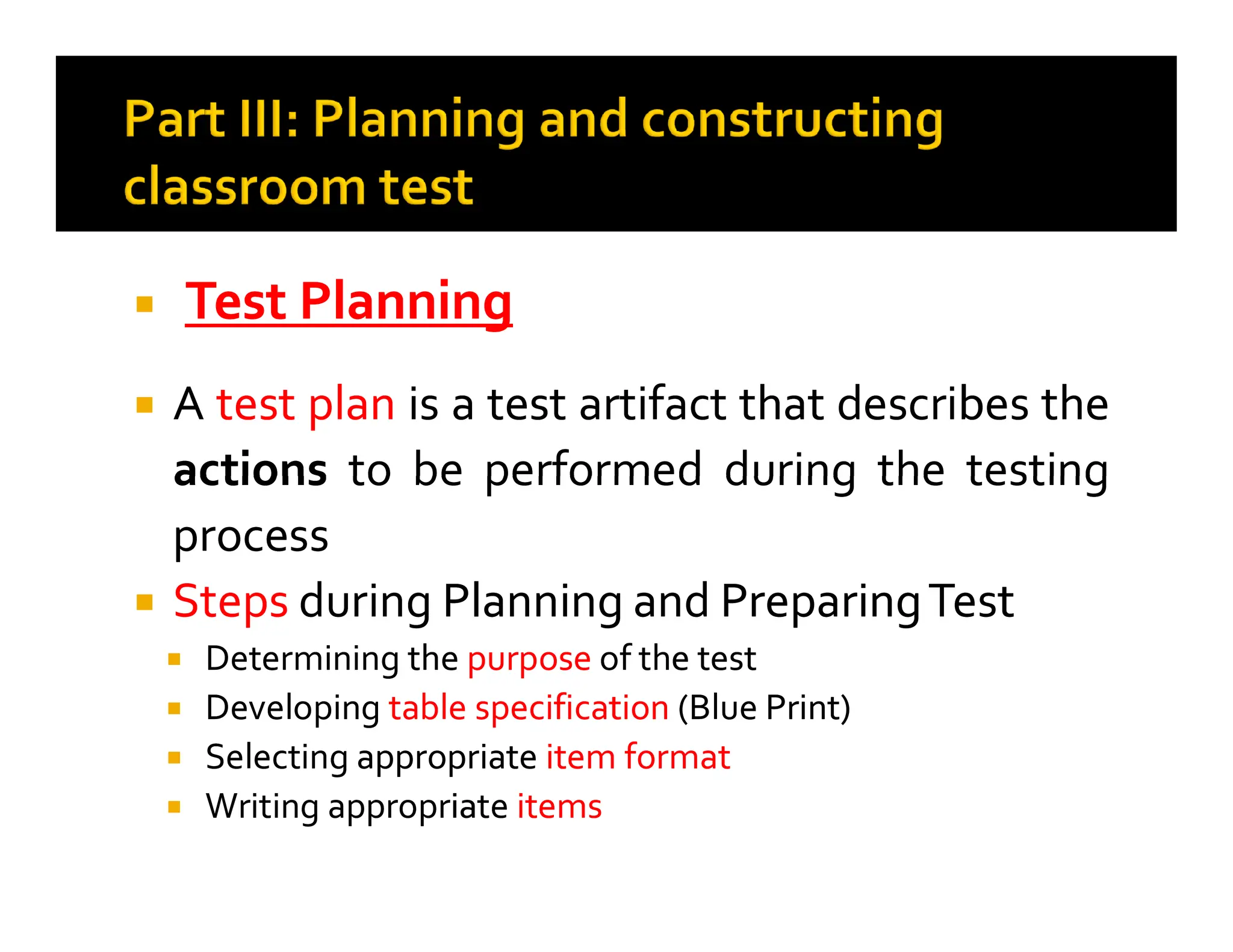
Test Planning
Planning

 A
A test
test plan
plan is
is a
a test
test artifact
artifact that
that describes
describes the
the
actions
actions to
to be
be performed
performed during
during the
the testing
testing
actions
actions to
to be
be performed
performed during
during the
the testing
testing
process
process

 Steps
Steps during
during Planning
Planning and
and Preparing
PreparingTest
Test

 Determining
Determining the
the purpose
purpose of
of the
the test
test

 Developing
Developing table
table specification
specification (Blue
(Blue Print)
Print)

 Selecting
Selecting appropriate
appropriate item
item format
format

 Writing
Writing appropriate
appropriate items
items
Activity
Activity III
III
 What do we mean by specific instructional
objectives?
Would you describe the different
 Would you describe the different
classification/ domains of instructional
objectives?
 Discuss the relationship between
instructional objectives (IO) and assessment?

 Knowledge
Knowledge of
of instructional
instructional objective
objective is
is required
required
to
to construct
construct a
a test
test

 Specific
Specific instructional
instructional objectives
objectives:
: are
are intended
intended
Specific
Specific instructional
instructional objectives
objectives:
: are
are intended
intended
outcomes
outcomes of
of instruction
instruction that
that are
are stated
stated in
in terms
terms of
of
specific,
specific, observable,
observable, and
and measurable
measurable students’
students’
performance
performance

 Test
Test construction
construction also
also requires
requires knowledge
knowledge of
of
Blooms’
Blooms’Taxonomy
Taxonomy

 Blooms’
Blooms’ Taxonomy
Taxonomy is
is a
a classification
classification of
of thinking
thinking
organized
organized by
by levels
levels of
of complexity
complexity

 It
It gives
gives teachers
teachers and
and students
students an
an opportunity
opportunity to
to

 It
It gives
gives teachers
teachers and
and students
students an
an opportunity
opportunity to
to
learn
learn practices
practices a
a range
range of
of thinking
thinking provides
provides a
a
simple
simple structure
structure for
for many
many different
different kinds
kinds of
of
questions
questions
Evaluation
Synthesis
Analysis
Application
Comprehension
Knowledge

 Knowledge
Knowledge

 Remembering
Remembering facts,
facts, information
information

 Comprehension
Comprehension

 Understanding
Understanding concepts
concepts or
or ideas
ideas

 Application
Application

 Application
Application

 Implementing,
Implementing, carrying
carrying out,
out, using
using

 Analysis
Analysis

 Breaking
Breaking information
information into
into parts
parts and
and explaining
explaining the
the relationships
relationships

 Synthesis
Synthesis

 Producing
Producing something
something original
original after
after having
having broken
broken the
the material
material down
down
into
into its
its component
component parts
parts

 Evaluation
Evaluation

 Making
Making a
a judgment
judgment based
based upon
upon a
a pre
pre-
-established
established set
set of
of criteria
criteria

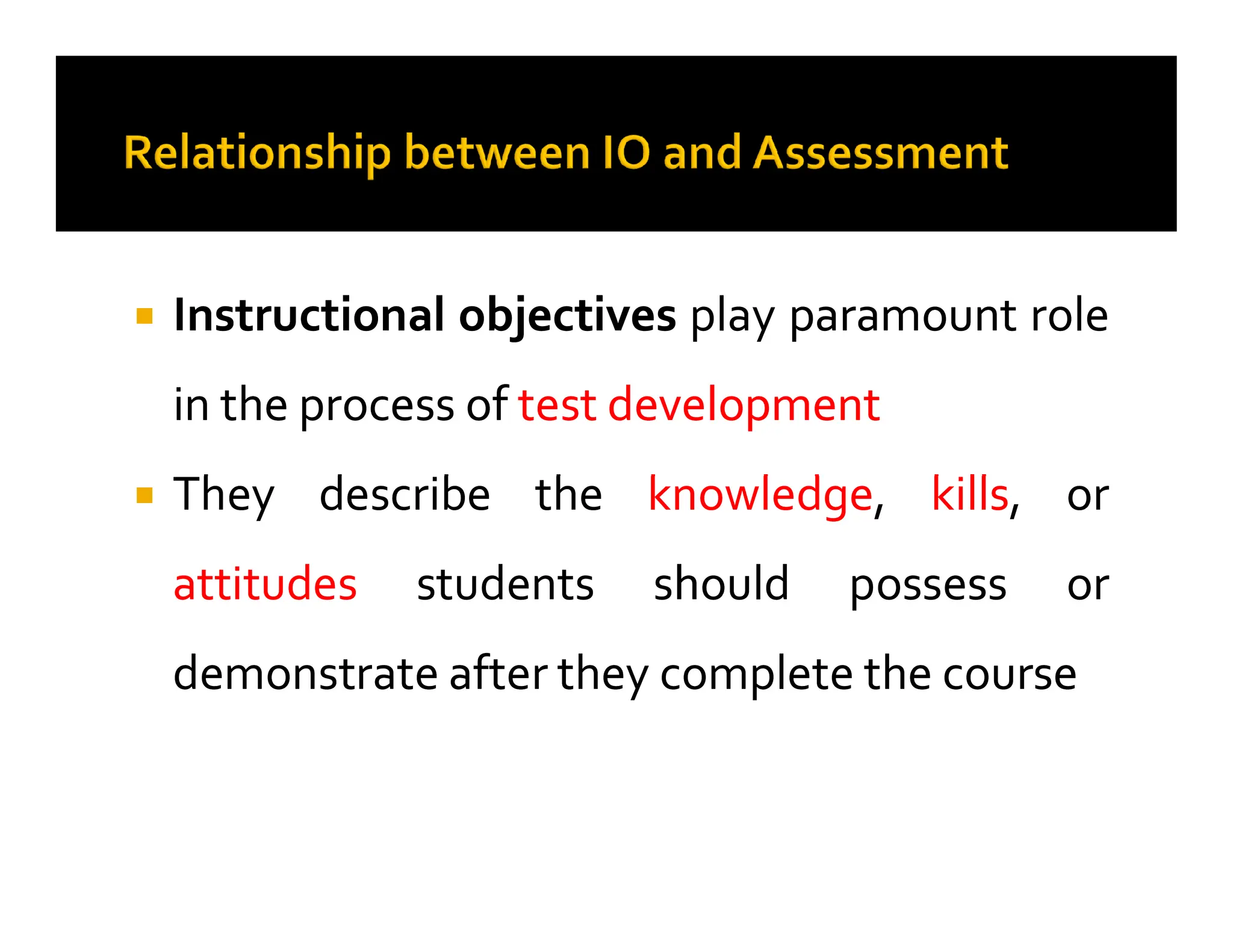
 Instructional
Instructional objectives
objectives play
play paramount
paramount role
role
in
in the
the process
process of
of test
test development
development
They
They describe
describe the
the knowledge
knowledge,
, kills
kills,
, or
or

 They
They describe
describe the
the knowledge
knowledge,
, kills
kills,
, or
or
attitudes
attitudes students
students should
should possess
possess or
or
demonstrate
demonstrate after
after they
they complete
complete the
the course
course

 Table
Table of
of specification
specification is
is a
a two
two-
-chart
chart that
that
describes
describes the
the topic
topic to
to be
be covered
covered by
by a
a test
test
and
and the
the number
number of
of items
items that
that should
should be
be
and
and the
the number
number of
of items
items that
that should
should be
be
associated
associated with
with each
each topic
topic

 Ensures
Ensures that
that a
a fair
fair and
and representative
representative questions
questions
appear
appear on
on the
the test
test

 Improves
Improves the
the validity
validity of
of teachers’
teachers’ evaluations
evaluations based
based
on
on the
the test
test constructed
constructed
on
on the
the test
test constructed
constructed

 Help
Help teachers
teachers identify
identify the
the type
type of
of items
items they
they need
need
to
to include
include on
on their
their test
test

 Provides
Provides the
the teachers
teachers with
with evidence
evidence that
that a
a test
test has
has
content
content validity
validity,
, that
that it
it covers
covers what
what should
should be
be
covered
covered

 Helps
Helps measure
measure higher
higher thinking
thinking skills
skills and
and lower
lower
thinking
thinking skills
skills of
of students
students

 Creating
Creating a
a table
table of
of specification
specification requires
requires a
a
mathematical
mathematical computations
computations

 Let
Let us
us assume
assume that
that the
the test
test is
is a
a final
final
examination
examination of
of grade
grade 8
8 GS
GS with
with 60
60 questions
questions
examination
examination of
of grade
grade 8
8 GS
GS with
with 60
60 questions
questions

 Formula
Formula:
:

 N
N.
.I
I =
= PS
PS X
XT
T.
.Q
Q
PT
PT Where
Where

 N
N.
.I
I =
= Number
Number of
of items
items to
to be
be prepared
prepared from
from each
each unit
unit /
/ or
or sub
sub unit
unit

 PS
PS =
=The
The allotted
allotted periods
periods to
to teach
teach that
that specific
specific topic
topic or
or sub
sub topic
topic

 TQ
TQ =
=Total
Total number
number of
of questions
questions to
to be
be prepared
prepared as
as a
a whole
whole

 PT
PT =
=The
The total
total number
number of
of periods
periods assigned
assigned to
to teach
teach the
the subject
subject.
.
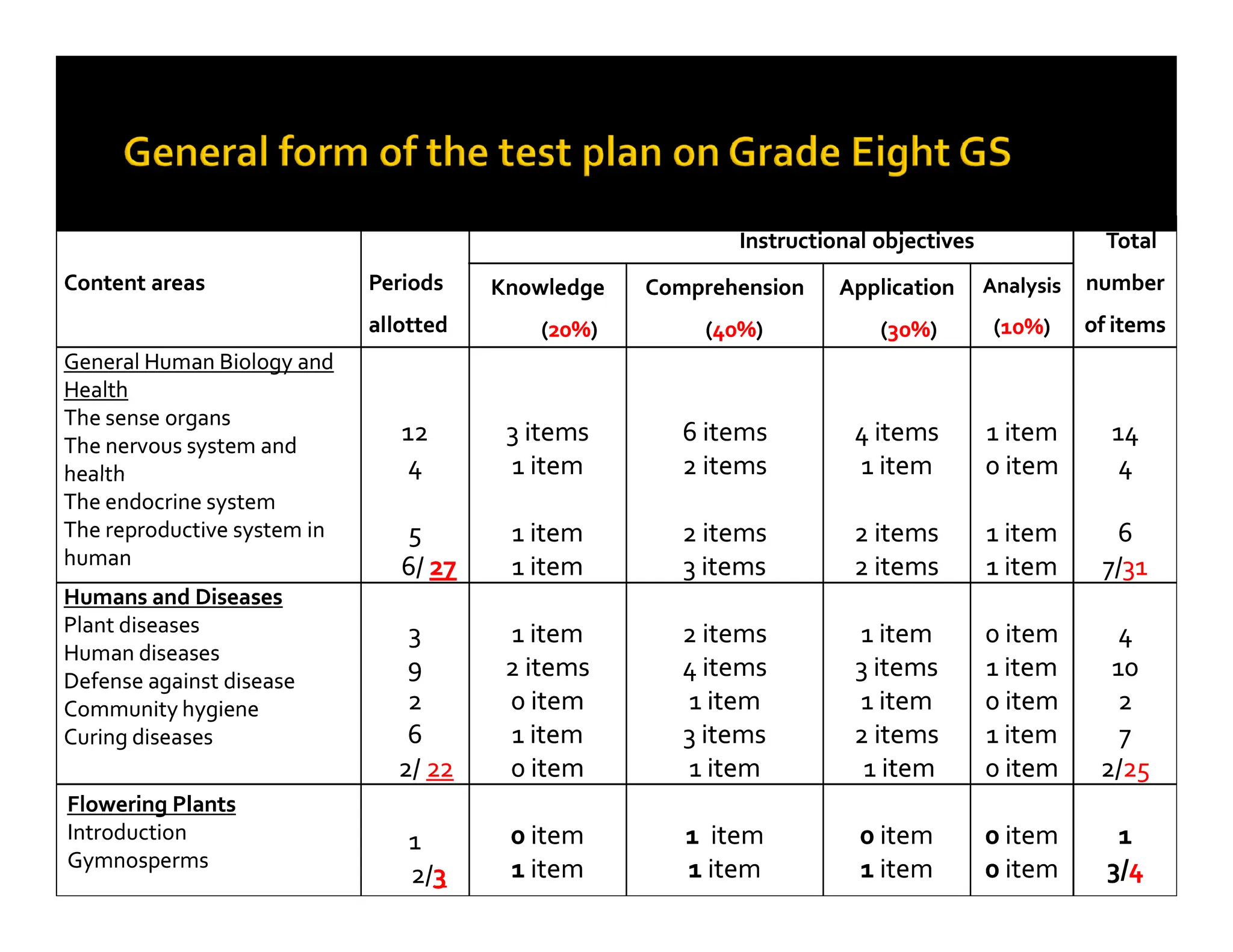
Unit Main topic Period
allotted to
cover
Number of
items
App. of the formula
1
1 General human
General human
biology and health
biology and health
27
27 ?
? 27 x 60
27 x 60 =31
=31
52
52
2
2 Human and
Human and
Diseases
Diseases
22
22 ?
? 22 x 60 =25
22 x 60 =25
52
52
3
3 Flowering Plants
Flowering Plants 3
3 ?
? 3 x 60
3 x 60 = 4
= 4
52
52
Total
Total 52
52 60
60
Unit
Unit MainTopics / Sub topics
MainTopics / Sub topics Period
Period assigned
assigned
to cover the
to cover the
topics/subtopics
topics/subtopics
Number of items
Number of items
to be included
to be included
based on the
based on the
allotted period
allotted period
Number of
Number of
items by
items by %
%
1
1 General Human Biology and
General Human Biology and
Health
Health
The sense organs
The sense organs
The nervous system and health
12
12
4
4
31
31
31/60*100%
31/60*100%
=
= 51.67%
51.67%
The nervous system and health
The endocrine system
The reproductive system in
human
human
4
4
5
5
6
6
=
= 51.67%
51.67%
2
2 Humans and Diseases
Humans and Diseases
Plant diseases
Plant diseases
Human diseases
Human diseases
Defense against disease
Community Hygiene
Community Hygiene
Curing diseases
Curing diseases
3
3
9
9
2
2
6
6
2
2
25
25
25/60*100%
25/60*100%
=
=41.67%
41.67%
3
3 Flowering
Flowering Plants
Plants

Introduction
Introduction

Gymnosperms
Gymnosperms
1
1
2
2
4
4
4/60*100%
4/60*100%
=
= 6.67%
6.67%
Content
Content a
areas
reas Periods
Periods
allotted
allotted
Instructional
Instructional objectives
objectives Total
Total
number
number
of
of items
items
Knowledge
Knowledge
(
(20%
20%)
)
Comprehension
Comprehension
(
(40%
40%)
)
Application
Application
(
(30%
30%)
)
Analysis
Analysis
(
(10%
10%)
)
General Human Biology and
Health
Health
The sense organs
The sense organs
The nervous system and
health
health
12
12
4
4
3 items
3 items
1 item
1 item
6 items
6 items
2 items
2 items
4 items
4 items
1 item
1 item
1 item
1 item
0 item
0 item
14
14
4
4
health
health
The endocrine system
The reproductive system in
human
human
4
4
5
5
6/
6/ 27
27
1 item
1 item
1 item
1 item
1 item
1 item
2 items
2 items
2 items
2 items
3
3 items
items
1 item
1 item
2 items
2 items
2
2 items
items
0 item
0 item
1 item
1 item
1 item
1 item
4
4
6
6
7/
7/31
31
Humans and Diseases
Humans and Diseases
Plant diseases
Plant diseases
Human diseases
Human diseases
Defense against disease
Community hygiene
Community hygiene
Curing diseases
Curing diseases
3
3
9
9
2
2
6
6
2/
2/ 22
22
1
1 item
item
2
2 items
items
0
0 item
item
1
1 item
item
0
0 item
item
2
2 items
items
4
4 items
items
1
1 item
item
3
3 items
items
1
1 item
item
1
1 item
item
3
3 items
items
1
1 item
item
2
2 items
items
1
1 item
item
0
0 item
item
1
1 item
item
0
0 item
item
1
1 item
item
0
0 item
item
4
4
10
10
2
2
7
7
2/
2/25
25
Flowering
Flowering Plants
Plants
Introduction
Introduction
Gymnosperms
Gymnosperms
1
1
2/
2/3
3
0
0 item
item
1
1 item
item
1
1 item
item
1
1 item
item
0
0 item
item
1
1 item
item
0
0 item
item
0
0 item
item
1
1
3/
3/4
4

 Activity
Activity IV
IV

 What
What are
are test
test categories?
categories? Can
Can you
you name
name and
and
identify
identify them?
them?
identify
identify them?
them?

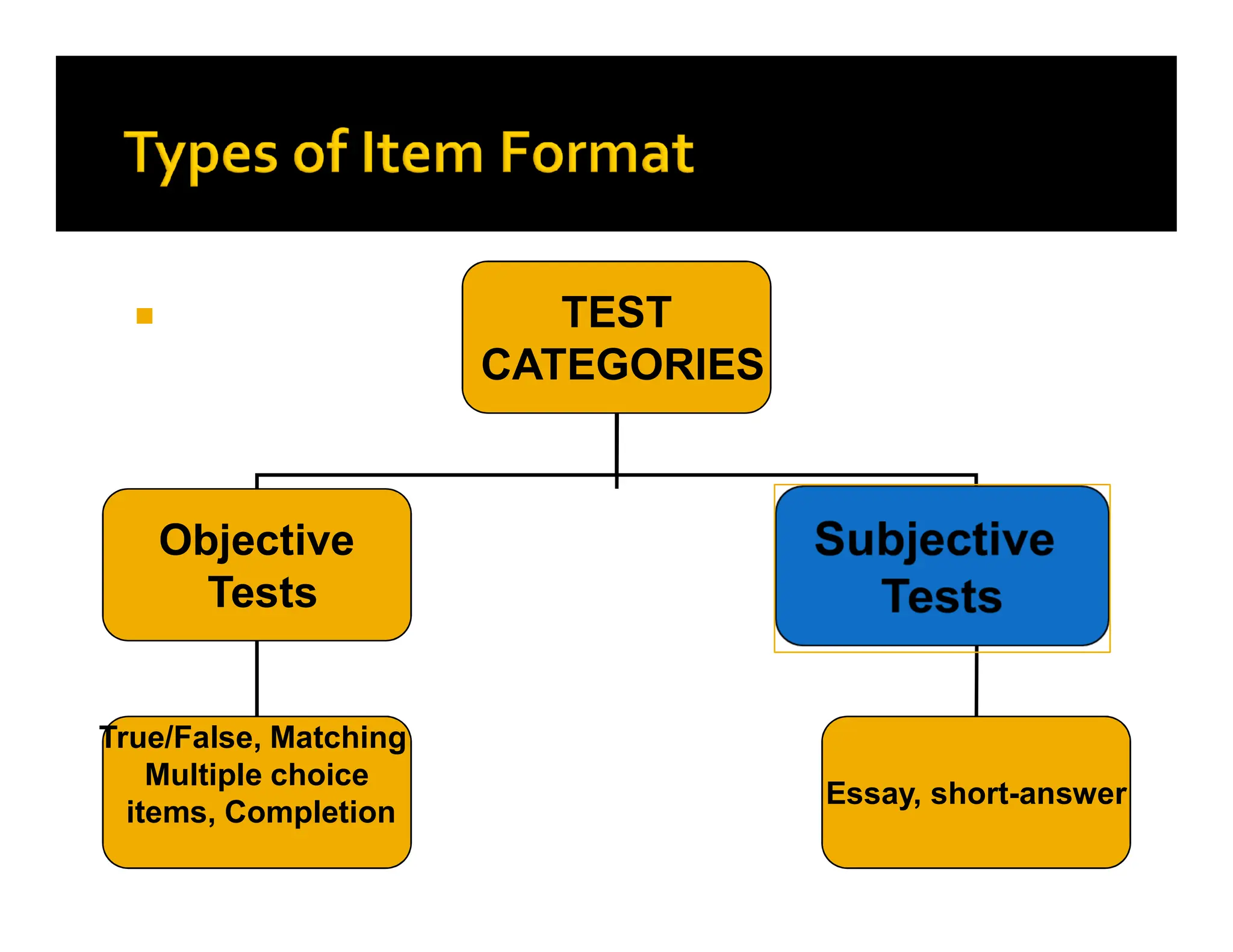
 TEST
CATEGORIES
Objective
Tests
True/False, Matching
Multiple choice
items, Completion
Essay, short-answer
1.
1. True /False item
True /False item
2. Matching item
2. Matching item
3. Multiple choice item
4. Completion / blank spaces item
5. Short answer item
6. Essay item
6. Essay item

 The
The directions
directions should
should be
be written
written
appropriately
appropriately

 Say
SayTrue
True or
or False
False (poor)
(poor)

 Answer
Answer as
asTrue
True-
-or
or False
False (poor)
(poor)

 Answer
Answer as
asTrue
True-
-or
or False
False (poor)
(poor)

 Read
Read each
each of
of the
the following
following sentences,
sentences, if
if the
the
sentence
sentence is
is correct,
correct, write
write "True",
"True", if
if it
it is
is incorrect
incorrect
write
write 'False'
'False' in
in the
the space
space provided
provided (
(better
better)
)

 Avoid
Avoid the
the use
use of
of general
general statements
statements.
.
Because
Because the
the statement
statement may
may be
be partially
partially true
true
or
or partially
partially false
false.
.
Example
Example:
:

 Example
Example:
:

 Equivalent
Equivalent sets
sets are
are equal
equal sets
sets (poor)
(poor)

 Equal
Equal sets
sets are
are equivalent
equivalent sets
sets (better)
(better)

 Use
Use negative
negative statements
statements sparingly
sparingly,
, but
but the
the
negative
negative words
words (
(no
no,
, not
not or
or none
none)
) should
should be
be
underlined
underlined or
or italized
italized

 Double
Double negatives
negatives,
, however,
however, should
should be
be totally
totally
avoided
avoided
avoided
avoided

 Examples
Examples:
 If x is an integer, then 2x + 2 is not an integer (very
poor)
 If x is an integer, then 2x + 2 is not an odd integer
(poor)
 If x is an integer, then 2x + 2 is an even integer
(better)

 Avoid
Avoid long
long and
and complex
complex sentence
sentence

 Example
Example:
:
 When sodium is put in water, it takes the water
molecules apart and joins with part of the broken
water molecules making a new substance called
sodium hydroxide“ (poor)
 When sodium is combined with water a new
substance called sodium hydroxide is produced
(better)

 Avoid
Avoid the
the use
use of
of qualifiers
qualifiers in
in constructing
constructing
true
true-
-false
false items
items.
. They
They give
give irrelevant
irrelevant clue
clue to
to
the
the correct
correct response
response.
.

 Example
Example:
:

 Example
Example:
:
 Any substance can be magnetised (poor)
 A substance can be magnetised (better)
 Photosynthesis takes place only during the night
(poor)
 Photosynthesis takes place during the night
(better)
 If
If possible
possible make
make the
the number
number of
of true
true and
and false
false
questions
questions nearly
nearly equal
equal (
(40
40-
-60
60%
%)
)
Avoid
Avoid putting
putting true
true-
-false
false questions
questions in
in pattern
pattern

 Avoid
Avoid putting
putting true
true-
-false
false questions
questions in
in pattern
pattern
 Choose
Choose homogeneous
homogeneous premises
premises and
and
responses
responses for
for any
any matching
matching item
item

 Make
Make a
a list
list of
of premises
premises and
and responses
responses
relatively
relatively short
short.
. Depending
Depending on
on the
the age
age of
of
relatively
relatively short
short.
. Depending
Depending on
on the
the age
age of
of
students,
students, the
the number
number of
of premises
premises can
can be
be 5
5-
-10
10
and
and responses
responses 5
5-
-15
15

 Do
Do not
not attempt
attempt perfect
perfect matching
matching unless
unless
they
they are
are primary
primary students
students
 Use
Use the
the longer
longer and
and meaningful
meaningful phrases
phrases as
as
premises
premises and
and the
the shorter
shorter as
as responses
responses

 Use
Use the
the same
same page
page for
for all
all matching
matching
questions
questions
questions
questions

 Arrange
Arrange premises
premises and
and responses
responses or
or both
both in
in
alphabetical
alphabetical order,
order, or
or in
in order
order from
from low
low to
to
high
high

 Use
Use numbers
numbers to
to identify
identify the
the premises
premises and
and
letter
letter to
to identify
identify the
the responses
responses
 Write
Write directions
directions that
that explain
explain completely
completely the
the
intended
intended basis
basis for
for matching
matching

 Example
Example:
:
 Match column A with column B (very weak)
 Match the items in column A with ideas in column
B (poor)
 Match the __________ in column B with the
_________ column A and write the letter of the
correct answer in the space provided/or in the
separate answer sheet (better).
 Instructions
Instructions:
: Match
Match the
the NAMES
NAMES of
of angles
angles in
in
column
column B
B with
with the
the MEASURES
MEASURES OF
OF ANGLES
ANGLES
under
under column
column A,
A, and
and write
write the
the letter
letter of
of the
the
correct
correct answer
answer in
in the
the space
space provided
provided.
.
correct
correct answer
answer in
in the
the space
space provided
provided.
.
A B
1. An angle that measures a)Acute angle
between 180 - 360 b) Complementary angles
2. An angle that measures c) Obtuse angle
between 90 - 180 d) Reflex angle
3. An angle that measures 90 e) Right angle
4. An angle that measures f) Supplementary angle
between 0 - 90
5. Two angles that add up 90
6. Two angles that up 180

 The
The item
item may
may be
be stated
stated as
as a
a direct
direct question
question
or
or as
as an
an incomplete
incomplete statement
statement form
form

 The
The student’s
student’s task
task is
is to
to select
select the
the correct
correct
(
(best
best)
) response
response from
from the
the list
list of
of alternatives
alternatives
(
(best
best)
) response
response from
from the
the list
list of
of alternatives
alternatives

 The
The stem
stem should
should be
be meaningful
meaningful by
by itself
itself.
.
That
That is,
is, be
be clear
clear,
, concise
concise,
, and
and present
present a
a single
single
problem
problem

 A
A multiple
multiple-
-choice
choice item
item should
should have
have only
only one
one
correct
correct answer
answer from
from the
the alternatives
alternatives given
given

 Example
Example:
:
 A magnet can pick up
 a) wood b) plastic c) all metal d) none (poor)
 The stem in not meaningfully stated.
 Choice ‘c’ and ‘d’ could be answers, however, the
choice “all metals” is partly correct and partly
incorrect for some metals cannot be attracted.

 Avoid
Avoid negatively
negatively stated
stated item
item,
, especially
especially double
double
negatives
negatives

 All
All of
of the
the alternatives
alternatives should
should be
be grammatically
grammatically
consistent
consistent with
with the
the stem
stem
All
All distracters
distracters should
should be
be plausible
plausible and
and

 All
All distracters
distracters should
should be
be plausible
plausible and
and
homogeneous
homogeneous.
.

 If
If possible,
possible, avoid
avoid the
the choices
choices “
“ALL
ALL OF
OF THE
THE ABOVE
ABOVE”
”
and
and “
“NONE
NONE OF
OFTHE
THE ABOVE
ABOVE”
”.
.

 Avoid
Avoid using
using ALWAYS
ALWAYS and
and NEVER
NEVER in
in the
the stem
stem

 Do
Do not
not create
create distracters
distracters that
that are
are so
so close
close to
to the
the
correct
correct answer
answer

 Writes
Writes with
with clear
clear instruction
instruction

 Uses
Uses one blank space
one blank space for
for one question
one question

 Avoid
Avoid too
too many blank spaces
many blank spaces

 Make the blanks of
Make the blanks of uniform length
uniform length to avoid
to avoid

 Make the blanks of
Make the blanks of uniform length
uniform length to avoid
to avoid
guessing
guessing

 Don’t copy statements from the text book
Don’t copy statements from the text book

 Avoid using trivial words
Avoid using trivial words

 Write
Write the
the item(s)
item(s) in
in such
such a
a way
way it
it requires
requires
definite
definite &
& brief
brief answer(s
answer(s)
)

 Do
Do not
not take
take statements
statements directly
directly from
from
textbooks/handouts
textbooks/handouts
textbooks/handouts
textbooks/handouts

 Where
Where the
the answer
answer is
is to
to be
be expressed
expressed in
in
numerical
numerical units,
units, indicate
indicate the
the type
type of
of answer
answer
wanted
wanted

 Avoid
Avoid statements
statements that
that may
may be
be logically
logically
answered
answered by
by several
several terms
terms

 Use only when other item types
Use only when other item types cannot
cannot be
be
used
used

 Indicate an approximate
Indicate an approximate time limit
time limit for each
for each
question
question
question
question

 Prepare in advance a
Prepare in advance a scoring
scoring scheme based
scheme based
on valid
on valid criteria
criteria

 Score one question at a time
Score one question at a time for all who
for all who
attempted it
attempted it

 Feedback
Feedback is
is information
information a
a student
student can
can use
use to
to improve
improve

 Feedback
Feedback is
is information
information you
you give
give to
to students
students to
to let
let
them
them know
know about
about their
their performance
performance or
or achievement
achievement

 Feedback
Feedback is
is not
not a
a simple
simple number
number or
or symbol
symbol

 Feedback
Feedback is
is not
not a
a simple
simple number
number or
or symbol
symbol

 Good
Good feedback
feedback is
is descriptive
descriptive of
of the
the student’s
student’s work,
work, is
is
specific
specific to
to the
the work
work and
and learning
learning outcomes,
outcomes, and
and
contains
contains help
help for
for the
the student
student on
on how
how to
to improve
improve

 It
It describes
describes a
a student’s
student’s strengths
strengths,
, improvements
improvements
needed
needed,
, and
and ways
ways of
of improving
improving
Thank
ThankYou
You So
So Much
Much
Thank
ThankYou
You So
So Much
Much
for
forYour
Your Attention!
Attention!

Continuous assessment and test construction

  • 1.
  • 2.
      What isyour What is your expectation expectation from this training? from this training?   _________________________________________ _________________________________________ _________________________________________ _________________________________________ _________________________________________ _________________________________________   What do you think should be observed as What do you think should be observed as ground rules ground rules during this training? during this training?   _________________________________________ _________________________________________ _________________________________________ _________________________________________
  • 3.
      At theend of the training, the trainees will be At the end of the training, the trainees will be able to: able to:  defines basic terms related with educational assessment assessment  differentiates between formative and summative assessment  prepares a table of specification  constructs classroom test that consists different item types
  • 4.
      Part I:Meaning of basic terms in educational Part I: Meaning of basic terms in educational testing testing   Part II: Continuous assessment Part II: Continuous assessment   Part III: Planning and constructing classroom Part III: Planning and constructing classroom test test   Part IV: Giving feedback Part IV: Giving feedback
  • 5.
  • 6.
      Test, Measurement,Assessment,and Test, Measurement,Assessment, and Evaluation Evaluation Activity 1 Activity 1 Activity 1 Activity 1   What do we mean by What do we mean byTest, Measurement, Test, Measurement, Assessment, and Evaluation? What is their Assessment, and Evaluation? What is their difference? difference?     Share your thoughts with your colleagues Share your thoughts with your colleagues
  • 7.
      Set of Setof questions questions answered by the students answered by the students   Is an Is an instrument instrument for measuring a sample of for measuring a sample of behavior behavior   Written test/Paper Written test/Paper- -and and- -pencil tests pencil tests   Require the student to respond to the test items by Require the student to respond to the test items by writing writing   Require the student to respond to the test items by Require the student to respond to the test items by writing writing the answers the answers   Oral tests Oral tests   Questioning and answering are done Questioning and answering are done orally orally   Performance tests Performance tests   Assessment that evaluates Assessment that evaluates actual actual student performance student performance   Types: Types:   Products Products: drawings, science experiments, etc : drawings, science experiments, etc   Behavior Behavior:Time trials to run a mile etc :Time trials to run a mile etc
  • 8.
      Assigning anumber value Assigning a number value for the traits of the for the traits of the student assessed student assessed   System of System of quantifying quantifying student achievement or student achievement or   System of System of quantifying quantifying student achievement or student achievement or performance performance   Obtaining information in a quantitative form using Obtaining information in a quantitative form using measuring devices measuring devices such as test, observation, such as test, observation, group group work, project work, presentation etc work, project work, presentation etc
  • 9.
      Process of Processof collecting, interpreting and collecting, interpreting and synthesizing information synthesizing information to aid in decision to aid in decision- - making making making making   The data is collected using quizzes, tests, The data is collected using quizzes, tests, examinations, discussions with students, interviews, examinations, discussions with students, interviews, home works, class works, observations, and project home works, class works, observations, and project works works
  • 10.
      Systematic processof Systematic process of determining determining the extent the extent to which instructional objectives are achieved to which instructional objectives are achieved by students by students by students by students   It is the value It is the value judgment judgment aspect of the aspect of the assessment process in education assessment process in education   Assigning Assigning grades grades
  • 11.
      Systematic processof determining the extent Systematic process of determining the extent to which instructional objectives are achieved to which instructional objectives are achieved by students by students by students by students   The value judgment aspect of the assessment The value judgment aspect of the assessment process in education process in education
  • 12.
  • 13.
    Activity II Activity II  What is continuous assessment (CA)? What is continuous assessment (CA)?   Types of CA?What is their difference? Types of CA?What is their difference?   Types of CA?What is their difference? Types of CA?What is their difference?   Strategies that used Strategies that used in CA in CA? ?
  • 14.
      Continual Continual process processof of gathering gathering information information about about students’ students’ behavior behavior, , instruction instruction, , and and classroom classroom climate climate climate climate   Refers Refers to to conducting conducting assessment assessment frequently frequently to to determine determine: :   What What students students might might do do to to improve improve their their learning learning   What What teachers teachers might might do do to to improve improve their their teaching teaching   How How well well students students are are achieving achieving the the learning learning outcomes outcomes
  • 15.
      CA CA is isan an ongoing ongoing process process as as part part of of instruction instruction   Uses Uses for for evaluating evaluating students’ students’ learning learning and and as as well well teacher’s teacher’s teaching teaching fairly fairly and and accurately accurately well well teacher’s teacher’s teaching teaching fairly fairly and and accurately accurately   CA CA includes includes formative formative and and summative summative assessment assessment
  • 16.
      FCA FCA is isan an ongoing ongoing assessment assessment of of the the student’s student’s achievement achievement while while the the instructional instructional program program is is in in process process   Occurs Occurs before before and and during during instruction instruction to to guide guide learning learning & & teaching teaching Occurs Occurs before before and and during during instruction instruction to to guide guide learning learning & & teaching teaching   The teacher gives The teacher gives feedback feedback to the students to the students on how to improve their learning on how to improve their learning   FCA uses oral questioning, FCA uses oral questioning, classwork classwork and and homework, quizzes, short tests, assignments, homework, quizzes, short tests, assignments, projects etc. projects etc.   FCA mostly FCA mostly informal assessment informal assessment
  • 17.
      Are Are teachers’ teachers’spontaneous, spontaneous, day day to to day day observation observation of of student student performances performances   Examples Examples   Verbal Verbal Verbal Verbal   Asking Asking questions questions   Listening Listening to to students students discussion discussion   Conducting Conducting student student conference conference   Nonverbal Nonverbal   Observing Observing ▪ ▪ Student body language Student body language ▪ ▪ Task performances etc Task performances etc
  • 18.
      SCA occursat the SCA occurs at the end of instruction end of instruction to to evaluate evaluate students’ achievement of students’ achievement of objectives objectives. .   Refers to assigning a Refers to assigning a grade grade for student's for student's   Refers to assigning a Refers to assigning a grade grade for student's for student's achievement at the end of a quarter/semester achievement at the end of a quarter/semester   It uses unit tests, mid tests, final exams, It uses unit tests, mid tests, final exams, standardized tests, research works, etc. standardized tests, research works, etc.   Mostly Mostly formal formal and is used to assign grades and is used to assign grades
  • 19.
      Formative assessment Formativeassessment   Assessment for learning Assessment for learning   Focuses on the processes Focuses on the processes   Monitor student learning to Monitor student learning to provide ongoing feedback that provide ongoing feedback that can be used teachers to improve can be used teachers to improve   Summative assessment Summative assessment   Assessment of learning Assessment of learning   Focuses Focuses on the outcomes on the outcomes   Provides teachers and students Provides teachers and students with information about the with information about the attainment of knowledge attainment of knowledge can be used teachers to improve can be used teachers to improve their teaching and by the students their teaching and by the students to improve their learning to improve their learning   Helps to identify students Helps to identify students strengths and weaknesses target strengths and weaknesses target area that need work area that need work   Foster development and Foster development and improvement within an on improvement within an on- -going going activity activity attainment of knowledge attainment of knowledge   The goal is to evaluate student The goal is to evaluate student learning at the end of an learning at the end of an instructional unit by comparing instructional unit by comparing it against some sort of standard it against some sort of standard   Assess whether the results of the Assess whether the results of the objective being evaluated met objective being evaluated met the stated goal the stated goal
  • 20.
      CA ison CA is on going process of gathering information going process of gathering information about students’ learning about students’ learning   Uses Uses a a variety variety of of assessment assessment methods methods   Uses Uses a a variety variety of of assessment assessment methods methods (instruments) (instruments) to to make make decisions decisions about about   what what to to teach teach ( (contents contents) )   how how to to teach teach ( (methodology methodology) )   how how well well students students have have learned learned
  • 21.
     CA CA is isaccompanied accompanied with with provision provision of of timely timely feedback feedback /immediate /immediate (ideal) (ideal)   As As soon soon as as possible possible: :Test Test on on Friday Friday, , result result on on Monday Monday (next (next best) best)   As As soon soon as as possible possible: :Test Test on on Friday Friday, , result result on on Monday Monday (next (next best) best)   Latest Latest possible possible: :Test Test on on Friday Friday, , result result on on next next Friday Friday   Poor Poor practice practice: : result result after after two two weeks weeks and and later later   CA CA is is aligned aligned with with curriculum curriculum objectives objectives
  • 22.
     CA CA shall shallbe be given given : :   Before Before instruction instruction: : What What students students already already know know   A A class class discussion discussion lead lead by by the the teacher teacher during during which which s/he s/he makes makes notes notes. . notes notes. .   During During instruction instruction : : How How well well are are students students learning? learning?   by by using using methods methods such such as as oral oral question question, , class class works, works, quizzes quizzes and and etc etc. .   After After instruction instruction: : What What students students have have learned learned from from the the current current lessons lessons   Assignments, Assignments, project project work, work, test test, , etc, etc,. .
  • 24.
     Test Test Planning Planning  A A test test plan plan is is a a test test artifact artifact that that describes describes the the actions actions to to be be performed performed during during the the testing testing actions actions to to be be performed performed during during the the testing testing process process   Steps Steps during during Planning Planning and and Preparing PreparingTest Test   Determining Determining the the purpose purpose of of the the test test   Developing Developing table table specification specification (Blue (Blue Print) Print)   Selecting Selecting appropriate appropriate item item format format   Writing Writing appropriate appropriate items items
  • 25.
    Activity Activity III III  Whatdo we mean by specific instructional objectives? Would you describe the different  Would you describe the different classification/ domains of instructional objectives?  Discuss the relationship between instructional objectives (IO) and assessment?
  • 26.
      Knowledge Knowledge of ofinstructional instructional objective objective is is required required to to construct construct a a test test   Specific Specific instructional instructional objectives objectives: : are are intended intended Specific Specific instructional instructional objectives objectives: : are are intended intended outcomes outcomes of of instruction instruction that that are are stated stated in in terms terms of of specific, specific, observable, observable, and and measurable measurable students’ students’ performance performance   Test Test construction construction also also requires requires knowledge knowledge of of Blooms’ Blooms’Taxonomy Taxonomy
  • 27.
      Blooms’ Blooms’ Taxonomy Taxonomyis is a a classification classification of of thinking thinking organized organized by by levels levels of of complexity complexity   It It gives gives teachers teachers and and students students an an opportunity opportunity to to   It It gives gives teachers teachers and and students students an an opportunity opportunity to to learn learn practices practices a a range range of of thinking thinking provides provides a a simple simple structure structure for for many many different different kinds kinds of of questions questions
  • 28.
  • 29.
      Knowledge Knowledge   Remembering Rememberingfacts, facts, information information   Comprehension Comprehension   Understanding Understanding concepts concepts or or ideas ideas   Application Application   Application Application   Implementing, Implementing, carrying carrying out, out, using using   Analysis Analysis   Breaking Breaking information information into into parts parts and and explaining explaining the the relationships relationships   Synthesis Synthesis   Producing Producing something something original original after after having having broken broken the the material material down down into into its its component component parts parts   Evaluation Evaluation   Making Making a a judgment judgment based based upon upon a a pre pre- -established established set set of of criteria criteria
  • 31.
      Instructional Instructional objectives objectivesplay play paramount paramount role role in in the the process process of of test test development development They They describe describe the the knowledge knowledge, , kills kills, , or or   They They describe describe the the knowledge knowledge, , kills kills, , or or attitudes attitudes students students should should possess possess or or demonstrate demonstrate after after they they complete complete the the course course
  • 32.
      Table Table of ofspecification specification is is a a two two- -chart chart that that describes describes the the topic topic to to be be covered covered by by a a test test and and the the number number of of items items that that should should be be and and the the number number of of items items that that should should be be associated associated with with each each topic topic
  • 33.
      Ensures Ensures that thata a fair fair and and representative representative questions questions appear appear on on the the test test   Improves Improves the the validity validity of of teachers’ teachers’ evaluations evaluations based based on on the the test test constructed constructed on on the the test test constructed constructed   Help Help teachers teachers identify identify the the type type of of items items they they need need to to include include on on their their test test   Provides Provides the the teachers teachers with with evidence evidence that that a a test test has has content content validity validity, , that that it it covers covers what what should should be be covered covered   Helps Helps measure measure higher higher thinking thinking skills skills and and lower lower thinking thinking skills skills of of students students
  • 34.
      Creating Creating a atable table of of specification specification requires requires a a mathematical mathematical computations computations   Let Let us us assume assume that that the the test test is is a a final final examination examination of of grade grade 8 8 GS GS with with 60 60 questions questions examination examination of of grade grade 8 8 GS GS with with 60 60 questions questions   Formula Formula: :   N N. .I I = = PS PS X XT T. .Q Q PT PT Where Where   N N. .I I = = Number Number of of items items to to be be prepared prepared from from each each unit unit / / or or sub sub unit unit   PS PS = =The The allotted allotted periods periods to to teach teach that that specific specific topic topic or or sub sub topic topic   TQ TQ = =Total Total number number of of questions questions to to be be prepared prepared as as a a whole whole   PT PT = =The The total total number number of of periods periods assigned assigned to to teach teach the the subject subject. .
  • 35.
    Unit Main topicPeriod allotted to cover Number of items App. of the formula 1 1 General human General human biology and health biology and health 27 27 ? ? 27 x 60 27 x 60 =31 =31 52 52 2 2 Human and Human and Diseases Diseases 22 22 ? ? 22 x 60 =25 22 x 60 =25 52 52 3 3 Flowering Plants Flowering Plants 3 3 ? ? 3 x 60 3 x 60 = 4 = 4 52 52 Total Total 52 52 60 60
  • 36.
    Unit Unit MainTopics /Sub topics MainTopics / Sub topics Period Period assigned assigned to cover the to cover the topics/subtopics topics/subtopics Number of items Number of items to be included to be included based on the based on the allotted period allotted period Number of Number of items by items by % % 1 1 General Human Biology and General Human Biology and Health Health The sense organs The sense organs The nervous system and health The nervous system and health 12 12 4 4 31 31 31/60*100% 31/60*100% = = 51.67% 51.67% The nervous system and health The nervous system and health The endocrine system The endocrine system The reproductive system in The reproductive system in human human 4 4 5 5 6 6 = = 51.67% 51.67% 2 2 Humans and Diseases Humans and Diseases Plant diseases Plant diseases Human diseases Human diseases Defense against disease Defense against disease Community Hygiene Community Hygiene Curing diseases Curing diseases 3 3 9 9 2 2 6 6 2 2 25 25 25/60*100% 25/60*100% = =41.67% 41.67% 3 3 Flowering Flowering Plants Plants  Introduction Introduction  Gymnosperms Gymnosperms 1 1 2 2 4 4 4/60*100% 4/60*100% = = 6.67% 6.67%
  • 37.
    Content Content a areas reas Periods Periods allotted allotted Instructional Instructionalobjectives objectives Total Total number number of of items items Knowledge Knowledge ( (20% 20%) ) Comprehension Comprehension ( (40% 40%) ) Application Application ( (30% 30%) ) Analysis Analysis ( (10% 10%) ) General Human Biology and General Human Biology and Health Health The sense organs The sense organs The nervous system and The nervous system and health health 12 12 4 4 3 items 3 items 1 item 1 item 6 items 6 items 2 items 2 items 4 items 4 items 1 item 1 item 1 item 1 item 0 item 0 item 14 14 4 4 health health The endocrine system The endocrine system The reproductive system in The reproductive system in human human 4 4 5 5 6/ 6/ 27 27 1 item 1 item 1 item 1 item 1 item 1 item 2 items 2 items 2 items 2 items 3 3 items items 1 item 1 item 2 items 2 items 2 2 items items 0 item 0 item 1 item 1 item 1 item 1 item 4 4 6 6 7/ 7/31 31 Humans and Diseases Humans and Diseases Plant diseases Plant diseases Human diseases Human diseases Defense against disease Defense against disease Community hygiene Community hygiene Curing diseases Curing diseases 3 3 9 9 2 2 6 6 2/ 2/ 22 22 1 1 item item 2 2 items items 0 0 item item 1 1 item item 0 0 item item 2 2 items items 4 4 items items 1 1 item item 3 3 items items 1 1 item item 1 1 item item 3 3 items items 1 1 item item 2 2 items items 1 1 item item 0 0 item item 1 1 item item 0 0 item item 1 1 item item 0 0 item item 4 4 10 10 2 2 7 7 2/ 2/25 25 Flowering Flowering Plants Plants Introduction Introduction Gymnosperms Gymnosperms 1 1 2/ 2/3 3 0 0 item item 1 1 item item 1 1 item item 1 1 item item 0 0 item item 1 1 item item 0 0 item item 0 0 item item 1 1 3/ 3/4 4
  • 38.
      Activity Activity IV IV  What What are are test test categories? categories? Can Can you you name name and and identify identify them? them? identify identify them? them?
  • 39.
  • 40.
    1. 1. True /Falseitem True /False item 2. Matching item 2. Matching item 3. Multiple choice item 3. Multiple choice item 4. Completion / blank spaces item 4. Completion / blank spaces item 5. Short answer item 5. Short answer item 6. Essay item 6. Essay item
  • 41.
      The The directions directionsshould should be be written written appropriately appropriately   Say SayTrue True or or False False (poor) (poor)   Answer Answer as asTrue True- -or or False False (poor) (poor)   Answer Answer as asTrue True- -or or False False (poor) (poor)   Read Read each each of of the the following following sentences, sentences, if if the the sentence sentence is is correct, correct, write write "True", "True", if if it it is is incorrect incorrect write write 'False' 'False' in in the the space space provided provided ( (better better) )
  • 42.
      Avoid Avoid the theuse use of of general general statements statements. . Because Because the the statement statement may may be be partially partially true true or or partially partially false false. . Example Example: :   Example Example: :   Equivalent Equivalent sets sets are are equal equal sets sets (poor) (poor)   Equal Equal sets sets are are equivalent equivalent sets sets (better) (better)
  • 43.
      Use Use negative negativestatements statements sparingly sparingly, , but but the the negative negative words words ( (no no, , not not or or none none) ) should should be be underlined underlined or or italized italized   Double Double negatives negatives, , however, however, should should be be totally totally avoided avoided avoided avoided   Examples Examples:  If x is an integer, then 2x + 2 is not an integer (very poor)  If x is an integer, then 2x + 2 is not an odd integer (poor)  If x is an integer, then 2x + 2 is an even integer (better)
  • 44.
      Avoid Avoid long longand and complex complex sentence sentence   Example Example: :  When sodium is put in water, it takes the water molecules apart and joins with part of the broken molecules apart and joins with part of the broken water molecules making a new substance called sodium hydroxide“ (poor)  When sodium is combined with water a new substance called sodium hydroxide is produced (better)
  • 45.
      Avoid Avoid the theuse use of of qualifiers qualifiers in in constructing constructing true true- -false false items items. . They They give give irrelevant irrelevant clue clue to to the the correct correct response response. .   Example Example: :   Example Example: :  Any substance can be magnetised (poor)  A substance can be magnetised (better)  Photosynthesis takes place only during the night (poor)  Photosynthesis takes place during the night (better)
  • 46.
     If If possible possiblemake make the the number number of of true true and and false false questions questions nearly nearly equal equal ( (40 40- -60 60% %) ) Avoid Avoid putting putting true true- -false false questions questions in in pattern pattern   Avoid Avoid putting putting true true- -false false questions questions in in pattern pattern
  • 47.
     Choose Choose homogeneous homogeneouspremises premises and and responses responses for for any any matching matching item item   Make Make a a list list of of premises premises and and responses responses relatively relatively short short. . Depending Depending on on the the age age of of relatively relatively short short. . Depending Depending on on the the age age of of students, students, the the number number of of premises premises can can be be 5 5- -10 10 and and responses responses 5 5- -15 15   Do Do not not attempt attempt perfect perfect matching matching unless unless they they are are primary primary students students
  • 48.
     Use Use the thelonger longer and and meaningful meaningful phrases phrases as as premises premises and and the the shorter shorter as as responses responses   Use Use the the same same page page for for all all matching matching questions questions questions questions   Arrange Arrange premises premises and and responses responses or or both both in in alphabetical alphabetical order, order, or or in in order order from from low low to to high high   Use Use numbers numbers to to identify identify the the premises premises and and letter letter to to identify identify the the responses responses
  • 49.
     Write Write directions directionsthat that explain explain completely completely the the intended intended basis basis for for matching matching   Example Example: :  Match column A with column B (very weak)  Match column A with column B (very weak)  Match the items in column A with ideas in column B (poor)  Match the __________ in column B with the _________ column A and write the letter of the correct answer in the space provided/or in the separate answer sheet (better).
  • 50.
     Instructions Instructions: : Match Matchthe the NAMES NAMES of of angles angles in in column column B B with with the the MEASURES MEASURES OF OF ANGLES ANGLES under under column column A, A, and and write write the the letter letter of of the the correct correct answer answer in in the the space space provided provided. . correct correct answer answer in in the the space space provided provided. . A B 1. An angle that measures a)Acute angle between 180 - 360 b) Complementary angles 2. An angle that measures c) Obtuse angle between 90 - 180 d) Reflex angle 3. An angle that measures 90 e) Right angle 4. An angle that measures f) Supplementary angle between 0 - 90 5. Two angles that add up 90 6. Two angles that up 180
  • 51.
      The The item itemmay may be be stated stated as as a a direct direct question question or or as as an an incomplete incomplete statement statement form form   The The student’s student’s task task is is to to select select the the correct correct ( (best best) ) response response from from the the list list of of alternatives alternatives ( (best best) ) response response from from the the list list of of alternatives alternatives   The The stem stem should should be be meaningful meaningful by by itself itself. . That That is, is, be be clear clear, , concise concise, , and and present present a a single single problem problem
  • 52.
      A A multiple multiple- -choice choiceitem item should should have have only only one one correct correct answer answer from from the the alternatives alternatives given given   Example Example: :  A magnet can pick up  A magnet can pick up  a) wood b) plastic c) all metal d) none (poor)  The stem in not meaningfully stated.  Choice ‘c’ and ‘d’ could be answers, however, the choice “all metals” is partly correct and partly incorrect for some metals cannot be attracted.
  • 53.
      Avoid Avoid negatively negativelystated stated item item, , especially especially double double negatives negatives   All All of of the the alternatives alternatives should should be be grammatically grammatically consistent consistent with with the the stem stem All All distracters distracters should should be be plausible plausible and and   All All distracters distracters should should be be plausible plausible and and homogeneous homogeneous. .   If If possible, possible, avoid avoid the the choices choices “ “ALL ALL OF OF THE THE ABOVE ABOVE” ” and and “ “NONE NONE OF OFTHE THE ABOVE ABOVE” ”. .   Avoid Avoid using using ALWAYS ALWAYS and and NEVER NEVER in in the the stem stem   Do Do not not create create distracters distracters that that are are so so close close to to the the correct correct answer answer
  • 54.
      Writes Writes with withclear clear instruction instruction   Uses Uses one blank space one blank space for for one question one question   Avoid Avoid too too many blank spaces many blank spaces   Make the blanks of Make the blanks of uniform length uniform length to avoid to avoid   Make the blanks of Make the blanks of uniform length uniform length to avoid to avoid guessing guessing   Don’t copy statements from the text book Don’t copy statements from the text book   Avoid using trivial words Avoid using trivial words
  • 55.
      Write Write the theitem(s) item(s) in in such such a a way way it it requires requires definite definite & & brief brief answer(s answer(s) )   Do Do not not take take statements statements directly directly from from textbooks/handouts textbooks/handouts textbooks/handouts textbooks/handouts   Where Where the the answer answer is is to to be be expressed expressed in in numerical numerical units, units, indicate indicate the the type type of of answer answer wanted wanted   Avoid Avoid statements statements that that may may be be logically logically answered answered by by several several terms terms
  • 56.
      Use onlywhen other item types Use only when other item types cannot cannot be be used used   Indicate an approximate Indicate an approximate time limit time limit for each for each question question question question   Prepare in advance a Prepare in advance a scoring scoring scheme based scheme based on valid on valid criteria criteria   Score one question at a time Score one question at a time for all who for all who attempted it attempted it
  • 57.
      Feedback Feedback is isinformation information a a student student can can use use to to improve improve   Feedback Feedback is is information information you you give give to to students students to to let let them them know know about about their their performance performance or or achievement achievement   Feedback Feedback is is not not a a simple simple number number or or symbol symbol   Feedback Feedback is is not not a a simple simple number number or or symbol symbol   Good Good feedback feedback is is descriptive descriptive of of the the student’s student’s work, work, is is specific specific to to the the work work and and learning learning outcomes, outcomes, and and contains contains help help for for the the student student on on how how to to improve improve   It It describes describes a a student’s student’s strengths strengths, , improvements improvements needed needed, , and and ways ways of of improving improving
  • 59.
    Thank ThankYou You So So Much Much Thank ThankYou YouSo So Much Much for forYour Your Attention! Attention!