Measurement, Assessment
and Evaluation
JUBILEE PADMANABHAN
ASSISTANT PROFESSOR IN EDUCATION
CENTRAL UNIVERSITY OF PUNJAB
Furst’s paradigm
Learning objectives
Learning
experience
Evaluate
Measurement
The information about students’ learning is often assigned specific
numbers or grades and this involves measurement.
- Assigns numbers (e.g. 28/ 30 on the mathematics test; 90/ 100
on the science project) marks obtained on tests or other pieces of
work set by the teacher.
According to Ebel & Frisbie (1986) “Measurement involves using
rules to assign a number(s), such as score, rating or a ranking, to an
individual or group for a specified behaviour or performance.”
ASSESSMENT
The word ‘assess’ comes from the Latin verb ‘assidere’ meaning ‘to sit with’.
In assessment one is supposed to sit with the learner. This implies it is something we
do ‘with’ and ‘for’ students and not ‘to’ students (Green, 1999).
Assessment in education is the process of gathering, interpreting, recording, and
using information about pupils’ responses to an educational task. (Harlen, Gipps,
Broadfoot, Nuttal,1992)
It is an integrated process of gaining information about students’ learning and
making value.
Information about students’ progress can be obtained from a variety of sources
including projects, portfolios, performances, observations, and tests.
EVALUATION
It is also the process of obtaining, analyzing and
interpreting information to determine the extent
to which students achieve instructional objective.
It is concerned with making judgments on the
worth or value of a performance, answer the
question “how good, adequate, or desirable”.
EVALUATION
e.g.: A teacher measures Raju’s achievement in Science to
be 60%. The teacher evaluates his achievement in Science
when he/ she says that Raju’s performance is satisfactory.
Evaluation= Quantitative description of pupils’
achievement+ Qualitative description of pupils’ abilities+
Value judgments about achievements and abilities.
Purpose of Evaluation
 Learner’s level
 Teacher’s level
 Guidance and counsellor’s level
 Curriculum development
 School administration
 Classroom research
Relationship between measurement
and evaluation
 Evaluation goes beyond the meaning of the terms “test”
and “measurement”.
 Evaluation depends upon measurement but is not
synonymous with it.
 Measurement is a quantitative determination of how
much an individual’s performance has been, while
evaluation is a qualitative judgment of how good or how
satisfactory an individual’s performance has been.
 Sound evaluation is based upon the results of accurate
and relevant measurement.
Relationship between measurement
and evaluation
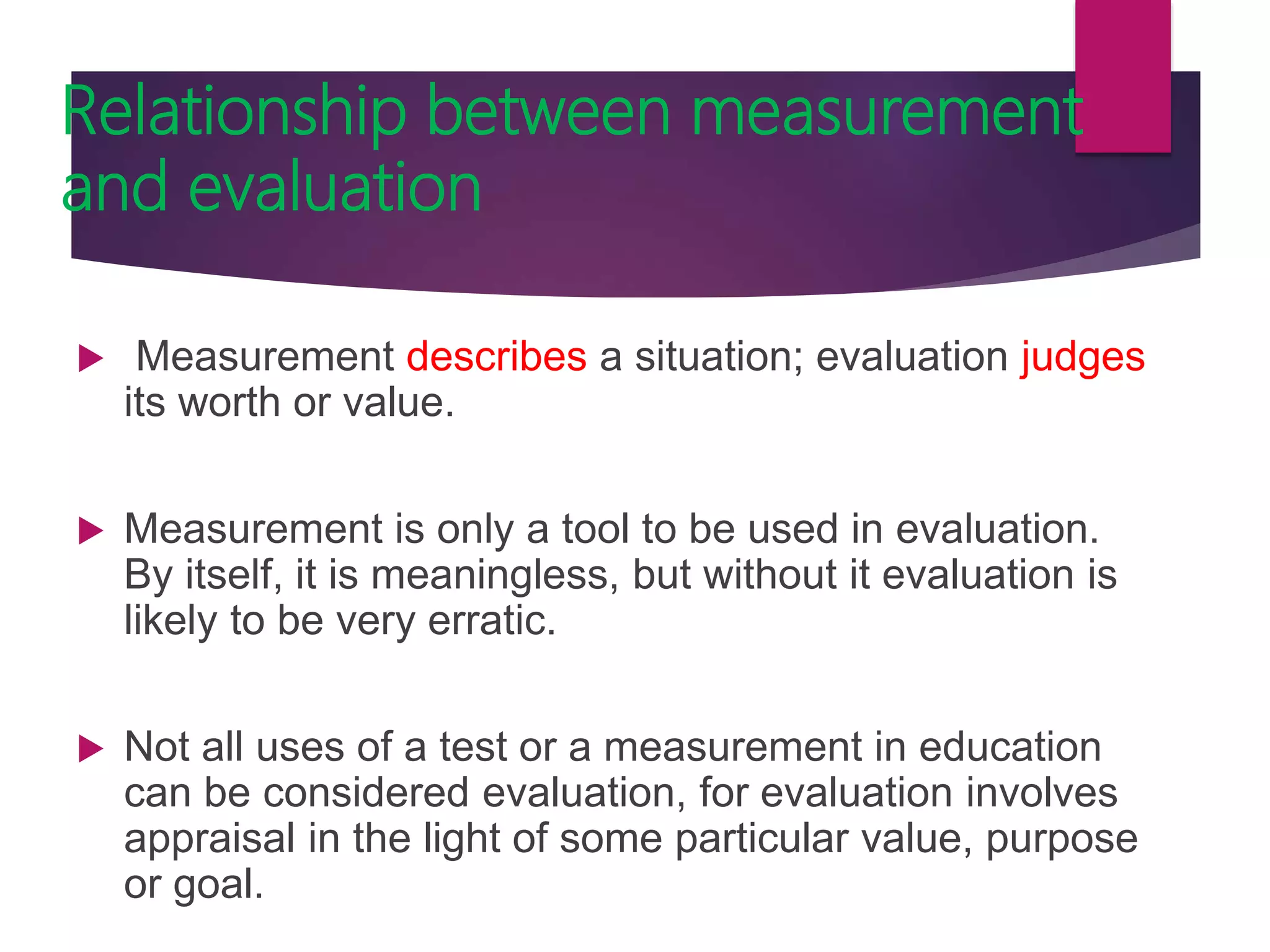
 Measurement describes a situation; evaluation judges
its worth or value.
 Measurement is only a tool to be used in evaluation.
By itself, it is meaningless, but without it evaluation is
likely to be very erratic.
 Not all uses of a test or a measurement in education
can be considered evaluation, for evaluation involves
appraisal in the light of some particular value, purpose
or goal.
Relationship between measurement and
evaluation
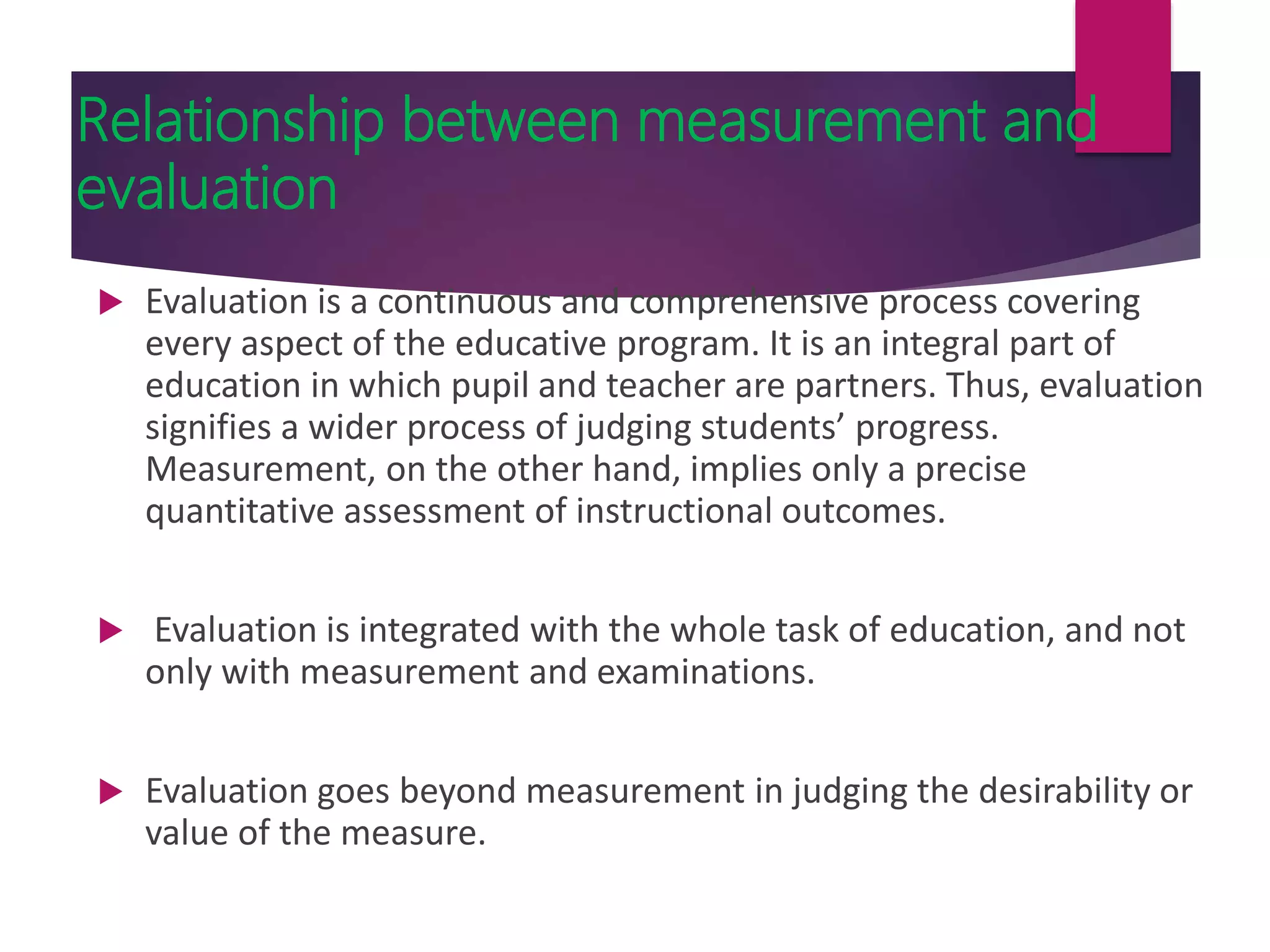
 Evaluation is a continuous and comprehensive process covering
every aspect of the educative program. It is an integral part of
education in which pupil and teacher are partners. Thus, evaluation
signifies a wider process of judging students’ progress.
Measurement, on the other hand, implies only a precise
quantitative assessment of instructional outcomes.
 Evaluation is integrated with the whole task of education, and not
only with measurement and examinations.
 Evaluation goes beyond measurement in judging the desirability or
value of the measure.
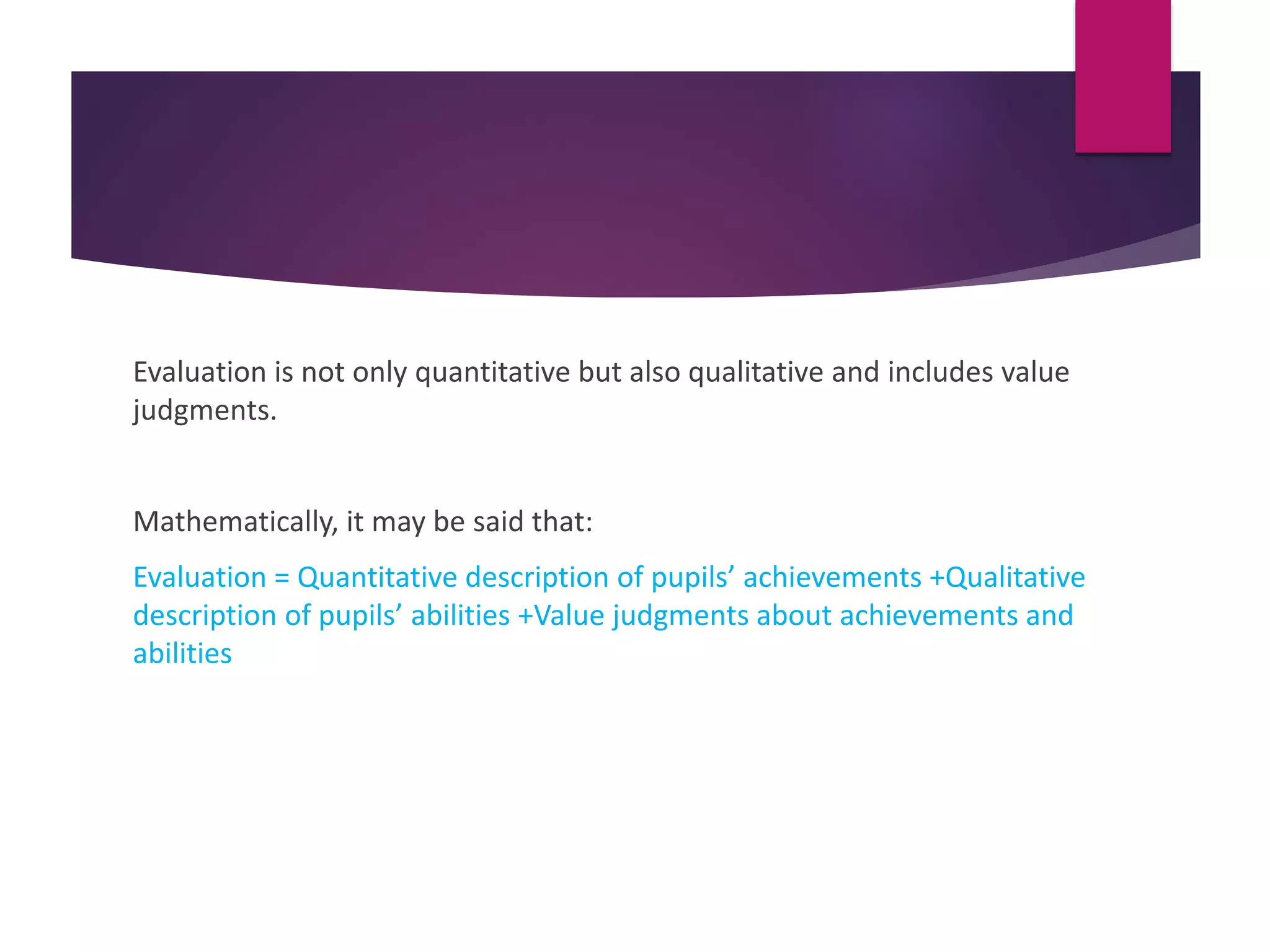
Evaluation is not only quantitative but also qualitative and includes value
judgments.
Mathematically, it may be said that:
Evaluation = Quantitative description of pupils’ achievements +Qualitative
description of pupils’ abilities +Value judgments about achievements and
abilities
Evaluation chain
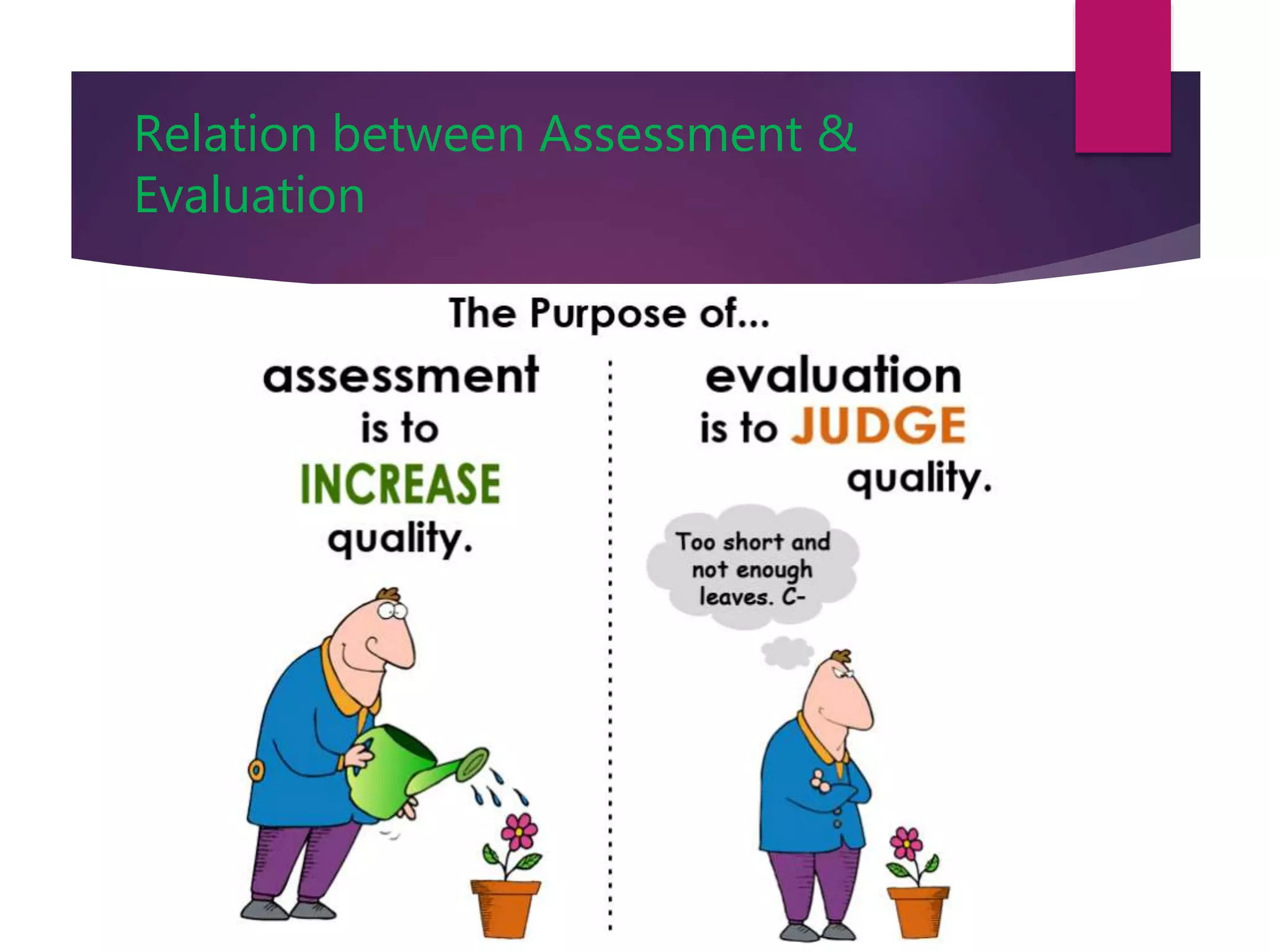
Relation between Assessment &
Evaluation
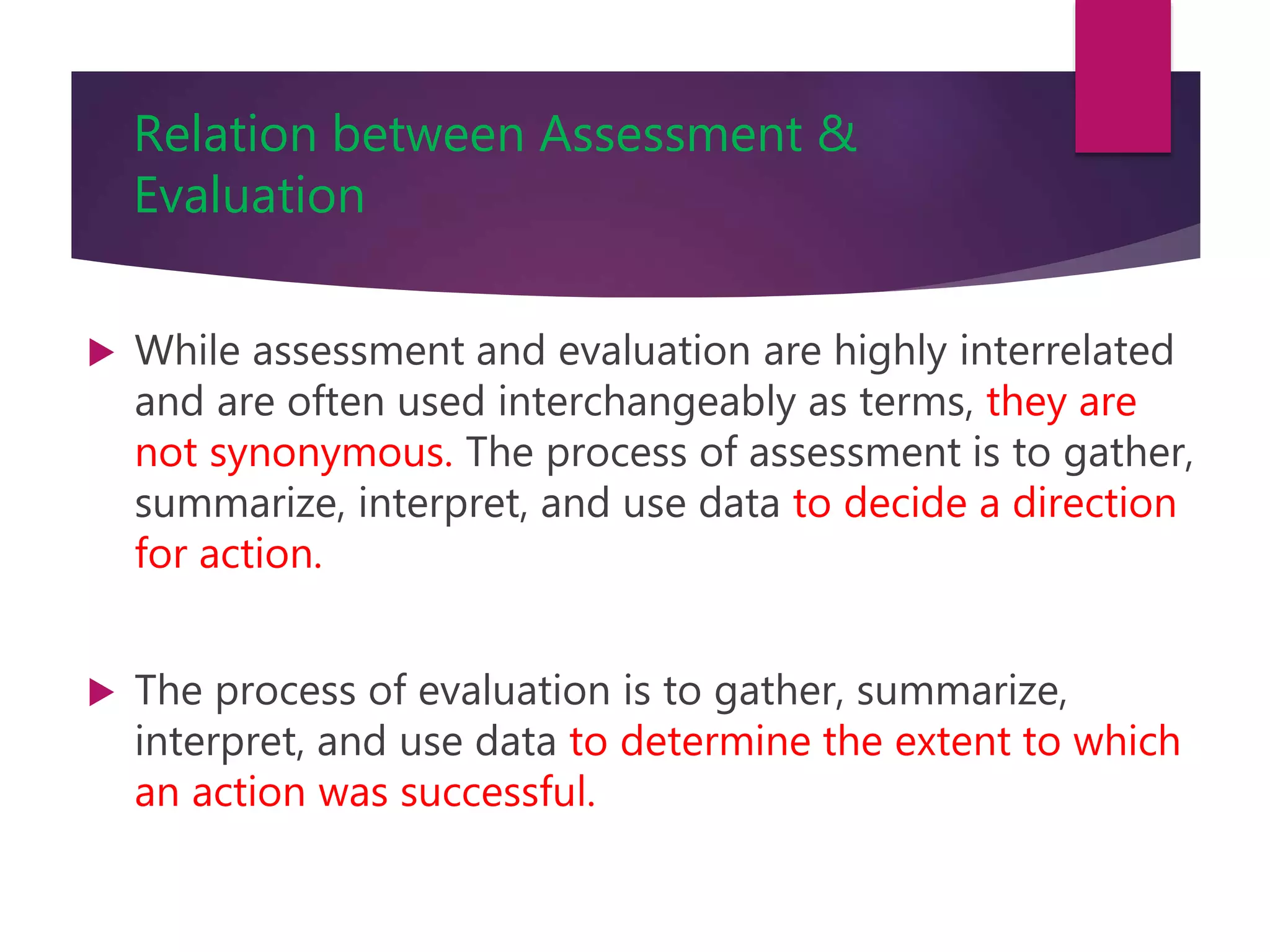
 While assessment and evaluation are highly interrelated
and are often used interchangeably as terms, they are
not synonymous. The process of assessment is to gather,
summarize, interpret, and use data to decide a direction
for action.
 The process of evaluation is to gather, summarize,
interpret, and use data to determine the extent to which
an action was successful.
Relation between Assessment &
Evaluation
Relation between Assessment & Evaluation
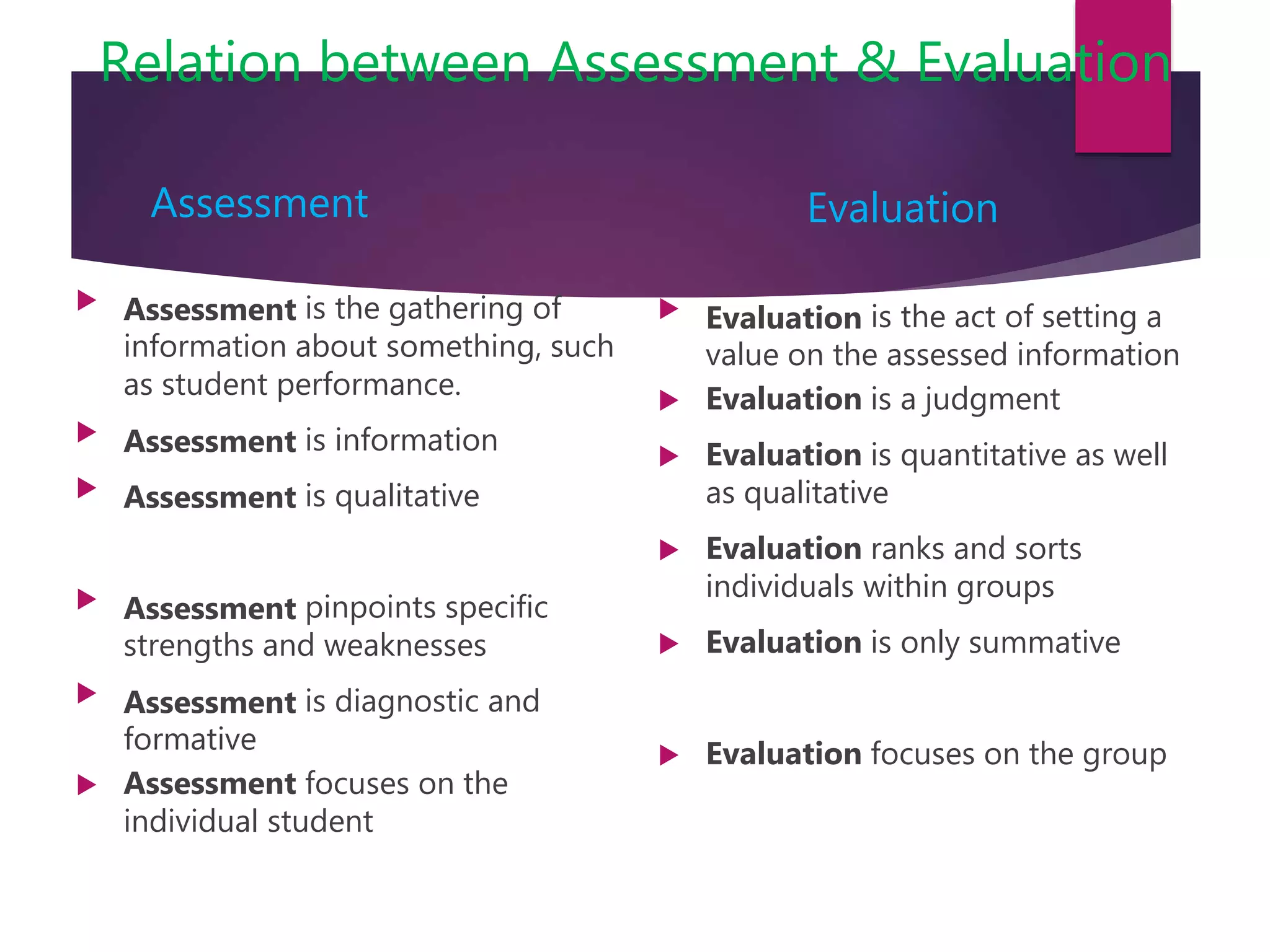
Assessment
 Assessment is the gathering of
information about something, such
as student performance.
 Assessment is information
 Assessment is qualitative
 Assessment pinpoints specific
strengths and weaknesses
 Assessment is diagnostic and
formative
 Assessment focuses on the
individual student
Evaluation
 Evaluation is the act of setting a
value on the assessed information
 Evaluation is a judgment
 Evaluation is quantitative as well
as qualitative
 Evaluation ranks and sorts
individuals within groups
 Evaluation is only summative
 Evaluation focuses on the group
Purposes of assessment
 Assessment to support learning
 Assessment for accountability
 assessment for certification, progress, and quality education.
Need and uses of measurement,
assessment and evaluation in behavioral
sciences
 Assessment is an integral part of instruction, as it determines
whether or not the goals of education are being met
 Testing the attainment of objectives (Cog, Aff., Psy)
 Help students to set learning goals
 Diagnosing learning problems
 Providing remedial measures
 Identifying the skills and ability (Practical)
 Marking, Grading, ranking
 Promotion to higher grades
 Providing guidance
 Choosing the right career/ vocation
 Providing feedback at the right time and directing
 Assessment can also help motivate students
 Assessment affects decisions about grades, placement, advancement,
instructional needs, curriculum, and, in some cases, funding
 Identify any anecdotes/ behavioural problems
 Identify hidden talents/ potentials
 Tracking the progress pattern
 Identify the higher order thinking skills
 Assigning appropriate task to individuals
 Helps in deciding the need based classes
 Planning for context based teaching
 Involving teachers, students and parents in assessment
 Focus on holistic development
Readings
 Ebel, R. L, Frisbie, D. A. (1986):Essentials of Educational Measurement (4th ed);
London, Prentice-Hall International(Uk) Ltd
 Furst, E.J. (1958), Constructing Evaluation Instruments, Longman Group, London
 Linn, R.L., Gronlund, N.E. (1995): Measurement and Assessment in Teaching(7th
ed); New Jersey, Prentice-Hall Inc
 Payne, D.A.(2003): Applied Educational Assessment (2nded); Canada,
Wadsworth/Thomson Learning
 Popham, W.J.(2011):Classroom Assessment(6th ed); Boston, Pearson
Any Questions? Comments?
THANK YOU !

Measurement, Assessment and Evaluation

  • 1.
    Measurement, Assessment and Evaluation JUBILEEPADMANABHAN ASSISTANT PROFESSOR IN EDUCATION CENTRAL UNIVERSITY OF PUNJAB
  • 2.
  • 3.
    Measurement The information aboutstudents’ learning is often assigned specific numbers or grades and this involves measurement. - Assigns numbers (e.g. 28/ 30 on the mathematics test; 90/ 100 on the science project) marks obtained on tests or other pieces of work set by the teacher. According to Ebel & Frisbie (1986) “Measurement involves using rules to assign a number(s), such as score, rating or a ranking, to an individual or group for a specified behaviour or performance.”
  • 4.
    ASSESSMENT The word ‘assess’comes from the Latin verb ‘assidere’ meaning ‘to sit with’. In assessment one is supposed to sit with the learner. This implies it is something we do ‘with’ and ‘for’ students and not ‘to’ students (Green, 1999). Assessment in education is the process of gathering, interpreting, recording, and using information about pupils’ responses to an educational task. (Harlen, Gipps, Broadfoot, Nuttal,1992) It is an integrated process of gaining information about students’ learning and making value. Information about students’ progress can be obtained from a variety of sources including projects, portfolios, performances, observations, and tests.
  • 5.
    EVALUATION It is alsothe process of obtaining, analyzing and interpreting information to determine the extent to which students achieve instructional objective. It is concerned with making judgments on the worth or value of a performance, answer the question “how good, adequate, or desirable”.
  • 6.
    EVALUATION e.g.: A teachermeasures Raju’s achievement in Science to be 60%. The teacher evaluates his achievement in Science when he/ she says that Raju’s performance is satisfactory. Evaluation= Quantitative description of pupils’ achievement+ Qualitative description of pupils’ abilities+ Value judgments about achievements and abilities.
  • 7.
    Purpose of Evaluation Learner’s level  Teacher’s level  Guidance and counsellor’s level  Curriculum development  School administration  Classroom research
  • 8.
    Relationship between measurement andevaluation  Evaluation goes beyond the meaning of the terms “test” and “measurement”.  Evaluation depends upon measurement but is not synonymous with it.  Measurement is a quantitative determination of how much an individual’s performance has been, while evaluation is a qualitative judgment of how good or how satisfactory an individual’s performance has been.  Sound evaluation is based upon the results of accurate and relevant measurement.
  • 9.
    Relationship between measurement andevaluation  Measurement describes a situation; evaluation judges its worth or value.  Measurement is only a tool to be used in evaluation. By itself, it is meaningless, but without it evaluation is likely to be very erratic.  Not all uses of a test or a measurement in education can be considered evaluation, for evaluation involves appraisal in the light of some particular value, purpose or goal.
  • 10.
    Relationship between measurementand evaluation  Evaluation is a continuous and comprehensive process covering every aspect of the educative program. It is an integral part of education in which pupil and teacher are partners. Thus, evaluation signifies a wider process of judging students’ progress. Measurement, on the other hand, implies only a precise quantitative assessment of instructional outcomes.  Evaluation is integrated with the whole task of education, and not only with measurement and examinations.  Evaluation goes beyond measurement in judging the desirability or value of the measure.
  • 11.
    Evaluation is notonly quantitative but also qualitative and includes value judgments. Mathematically, it may be said that: Evaluation = Quantitative description of pupils’ achievements +Qualitative description of pupils’ abilities +Value judgments about achievements and abilities
  • 12.
  • 13.
    Relation between Assessment& Evaluation  While assessment and evaluation are highly interrelated and are often used interchangeably as terms, they are not synonymous. The process of assessment is to gather, summarize, interpret, and use data to decide a direction for action.  The process of evaluation is to gather, summarize, interpret, and use data to determine the extent to which an action was successful.
  • 14.
  • 15.
    Relation between Assessment& Evaluation Assessment  Assessment is the gathering of information about something, such as student performance.  Assessment is information  Assessment is qualitative  Assessment pinpoints specific strengths and weaknesses  Assessment is diagnostic and formative  Assessment focuses on the individual student Evaluation  Evaluation is the act of setting a value on the assessed information  Evaluation is a judgment  Evaluation is quantitative as well as qualitative  Evaluation ranks and sorts individuals within groups  Evaluation is only summative  Evaluation focuses on the group
  • 16.
    Purposes of assessment Assessment to support learning  Assessment for accountability  assessment for certification, progress, and quality education.
  • 17.
    Need and usesof measurement, assessment and evaluation in behavioral sciences  Assessment is an integral part of instruction, as it determines whether or not the goals of education are being met  Testing the attainment of objectives (Cog, Aff., Psy)  Help students to set learning goals  Diagnosing learning problems  Providing remedial measures  Identifying the skills and ability (Practical)
  • 18.
     Marking, Grading,ranking  Promotion to higher grades  Providing guidance  Choosing the right career/ vocation  Providing feedback at the right time and directing  Assessment can also help motivate students
  • 19.
     Assessment affectsdecisions about grades, placement, advancement, instructional needs, curriculum, and, in some cases, funding  Identify any anecdotes/ behavioural problems  Identify hidden talents/ potentials  Tracking the progress pattern  Identify the higher order thinking skills
  • 20.
     Assigning appropriatetask to individuals  Helps in deciding the need based classes  Planning for context based teaching  Involving teachers, students and parents in assessment  Focus on holistic development
  • 22.
    Readings  Ebel, R.L, Frisbie, D. A. (1986):Essentials of Educational Measurement (4th ed); London, Prentice-Hall International(Uk) Ltd  Furst, E.J. (1958), Constructing Evaluation Instruments, Longman Group, London  Linn, R.L., Gronlund, N.E. (1995): Measurement and Assessment in Teaching(7th ed); New Jersey, Prentice-Hall Inc  Payne, D.A.(2003): Applied Educational Assessment (2nded); Canada, Wadsworth/Thomson Learning  Popham, W.J.(2011):Classroom Assessment(6th ed); Boston, Pearson
  • 23.