TOTAL QUALITY
MANAGEMENT
BY:
O P FOUSIYA
Asst. Prof. in Education
ATCW
24/09/2017 fousimohd76@gmail.com 1
TQM as a management model, with
its emphasis on leadership, strategy,
teamwork, rigorous analysis and
self-assessment, has a universal
message.
 TQM in education has as its
message the idea that every
student has worth and demands the
best possible chance in life
24/09/2017 fousimohd76@gmail.com 2
Total Quality Management (TQM)
• Total - made up of the whole
• Quality - degree of excellence a product or
service provides
• Management - act, art or manner of
planning, controlling, directing,….
Therefore, TQM is the art of managing the
whole to achieve excellence.
24/09/2017 fousimohd76@gmail.com 3
What does TQM mean?
TQM means that the organization's culture
is defined by and supports the constant
attainment of customer satisfaction
through an integrated system of tools,
techniques, and training.
This involves the continuous improvement
of organizational processes, resulting in
high quality products and services.
24/09/2017 fousimohd76@gmail.com 4
“DO THE RIGHT THINGS RIGHT THE
FIRST TIME, EVERY TIME.”
What’s the goal of TQM?
24/09/2017 fousimohd76@gmail.com 5
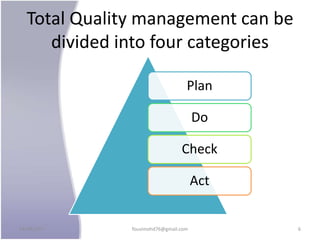
Total Quality management can be
divided into four categories
Plan
Do
Check
Act
24/09/2017 fousimohd76@gmail.com 6
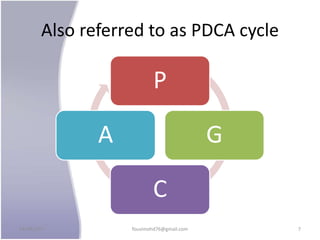
Also referred to as PDCA cycle
P
G
C
A
24/09/2017 fousimohd76@gmail.com 7
Elements for Success
• Management Support
• Mission Statement
• Proper Planning
• Customer and Bottom Line Focus
• Measurement
• Empowerment
• Teamwork/Effective Meetings
• Continuous Process Improvement
• Dedicated Resources
24/09/2017 fousimohd76@gmail.com 8
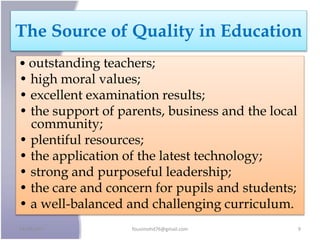
The Source of Quality in Education
• outstanding teachers;
• high moral values;
• excellent examination results;
• the support of parents, business and the local
community;
• plentiful resources;
• the application of the latest technology;
• strong and purposeful leadership;
• the care and concern for pupils and students;
• a well-balanced and challenging curriculum.
24/09/2017 fousimohd76@gmail.com 9
How TQM applied in school setting?
TQM?
24/09/2017fousimohd76@gmail.com 10
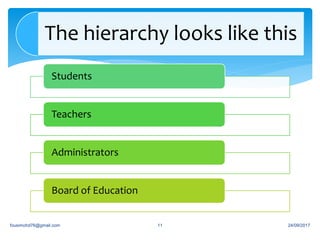
Students
Teachers
Administrators
Board of Education
The hierarchy looks like this
24/09/2017fousimohd76@gmail.com 11
Students are the workers and the products. The
difference between success and failure of the
school depends on the quality of their work.
24/09/2017 fousimohd76@gmail.com 12
Teachers are the first level managers.
Therefore the teacher will be leader of
the class, emphasizing quality through
non-coercive management featuring
student as worker and teacher as coach,
provoking the students to learn how to
learn and thus to teach themselves
24/09/2017 fousimohd76@gmail.com 13
Administrators are middle and upper level
management. The productivity of any
school depends mostly on the skills of
those who directly manage the workers,
i.e., the teachers. According to Deming,
their success in turn depends on how well
they are managed by the administration
above them. Therefore, any attempt at
educational quality are best centered
around organizational improvement efforts
24/09/2017 fousimohd76@gmail.com 14
The Board of Education
is the board of directors
thus responsible directly
to the clients, and board
members are overseers
of the administration
24/09/2017 fousimohd76@gmail.com 15
LEVELS OF APPLICATION
Herman and Herman (1994) stated three levels
of application of quality management in
education
24/09/2017 fousimohd76@gmail.com 16
The first level is to the management process of a school,
including strategic planning, recruiting and staff
development, deploying resources, and alignment of
what is taught, how it is taught, and how it is assessed
24/09/2017 fousimohd76@gmail.com 17
The next level is teaching quality to students. Students are
recognized as both customer and workers in the educational
system. Administrators need to involve students in their own
education by training them to evaluate the learning process
and accept responsibility for their learning
24/09/2017 fousimohd76@gmail.com 18
Robert and Robert (1998) addressed the most influential factor
in success or failure of a TQM implementation effort is universal
endorsement. If management is not completely sold on TQM, it
is unlikely that an implementation effort will be successful.
Endorsing TQM represents a fundamental change in the way.
Less than full support by anyone in the chain of authority
essentially condemns the effort to failure
24/09/2017 fousimohd76@gmail.com 19
A.E. Wiggam24/09/2017 fousimohd76@gmail.com 20
24/09/2017 fousimohd76@gmail.com 21

Total quality management

  • 1.
    TOTAL QUALITY MANAGEMENT BY: O PFOUSIYA Asst. Prof. in Education ATCW 24/09/2017 fousimohd76@gmail.com 1
  • 2.
    TQM as amanagement model, with its emphasis on leadership, strategy, teamwork, rigorous analysis and self-assessment, has a universal message.  TQM in education has as its message the idea that every student has worth and demands the best possible chance in life 24/09/2017 fousimohd76@gmail.com 2
  • 3.
    Total Quality Management(TQM) • Total - made up of the whole • Quality - degree of excellence a product or service provides • Management - act, art or manner of planning, controlling, directing,…. Therefore, TQM is the art of managing the whole to achieve excellence. 24/09/2017 fousimohd76@gmail.com 3
  • 4.
    What does TQMmean? TQM means that the organization's culture is defined by and supports the constant attainment of customer satisfaction through an integrated system of tools, techniques, and training. This involves the continuous improvement of organizational processes, resulting in high quality products and services. 24/09/2017 fousimohd76@gmail.com 4
  • 5.
    “DO THE RIGHTTHINGS RIGHT THE FIRST TIME, EVERY TIME.” What’s the goal of TQM? 24/09/2017 fousimohd76@gmail.com 5
  • 6.
    Total Quality managementcan be divided into four categories Plan Do Check Act 24/09/2017 fousimohd76@gmail.com 6
  • 7.
    Also referred toas PDCA cycle P G C A 24/09/2017 fousimohd76@gmail.com 7
  • 8.
    Elements for Success •Management Support • Mission Statement • Proper Planning • Customer and Bottom Line Focus • Measurement • Empowerment • Teamwork/Effective Meetings • Continuous Process Improvement • Dedicated Resources 24/09/2017 fousimohd76@gmail.com 8
  • 9.
    The Source ofQuality in Education • outstanding teachers; • high moral values; • excellent examination results; • the support of parents, business and the local community; • plentiful resources; • the application of the latest technology; • strong and purposeful leadership; • the care and concern for pupils and students; • a well-balanced and challenging curriculum. 24/09/2017 fousimohd76@gmail.com 9
  • 10.
    How TQM appliedin school setting? TQM? 24/09/2017fousimohd76@gmail.com 10
  • 11.
    Students Teachers Administrators Board of Education Thehierarchy looks like this 24/09/2017fousimohd76@gmail.com 11
  • 12.
    Students are theworkers and the products. The difference between success and failure of the school depends on the quality of their work. 24/09/2017 fousimohd76@gmail.com 12
  • 13.
    Teachers are thefirst level managers. Therefore the teacher will be leader of the class, emphasizing quality through non-coercive management featuring student as worker and teacher as coach, provoking the students to learn how to learn and thus to teach themselves 24/09/2017 fousimohd76@gmail.com 13
  • 14.
    Administrators are middleand upper level management. The productivity of any school depends mostly on the skills of those who directly manage the workers, i.e., the teachers. According to Deming, their success in turn depends on how well they are managed by the administration above them. Therefore, any attempt at educational quality are best centered around organizational improvement efforts 24/09/2017 fousimohd76@gmail.com 14
  • 15.
    The Board ofEducation is the board of directors thus responsible directly to the clients, and board members are overseers of the administration 24/09/2017 fousimohd76@gmail.com 15
  • 16.
    LEVELS OF APPLICATION Hermanand Herman (1994) stated three levels of application of quality management in education 24/09/2017 fousimohd76@gmail.com 16
  • 17.
    The first levelis to the management process of a school, including strategic planning, recruiting and staff development, deploying resources, and alignment of what is taught, how it is taught, and how it is assessed 24/09/2017 fousimohd76@gmail.com 17
  • 18.
    The next levelis teaching quality to students. Students are recognized as both customer and workers in the educational system. Administrators need to involve students in their own education by training them to evaluate the learning process and accept responsibility for their learning 24/09/2017 fousimohd76@gmail.com 18
  • 19.
    Robert and Robert(1998) addressed the most influential factor in success or failure of a TQM implementation effort is universal endorsement. If management is not completely sold on TQM, it is unlikely that an implementation effort will be successful. Endorsing TQM represents a fundamental change in the way. Less than full support by anyone in the chain of authority essentially condemns the effort to failure 24/09/2017 fousimohd76@gmail.com 19
  • 20.
  • 21.