TEST DEVELOPMENT AND
EVALUATION (6462)
DIFFERENT MODELS OF EVALUATION AND THEIR
IMPLICATIONS
Department of Secondary Teacher Education
ALLAMA IQBAL OPEN UNIVERSITY, ISLAMABAD
OBJECTIVES OF THE UNIT
After studying this unit, the students will have ability to demonstrate.
• define what evaluation is.
• understand the evaluation as a whole process.
• delineate various stages of evaluation.
• to implement any type of evaluation.
• determining when and where to use various evaluation models and
approaches
• report the results of evaluation
9.1 THE FOUR-LEVEL MODEL
9.1.1 Responsive Evaluation
 This approach calls for evaluators to be responsive to the information needs of various
audiences or stakeholders.
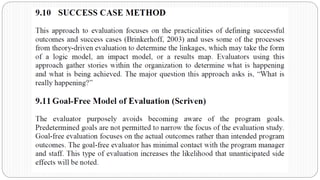
9.1.2 Goal-Free Evaluation
 This approach focuses on the actual outcomes rather than the intended outcomes of a
program.
9.1.3 Adversary/Judicial Approaches
 These approaches adapt the legal paradigm to program evaluation. Thus, two teams of
evaluators representing two views of the program’s effects argue their cases based on
the evidence (data) collected.
9.1.4 Consumer-Oriented Approaches
 Consumer-Oriented Evaluation Developed by Scriven. It helps in inform decisions on
what to purchase or trade. This approach judge the quality of something, establish
value, merit or worth of a product.
9.2 UTILIZATION-FOCUSED EVALUATION
➢ Utilization-Focused Evaluation (UFE), developed by Michael Quinn Patton, is an approach
based on the principle that an evaluation should be judged on its usefulness to its intended
users.
➢ Utilization-focused evaluation is highly personal and situational. The evaluation facilitator
develops a working relationship with intended users to help them determine what kind of
evaluation they need.
➢ Utilization-focused evaluation does not depend on or advocate any particular evaluation
content, model, method, theory, or even use. Rather, it is a process for helping primary intended
users select the most appropriate content, model, methods, theory, and uses for their particular
situation.
➢ In considering the rich and varied menu of evaluation, utilization-focused evaluation can
include any evaluative purpose (formative, summative, developmental), any kind of data
(quantitative, qualitative, mixed),
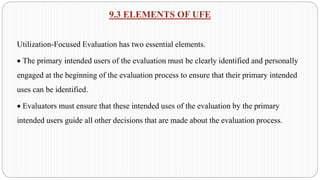
9.3 ELEMENTS OF UFE
Utilization-Focused Evaluation has two essential elements.
• The primary intended users of the evaluation must be clearly identified and personally
engaged at the beginning of the evaluation process to ensure that their primary intended
uses can be identified.
• Evaluators must ensure that these intended uses of the evaluation by the primary
intended users guide all other decisions that are made about the evaluation process.
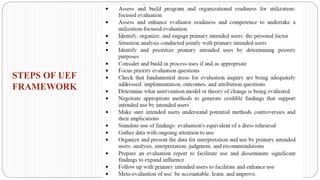
STEPS OF UEF
FRAMEWORK
9.5 EXPERTISE/ACCREDITATION APPROACHES
 It is the oldest type of formal evaluation. It relies on professional expertise to
judge the quality of following things;
 ✓ An institution,
 ✓ Program,
 ✓ Product,
 ✓ Activity
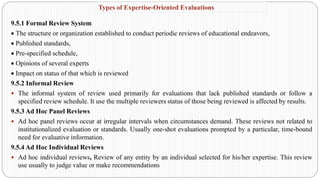
Types of Expertise-Oriented Evaluations
Following are the types of expertise-oriented evaluation.
• Formal review system
• Informal review system
• Ad hoc panel review
• Ad hoc individual review
9.5.1 Formal Review System
• The structure or organization established to conduct periodic reviews of educational endeavors,
• Published standards,
• Pre-specified schedule,
• Opinions of several experts
• Impact on status of that which is reviewed
9.5.2 Informal Review
 The informal system of review used primarily for evaluations that lack published standards or follow a
specified review schedule. It use the multiple reviewers status of those being reviewed is affected by results.
9.5.3 Ad Hoc Panel Reviews
 Ad hoc panel reviews occur at irregular intervals when circumstances demand. These reviews not related to
institutionalized evaluation or standards. Usually one-shot evaluations prompted by a particular, time-bound
need for evaluative information.
9.5.4 Ad Hoc Individual Reviews
 Ad hoc individual reviews, Review of any entity by an individual selected for his/her expertise. This review
use usually to judge value or make recommendations
Types of Expertise-Oriented Evaluations
Department of Secondary Teacher Education
ALLAMA IQBAL OPEN UNIVERSITY, ISLAMABAD
Dr. Hina Jalal
hinansari23@gmail.com

TEST DEVELOPMENT AND EVALUATION (6462)

  • 1.
    TEST DEVELOPMENT AND EVALUATION(6462) DIFFERENT MODELS OF EVALUATION AND THEIR IMPLICATIONS Department of Secondary Teacher Education ALLAMA IQBAL OPEN UNIVERSITY, ISLAMABAD
  • 2.
    OBJECTIVES OF THEUNIT After studying this unit, the students will have ability to demonstrate. • define what evaluation is. • understand the evaluation as a whole process. • delineate various stages of evaluation. • to implement any type of evaluation. • determining when and where to use various evaluation models and approaches • report the results of evaluation
  • 3.
    9.1 THE FOUR-LEVELMODEL 9.1.1 Responsive Evaluation  This approach calls for evaluators to be responsive to the information needs of various audiences or stakeholders. 9.1.2 Goal-Free Evaluation  This approach focuses on the actual outcomes rather than the intended outcomes of a program. 9.1.3 Adversary/Judicial Approaches  These approaches adapt the legal paradigm to program evaluation. Thus, two teams of evaluators representing two views of the program’s effects argue their cases based on the evidence (data) collected. 9.1.4 Consumer-Oriented Approaches  Consumer-Oriented Evaluation Developed by Scriven. It helps in inform decisions on what to purchase or trade. This approach judge the quality of something, establish value, merit or worth of a product.
  • 4.
    9.2 UTILIZATION-FOCUSED EVALUATION ➢Utilization-Focused Evaluation (UFE), developed by Michael Quinn Patton, is an approach based on the principle that an evaluation should be judged on its usefulness to its intended users. ➢ Utilization-focused evaluation is highly personal and situational. The evaluation facilitator develops a working relationship with intended users to help them determine what kind of evaluation they need. ➢ Utilization-focused evaluation does not depend on or advocate any particular evaluation content, model, method, theory, or even use. Rather, it is a process for helping primary intended users select the most appropriate content, model, methods, theory, and uses for their particular situation. ➢ In considering the rich and varied menu of evaluation, utilization-focused evaluation can include any evaluative purpose (formative, summative, developmental), any kind of data (quantitative, qualitative, mixed),
  • 5.
    9.3 ELEMENTS OFUFE Utilization-Focused Evaluation has two essential elements. • The primary intended users of the evaluation must be clearly identified and personally engaged at the beginning of the evaluation process to ensure that their primary intended uses can be identified. • Evaluators must ensure that these intended uses of the evaluation by the primary intended users guide all other decisions that are made about the evaluation process.
  • 6.
  • 7.
    9.5 EXPERTISE/ACCREDITATION APPROACHES It is the oldest type of formal evaluation. It relies on professional expertise to judge the quality of following things;  ✓ An institution,  ✓ Program,  ✓ Product,  ✓ Activity Types of Expertise-Oriented Evaluations Following are the types of expertise-oriented evaluation. • Formal review system • Informal review system • Ad hoc panel review • Ad hoc individual review
  • 8.
    9.5.1 Formal ReviewSystem • The structure or organization established to conduct periodic reviews of educational endeavors, • Published standards, • Pre-specified schedule, • Opinions of several experts • Impact on status of that which is reviewed 9.5.2 Informal Review  The informal system of review used primarily for evaluations that lack published standards or follow a specified review schedule. It use the multiple reviewers status of those being reviewed is affected by results. 9.5.3 Ad Hoc Panel Reviews  Ad hoc panel reviews occur at irregular intervals when circumstances demand. These reviews not related to institutionalized evaluation or standards. Usually one-shot evaluations prompted by a particular, time-bound need for evaluative information. 9.5.4 Ad Hoc Individual Reviews  Ad hoc individual reviews, Review of any entity by an individual selected for his/her expertise. This review use usually to judge value or make recommendations Types of Expertise-Oriented Evaluations
  • 12.
    Department of SecondaryTeacher Education ALLAMA IQBAL OPEN UNIVERSITY, ISLAMABAD Dr. Hina Jalal hinansari23@gmail.com