Technology Acquisition &
       Transfer
                By
      Dr. Vijay Kr. Khurana
What is Technology Transfer ?
•   Technology Transfer is the process by which
    technology is disseminated.
•   It involves communication of relevant knowledge by
    the Transferor to the Recipient.
•   It is in the form of technology transfer
    transaction which way or may not be a legally
    binding contract.
What is Technology Acquisition ?
Twoterms technology transfer and technology are
    normally used interchangeably.
The verb “Acquire” means
•   To come into possesion of; get as one’s own
•   To gain for oneself through one’s actions or
    efforts
Technology Acquisition is the process of acquiring a
    new technology, new product, process or service ;
    by efforts of an individual or an enterprise or any
    other macro entity. This process can be conducted
    either internally or externally to the enterprise.
Types of Technology Transfer
•   Scientific Knowledge Transfer, Direct Technology
    Transfer, Spin-off Technology Transfer
•   Informal    Technology   Transfer     &   Formal
    Technology Transfer
•   Internal Technology Transfer & External
    Technology Transfer
Internal Technology Transfer
Internal Technology Transfer refer to such technology
     transfers / investments where control on the
     ownership & usage of technology resides with the
     transferor.
It is a complex process involving following decisions:
•    Timing : When to introduce new technology /
     products in the market?
•    Location : Where to transfer new technology /
     products?
•    Multi-functional teams --Which staff members
     should be involved in transfer process ?
•    Communication methods & procedures – What type
     of Communication methods & procedures be
     adopted to facilitate transfer ?
Barriers to Internal Technology Transfer

• R & D goals are not known to Production Department.
• Difficulties in stopping current production to test
  new products / processes
• R&D Department does not understand needs &
  capability of Production Department.
• In general, Production Department is resistant to
  innovation and is bound by routine.
• Non-linkage of new technologies to marketing /
  customer needs.
Overcoming Barriers to Internal
           Technology Transfer
• Top management support and participation in the
  transfer process
• Providing supportive organizational culture
• Use of multi-functional teams in the transfer
  process
• Ensuring effective communication in the organization
• Bringing R&D closer to production.
• Rotation of few person between R&D and production
• Linking & participation of marketing elements in the
  transfer process.
Steps in Internal Technology Acquisition by
                  a firm
1. Planning new products / services / processes to be
   offered – planning must incorporate voice of the
   customer & user needs
2. Screening new products, processes or services – only
   viable / feasible items be offered as only one out of
   4/5 becomes a commercial success.
3. Initiating development process – must be properly
   designed and carried out so that it facilitates
   success. Enterprises should
a. Consist of temporary system capable of adapting to
   dymanics of change
b. Organize the systems around problem solving
Steps in Internal Technology Acquisition
                by a firm
c. Have flexible management system & replace rigid
   management system
d. Use multi-functional teams.
e. Proper integration between R&D, Production &
   Marketing sub-systems
f. Ensure effective communication
4. Carrying out trial production on small scale and test
   marketing
5. Improving design & production processes based on
   experiences / feedback
6. Commercialization i.e. mass production & sales
External Technology Transfer
• In these transfers, control on the ownership &
  usage of technology usually does not remain with
  transferor and it passes on to the recipient, like
  joint venture with local control, licensing agreement
  etc.
External Technology Transfer
Successful external technology transfer depends upon
  following factors:
• Type of the technology being transferred
• Complexity of the technology being transferred
• Transfer mechanism selected
• Relationships between the parties – building of
  mutual trust
• Core competencies of the parties & compatibilty
  thereof
• Organizational culture of the parties & mutual
  understanding thereof
Methods of External Technology
                 Transfer
• Co-operative & collaborative ventures / strategic
  alliances
• Licensing agreements
• Contracting agreements
• Enterprise acquisition.
Why External Technology Transfer
• Technology already developed saves time & efforts
• Sometimes Growth objectives or competitive goals
  cannot be reached through internal development
• Lack of risk taking ability for innovations
• Lack of internal resources (physical & human) for
  innovation
• Firm does not have core competencies to deal with
  complex technological developments.
• Need to keep up with competitors
• Need to cope up with acceleration of technological
  change
• As a part of firm’ strategy --- let other firms take
             big risks & it will purchase technology
             developed by them.
Barriers to External Technology
                  Transfer
• Associated costs – usually high prices are required
  to be paid in the form of royalities, technical &
  knowhow fees etc over medium to long term period
• Appropriatesness of technology i.e. its suitability to
  core competencies and market needs is always a
  point of discussion and investigation
• Heavy reliances on foreign technology- may make
  transferee / recipient technologically dependent on
  external technology providers / transferors even
  for small issues
• Lack of mutual trust between two parties may hinder
  full & timely transfer
Barriers to External Technology
                  Transfer
• There is risk of loss of control over technology and
  the transferee / recipient may use technology in an
  arbitrary manner
• Transfer may render existing technology & its
  related products / services / processes obsolete
• Transferee may turn a potential competitor in
  future.
• Mismatch in core competencies of the transferor &
  transferee may create difficulties in transfer
• Different organisation cultures may create
  difficulties in transfer
• Lack of effective communication between the parties
             may also create difficulties in transfer
Overcoming Barriers to External
           Technology Transfer
• Proper & well defined technology transfer
  agreement should be signed
• Proper assessment / evaluation of appropriateness
  of technology
• Proper assessment / evaluation of compatability of
  core competencies of the parties
• Building pre-agreement relationships so as to
  develop mutual trust and so as to understand culture
  of opposite parties
• Seeking cross cultural training
• Ensuring effective communication
• Anticipating problems and adopting measures for
             facilitating transfer
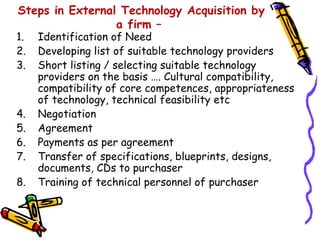
Steps in External Technology Acquisition by
                 a firm –
1.   Identification of Need
2.   Developing list of suitable technology providers
3.   Short listing / selecting suitable technology
     providers on the basis …. Cultural compatibility,
     compatibility of core competences, appropriateness
     of technology, technical feasibility etc
4.   Negotiation
5.   Agreement
6.   Payments as per agreement
7.   Transfer of specifications, blueprints, designs,
     documents, CDs to purchaser
8.   Training of technical personnel of purchaser
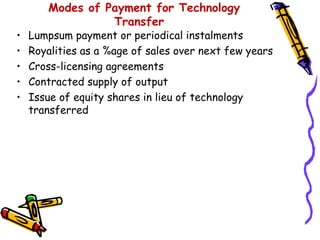
Modes of Payment for Technology
                 Transfer
•   Lumpsum payment or periodical instalments
•   Royalities as a %age of sales over next few years
•   Cross-licensing agreements
•   Contracted supply of output
•   Issue of equity shares in lieu of technology
    transferred
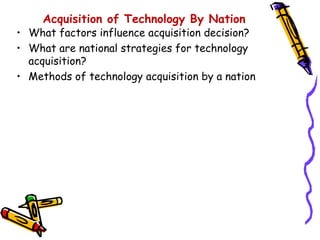
Acquisition of Technology By Nation
• What factors influence acquisition decision?
• What are national strategies for technology
  acquisition?
• Methods of technology acquisition by a nation
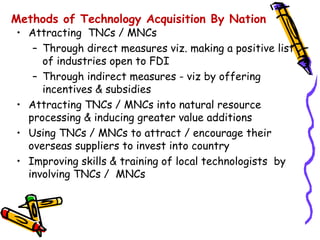
Methods of Technology Acquisition By Nation
• Attracting TNCs / MNCs
   – Through direct measures viz. making a positive list
     of industries open to FDI
   – Through indirect measures - viz by offering
     incentives & subsidies
• Attracting TNCs / MNCs into natural resource
  processing & inducing greater value additions
• Using TNCs / MNCs to attract / encourage their
  overseas suppliers to invest into country
• Improving skills & training of local technologists by
  involving TNCs / MNCs
Methods of Technology Acquisition By Nation
 • Developing industrial parks / technology parks to
   attract high technology investors
 • Offering incentives to existing investors to move to
   more complex technologies and to increase or
   upgrade technological R& D base
 • Changing competitive environment and existing
   incentive structure to encourage world class
   technology & management
 • Improving technological access for local firms for
   outsourcing / technology transfer
 • Collecting, organising & disseminating information
   about technology development
Regulation of Technology Transfer By Nation
• The regulation is undertaken in two directions:
   – Regulation of import of technology / technology inflows
   – Regulation of export of technology / technology outflows &
     Setting up of Joint Ventures (JV) and Wholly Owned
     Subsidiaries (WOS) Abroad
• Why regulation of import of technology? – What are
  advantages & disadvantages of import of technology?
• What are – Guidelines on import of Foreign Technology into
  India?
• Why regulation of export of technology? –What are advantages
  & disadvantages of export of technology?
• What are – Guidelines on Export of Technology & Setting up
  Joint Venture & Wholly Owned subsidiary abroad?
Technology Acquisition &
       Transfer
                By
      Dr. Vijay Kr. Khurana

Technology transfer & acquisition

  • 1.
    Technology Acquisition & Transfer By Dr. Vijay Kr. Khurana
  • 2.
    What is TechnologyTransfer ? • Technology Transfer is the process by which technology is disseminated. • It involves communication of relevant knowledge by the Transferor to the Recipient. • It is in the form of technology transfer transaction which way or may not be a legally binding contract.
  • 3.
    What is TechnologyAcquisition ? Twoterms technology transfer and technology are normally used interchangeably. The verb “Acquire” means • To come into possesion of; get as one’s own • To gain for oneself through one’s actions or efforts Technology Acquisition is the process of acquiring a new technology, new product, process or service ; by efforts of an individual or an enterprise or any other macro entity. This process can be conducted either internally or externally to the enterprise.
  • 4.
    Types of TechnologyTransfer • Scientific Knowledge Transfer, Direct Technology Transfer, Spin-off Technology Transfer • Informal Technology Transfer & Formal Technology Transfer • Internal Technology Transfer & External Technology Transfer
  • 5.
    Internal Technology Transfer InternalTechnology Transfer refer to such technology transfers / investments where control on the ownership & usage of technology resides with the transferor. It is a complex process involving following decisions: • Timing : When to introduce new technology / products in the market? • Location : Where to transfer new technology / products? • Multi-functional teams --Which staff members should be involved in transfer process ? • Communication methods & procedures – What type of Communication methods & procedures be adopted to facilitate transfer ?
  • 6.
    Barriers to InternalTechnology Transfer • R & D goals are not known to Production Department. • Difficulties in stopping current production to test new products / processes • R&D Department does not understand needs & capability of Production Department. • In general, Production Department is resistant to innovation and is bound by routine. • Non-linkage of new technologies to marketing / customer needs.
  • 7.
    Overcoming Barriers toInternal Technology Transfer • Top management support and participation in the transfer process • Providing supportive organizational culture • Use of multi-functional teams in the transfer process • Ensuring effective communication in the organization • Bringing R&D closer to production. • Rotation of few person between R&D and production • Linking & participation of marketing elements in the transfer process.
  • 8.
    Steps in InternalTechnology Acquisition by a firm 1. Planning new products / services / processes to be offered – planning must incorporate voice of the customer & user needs 2. Screening new products, processes or services – only viable / feasible items be offered as only one out of 4/5 becomes a commercial success. 3. Initiating development process – must be properly designed and carried out so that it facilitates success. Enterprises should a. Consist of temporary system capable of adapting to dymanics of change b. Organize the systems around problem solving
  • 9.
    Steps in InternalTechnology Acquisition by a firm c. Have flexible management system & replace rigid management system d. Use multi-functional teams. e. Proper integration between R&D, Production & Marketing sub-systems f. Ensure effective communication 4. Carrying out trial production on small scale and test marketing 5. Improving design & production processes based on experiences / feedback 6. Commercialization i.e. mass production & sales
  • 10.
    External Technology Transfer •In these transfers, control on the ownership & usage of technology usually does not remain with transferor and it passes on to the recipient, like joint venture with local control, licensing agreement etc.
  • 11.
    External Technology Transfer Successfulexternal technology transfer depends upon following factors: • Type of the technology being transferred • Complexity of the technology being transferred • Transfer mechanism selected • Relationships between the parties – building of mutual trust • Core competencies of the parties & compatibilty thereof • Organizational culture of the parties & mutual understanding thereof
  • 12.
    Methods of ExternalTechnology Transfer • Co-operative & collaborative ventures / strategic alliances • Licensing agreements • Contracting agreements • Enterprise acquisition.
  • 13.
    Why External TechnologyTransfer • Technology already developed saves time & efforts • Sometimes Growth objectives or competitive goals cannot be reached through internal development • Lack of risk taking ability for innovations • Lack of internal resources (physical & human) for innovation • Firm does not have core competencies to deal with complex technological developments. • Need to keep up with competitors • Need to cope up with acceleration of technological change • As a part of firm’ strategy --- let other firms take big risks & it will purchase technology developed by them.
  • 14.
    Barriers to ExternalTechnology Transfer • Associated costs – usually high prices are required to be paid in the form of royalities, technical & knowhow fees etc over medium to long term period • Appropriatesness of technology i.e. its suitability to core competencies and market needs is always a point of discussion and investigation • Heavy reliances on foreign technology- may make transferee / recipient technologically dependent on external technology providers / transferors even for small issues • Lack of mutual trust between two parties may hinder full & timely transfer
  • 15.
    Barriers to ExternalTechnology Transfer • There is risk of loss of control over technology and the transferee / recipient may use technology in an arbitrary manner • Transfer may render existing technology & its related products / services / processes obsolete • Transferee may turn a potential competitor in future. • Mismatch in core competencies of the transferor & transferee may create difficulties in transfer • Different organisation cultures may create difficulties in transfer • Lack of effective communication between the parties may also create difficulties in transfer
  • 16.
    Overcoming Barriers toExternal Technology Transfer • Proper & well defined technology transfer agreement should be signed • Proper assessment / evaluation of appropriateness of technology • Proper assessment / evaluation of compatability of core competencies of the parties • Building pre-agreement relationships so as to develop mutual trust and so as to understand culture of opposite parties • Seeking cross cultural training • Ensuring effective communication • Anticipating problems and adopting measures for facilitating transfer
  • 17.
    Steps in ExternalTechnology Acquisition by a firm – 1. Identification of Need 2. Developing list of suitable technology providers 3. Short listing / selecting suitable technology providers on the basis …. Cultural compatibility, compatibility of core competences, appropriateness of technology, technical feasibility etc 4. Negotiation 5. Agreement 6. Payments as per agreement 7. Transfer of specifications, blueprints, designs, documents, CDs to purchaser 8. Training of technical personnel of purchaser
  • 18.
    Modes of Paymentfor Technology Transfer • Lumpsum payment or periodical instalments • Royalities as a %age of sales over next few years • Cross-licensing agreements • Contracted supply of output • Issue of equity shares in lieu of technology transferred
  • 19.
    Acquisition of TechnologyBy Nation • What factors influence acquisition decision? • What are national strategies for technology acquisition? • Methods of technology acquisition by a nation
  • 20.
    Methods of TechnologyAcquisition By Nation • Attracting TNCs / MNCs – Through direct measures viz. making a positive list of industries open to FDI – Through indirect measures - viz by offering incentives & subsidies • Attracting TNCs / MNCs into natural resource processing & inducing greater value additions • Using TNCs / MNCs to attract / encourage their overseas suppliers to invest into country • Improving skills & training of local technologists by involving TNCs / MNCs
  • 21.
    Methods of TechnologyAcquisition By Nation • Developing industrial parks / technology parks to attract high technology investors • Offering incentives to existing investors to move to more complex technologies and to increase or upgrade technological R& D base • Changing competitive environment and existing incentive structure to encourage world class technology & management • Improving technological access for local firms for outsourcing / technology transfer • Collecting, organising & disseminating information about technology development
  • 22.
    Regulation of TechnologyTransfer By Nation • The regulation is undertaken in two directions: – Regulation of import of technology / technology inflows – Regulation of export of technology / technology outflows & Setting up of Joint Ventures (JV) and Wholly Owned Subsidiaries (WOS) Abroad • Why regulation of import of technology? – What are advantages & disadvantages of import of technology? • What are – Guidelines on import of Foreign Technology into India? • Why regulation of export of technology? –What are advantages & disadvantages of export of technology? • What are – Guidelines on Export of Technology & Setting up Joint Venture & Wholly Owned subsidiary abroad?
  • 23.
    Technology Acquisition & Transfer By Dr. Vijay Kr. Khurana