TECHNOLOGY MANAGEMENT
What is Technology ?
• “the application of scientific knowledge for practical
purposes, especially in industry” – Oxford Dictionary
• “Technology is the making, modification, usage, and
knowledge of tools, machines, techniques… in order to
solve a problem … achieve a goal … perform a
specific function.
•
• “The purposeful application of information in the
design, production, and utilization of goods and services,
and in the organization of human activities.” – Business
Dictionary
Technology Management & Concept
Integrated Planning,
Design,
Optimization,
Operation and
Control of technological products, processes and services,
Types of technology
• Generic, Basic, Key
• Embodied and Disembodied
• System and Infra
• Hybrid and Emerging
Technology Portfolio(Passenger car)
• Steel Making
• Metal Body forming
• Electrical Engineering
• Electronic Engineering
• Rubber & Plastic
• Paint
• Metal Cutting & welding
• Mechanical
• Glass and etc.
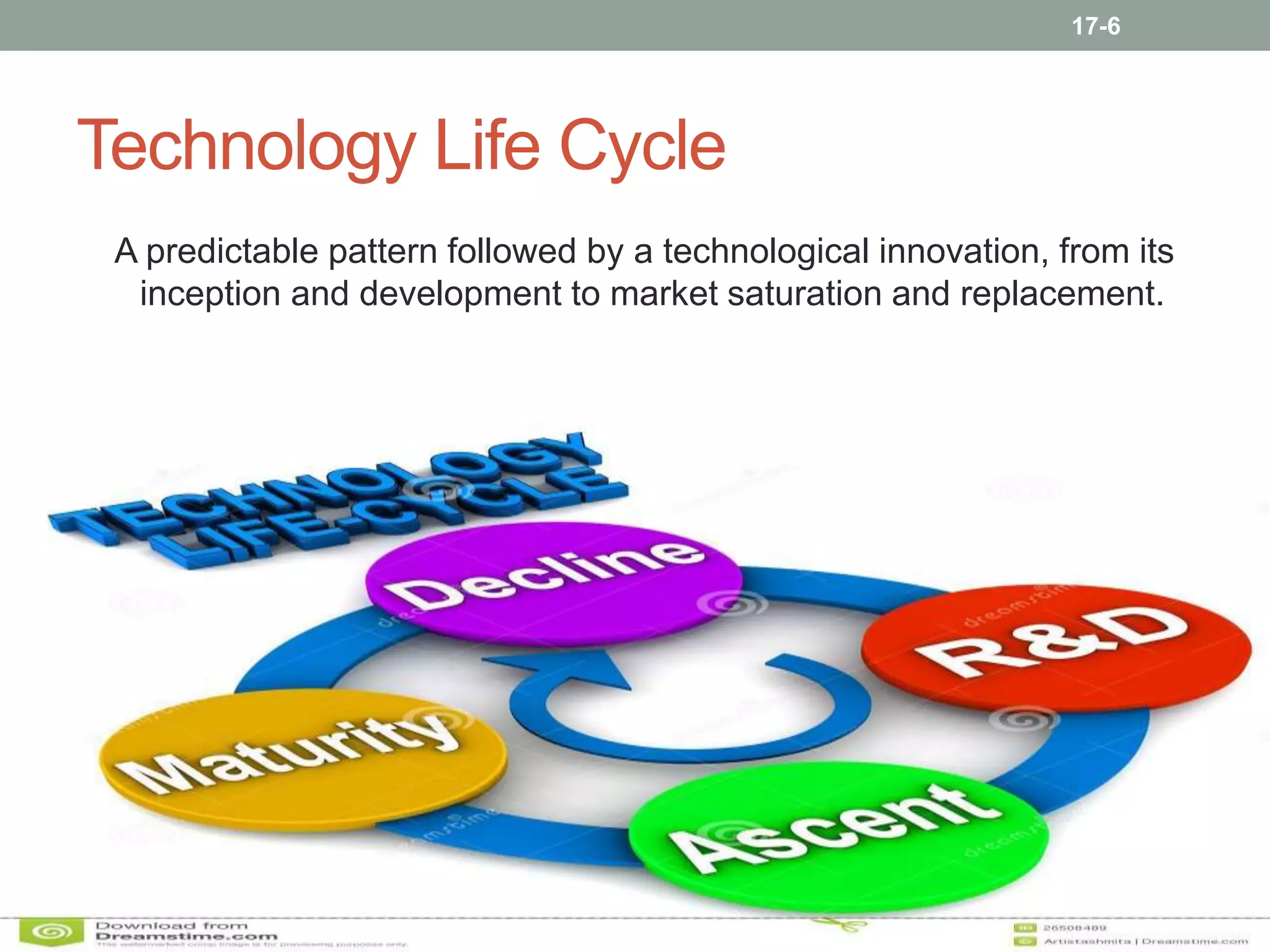
Technology Life Cycle
A predictable pattern followed by a technological innovation, from its
inception and development to market saturation and replacement.
17-6
The four phases of the technology life-
cycle
• The research and development (R&D){Bleeding Edge}
• The ascent phase {leading edge}
• The maturity phase
• The decline {decay phase}
What is Technology Life Cycle?
•
Stage /
Phase
No
Technological
Stage / Phase
Features
I Technology
Development
Basic Technology
II Technology
Application
Technology + Applications
III Application Launch Technology + Applications + Product
Launch
IV Application Growth Technology + Applications + Rise in
product sales
V Technological
Maturity
Technology + Applications + Fall in
product sales
VI Degraded
Technology
Minimal Product sales + Loss of
application + Alternative Technology
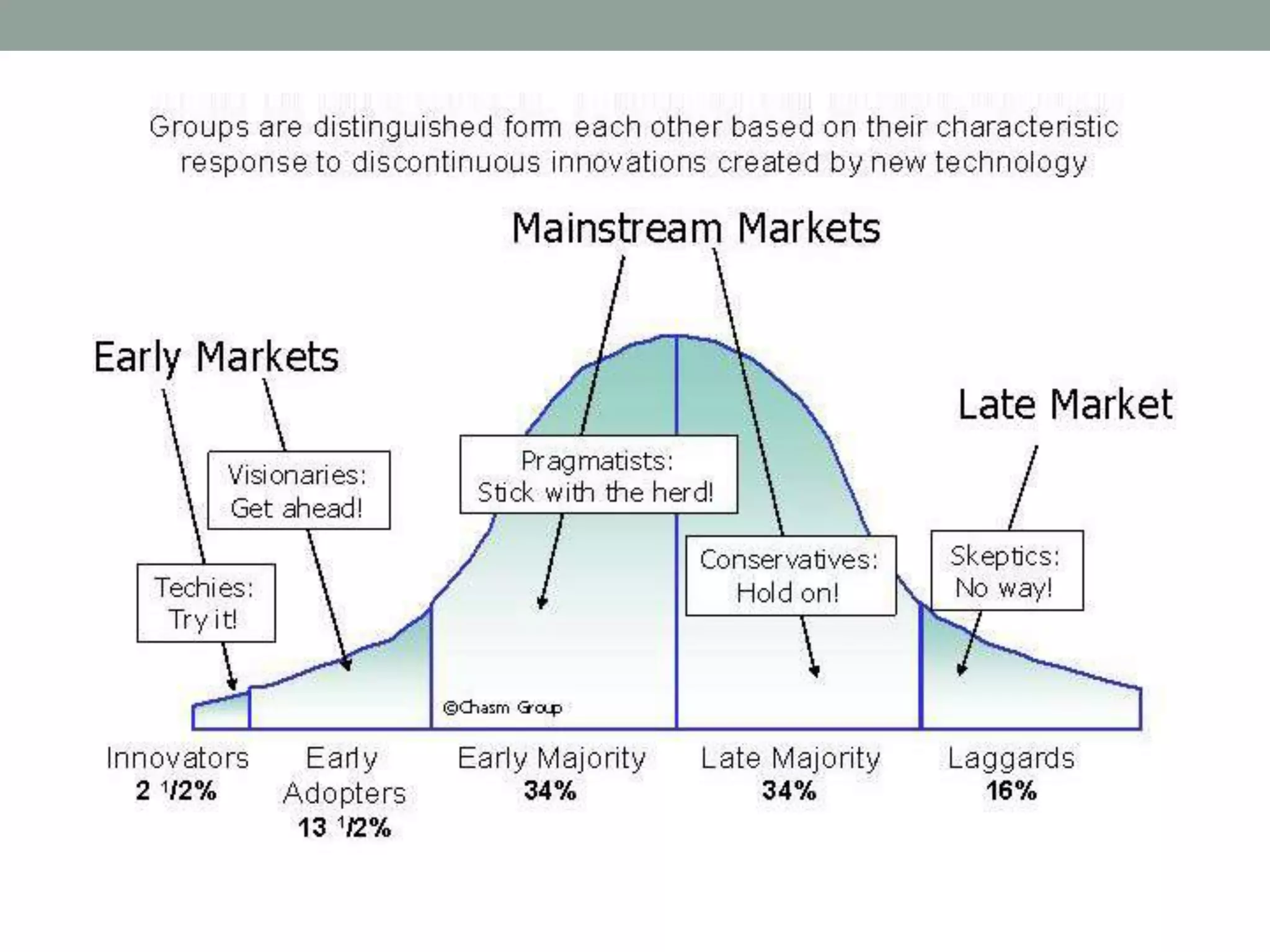
Technology adoption lifecycle
• innovators – had larger farms, were more educated,
more prosperous and more risk-oriented
• early adopters – younger, more educated, tended to be
community leaders, less prosperous
• early majority – more conservative but open to new
ideas, active in community and influence to neighbors
• late majority – older, less educated, fairly conservative
and less socially active
• laggards – very conservative, had small farms and
capital, oldest and least educated
Management of Technology at National
level(Objectives)
• Developing Appropriate Technology Strategy
• Technology forecasting
• Appropriateness of new tech.(justification)
• Sustainable technologies; Development of renewable
technologies
• Sustainable economic growth
• Planning National Technology portfolio
• Managing external Technology acquisitions
• Managing Absorption
• Managing Technology Diffusion
MOT at enterprise level
• Developing technology Strategy(Leader Vs. followers
strategy)
• Tech. forecasting
• Managing Enterprise’s tech. portfolio
• Technovation
• Implementation of New Technology
• Technology Absorption
• Managing Technology Change(productivity and Quality of
work life)
• Technology advancement
• Performance Measurement
KRA’s at enterprise level
• Tech Planning like declining technology strategy,
Selecting appropriate techniques
• R&D management
• Innovation Management
• SMOT
SMOT Importance
• Improvement in quality(high quality)
• Minimum; LCC of Product Development
• Increased in machine utilization rate by removing
bottlenecks
• Reduction in work process.
• Flexibility in design and manufacturing options.
• Earning through technology agreement transfer.
Contd.
• Increased ability to enter in new markets quickly, faster
introduction of new products.
• Shortened delivery time for customer.
• Monopoly and high prices for hi-tech products in the
international market.
• Reduction in overall cycle time
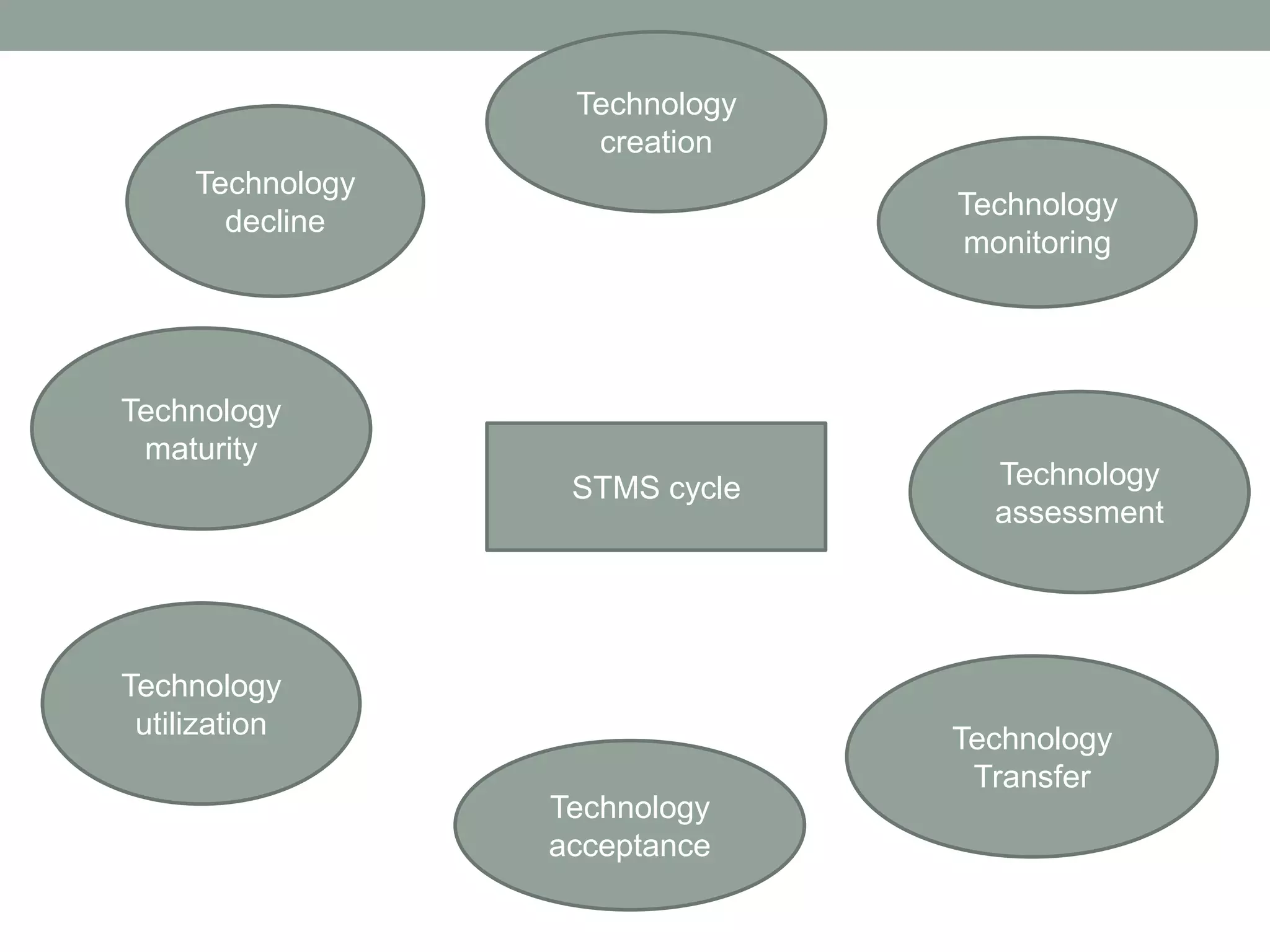
Technology
creation
Technology
monitoring
Technology
assessment
Technology
Transfer
Technology
acceptance
Technology
utilization
Technology
decline
Technology
maturity
STMS cycle
Technology Creation
• Creativity and Invention
• Innovation
• Senior management Commitment to technology creation and
generation
• Developing requisite and supportive corporate culture for
promoting technology creation and generation.
Technology Monitoring
• Installing and developing IS to monitor trends and
changes.
• Competitive analysis to understand competitiveness
provides by existing and prospective technologies.
• Customer and supplier interfaces to understand market
and technological Changes.
• People Links,
Technology Assessment
• Understanding direction of market in terms of technology
• Integration of technology and business planning
• Customer interfaces to assess the commercial feasibility
of prospective technologies
• Assessing contribution of technology projects to business
strategy.
Technology Transfer
• Entering strategic alliances to develop or acquire
potential technologies
• Using product design teams for reaping benefits of
planned technological change
• Reducing functional barriers to technology transfer
• Utilizing people links for successful technology transfer
i.e. involving people across the organization.
Technology acceptance
• Supportive organizational design and structures
• Supportive corporate culture
• Senior management commitment
• Assessment of impacts of technological changes on
organization, enhancing benefits, reduction adverse
effects, smoothing barriers/hurdles in the change.
Technology Utilization
• Effective project management to seek maximum
utilization.
• Process tech. to support and facilitate maximum
utilization.
• Supportive marketing strategies, efforts and utilization
feedback for improvement.
Technology Maturity
• Efficiency vs effectiveness contributed by the current
technologies in attaining organizational goals.
• Market stability in terms of volumes/sales
• Rise of substitutes in the marketplace
• Start Declining market share
• Loss of competitiveness in the marketplace.
Technology Decline
• Time to find a sustainable innovation technologies.
Technology Transfer
• Technology transfer is a process by which technology is
disseminated.
• It involves Communication of relevant knowledge by the
transferor to the recipient.
Types of Technology transfer:-
Scientific Knowledge transfer
Direct Technology Transfer
Spin-Off Technology Transfer
Scientific Knowledge Transfer
• Transfer Trough basic Research and development
activities.
Direct Technology Transfer
• Occurs through formal agreement
• Enterprise Elements
• Enterprise to Enterprise
• Government to Enterprise
• Government to Government
Spin off Technology Transfer
Informal and Formal Technology Transfer
Informal Technology Transfer
• The process involves few decisions to keep in mind:-
(4W+1H)
• Timing
• Location
• Multifunctional team
• Communication Methods and procedure
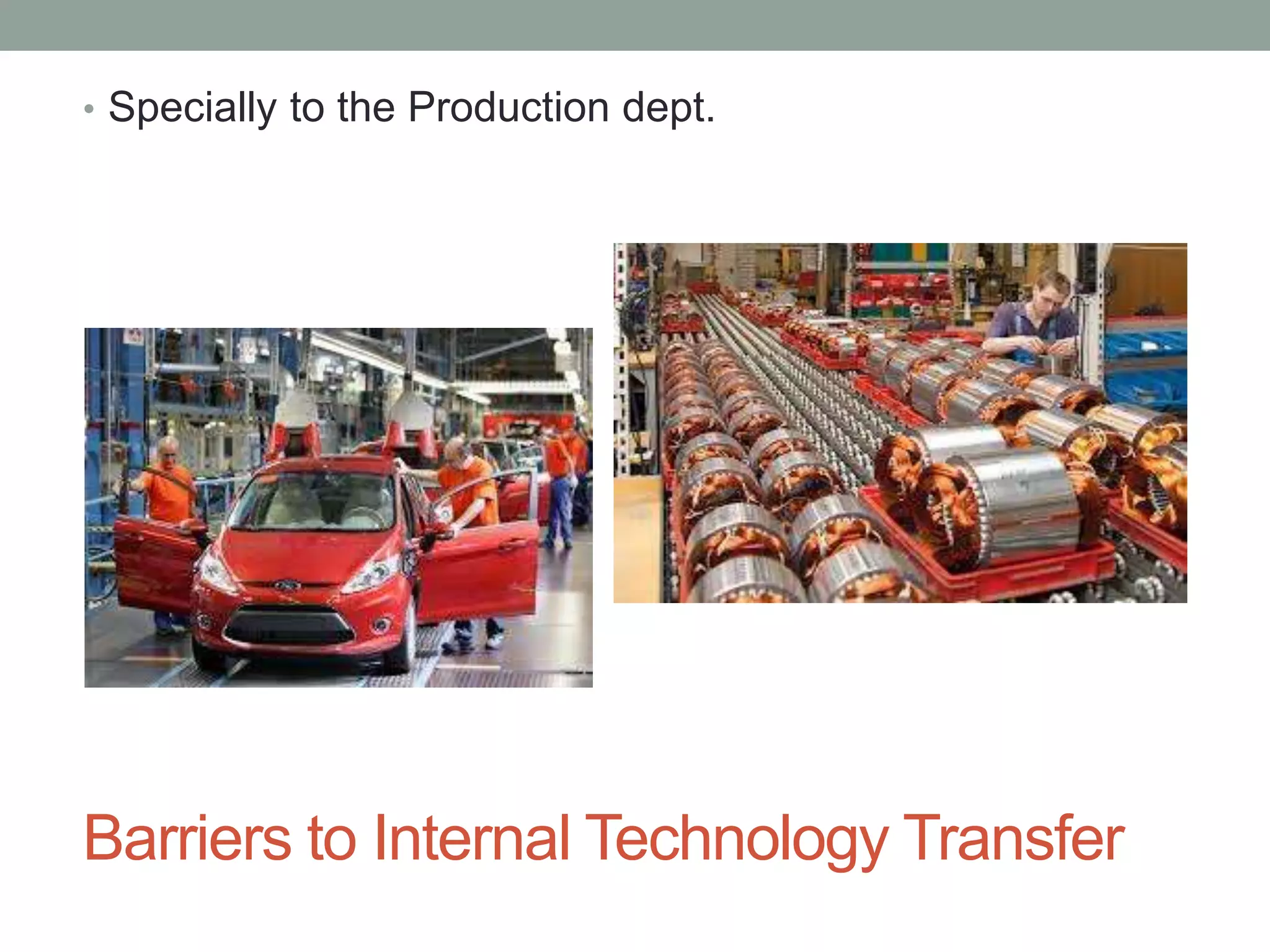
Barriers to Internal Technology Transfer
• Specially to the Production dept.
Overcoming the barriers
• Top management support
• Effective Communication
• Adaptability
External Technology Transfer
• Control on technical usage / Ownership, licensing
agreements
• Transfer mechanisms:
• Cooperative and collaborative ventures/ Strategic
Alliances.
• Licensing agreements
• Enterprise Acquisition
• Technical exchanges
• Cross-licensing Agreements
• Co-Production agreement between parties
• Marketing Agreement between parties
• Joint ventures with equity ownership
Factors/reason necessitating external
technology transfer
• Technology already developed saves time and effort
• Lack of risk taking ability for innovations
• Lack of internal resources(physical/human) for innovation.
• Need to keep up with competitors
• Need to keep up with the acceleration of technological
change.
Barriers to External Technology Transfer
 Associated cost
 Lack of mutual trust
 Risk of loss of control over technology
 Transferee may turn a potential competitor in future
 Different organization cultures may create difficult in
transfer.
 Lack of effective communication
Overcoming Barriers
• Proper and well defined agreement should be signed
• A proper assessment/evaluation of appropriateness of
technology
• Cross-cultural training may be helpful
Technology Absorption
• Using technology requires
• Information about the method
• Means of carrying out the method
• Some understanding of the method.
• Technology can be
• Acquired,
• Assimilated,
• Used,
• Adapted,
• Changed, or
• Created.
39
Technology Acquisition
Two terms technology transfer and technology Acquisition
are normally used interchangeably.
The verb “Acquire” means
• To come into possesion of; get as one’s own
• To gain for oneself through one’s actions or efforts
• Technology Acquisition is the process of acquiring a new
technology, new product, process or service ; by efforts of
an individual or an enterprise or any other macro entity.
This process can be conducted either internally or
externally to the enterprise.
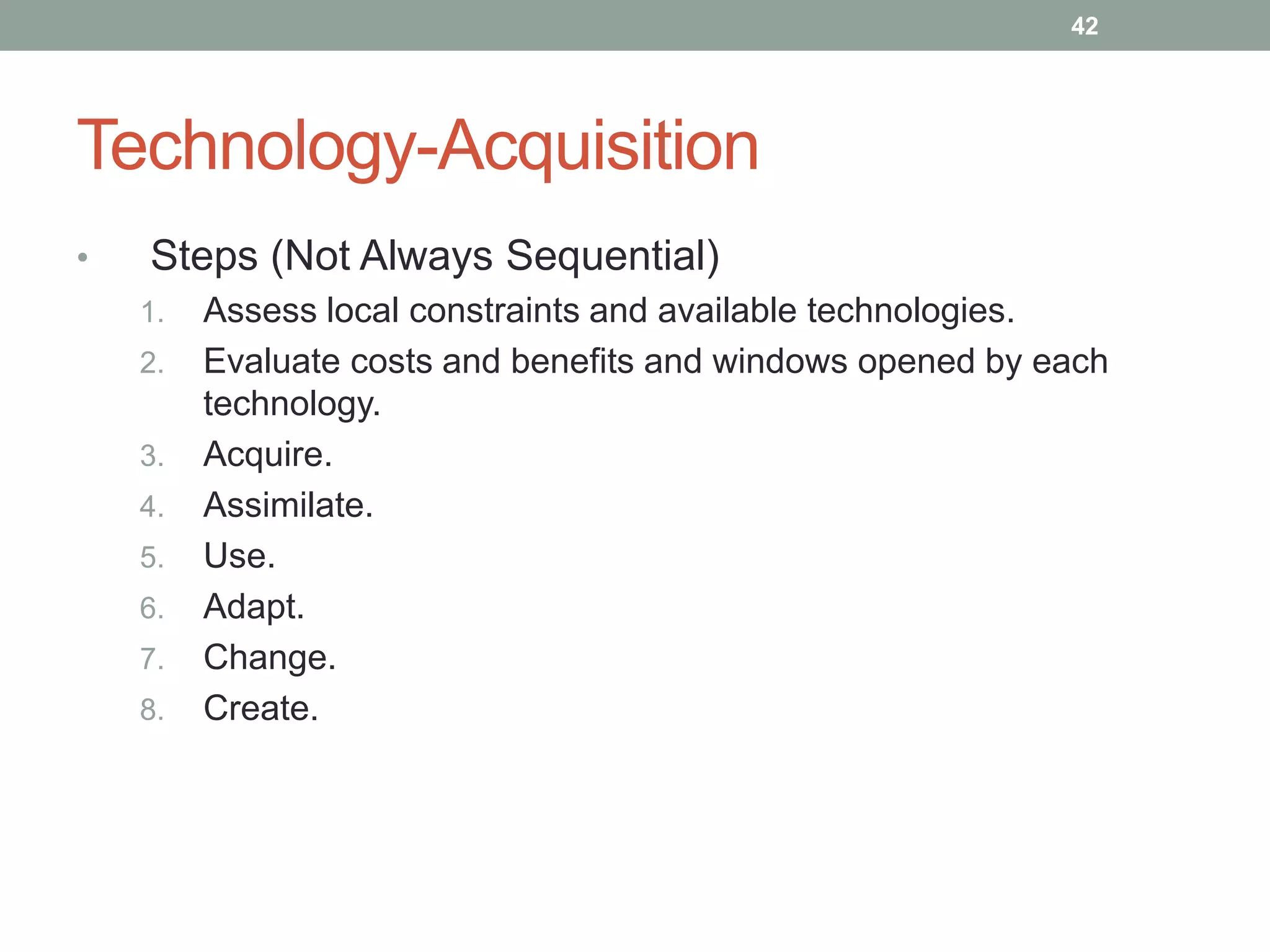
Technology-Acquisition
• Steps (Not Always Sequential)
1. Assess local constraints and available technologies.
2. Evaluate costs and benefits and windows opened by each
technology.
3. Acquire.
4. Assimilate.
5. Use.
6. Adapt.
7. Change.
8. Create.
42
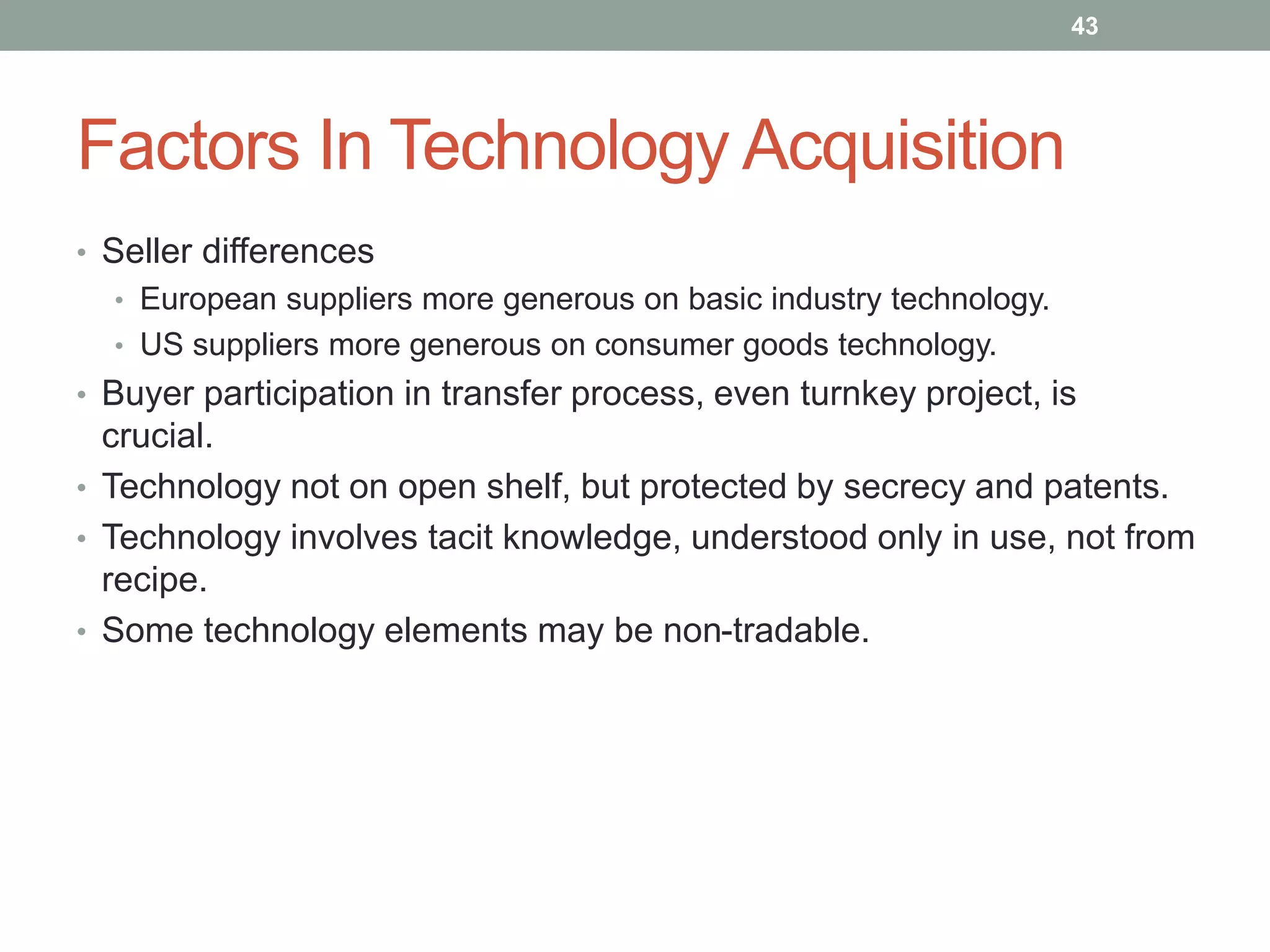
Factors In Technology Acquisition
• Seller differences
• European suppliers more generous on basic industry technology.
• US suppliers more generous on consumer goods technology.
• Buyer participation in transfer process, even turnkey project, is
crucial.
• Technology not on open shelf, but protected by secrecy and patents.
• Technology involves tacit knowledge, understood only in use, not from
recipe.
• Some technology elements may be non-tradable.
43
Lessons of Technology Acquisition
• Lengthy process, often 10 to 20 years.
• Mix of local and external inputs (purchase to fill gaps).
• Lumpiness of technology in multistage process.
• Challenge of adapting imported management techniques.
• Importance of local learning and adaptation
• Assessing local constraints
• Capacity stretching solutions
• Ability to scan world for need technology.
44
Key terms related to technology transfer
• Intellectual Property
Invention and patents
Trade secrets
Copyrights
Licensing
GI’s
IC’s
Internal Technology acquisition
• Seizing tacit knowledge, taking advantage of available in
house knowledge
• Promoting internal R&D.
Modes of Payment for Transfer
• Lump-sum payment or periodical installments
• Royalties as a percentage of sales over next few years
• Cross-licensing agreements
Methods for technology Acquisition by a
Nation
• Attracting MNCs
 Through direct measures viz. making a positive list of
industries open to FDI
 Through indirect measures viz by offering incentives
and subsidies.
 Attracting MNCs into natural resource processing and
including greater value addition
 Offering incentives to existing investors to increase R&D
base.
Joint Venture and WOS Abroad
Contractual Agreement
Specific Limited Purpose and Duration
Joint Property Interest
Common Financial and Intangible Goals and Objectives
Shared Profits, Losses, Management, and Control
Reasons for Forming a Joint Venture
• Risk Sharing
• Economies of Scale
• Market Access
• Geographical Constraints
• Funding Constraints
• Acquisition Barriers
TECHNOLOGY INTELLIGENCE
• The Centre for Technology Management has defined
'technology intelligence' as "the capture and delivery of
technological information as part of the process whereby
an organization develops an awareness of technological
threats and opportunities."
Absorption
• Acquisition,Development,Assimilation and utilization of
tech knowledge by a firm.
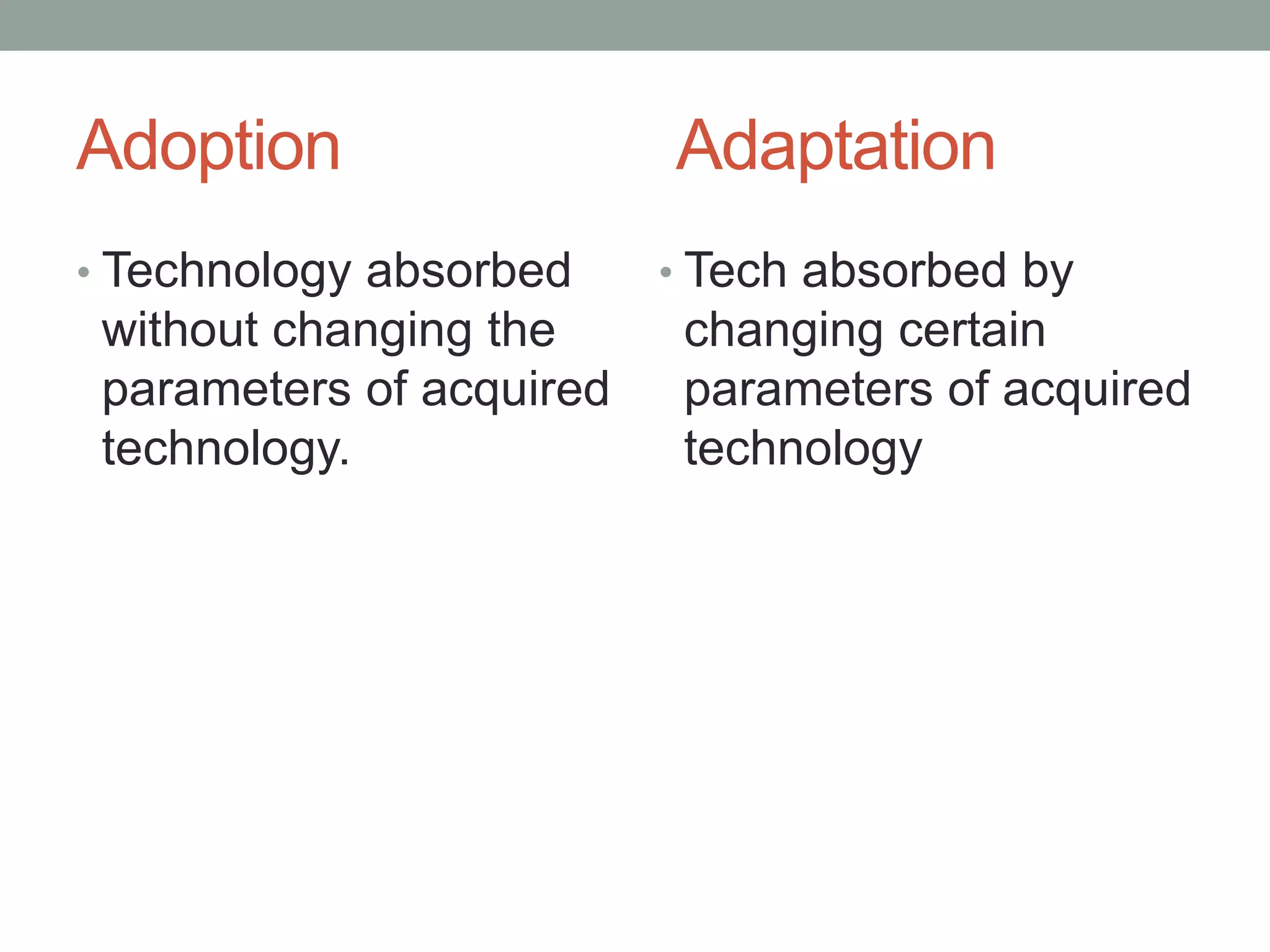
Adoption Adaptation
• Technology absorbed
without changing the
parameters of acquired
technology.
• Tech absorbed by
changing certain
parameters of acquired
technology
Diffusion
• Spreading out the application/usage of a new technology
and its related product, services and process

Technology management concept

  • 1.
  • 2.
    What is Technology? • “the application of scientific knowledge for practical purposes, especially in industry” – Oxford Dictionary • “Technology is the making, modification, usage, and knowledge of tools, machines, techniques… in order to solve a problem … achieve a goal … perform a specific function. • • “The purposeful application of information in the design, production, and utilization of goods and services, and in the organization of human activities.” – Business Dictionary
  • 3.
    Technology Management &Concept Integrated Planning, Design, Optimization, Operation and Control of technological products, processes and services,
  • 4.
    Types of technology •Generic, Basic, Key • Embodied and Disembodied • System and Infra • Hybrid and Emerging
  • 5.
    Technology Portfolio(Passenger car) •Steel Making • Metal Body forming • Electrical Engineering • Electronic Engineering • Rubber & Plastic • Paint • Metal Cutting & welding • Mechanical • Glass and etc.
  • 6.
    Technology Life Cycle Apredictable pattern followed by a technological innovation, from its inception and development to market saturation and replacement. 17-6
  • 8.
    The four phasesof the technology life- cycle • The research and development (R&D){Bleeding Edge} • The ascent phase {leading edge} • The maturity phase • The decline {decay phase}
  • 9.
    What is TechnologyLife Cycle? • Stage / Phase No Technological Stage / Phase Features I Technology Development Basic Technology II Technology Application Technology + Applications III Application Launch Technology + Applications + Product Launch IV Application Growth Technology + Applications + Rise in product sales V Technological Maturity Technology + Applications + Fall in product sales VI Degraded Technology Minimal Product sales + Loss of application + Alternative Technology
  • 11.
    Technology adoption lifecycle •innovators – had larger farms, were more educated, more prosperous and more risk-oriented • early adopters – younger, more educated, tended to be community leaders, less prosperous • early majority – more conservative but open to new ideas, active in community and influence to neighbors • late majority – older, less educated, fairly conservative and less socially active • laggards – very conservative, had small farms and capital, oldest and least educated
  • 12.
    Management of Technologyat National level(Objectives) • Developing Appropriate Technology Strategy • Technology forecasting • Appropriateness of new tech.(justification) • Sustainable technologies; Development of renewable technologies • Sustainable economic growth • Planning National Technology portfolio • Managing external Technology acquisitions • Managing Absorption • Managing Technology Diffusion
  • 13.
    MOT at enterpriselevel • Developing technology Strategy(Leader Vs. followers strategy) • Tech. forecasting • Managing Enterprise’s tech. portfolio • Technovation • Implementation of New Technology • Technology Absorption • Managing Technology Change(productivity and Quality of work life) • Technology advancement • Performance Measurement
  • 14.
    KRA’s at enterpriselevel • Tech Planning like declining technology strategy, Selecting appropriate techniques • R&D management • Innovation Management • SMOT
  • 15.
    SMOT Importance • Improvementin quality(high quality) • Minimum; LCC of Product Development • Increased in machine utilization rate by removing bottlenecks • Reduction in work process. • Flexibility in design and manufacturing options. • Earning through technology agreement transfer.
  • 16.
    Contd. • Increased abilityto enter in new markets quickly, faster introduction of new products. • Shortened delivery time for customer. • Monopoly and high prices for hi-tech products in the international market. • Reduction in overall cycle time
  • 17.
  • 18.
    Technology Creation • Creativityand Invention • Innovation • Senior management Commitment to technology creation and generation • Developing requisite and supportive corporate culture for promoting technology creation and generation.
  • 19.
    Technology Monitoring • Installingand developing IS to monitor trends and changes. • Competitive analysis to understand competitiveness provides by existing and prospective technologies. • Customer and supplier interfaces to understand market and technological Changes. • People Links,
  • 20.
    Technology Assessment • Understandingdirection of market in terms of technology • Integration of technology and business planning • Customer interfaces to assess the commercial feasibility of prospective technologies • Assessing contribution of technology projects to business strategy.
  • 21.
    Technology Transfer • Enteringstrategic alliances to develop or acquire potential technologies • Using product design teams for reaping benefits of planned technological change • Reducing functional barriers to technology transfer • Utilizing people links for successful technology transfer i.e. involving people across the organization.
  • 22.
    Technology acceptance • Supportiveorganizational design and structures • Supportive corporate culture • Senior management commitment • Assessment of impacts of technological changes on organization, enhancing benefits, reduction adverse effects, smoothing barriers/hurdles in the change.
  • 23.
    Technology Utilization • Effectiveproject management to seek maximum utilization. • Process tech. to support and facilitate maximum utilization. • Supportive marketing strategies, efforts and utilization feedback for improvement.
  • 24.
    Technology Maturity • Efficiencyvs effectiveness contributed by the current technologies in attaining organizational goals. • Market stability in terms of volumes/sales • Rise of substitutes in the marketplace • Start Declining market share • Loss of competitiveness in the marketplace.
  • 25.
    Technology Decline • Timeto find a sustainable innovation technologies.
  • 26.
    Technology Transfer • Technologytransfer is a process by which technology is disseminated. • It involves Communication of relevant knowledge by the transferor to the recipient. Types of Technology transfer:- Scientific Knowledge transfer Direct Technology Transfer Spin-Off Technology Transfer
  • 27.
    Scientific Knowledge Transfer •Transfer Trough basic Research and development activities.
  • 28.
    Direct Technology Transfer •Occurs through formal agreement • Enterprise Elements • Enterprise to Enterprise • Government to Enterprise • Government to Government
  • 29.
  • 30.
    Informal and FormalTechnology Transfer
  • 31.
    Informal Technology Transfer •The process involves few decisions to keep in mind:- (4W+1H) • Timing • Location • Multifunctional team • Communication Methods and procedure
  • 32.
    Barriers to InternalTechnology Transfer • Specially to the Production dept.
  • 33.
    Overcoming the barriers •Top management support • Effective Communication • Adaptability
  • 34.
    External Technology Transfer •Control on technical usage / Ownership, licensing agreements • Transfer mechanisms: • Cooperative and collaborative ventures/ Strategic Alliances. • Licensing agreements • Enterprise Acquisition
  • 35.
    • Technical exchanges •Cross-licensing Agreements • Co-Production agreement between parties • Marketing Agreement between parties • Joint ventures with equity ownership
  • 36.
    Factors/reason necessitating external technologytransfer • Technology already developed saves time and effort • Lack of risk taking ability for innovations • Lack of internal resources(physical/human) for innovation. • Need to keep up with competitors • Need to keep up with the acceleration of technological change.
  • 37.
    Barriers to ExternalTechnology Transfer  Associated cost  Lack of mutual trust  Risk of loss of control over technology  Transferee may turn a potential competitor in future  Different organization cultures may create difficult in transfer.  Lack of effective communication
  • 38.
    Overcoming Barriers • Properand well defined agreement should be signed • A proper assessment/evaluation of appropriateness of technology • Cross-cultural training may be helpful
  • 39.
    Technology Absorption • Usingtechnology requires • Information about the method • Means of carrying out the method • Some understanding of the method. • Technology can be • Acquired, • Assimilated, • Used, • Adapted, • Changed, or • Created. 39
  • 40.
    Technology Acquisition Two termstechnology transfer and technology Acquisition are normally used interchangeably. The verb “Acquire” means • To come into possesion of; get as one’s own • To gain for oneself through one’s actions or efforts
  • 41.
    • Technology Acquisitionis the process of acquiring a new technology, new product, process or service ; by efforts of an individual or an enterprise or any other macro entity. This process can be conducted either internally or externally to the enterprise.
  • 42.
    Technology-Acquisition • Steps (NotAlways Sequential) 1. Assess local constraints and available technologies. 2. Evaluate costs and benefits and windows opened by each technology. 3. Acquire. 4. Assimilate. 5. Use. 6. Adapt. 7. Change. 8. Create. 42
  • 43.
    Factors In TechnologyAcquisition • Seller differences • European suppliers more generous on basic industry technology. • US suppliers more generous on consumer goods technology. • Buyer participation in transfer process, even turnkey project, is crucial. • Technology not on open shelf, but protected by secrecy and patents. • Technology involves tacit knowledge, understood only in use, not from recipe. • Some technology elements may be non-tradable. 43
  • 44.
    Lessons of TechnologyAcquisition • Lengthy process, often 10 to 20 years. • Mix of local and external inputs (purchase to fill gaps). • Lumpiness of technology in multistage process. • Challenge of adapting imported management techniques. • Importance of local learning and adaptation • Assessing local constraints • Capacity stretching solutions • Ability to scan world for need technology. 44
  • 45.
    Key terms relatedto technology transfer • Intellectual Property Invention and patents Trade secrets Copyrights Licensing GI’s IC’s
  • 46.
    Internal Technology acquisition •Seizing tacit knowledge, taking advantage of available in house knowledge • Promoting internal R&D.
  • 47.
    Modes of Paymentfor Transfer • Lump-sum payment or periodical installments • Royalties as a percentage of sales over next few years • Cross-licensing agreements
  • 48.
    Methods for technologyAcquisition by a Nation • Attracting MNCs  Through direct measures viz. making a positive list of industries open to FDI  Through indirect measures viz by offering incentives and subsidies.  Attracting MNCs into natural resource processing and including greater value addition  Offering incentives to existing investors to increase R&D base.
  • 49.
    Joint Venture andWOS Abroad Contractual Agreement Specific Limited Purpose and Duration Joint Property Interest Common Financial and Intangible Goals and Objectives Shared Profits, Losses, Management, and Control
  • 50.
    Reasons for Forminga Joint Venture • Risk Sharing • Economies of Scale • Market Access • Geographical Constraints • Funding Constraints • Acquisition Barriers
  • 51.
    TECHNOLOGY INTELLIGENCE • TheCentre for Technology Management has defined 'technology intelligence' as "the capture and delivery of technological information as part of the process whereby an organization develops an awareness of technological threats and opportunities."
  • 52.
    Absorption • Acquisition,Development,Assimilation andutilization of tech knowledge by a firm.
  • 53.
    Adoption Adaptation • Technologyabsorbed without changing the parameters of acquired technology. • Tech absorbed by changing certain parameters of acquired technology
  • 54.
    Diffusion • Spreading outthe application/usage of a new technology and its related product, services and process