Technology Life Cycle
Mr. Roshan Bhattarai
Kathmandu, Nepal
Technology Life Cycle
• The Technology Life Cycle can be defined as
– how the technology affects the business processes and
how it impacts the entire life cycle of the product
offerings of the company
• The phases that get impacted are:
– Research and development,
– growth,
– maturity, and
– decline
2
Breaking Down the Technology Life Cycle
• Life cycle of product deals with the performance of the
product at the marketplace, whereas
• Life cycle of the technology focuses on the various stages of
the technology in the development of the product and
utilization of technology in the business processes
• The lifespan of the technologies depends on the nature of
the products and the business processes
• Technologies such as steel, cement manufacturing or paper
have larger lifespan whereas technologies of electronic
appliances or pharmaceuticals have relatively shorter
3
• TLC is mainly concerned with the time and cost of
developing the innovative style of technology
– that gives a new edge to the business with the factor
of competitive advantage
• development of a competitive product can have a major
impact on the entire lifecycle of the technology making it
larger/longer
• the loss of intellectual property rights through leakages,
loss of secret elements or litigation (court case) can make
the TLC shorter
• The TLC may, further, be protected during its cycle
with patents seeking to lengthen the cycle and to
maximize the profit from it
4
• Thus, it is apparent that the management of the TLC is an
important aspect of technology development
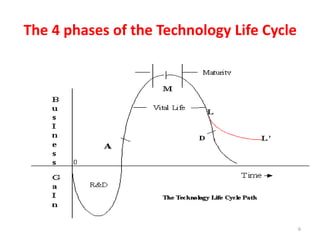
• Shape of the TLC is often referred to as the “S curved
shape”
• Many of the famous and renowned companies develop
the technology for their own benefit and growth of the
corporation rather than licensing it
5
The 4 phases of the Technology Life Cycle
6
1. Research and Development Phase/ Innovation Stage
• bleeding edge as income from the input being put in
making the technology are negative in nature
• chances of failure of technology is quite high
• the money for developing the technology is poured
from your own pocket
• important to take the feedback on the technology
developed from the industry experts
• also important to tweak it to match as per the industry
standards and to give it an edge of innovation and
novelty
7
2. Ascent Phase/ Commercialization Stage
• leading edge as the company starts to recover the costs
and expenses that have been incurred and
• plus the technology developed begins to gather strength
• goes beyond the initial point of development to get
accepted in the market
• company creates all the hype and promotion of the
innovation and
• newness of the technology grabs the attention
8
3. Maturity Phase/Diffusion Stage
• arrives when the gains from the technology are high and
stable, technology developed is well accepted by the public
• as the competitors are well aware of the technology
developed, the market has reached the point of saturation
• revenues start to get slow down as the technology
developed starts to become yet another commodity in the
market
• important to make the incremental and innovative changes
in the technology considering the changing dynamics of
the markets and the evolving tastes of the customers
9
4. Decline Phase/Substitution Stage
• decline phase is inevitable in nature
• when the companies witness gradual decrease in sales of
its products, there is an emergence of the
new/replacement of the technology
• companies reach the point where there are no returns at
all and further developments are not profitable at all
• best possible step is to move out of the current technology
and plant its resources on the new project that is sure to
yield more profits
10
• After reaching a point such as D in the above diagram,
the earnings from the technology begin to decline rather
rapidly
• To prolong the life cycle,
– owners of technology might try to license it out at some point L
when it can still be attractive to firms in other markets
• This, then, traces the lengthening path, LL'
11
• In the early 2000’s the mobile brand Nokia was one of the best
of the crops
• was much loved and adored by its loyal customers
• The Symbian technology used in its mobile phones was an
instant hit with the customers
• the brand was the market leader for a very long time until the
inception of ios and Android technologies by Apple and Google
• that were high on the levels of revolutionary ideation and
innovation leading to the decline stage of Nokia and its
technologies
12

Technology Life Cycle

  • 1.
    Technology Life Cycle Mr.Roshan Bhattarai Kathmandu, Nepal
  • 2.
    Technology Life Cycle •The Technology Life Cycle can be defined as – how the technology affects the business processes and how it impacts the entire life cycle of the product offerings of the company • The phases that get impacted are: – Research and development, – growth, – maturity, and – decline 2
  • 3.
    Breaking Down theTechnology Life Cycle • Life cycle of product deals with the performance of the product at the marketplace, whereas • Life cycle of the technology focuses on the various stages of the technology in the development of the product and utilization of technology in the business processes • The lifespan of the technologies depends on the nature of the products and the business processes • Technologies such as steel, cement manufacturing or paper have larger lifespan whereas technologies of electronic appliances or pharmaceuticals have relatively shorter 3
  • 4.
    • TLC ismainly concerned with the time and cost of developing the innovative style of technology – that gives a new edge to the business with the factor of competitive advantage • development of a competitive product can have a major impact on the entire lifecycle of the technology making it larger/longer • the loss of intellectual property rights through leakages, loss of secret elements or litigation (court case) can make the TLC shorter • The TLC may, further, be protected during its cycle with patents seeking to lengthen the cycle and to maximize the profit from it 4
  • 5.
    • Thus, itis apparent that the management of the TLC is an important aspect of technology development • Shape of the TLC is often referred to as the “S curved shape” • Many of the famous and renowned companies develop the technology for their own benefit and growth of the corporation rather than licensing it 5
  • 6.
    The 4 phasesof the Technology Life Cycle 6
  • 7.
    1. Research andDevelopment Phase/ Innovation Stage • bleeding edge as income from the input being put in making the technology are negative in nature • chances of failure of technology is quite high • the money for developing the technology is poured from your own pocket • important to take the feedback on the technology developed from the industry experts • also important to tweak it to match as per the industry standards and to give it an edge of innovation and novelty 7
  • 8.
    2. Ascent Phase/Commercialization Stage • leading edge as the company starts to recover the costs and expenses that have been incurred and • plus the technology developed begins to gather strength • goes beyond the initial point of development to get accepted in the market • company creates all the hype and promotion of the innovation and • newness of the technology grabs the attention 8
  • 9.
    3. Maturity Phase/DiffusionStage • arrives when the gains from the technology are high and stable, technology developed is well accepted by the public • as the competitors are well aware of the technology developed, the market has reached the point of saturation • revenues start to get slow down as the technology developed starts to become yet another commodity in the market • important to make the incremental and innovative changes in the technology considering the changing dynamics of the markets and the evolving tastes of the customers 9
  • 10.
    4. Decline Phase/SubstitutionStage • decline phase is inevitable in nature • when the companies witness gradual decrease in sales of its products, there is an emergence of the new/replacement of the technology • companies reach the point where there are no returns at all and further developments are not profitable at all • best possible step is to move out of the current technology and plant its resources on the new project that is sure to yield more profits 10
  • 11.
    • After reachinga point such as D in the above diagram, the earnings from the technology begin to decline rather rapidly • To prolong the life cycle, – owners of technology might try to license it out at some point L when it can still be attractive to firms in other markets • This, then, traces the lengthening path, LL' 11
  • 12.
    • In theearly 2000’s the mobile brand Nokia was one of the best of the crops • was much loved and adored by its loyal customers • The Symbian technology used in its mobile phones was an instant hit with the customers • the brand was the market leader for a very long time until the inception of ios and Android technologies by Apple and Google • that were high on the levels of revolutionary ideation and innovation leading to the decline stage of Nokia and its technologies 12