INTERNATIONAL
TECHNOLOGY
TRANSFER
Technology Transfer is a process that permits flow of technology
from a source to a receiver. The source is the owner or holder
of knowledge while the recipient is the beneficiary of such
knowledge.
The movement of scientific methods of production or distribution
from one enterprise, institution or country to another, as through
foreign investment, international trade, licensing of patents
rights, technical assistance or training. The process to
commercially exploit research varies widely.
INTRODUCTION
Start up
Firms
R & D
Firms
Universiti
es
Research
Institutes
Research
Development
Production
Manufacturin
g
Distributio
n
Large
Companies
Market
Ide
a
Varied roots
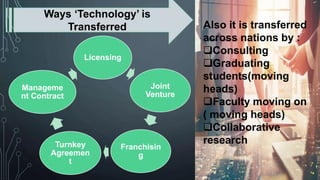
Licensing
Joint
Venture
Franchisin
g
Turnkey
Agreemen
t
Manageme
nt Contract
Ways ‘Technology’ is
Transferred Also it is transferred
across nations by :
Consulting
Graduating
students(moving
heads)
Faculty moving on
( moving heads)
Collaborative
research
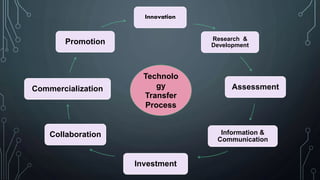
Innovation
Research &
Development
Assessment
Information &
Communication
Investment
Collaboration
Commercialization
Promotion
Technolo
gy
Transfer
Process
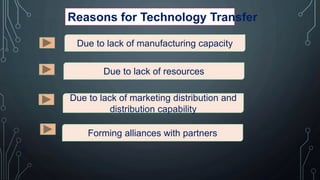
Due to lack of manufacturing capacity
Due to lack of resources
Due to lack of marketing distribution and
distribution capability
Forming alliances with partners
Reasons for Technology Transfer
Asia Pacific
Centre for
Transfer of
Technology
(APCTT)
Technology
Bureau for
small
enterprises
(TBSE)
National
Research
and
Developme
nt
Corporatio
n
Foundation
for
Innovation
and
Technology
Transfer
List of Institutes in India assisting in
Technology Transfer
International
Technology Transfer
Agreement
IMPORTANCE OF TECHNOLOGICAL
TRANSFER
• Technology transfer helps develop early stage intellectual
property into tools for direct use by the research community,
or into bases for new platforms, products, or services to be
made into products for public use.
EXAMPLE
THE CASE OF GEELY AND VOLVO CARS
• Chinese automobile industry policy of making JVs with 50% shares.
• In order to stay competitive in Chinese market, Volvo Cars has to produce
cars in China.
• Volvo’s decision of being going opposite way cause most of Western
companies keep their cone technologies in headquarters.
• Volvo want the way to transfer should be transfer to JV company directly by
being in very controlled in intellectual property (IP).
BY:
Aayushi Gupta
Aditi Mantri
Shubhi Chauhan
Soumya Vyas

International technology transfer