 Technology Management (MOT) is concerned with
development, planning, implementation & assessment of
technological capabilities to shape and accomplish the
strategic & operational objectives of an organization or
central planning goals and priorities of a nation.
 Technology Management can also be defined as the
integrated planning, design, optimization, operation and
control of technological products, processes and services, a
better definition would be the management of the use of
technology for human advantage
 Technology Management is set of management disciplines
that allows organizations to manage its technological
fundamentals to create competitive advantage.
 The Association of Technology, Management, and Applied
Engineering defines Technology Management as the field
concerned with the supervision of personnel across the
technical spectrum and a wide variety of complex
technological systems. Technology Management programs
typically include instruction in production and operations
management, project management, computer applications,
quality control, safety and health issues, statistics, and
general management principles.
 Typical concepts used in technology management are
technology strategy ,technology forecasting , technology
road-mapping (mapping technologies to business and
market needs), technology project portfolio ( a set of
projects under development) and technology portfolio (a set
of technologies in use).
 Effective use of IT provides a competitive edge.
 IT is a means, not an end.
 People are the most important resources.
 Most projects fail due to poor management.
 Innovation refers to new products, new
processes, new managerial approaches, and
combinations of the above.
 An important aspect of innovation is “Adoption
and implementation of IT.”
 Resource availability and allocation
 Ability to understand competitors’ innovative
strategies
 The business’ technological environment
 Structure and cultural context
 Strategic management capacity in dealing with
entrepreneurial behavior
 Business focus
 Adaptability
 Organizational cohesion
 Entrepreneurial culture
 A sense of integrity
 Hands-on top management
 Discovery of a new idea or product
 Emergence of the proposed idea or design concept
 Verification of the theory or design
 Demonstration of a prototype
 Trail and evaluation
 Commercial introduction or initial operation of the
innovation
 Innovation adoption
 Innovation proliferation
Technology Management (MOT) is mainly carried out at two levels:
 At National Level
 At Enterprise Level
 a. Technology Management (MOT) At National Level ---
main obejective of is to assure that the nation and its
business firms gain sustainable technological
compeitiveness in the international markets and maintain
strong position in the international business on long-term
basis.
a. At national level, the domain of technology management
includes the following areas:
 Developing approprate technology strategy for the nation
(e.g. internalisation vs externalisation strategy of the
nation)
 Technology forecasting (i.e. forecasting the technological
changes)
 Justification / appropriateness of new technology
(including justification for technology adoption )
 Sustainable technologies; development of renewable
energy technologies
 Sustainable economic growth
 Planning national technology portfolio
a. Contd …
 Knowledge mangement (i.e. creation, deployment and
protection of national technological knowledge base)
 Managing external technology acquisitions viz
guidelines for foreign technology collaborations
 Managing technology absorption
 Managing technology diffusion
 Performance measurement of new technology
 Technology and environment management (Green
accounting, Environment Protection Act, 1986 etc)
 Technolgy and health & societal management
 b. Technology Management (MOT) At Enterprise Level ----
main obejective is to assure that the firm gains &
maintains a srong position in its core technologies which
are relevant to its product-market relationship and that
these technologies support the firm’s competitive
strategies.
 b. Overview of Technology Management (MOT) At
Enterprise Level ----
 b. Evolution of Technology Management (MOT) At
Enterprise Level ----
b. At enterprise level, MOT includes following areas:
 Developing technology strategy (e.g. leader versus
follower strategy)
 Technology forecasting
 Managing enterprise’s technology portfoio
 Technovation (technology innovation)
 Knowledge management (e.g. creation, deployment,
transfer and protection of firm specific technological
knowledge viz through patent etc)
 Implementation of new technology (including its
integration with the existing structure, systems and
workforce)
b. Contd…
 Technology transfer (inculding problems & management
issues), Technology absorption (inculding problems &
management issues)
 Managing technology change (including organizational
issues viz productivity and quality of work life)
 Integration of engineering (R&D) and management (of
new project) leading to successful implementation /
commercialization
 Integration of product and process technology ( for
delivering the objects)
c. contd…
 Technology advancement (e.g. learning and process
improvement)
 Managing technology at the boundary / border of the firm
(e.g. collaboration and coordination with supply chain
partners and customers) and Technology diffusion (from
firm to suppliers and customers)
 Performance measurement of new technology (e.g.
technlogy assessment, technology audit and feedback)
 Technology and environmental sustainability (e.g.
environmental impact assessment, environmental
audit, discharge of environmental
responsibility, green marketing etc)
The key tasks of MOT at enterprise level may be summed up
as below:
 Technology Planning like deciding technology strategy,
selecting appropriate technologies etc.
 R&D Management
 Innovation Management
 Strategic Management of Technology (SMOT)
 Strategic Management of Technology (SMOT) means that
the product, service or process technologies of an
organization / enterprise are managed from a long range
prespective, as these technologies have wide-ranging
effects on all levels and functions in the organization.
 Importance / benefits of SMOT
???
 Strategic Technology Management System (STMS) calls
for adopting systems approach in the organization on long
term basis i.e. STMS emphasizes systematic management
of technology on long term basis as the technology moves
along its life cycle from birth to decline.
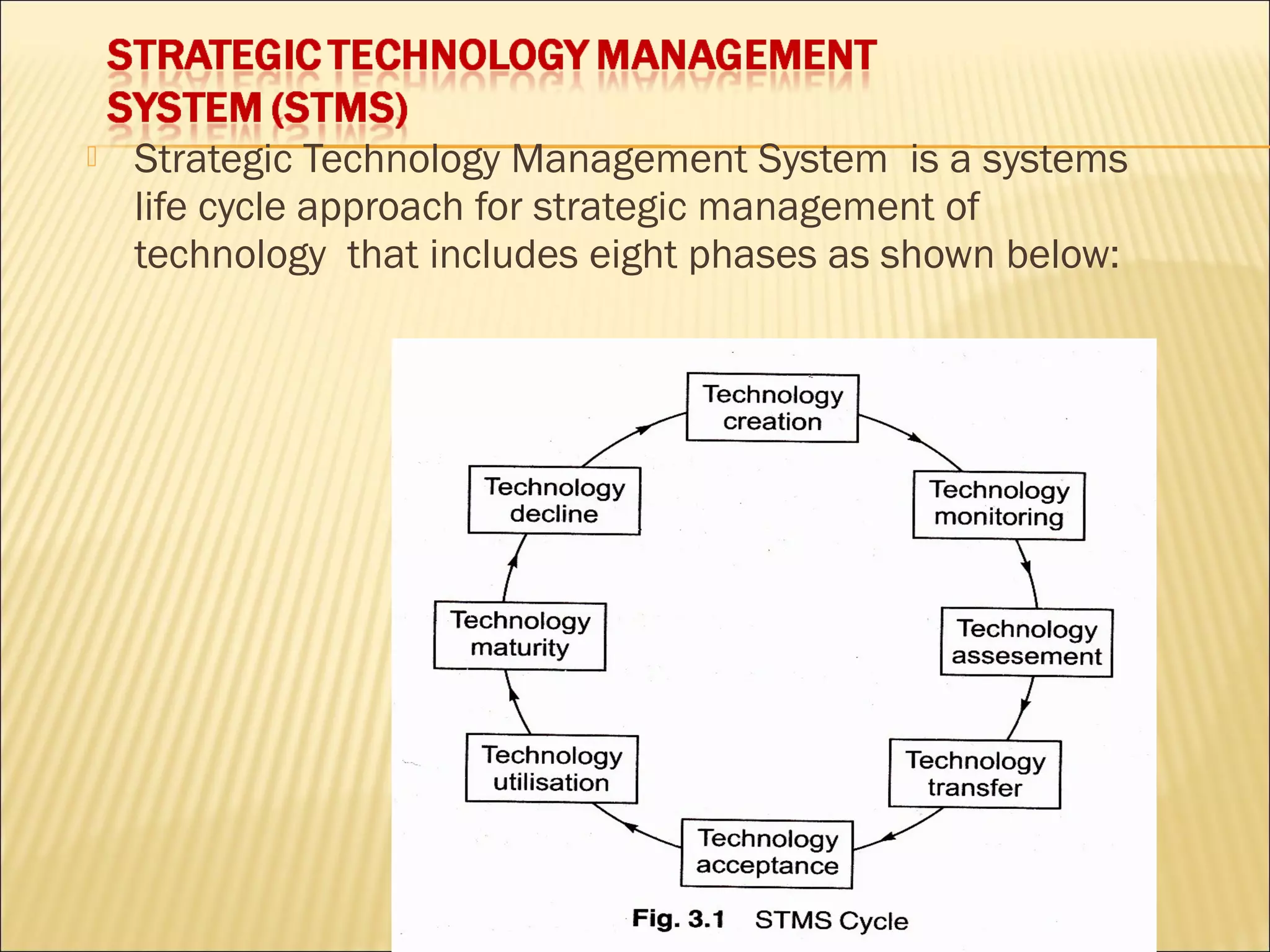
 Strategic Technology Management System is a systems
life cycle approach for strategic management of
technology that includes eight phases as shown below:
I. Technology Creation
This phase involves creation & generation of new
technologies. This phase involves following activities :
 Creativity & Invention
 Innovation
 Senior management commitment to technology creation
and generation
 Developing requisite & supportive corporate culture for
promoting technology creation and generation
II. Technology Monitoring
This phase calls for monitoring technology trends and changes
before implementing new technology. It involves following
activities :
 Installing & developing information systems for monitoring
technological trends and changes
 Competitive analysis to understand competitiveness provided
by existing and prospective technologies
 Customer & supplier interfaces to understand market and
technological changes
 People links (viz. internal staff, research bodies etc) to
understand market trends and technological changes
III. Technology Assessment
This phase involves following activities :
 Understanding directions of markets in terms of
technology
 Integration of technology & business planning
 Customer interfaces to assess the commercial feasibilty
of prospective technologies
 Assessing contributions of technology projects to business
strategy
IV. Technology Transfer
This phase leads to transfer of technology from external
source to own Research and Development (R&D); and
internally from R&D to production. This phase involves
following activities :
 Entering strategic alliances to develop or acquire
potential technologies
 Using product design teams for reaping benefits of
planned technological change
 Reducing functional barriers to technology transfer
 Utilizing people links for successful technology transfer
i.e. involving people across the organization
V. Technology Acceptance
This phase calls for acceptance of technology as a beneficial
change and involves following activities :
 Supportive organizational design & structures
 Supportive corporate culture
 Senior management commitment
 Asessment of impacts of technological change on
orgnanization, enhancing benefits, reducing adverse
effects, smoothening barriers / hurdles in the change
VI. Technology Utilization
This phase involves following activities :
 Effective project management for seeking maximum
utilization
 Process technologies to support and facilitate maximum
utilization
 Supportive marketing starategies, efforts and utilizing
feedback for improvement
This phase leads to technology growth as reflected by
incease in sales.
VII. Technology Maturity
This phase involves analyzing maturity of existing technology
and its related products / services / processes through
study of following indicators:
 Efficiency vs. effectiveness contributed by the current
technologies in attaining organizational goals
 Market stability in terms of volumes / sales
 Rise of substitutes in the marketplace
 Diminished returns on investment
 Decline of market share
 Loss of competitiveness in the marketplace
VIII. Technology Decline
 This is the last phase. During this phase a technology and
its related products / services / proceses/ applications
show substantial / sharp decline in usage / applications /
sales. Technology and its associated products or services
become ordinary commodity. Technology degrades and
becomes obsolete.
 This phase calls for movement to new technological
opportunities.
 Thereafter the cycle re-starts by the creation of a new
technlogy / movement towards a new technology. All the
above steps are repeated .
 Advanced technology can create an abrupt
change in businesses.
 New technology requires (Beatty 1992)
 A skilled champion
 A plan for systems integration
 Organizational integration
 Failure of a champion
 Lack of systems integration
 Incompatible systems
 Lack of a cross-functional team
 Requirements of international facility location
and technology transfer (Woodward & Liu 1993).
 Technology will be useful only when it is used.
 More emphasis needs to be placed on
adoption, adaptation, and exploitation of
technology
 Protecting existing technology rather than promptly
embracing new technology becomes a “dead end”
strategy (Ali & Zahra 1994).
 Customer involvement leads to success.
 Managers today must understand
 Impact of IT on the strategic and organizational changes
 New role of IT in integrating different business functions in
systems design
 Similar to tangible assets, technology can be
bought, sold, or lease
 Intellectual property rights can also be bought
and sold, or licensed for a limited time, to
another party
 Flexible systems and computer integrated
manufacturing (CIM) are used in manufacturing.
 It is not clear whether or not there is a direct link
between flexibility and increased performance.
 Other factors such as organizational structure, culture,
and management processes can influence the
outcome.
Evolution of R&D Management
 1950-1975: TF is tactical, isolated, and not a
pervasive part of strategic planning.
 1975-1990: TF is a data-gathering and
environmental scanning exercise, still an
isolated subtask of strategic planning.
 1990-present: TF is an integral part of strategic
planning and business intelligence.
 It is true that people’s abilities haven’t changed much while
technology (esp. IT) has changed dramatically Harrison & Samson
(2002). However, people’s behavior has changed significantly,
which the authors fail to emphasize. Thus, the way we
manage people must be changed as well.
 Although Harrison & Samson (2002) argue “technological resources
are becoming more important than human resources in
determining competitive outcomes” (p. 15), I disagree as
we’ve seen so many IS project failures due to lack of skilled
people and poor management. Research in the past few
years has begun to call for more studies done on the human
factor because it has been ignored for too long.
 Checking the sampling process
 Preparation of questionnaire
 Pilot survey
 Fix procedures
 Use of competent manpower
 Provide information
 Provide training
 Use of experts
 Checking data processing and analysis

Technology management

  • 2.
     Technology Management(MOT) is concerned with development, planning, implementation & assessment of technological capabilities to shape and accomplish the strategic & operational objectives of an organization or central planning goals and priorities of a nation.  Technology Management can also be defined as the integrated planning, design, optimization, operation and control of technological products, processes and services, a better definition would be the management of the use of technology for human advantage  Technology Management is set of management disciplines that allows organizations to manage its technological fundamentals to create competitive advantage.
  • 3.
     The Associationof Technology, Management, and Applied Engineering defines Technology Management as the field concerned with the supervision of personnel across the technical spectrum and a wide variety of complex technological systems. Technology Management programs typically include instruction in production and operations management, project management, computer applications, quality control, safety and health issues, statistics, and general management principles.  Typical concepts used in technology management are technology strategy ,technology forecasting , technology road-mapping (mapping technologies to business and market needs), technology project portfolio ( a set of projects under development) and technology portfolio (a set of technologies in use).
  • 4.
     Effective useof IT provides a competitive edge.  IT is a means, not an end.  People are the most important resources.  Most projects fail due to poor management.
  • 5.
     Innovation refersto new products, new processes, new managerial approaches, and combinations of the above.  An important aspect of innovation is “Adoption and implementation of IT.”
  • 6.
     Resource availabilityand allocation  Ability to understand competitors’ innovative strategies  The business’ technological environment  Structure and cultural context  Strategic management capacity in dealing with entrepreneurial behavior
  • 7.
     Business focus Adaptability  Organizational cohesion  Entrepreneurial culture  A sense of integrity  Hands-on top management
  • 8.
     Discovery ofa new idea or product  Emergence of the proposed idea or design concept  Verification of the theory or design  Demonstration of a prototype  Trail and evaluation  Commercial introduction or initial operation of the innovation  Innovation adoption  Innovation proliferation
  • 9.
    Technology Management (MOT)is mainly carried out at two levels:  At National Level  At Enterprise Level
  • 10.
     a. TechnologyManagement (MOT) At National Level --- main obejective of is to assure that the nation and its business firms gain sustainable technological compeitiveness in the international markets and maintain strong position in the international business on long-term basis.
  • 11.
    a. At nationallevel, the domain of technology management includes the following areas:  Developing approprate technology strategy for the nation (e.g. internalisation vs externalisation strategy of the nation)  Technology forecasting (i.e. forecasting the technological changes)  Justification / appropriateness of new technology (including justification for technology adoption )  Sustainable technologies; development of renewable energy technologies  Sustainable economic growth  Planning national technology portfolio
  • 12.
    a. Contd … Knowledge mangement (i.e. creation, deployment and protection of national technological knowledge base)  Managing external technology acquisitions viz guidelines for foreign technology collaborations  Managing technology absorption  Managing technology diffusion  Performance measurement of new technology  Technology and environment management (Green accounting, Environment Protection Act, 1986 etc)  Technolgy and health & societal management
  • 13.
     b. TechnologyManagement (MOT) At Enterprise Level ---- main obejective is to assure that the firm gains & maintains a srong position in its core technologies which are relevant to its product-market relationship and that these technologies support the firm’s competitive strategies.
  • 14.
     b. Overviewof Technology Management (MOT) At Enterprise Level ----
  • 15.
     b. Evolutionof Technology Management (MOT) At Enterprise Level ----
  • 16.
    b. At enterpriselevel, MOT includes following areas:  Developing technology strategy (e.g. leader versus follower strategy)  Technology forecasting  Managing enterprise’s technology portfoio  Technovation (technology innovation)  Knowledge management (e.g. creation, deployment, transfer and protection of firm specific technological knowledge viz through patent etc)  Implementation of new technology (including its integration with the existing structure, systems and workforce)
  • 17.
    b. Contd…  Technologytransfer (inculding problems & management issues), Technology absorption (inculding problems & management issues)  Managing technology change (including organizational issues viz productivity and quality of work life)  Integration of engineering (R&D) and management (of new project) leading to successful implementation / commercialization  Integration of product and process technology ( for delivering the objects)
  • 18.
    c. contd…  Technologyadvancement (e.g. learning and process improvement)  Managing technology at the boundary / border of the firm (e.g. collaboration and coordination with supply chain partners and customers) and Technology diffusion (from firm to suppliers and customers)  Performance measurement of new technology (e.g. technlogy assessment, technology audit and feedback)  Technology and environmental sustainability (e.g. environmental impact assessment, environmental audit, discharge of environmental responsibility, green marketing etc)
  • 19.
    The key tasksof MOT at enterprise level may be summed up as below:  Technology Planning like deciding technology strategy, selecting appropriate technologies etc.  R&D Management  Innovation Management  Strategic Management of Technology (SMOT)
  • 20.
     Strategic Managementof Technology (SMOT) means that the product, service or process technologies of an organization / enterprise are managed from a long range prespective, as these technologies have wide-ranging effects on all levels and functions in the organization.  Importance / benefits of SMOT ???
  • 21.
     Strategic TechnologyManagement System (STMS) calls for adopting systems approach in the organization on long term basis i.e. STMS emphasizes systematic management of technology on long term basis as the technology moves along its life cycle from birth to decline.
  • 22.
     Strategic TechnologyManagement System is a systems life cycle approach for strategic management of technology that includes eight phases as shown below:
  • 23.
    I. Technology Creation Thisphase involves creation & generation of new technologies. This phase involves following activities :  Creativity & Invention  Innovation  Senior management commitment to technology creation and generation  Developing requisite & supportive corporate culture for promoting technology creation and generation
  • 24.
    II. Technology Monitoring Thisphase calls for monitoring technology trends and changes before implementing new technology. It involves following activities :  Installing & developing information systems for monitoring technological trends and changes  Competitive analysis to understand competitiveness provided by existing and prospective technologies  Customer & supplier interfaces to understand market and technological changes  People links (viz. internal staff, research bodies etc) to understand market trends and technological changes
  • 25.
    III. Technology Assessment Thisphase involves following activities :  Understanding directions of markets in terms of technology  Integration of technology & business planning  Customer interfaces to assess the commercial feasibilty of prospective technologies  Assessing contributions of technology projects to business strategy
  • 26.
    IV. Technology Transfer Thisphase leads to transfer of technology from external source to own Research and Development (R&D); and internally from R&D to production. This phase involves following activities :  Entering strategic alliances to develop or acquire potential technologies  Using product design teams for reaping benefits of planned technological change  Reducing functional barriers to technology transfer  Utilizing people links for successful technology transfer i.e. involving people across the organization
  • 27.
    V. Technology Acceptance Thisphase calls for acceptance of technology as a beneficial change and involves following activities :  Supportive organizational design & structures  Supportive corporate culture  Senior management commitment  Asessment of impacts of technological change on orgnanization, enhancing benefits, reducing adverse effects, smoothening barriers / hurdles in the change
  • 28.
    VI. Technology Utilization Thisphase involves following activities :  Effective project management for seeking maximum utilization  Process technologies to support and facilitate maximum utilization  Supportive marketing starategies, efforts and utilizing feedback for improvement This phase leads to technology growth as reflected by incease in sales.
  • 29.
    VII. Technology Maturity Thisphase involves analyzing maturity of existing technology and its related products / services / processes through study of following indicators:  Efficiency vs. effectiveness contributed by the current technologies in attaining organizational goals  Market stability in terms of volumes / sales  Rise of substitutes in the marketplace  Diminished returns on investment  Decline of market share  Loss of competitiveness in the marketplace
  • 30.
    VIII. Technology Decline This is the last phase. During this phase a technology and its related products / services / proceses/ applications show substantial / sharp decline in usage / applications / sales. Technology and its associated products or services become ordinary commodity. Technology degrades and becomes obsolete.  This phase calls for movement to new technological opportunities.  Thereafter the cycle re-starts by the creation of a new technlogy / movement towards a new technology. All the above steps are repeated .
  • 31.
     Advanced technologycan create an abrupt change in businesses.  New technology requires (Beatty 1992)  A skilled champion  A plan for systems integration  Organizational integration
  • 32.
     Failure ofa champion  Lack of systems integration  Incompatible systems  Lack of a cross-functional team
  • 33.
     Requirements ofinternational facility location and technology transfer (Woodward & Liu 1993).  Technology will be useful only when it is used.  More emphasis needs to be placed on adoption, adaptation, and exploitation of technology
  • 34.
     Protecting existingtechnology rather than promptly embracing new technology becomes a “dead end” strategy (Ali & Zahra 1994).  Customer involvement leads to success.  Managers today must understand  Impact of IT on the strategic and organizational changes  New role of IT in integrating different business functions in systems design
  • 35.
     Similar totangible assets, technology can be bought, sold, or lease  Intellectual property rights can also be bought and sold, or licensed for a limited time, to another party
  • 36.
     Flexible systemsand computer integrated manufacturing (CIM) are used in manufacturing.  It is not clear whether or not there is a direct link between flexibility and increased performance.  Other factors such as organizational structure, culture, and management processes can influence the outcome.
  • 37.
    Evolution of R&DManagement  1950-1975: TF is tactical, isolated, and not a pervasive part of strategic planning.  1975-1990: TF is a data-gathering and environmental scanning exercise, still an isolated subtask of strategic planning.  1990-present: TF is an integral part of strategic planning and business intelligence.
  • 38.
     It istrue that people’s abilities haven’t changed much while technology (esp. IT) has changed dramatically Harrison & Samson (2002). However, people’s behavior has changed significantly, which the authors fail to emphasize. Thus, the way we manage people must be changed as well.  Although Harrison & Samson (2002) argue “technological resources are becoming more important than human resources in determining competitive outcomes” (p. 15), I disagree as we’ve seen so many IS project failures due to lack of skilled people and poor management. Research in the past few years has begun to call for more studies done on the human factor because it has been ignored for too long.
  • 39.
     Checking thesampling process  Preparation of questionnaire  Pilot survey  Fix procedures  Use of competent manpower  Provide information  Provide training  Use of experts  Checking data processing and analysis