Technology
Transfer
What is Technology transfer
• Transfer of technology is defined as “a logical
procedure that controls the transfer of any
process together with its documentation and
professional expertise between development
and manufacture or between manufacture
sites” • Technology transfer is both integral
and critical to the drug discovery and
development process for new medicinal
products.
• Technology transfer is transferring of details of concerning formulation and
analytical strategies from one area to another area that’s from R&D to
Production department9(Transfering site) and succeeding drug product from
the laboratory scale to the production scale ( Receiving site) .
• In Pharmaceutical Industry, “Technology Transfer” refers to a method of
victorious steps forward from drug discovery to product development, clinical
trials and at last to full-scale commercialization .
• Researcher of technology creates his technology existing to a commercial
collaborator which will make use of the technology.
• It’s an organized procedure that’s followed to pass the documented
information and know-how knowledge gained throughout development .
According to WHO outlined as a logical procedure that controls the transfer of
any method alongside its documentation and professional expertise between
development and manufacture or b/w manufacturer site . It is useful to build
up dosage form in various ways because it provides efficiency in development,
maintains quality of product, helps to realize a standardized process that
facilitates price-effective production .
Standard Definition of Technology Transfer
• Knowledge must be systematic. This means that it
must be organized in terms of providing solutions to
problems.
• Knowledge must exist in certain places like in
someone’s head or documents and must be able to be
presented, so no matter what it means it must be able
to be transferred from one person to another.
• It must have purpose-orientation, so that it can be
utilized for useful purposes in industry, farming, and
commercial fields .
There are two sorts of technology transfer processes :
Vertical
Horizontal
• Vertical technology transfer refers to the transfer
of data from basic study to development and
production respectively.
• Horizontal technology transfer refers to the
movement and application of technology is to be
used in one place or context to a different place.
Commercial technology transfer is mutually
agreed, and goal destined. The achievement of
any specific technology transfer depends upon
method understanding or the flexibility to predict
exactly the long term performance of a process1.
Objective
• It is to transfer product and process
knowledge between and manufacturing and
within or between manufacturing sites to
achieve product realization. This knowledge
forms the basis for the manufacturing process,
control strategy process validation approach
and ongoing continual improvement .
• To explain the processing information to
transfer technology from R&D to production
site by listing out information gathered during
R&D.
• To explain the processing information to
transfer technology of already existing drug
product between various places.
• To illustrate specific procedures and points to
be considered for the above two types of
technology transfer to contribute smooth
technology transfer
Method of technology transfer
Licensing is the most common method of
technology transfer. There are two strategies
for licensing one is licensing in and licensing
out. In licensing - in strategy, small companies
and lack facilities to do basic research and
these facilities want to buy other research. In
case of licensing - out strategy, the company
right is given to another party
Facets of Technology Transfer
The technology transfer could happen any of
these following ways:
• Government labs to the private sector
• Between the private sector firms of the same
country
• From academia to private sector firms
• Academia, government, and industry
collaborations
• Government Labs to Private Sector: This type of technology
transfer is advantageous as the government labs can get good
financial support and funds from the govt. for their research work,
and the technology developed by them reaches the private sector.
• Between the Private Sector Firms of the Same Country: This type
of technology transfer generally occurs due to lack of appropriate
financial resources or inadequate knowledge of regulatory
requirements thus, the private sector that develops the technology
is paid by another sector that absorbs the technology
• From Academia to Private Sector: Academic sectors that are
actively involved in research develop the technology and make it
available to private firms. By collaboration of private firms with the
institutions, money can be saved.
• Between Academy, Private and Government Sectors: In this type
of technology transfer government provides necessary funds to the
academic institutions in developing technology that can be
transferred to the industry.
Importance of Technology Transfer
• Technology transfer shows important in extended benefits of
R&D to the society.
• In the pharmaceutical industry, designing of dosage form
needs scale up at several stages, such as pilot-scale from 0.5 -
2 kg batch can be scaled up to 5/10 kgs then to 20/100 kg.
• Production scale typically ranges from 200 kg to 1000 kg. It
involves manufacturing of drug product with increasing their
batch sizes with the help of larger equipment.
• Generally scale-up involves transfer of technology and
transfer of knowledge that has been accumulated during
small scale development of product and process.
• Usually research has been carried out on a small scale before
it produced for large scale commercial batch.
• Technology transfer is important for research activities to
materialize on a large scale for commercialization especially in
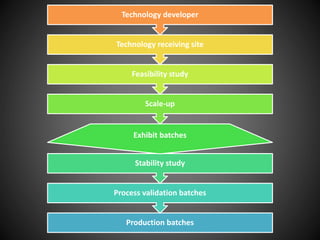
Production batches
Process validation batches
Stability study
Exhibit batches
Scale-up
Feasibility study
Technology receiving site
Technology developer
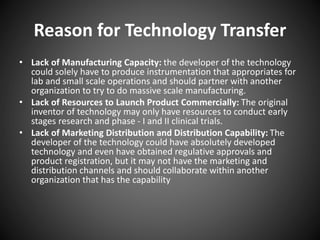
Reason for Technology Transfer
• Lack of Manufacturing Capacity: the developer of the technology
could solely have to produce instrumentation that appropriates for
lab and small scale operations and should partner with another
organization to try to do massive scale manufacturing.
• Lack of Resources to Launch Product Commercially: The original
inventor of technology may only have resources to conduct early
stages research and phase - I and II clinical trials.
• Lack of Marketing Distribution and Distribution Capability: The
developer of the technology could have absolutely developed
technology and even have obtained regulative approvals and
product registration, but it may not have the marketing and
distribution channels and should collaborate within another
organization that has the capability
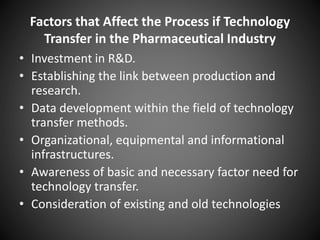
Factors that Affect the Process if Technology
Transfer in the Pharmaceutical Industry
• Investment in R&D.
• Establishing the link between production and
research.
• Data development within the field of technology
transfer methods.
• Organizational, equipmental and informational
infrastructures.
• Awareness of basic and necessary factor need for
technology transfer.
• Consideration of existing and old technologies
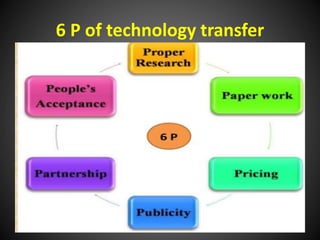
6 P of technology transfer
• Proper Research – By proper research we mean firstly that in which
the result are reproducible and issues such as scale up, stability etc
and other practical now has been addressed, also that in which
problem were taken up in first place
• Proper work- This refer to institutional and guidelines regarding IP
Protection licensing modalities etc. which must be in place
beforehand. In the absence of these, decision get delayed, lack of
fairness in decision e.g. case of X institute, which came up with
good technology but since no guidance were there, kept running
around for two years and then gave up.
• Pricing – most difficult and critical area of
Transfer of technology. - Too high price can
put off buyer, leaving the technology unsold. -
Too price a result in revenue loss. - There are
basically two model regarding pricing 1)Price
charged for a technology should depend upon
market force i.e. impact of the technology
irrespective of amount spent on developing it.
2)Price charged should include all expenses
involved in developing it.
• Publicity – It is important to identify and then
approach buyer i.e. adopt targeted Publicity and not
blanket publicity. Specific journal, website, letters to
manufacturer, personal selective visit etc. are some
common approach which help in locating buyer
• Partnership – this means working along with industry.
Industry takes it up, manufacturer and makes available
to society. Partnership are important to ensure your
technology is successfully adopted simply conveying
the details may not be sufficient.
• People’s Acceptance – It is no use trying to develop a
technology which people will not accept e.g. due to
religious reason/social concern etc. genetically
modified food, irradiated vegetables processed beef in
India, improved capsule made of non- vegetarian
material.
LIST OF INSTITUTE IN INDIA ASSISSTING IN
TECHNOLOGY TRANSFER
• Asia pacific centre for Transfer of technology (
APCTT)
• Technology Bureau for small enterprises (
TBSE)
• National Research & Development
corporation
• Foundation for Innovation and Technology
Transfer
WHEN TECHNOLOGY TRANSFER IS
DONE
o Idea to Discovery Lab
o Discovery Lab to Development Lab
o Development Lab to Pilot Plant
o Kilo Lab to Pilot Plant
o Pilot Plant to Semi-works (other pilot plant)
o Pilot Plant to Manufacturing
o Manufacturing to Manufacturing 14 Various stages of
formulation development were as follows • Preformulation
studies. • Bench scale - (1/1000th of X) • Lab scale –
(1/100th of X) • Scale up- (1/10th of X or 0.1M whichever is
maximum) • Commercial (X) Where X is the final
commercial scale batch size.
Various stages of formulation development
were as follows
 Preformulation studies
 Bench scale - (1/1000th of X)
 Lab scale – (1/100th of X)
 Commercial (X)
 Scale up- (1/10th of X or 0.1M whichever is
maximum)
Where X is the final commercial scale batch
size.
FACTORS INFLUENCING TECHNOLOGY TRANSFER
Drivers for Technology Transfer
• (A) Good business and manufacturing practices – The company’s success is
primarily the result of its adoption of good business and manufacturing
practices, particularly in the areas of product identification and
formulation technology.
• Potential for competitive pricing – Balance cost to remain competitive by
having higher private sector prices and very low public sector prices.
• Strategic planning – Create an enabling environment for vertical
integration, with prospects for higher capacity utilization and eventual
lowering of production costs.
• Strong economy and environment – For technology transfer to be
successful there needs to be supportive business and scientific
environment in the recipient country, and that environment should
include skilled workers, economic and political stability, supportive
regulatory environment, market size and potential and a well developed
national infrastructure of natural resources and transport.
• Transparent and efficient regulation – Pharmaceuticals are necessarily a
high regulated industry, the regulatory function must be efficient and
transparent for technology transfer to be economically viable.
• Opportunities for contingency supply –
Multinational pharmaceutical companies are
inclined to transfer technology to local
manufacturers with the potential to receive when
they foresee an inability to meet time scales and
volume demand from large procurers.
• Access to new machinery, training, know-how
and business partnership – This makes the
prospect of technology transfer very desirable to
local pharmaceutical manufacturers since the
technology, equipment, etc. could be applied
profitably beyond the initial purpose.
(B) Barriers of Technology Transfer.
Lack of efficiency – Automation of production
processes to improve efficiency and lower costs.
Low market share – Local producers face significant
challenges in meeting International Quality
Standards and capturing a critical market share.
Greater market share would increase profitability.
Cost of prequalification – There is benefit in
meeting International Standards since it opens up
the opportunity for trading across the entire
world.
Labour issues – The pharmaceutical sector
demands relatively skilled labour. High labour
turns over and absenteeism owing to unattractive
conditions of service is negative contributor.
Approaches to overcome barriers in
technology transfer
• 1. Commercializing publicly funded technologies: The basic
pattern envisioned is to give institutions receiving public
research funds the right to obtain and exploit patents on
inventions developed in the course of research.
• 2. Research tool patents and freedom to operate for the
public sector: Patents sometimes make it difficult for public
researchers to carry out their research or to make the
products of that research available. It is intensified by the
tendency of some publicly funded research laboratories to
avoid use of a patented technology without permission even
in nations where no relevant patent is in force.
• 3. Web access and scientific publication: Limited access to
scientific journals led to enormous problems for developing
nations scientists.
• 4. National security issues and restrictions on exports of particular
technology: International controls designed to protect national
security and to prevent the proliferation of important technologies
also restrict the flow of technologies.
• 5. Inadequate funding in important areas and possible treaties:
There are areas of research of importance to the developing world
that are being funded inadequately.
• 6. Co-operative research agreements: Global support for public
sector research might be encouraged is through co-operative
research agreements designed to meet specific goals. It would
seem more feasible to focus efforts on technologies of significant
social benefit to the developing nations.
• 7. Possible treaty on scientific access: There has also been a
proposal for an international treaty on access to knowledge and
technology negotiated on the basis of the type of reciprocity found
in normal international trade negotiations. The concept is mean to
be non- zero sum in the sense that, like free trade in goods, free
trade in scientific ideas benefits all, and such arrangements could
be made bilaterally as well as multilaterally.
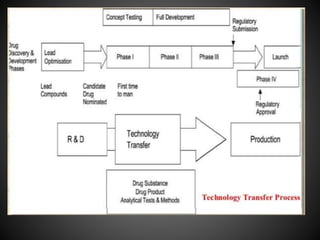
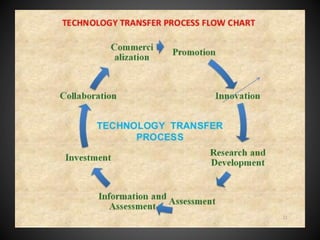
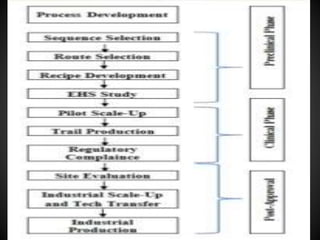
TECHNOLOGY TRANSFER PROCESS
• The processes are classified into the three categories.
Research Phase
– Quality by design
Development Phase
– Research for Factory Production
– Consistency between Quality and Specification
– Assurance of consistency through development and
manufacturing
– Technology Transfer from R&D to Production
Production Phase
– Validation & Production
– Feed back from Production and Technology Transfer of
Marketed Products
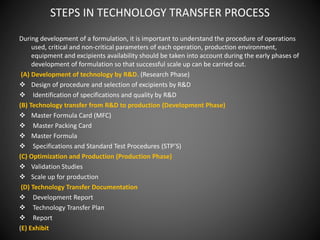
STEPS IN TECHNOLOGY TRANSFER PROCESS
During development of a formulation, it is important to understand the procedure of operations
used, critical and non-critical parameters of each operation, production environment,
equipment and excipients availability should be taken into account during the early phases of
development of formulation so that successful scale up can be carried out.
(A) Development of technology by R&D. (Research Phase)
 Design of procedure and selection of excipients by R&D
 Identification of specifications and quality by R&D
(B) Technology transfer from R&D to production (Development Phase)
 Master Formula Card (MFC)
 Master Packing Card
 Master Formula
 Specifications and Standard Test Procedures (STP’S)
(C) Optimization and Production (Production Phase)
 Validation Studies
 Scale up for production
(D) Technology Transfer Documentation
 Development Report
 Technology Transfer Plan
 Report
(E) Exhibit
Research Phase
(a) Design of procedure and selection of
excipients by R&D– Selection of materials
and design of procedures is developed by
R&D on the basis of innovator product
characteristics.
(b) Identification of specifications and quality by
R&D– Quality of product should meet the
specifications of an innovator product.
Development Phase
• Technology transfer from R&D to production
R&D provides technology transfer dossier (TTD) document to product
development laboratory, which contains all information of formulation
and drug product as follows
(a)Master Formula Card (MFC)– Includes product name along with its
strength, generic name, MFC number, page number, effective date,
shelf life and market.
(b) Master Packing Card– Gives information about packaging type,
material used for packaging, stability profile and shelf life of packaging.
(c) Master Formula– Describes formulation order and manufacturing
instructions. (Process order and environment conditions)
(d) Specifications and Standard Test Procedures (STP’S)– Helps to know
active ingredients and excipients profile, in-process parameters,
product release specifications and finished product details.
Production Phase
• Optimization and Production
(a) Validation Studies– Production is implemented after
validation studies that can verify that process is able to
stabilize the product based on transferred manufacturing
formula. Manufacturing department accepting technology
is responsible for validation and the R&D department
transferring technology should take responsibility for
validation such as performance qualification, cleaning and
process validation.
(b) Scale up for production– Involves the transfer of
technology during small scale development of the product
and processes. It is essential to consider the production
environment and system during development of process.
Operators should concentrate on keeping their segment of
the production process running smoothly.
Technology Transfer Documentation Generally interpreted as document indicating
contents of technology transfer for transferring and transferred parties. Each step
from R&D to production should be documented, task assignments and
responsibilities should be clarified and acceptance criteria for completion of
technology transfer concerning individual technology to be transferred. It is duty
of Quality Assurance department to check and approve the documentation for all
processes of technology transfer.
(a) Development Report– The R&D report is a file of technical development, and
R&D department is in-charge of its documentation. This report is an important
file to indicate rationale for the quality design of drug substances and its
specifications and test methods. The development report is not prerequisite for
the application for approval; it can be used at the pre approval an inspection as
valid document for quality design of new drug. The development report contains
(1) Data of pharmaceutical development of new drug substances and drug products
at stages from early development phase to final application of approval.
(2) Information of raw materials and components.
(3) Design of manufacturing methods.
(4) Change in histories of important processes and control parameters.
(5) Specifications and test methods of drug substances.
(6) Validity of specification range of important tests such as contents impurities and
dissolution.
(7) Verifications of results.
Documentation
b)Technology Transfer Plan– The technology transfer plan is to
describe items and contents of technology to be
transferred and detailed procedures of individual transfer
and transfer schedule, establish judgment criteria for the
completion of the transfer. The transferring party should
prepare the plan before the implementation of the transfer
and reach an agreement on its contents with the
transferred party.
(c) Report– Completion of technology transfer is to be made
once data are taken accordingly to the technology plan and
are evaluated to confirm that the predetermined judgment
criteria are met. Both transferring and transferred parties
should document the technology transfer report. (E) Exhibit
After taking scale up batches of the product, manufacturing
of exhibit batches takes place. In case of exhibit, batch sizes
are increased along with equipments and their processes.
This is done for filling purpose in regulatory agencies.
Exhibit
After taking scale up batches of the
product, manufacturing of exhibit
batches takes place. In case of exhibit,
batch sizes are increased along with
equipments and their processes. This is
done for filling purpose in regulatory
agencies.

Technology Transfer.pptx

  • 1.
  • 2.
    What is Technologytransfer • Transfer of technology is defined as “a logical procedure that controls the transfer of any process together with its documentation and professional expertise between development and manufacture or between manufacture sites” • Technology transfer is both integral and critical to the drug discovery and development process for new medicinal products.
  • 3.
    • Technology transferis transferring of details of concerning formulation and analytical strategies from one area to another area that’s from R&D to Production department9(Transfering site) and succeeding drug product from the laboratory scale to the production scale ( Receiving site) . • In Pharmaceutical Industry, “Technology Transfer” refers to a method of victorious steps forward from drug discovery to product development, clinical trials and at last to full-scale commercialization . • Researcher of technology creates his technology existing to a commercial collaborator which will make use of the technology. • It’s an organized procedure that’s followed to pass the documented information and know-how knowledge gained throughout development . According to WHO outlined as a logical procedure that controls the transfer of any method alongside its documentation and professional expertise between development and manufacture or b/w manufacturer site . It is useful to build up dosage form in various ways because it provides efficiency in development, maintains quality of product, helps to realize a standardized process that facilitates price-effective production .
  • 4.
    Standard Definition ofTechnology Transfer • Knowledge must be systematic. This means that it must be organized in terms of providing solutions to problems. • Knowledge must exist in certain places like in someone’s head or documents and must be able to be presented, so no matter what it means it must be able to be transferred from one person to another. • It must have purpose-orientation, so that it can be utilized for useful purposes in industry, farming, and commercial fields . There are two sorts of technology transfer processes : Vertical Horizontal
  • 5.
    • Vertical technologytransfer refers to the transfer of data from basic study to development and production respectively. • Horizontal technology transfer refers to the movement and application of technology is to be used in one place or context to a different place. Commercial technology transfer is mutually agreed, and goal destined. The achievement of any specific technology transfer depends upon method understanding or the flexibility to predict exactly the long term performance of a process1.
  • 7.
    Objective • It isto transfer product and process knowledge between and manufacturing and within or between manufacturing sites to achieve product realization. This knowledge forms the basis for the manufacturing process, control strategy process validation approach and ongoing continual improvement .
  • 8.
    • To explainthe processing information to transfer technology from R&D to production site by listing out information gathered during R&D. • To explain the processing information to transfer technology of already existing drug product between various places. • To illustrate specific procedures and points to be considered for the above two types of technology transfer to contribute smooth technology transfer
  • 9.
    Method of technologytransfer Licensing is the most common method of technology transfer. There are two strategies for licensing one is licensing in and licensing out. In licensing - in strategy, small companies and lack facilities to do basic research and these facilities want to buy other research. In case of licensing - out strategy, the company right is given to another party
  • 10.
    Facets of TechnologyTransfer The technology transfer could happen any of these following ways: • Government labs to the private sector • Between the private sector firms of the same country • From academia to private sector firms • Academia, government, and industry collaborations
  • 11.
    • Government Labsto Private Sector: This type of technology transfer is advantageous as the government labs can get good financial support and funds from the govt. for their research work, and the technology developed by them reaches the private sector. • Between the Private Sector Firms of the Same Country: This type of technology transfer generally occurs due to lack of appropriate financial resources or inadequate knowledge of regulatory requirements thus, the private sector that develops the technology is paid by another sector that absorbs the technology • From Academia to Private Sector: Academic sectors that are actively involved in research develop the technology and make it available to private firms. By collaboration of private firms with the institutions, money can be saved. • Between Academy, Private and Government Sectors: In this type of technology transfer government provides necessary funds to the academic institutions in developing technology that can be transferred to the industry.
  • 12.
    Importance of TechnologyTransfer • Technology transfer shows important in extended benefits of R&D to the society. • In the pharmaceutical industry, designing of dosage form needs scale up at several stages, such as pilot-scale from 0.5 - 2 kg batch can be scaled up to 5/10 kgs then to 20/100 kg. • Production scale typically ranges from 200 kg to 1000 kg. It involves manufacturing of drug product with increasing their batch sizes with the help of larger equipment. • Generally scale-up involves transfer of technology and transfer of knowledge that has been accumulated during small scale development of product and process. • Usually research has been carried out on a small scale before it produced for large scale commercial batch. • Technology transfer is important for research activities to materialize on a large scale for commercialization especially in
  • 13.
    Production batches Process validationbatches Stability study Exhibit batches Scale-up Feasibility study Technology receiving site Technology developer
  • 14.
    Reason for TechnologyTransfer • Lack of Manufacturing Capacity: the developer of the technology could solely have to produce instrumentation that appropriates for lab and small scale operations and should partner with another organization to try to do massive scale manufacturing. • Lack of Resources to Launch Product Commercially: The original inventor of technology may only have resources to conduct early stages research and phase - I and II clinical trials. • Lack of Marketing Distribution and Distribution Capability: The developer of the technology could have absolutely developed technology and even have obtained regulative approvals and product registration, but it may not have the marketing and distribution channels and should collaborate within another organization that has the capability
  • 15.
    Factors that Affectthe Process if Technology Transfer in the Pharmaceutical Industry • Investment in R&D. • Establishing the link between production and research. • Data development within the field of technology transfer methods. • Organizational, equipmental and informational infrastructures. • Awareness of basic and necessary factor need for technology transfer. • Consideration of existing and old technologies
  • 16.
    6 P oftechnology transfer
  • 17.
    • Proper Research– By proper research we mean firstly that in which the result are reproducible and issues such as scale up, stability etc and other practical now has been addressed, also that in which problem were taken up in first place • Proper work- This refer to institutional and guidelines regarding IP Protection licensing modalities etc. which must be in place beforehand. In the absence of these, decision get delayed, lack of fairness in decision e.g. case of X institute, which came up with good technology but since no guidance were there, kept running around for two years and then gave up.
  • 18.
    • Pricing –most difficult and critical area of Transfer of technology. - Too high price can put off buyer, leaving the technology unsold. - Too price a result in revenue loss. - There are basically two model regarding pricing 1)Price charged for a technology should depend upon market force i.e. impact of the technology irrespective of amount spent on developing it. 2)Price charged should include all expenses involved in developing it.
  • 19.
    • Publicity –It is important to identify and then approach buyer i.e. adopt targeted Publicity and not blanket publicity. Specific journal, website, letters to manufacturer, personal selective visit etc. are some common approach which help in locating buyer • Partnership – this means working along with industry. Industry takes it up, manufacturer and makes available to society. Partnership are important to ensure your technology is successfully adopted simply conveying the details may not be sufficient. • People’s Acceptance – It is no use trying to develop a technology which people will not accept e.g. due to religious reason/social concern etc. genetically modified food, irradiated vegetables processed beef in India, improved capsule made of non- vegetarian material.
  • 20.
    LIST OF INSTITUTEIN INDIA ASSISSTING IN TECHNOLOGY TRANSFER • Asia pacific centre for Transfer of technology ( APCTT) • Technology Bureau for small enterprises ( TBSE) • National Research & Development corporation • Foundation for Innovation and Technology Transfer
  • 23.
    WHEN TECHNOLOGY TRANSFERIS DONE o Idea to Discovery Lab o Discovery Lab to Development Lab o Development Lab to Pilot Plant o Kilo Lab to Pilot Plant o Pilot Plant to Semi-works (other pilot plant) o Pilot Plant to Manufacturing o Manufacturing to Manufacturing 14 Various stages of formulation development were as follows • Preformulation studies. • Bench scale - (1/1000th of X) • Lab scale – (1/100th of X) • Scale up- (1/10th of X or 0.1M whichever is maximum) • Commercial (X) Where X is the final commercial scale batch size.
  • 24.
    Various stages offormulation development were as follows  Preformulation studies  Bench scale - (1/1000th of X)  Lab scale – (1/100th of X)  Commercial (X)  Scale up- (1/10th of X or 0.1M whichever is maximum) Where X is the final commercial scale batch size.
  • 25.
    FACTORS INFLUENCING TECHNOLOGYTRANSFER Drivers for Technology Transfer • (A) Good business and manufacturing practices – The company’s success is primarily the result of its adoption of good business and manufacturing practices, particularly in the areas of product identification and formulation technology. • Potential for competitive pricing – Balance cost to remain competitive by having higher private sector prices and very low public sector prices. • Strategic planning – Create an enabling environment for vertical integration, with prospects for higher capacity utilization and eventual lowering of production costs. • Strong economy and environment – For technology transfer to be successful there needs to be supportive business and scientific environment in the recipient country, and that environment should include skilled workers, economic and political stability, supportive regulatory environment, market size and potential and a well developed national infrastructure of natural resources and transport. • Transparent and efficient regulation – Pharmaceuticals are necessarily a high regulated industry, the regulatory function must be efficient and transparent for technology transfer to be economically viable.
  • 26.
    • Opportunities forcontingency supply – Multinational pharmaceutical companies are inclined to transfer technology to local manufacturers with the potential to receive when they foresee an inability to meet time scales and volume demand from large procurers. • Access to new machinery, training, know-how and business partnership – This makes the prospect of technology transfer very desirable to local pharmaceutical manufacturers since the technology, equipment, etc. could be applied profitably beyond the initial purpose.
  • 27.
    (B) Barriers ofTechnology Transfer. Lack of efficiency – Automation of production processes to improve efficiency and lower costs. Low market share – Local producers face significant challenges in meeting International Quality Standards and capturing a critical market share. Greater market share would increase profitability. Cost of prequalification – There is benefit in meeting International Standards since it opens up the opportunity for trading across the entire world. Labour issues – The pharmaceutical sector demands relatively skilled labour. High labour turns over and absenteeism owing to unattractive conditions of service is negative contributor.
  • 28.
    Approaches to overcomebarriers in technology transfer • 1. Commercializing publicly funded technologies: The basic pattern envisioned is to give institutions receiving public research funds the right to obtain and exploit patents on inventions developed in the course of research. • 2. Research tool patents and freedom to operate for the public sector: Patents sometimes make it difficult for public researchers to carry out their research or to make the products of that research available. It is intensified by the tendency of some publicly funded research laboratories to avoid use of a patented technology without permission even in nations where no relevant patent is in force. • 3. Web access and scientific publication: Limited access to scientific journals led to enormous problems for developing nations scientists.
  • 29.
    • 4. Nationalsecurity issues and restrictions on exports of particular technology: International controls designed to protect national security and to prevent the proliferation of important technologies also restrict the flow of technologies. • 5. Inadequate funding in important areas and possible treaties: There are areas of research of importance to the developing world that are being funded inadequately. • 6. Co-operative research agreements: Global support for public sector research might be encouraged is through co-operative research agreements designed to meet specific goals. It would seem more feasible to focus efforts on technologies of significant social benefit to the developing nations. • 7. Possible treaty on scientific access: There has also been a proposal for an international treaty on access to knowledge and technology negotiated on the basis of the type of reciprocity found in normal international trade negotiations. The concept is mean to be non- zero sum in the sense that, like free trade in goods, free trade in scientific ideas benefits all, and such arrangements could be made bilaterally as well as multilaterally.
  • 30.
    TECHNOLOGY TRANSFER PROCESS •The processes are classified into the three categories. Research Phase – Quality by design Development Phase – Research for Factory Production – Consistency between Quality and Specification – Assurance of consistency through development and manufacturing – Technology Transfer from R&D to Production Production Phase – Validation & Production – Feed back from Production and Technology Transfer of Marketed Products
  • 32.
    STEPS IN TECHNOLOGYTRANSFER PROCESS During development of a formulation, it is important to understand the procedure of operations used, critical and non-critical parameters of each operation, production environment, equipment and excipients availability should be taken into account during the early phases of development of formulation so that successful scale up can be carried out. (A) Development of technology by R&D. (Research Phase)  Design of procedure and selection of excipients by R&D  Identification of specifications and quality by R&D (B) Technology transfer from R&D to production (Development Phase)  Master Formula Card (MFC)  Master Packing Card  Master Formula  Specifications and Standard Test Procedures (STP’S) (C) Optimization and Production (Production Phase)  Validation Studies  Scale up for production (D) Technology Transfer Documentation  Development Report  Technology Transfer Plan  Report (E) Exhibit
  • 33.
    Research Phase (a) Designof procedure and selection of excipients by R&D– Selection of materials and design of procedures is developed by R&D on the basis of innovator product characteristics. (b) Identification of specifications and quality by R&D– Quality of product should meet the specifications of an innovator product.
  • 34.
    Development Phase • Technologytransfer from R&D to production R&D provides technology transfer dossier (TTD) document to product development laboratory, which contains all information of formulation and drug product as follows (a)Master Formula Card (MFC)– Includes product name along with its strength, generic name, MFC number, page number, effective date, shelf life and market. (b) Master Packing Card– Gives information about packaging type, material used for packaging, stability profile and shelf life of packaging. (c) Master Formula– Describes formulation order and manufacturing instructions. (Process order and environment conditions) (d) Specifications and Standard Test Procedures (STP’S)– Helps to know active ingredients and excipients profile, in-process parameters, product release specifications and finished product details.
  • 35.
    Production Phase • Optimizationand Production (a) Validation Studies– Production is implemented after validation studies that can verify that process is able to stabilize the product based on transferred manufacturing formula. Manufacturing department accepting technology is responsible for validation and the R&D department transferring technology should take responsibility for validation such as performance qualification, cleaning and process validation. (b) Scale up for production– Involves the transfer of technology during small scale development of the product and processes. It is essential to consider the production environment and system during development of process. Operators should concentrate on keeping their segment of the production process running smoothly.
  • 36.
    Technology Transfer DocumentationGenerally interpreted as document indicating contents of technology transfer for transferring and transferred parties. Each step from R&D to production should be documented, task assignments and responsibilities should be clarified and acceptance criteria for completion of technology transfer concerning individual technology to be transferred. It is duty of Quality Assurance department to check and approve the documentation for all processes of technology transfer. (a) Development Report– The R&D report is a file of technical development, and R&D department is in-charge of its documentation. This report is an important file to indicate rationale for the quality design of drug substances and its specifications and test methods. The development report is not prerequisite for the application for approval; it can be used at the pre approval an inspection as valid document for quality design of new drug. The development report contains (1) Data of pharmaceutical development of new drug substances and drug products at stages from early development phase to final application of approval. (2) Information of raw materials and components. (3) Design of manufacturing methods. (4) Change in histories of important processes and control parameters. (5) Specifications and test methods of drug substances. (6) Validity of specification range of important tests such as contents impurities and dissolution. (7) Verifications of results. Documentation
  • 37.
    b)Technology Transfer Plan–The technology transfer plan is to describe items and contents of technology to be transferred and detailed procedures of individual transfer and transfer schedule, establish judgment criteria for the completion of the transfer. The transferring party should prepare the plan before the implementation of the transfer and reach an agreement on its contents with the transferred party. (c) Report– Completion of technology transfer is to be made once data are taken accordingly to the technology plan and are evaluated to confirm that the predetermined judgment criteria are met. Both transferring and transferred parties should document the technology transfer report. (E) Exhibit After taking scale up batches of the product, manufacturing of exhibit batches takes place. In case of exhibit, batch sizes are increased along with equipments and their processes. This is done for filling purpose in regulatory agencies.
  • 38.
    Exhibit After taking scaleup batches of the product, manufacturing of exhibit batches takes place. In case of exhibit, batch sizes are increased along with equipments and their processes. This is done for filling purpose in regulatory agencies.