Technology Diffusion
Prepared
By
B.SAIKIRAN
(12NA1E0036)
MEANING OF TECHNOLOGY
DIFFUSION

• Diffusion is the process by which a new idea or new
product is accepted by the market.
• Technology Diffusion means the spread of
applications / usage of a new technology and its
related products, services or processes from one
nation to another; from one entity to another; from
one industry to another; from the owner entity to
user or supplier; and from current user to the
prospective user.
•  Technology Diffusion means the study of how, why,
and at what rate new ideas and technology spread
across the economy.
•  
Business Firms and
Technological Diffusion
• Diffusion similar to that which occurs
from country to country
• Factors that influence diffusion:

– Relative advantages over existing Technology
– Compatibility w/ existing values of firm
– Ease/difficulty of understanding and applying
new Technology
– Ease of experimentation with new Technology
– Extent to which positive results appear
Pattern of Technology Diffusion
• During the intial stage i.e. innovation stage,
technology and innovation gets diffused within the
innovative organizations. Such organizations usually
follow technology leadership strategy.
• During next stage i.e. consolidation stage, diffusion
takes place amongst major competitors.
• During the last stage, i.e. mature technology stage,
diffusion spreads to laggards. These laggards are,
usually, risk-averse and small organizations or small
market players.
• The rate of learnings / spread amongst various
entities is influenced by profitability and investment
required.
Product Diffusion

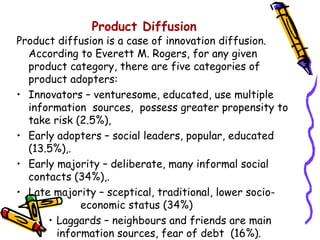
Product diffusion is a case of innovation diffusion.
According to Everett M. Rogers, for any given
product category, there are five categories of
product adopters:
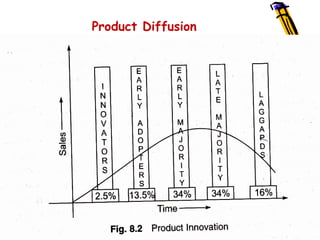
• Innovators – venturesome, educated, use multiple
information sources, possess greater propensity to
take risk (2.5%),
• Early adopters – social leaders, popular, educated
(13.5%),.
• Early majority – deliberate, many informal social
contacts (34%),.
• Late majority – sceptical, traditional, lower socioeconomic status (34%)
• Laggards – neighbours and friends are main
information sources, fear of debt (16%).
:

Product Diffusion
Characteristics of Technology
Diffusion

• Diffusion is not one-way traffic. The innovator can
also learn from imitator.
• Diffusion is not once- for-all occurance. It is cyclical
in nature.
• Diffusion can take place in varying degrees:
IntraFirm - diffusion of lowest degree ; InterFirmdiffusion of medium degree; Economy wide- diffusion
of highest degree.
• Diffusion can take place in variety of forms … viz
product , service or a process: use & production;
stock of technological knowledge
The standard measures

• The standard measures that need to be taken
to achieve diffusion are therefore, as follows
 Awareness-building
 Research
 Technical assistance and consultancy
 Training
 Financial support
 Personnel exchange and the support of R&D
personnel
 Standardization
What are Global Trends in
Technology Management

Prior to 1990, rate of technological change has been
slow due to cold war between USA & USSR,
restriction on MNCs, existence of high trade
barriers across countries. Since 1990s rate of
technological change has become faster.
This increased rate of technological change is
noticeable in following areas:
• Most of nations have adopted formal technology
development policy and aim at gaining technological
progress / advancement.

• Innovations (new product / process
developments) are no more confined to developed
world. They can take place anywhere, anytime.
What are Global Trends in
Technology Management

Contd …
• Globalisation of technology is taking place at a faster
pace due to variety of factors
• Technological development is becoming highly
customer-oriented. As the customer needs & tastes are
increasing and changing, technological changes are
increasing.
• Decreasing payback period – to derive benefits of
technology development
• Time compression – decrease in time available in
various activities / phases of technology development
• There is faster movement of products and services
from Research & Development center to markets
(reduction in lead times).
Conclusion:
• Hence technology diffusion involves
the determination of technical
information and know-how the
subsequent adoption of new
technologies and techniques by
users for development.

technology diffusion

  • 1.
  • 2.
    MEANING OF TECHNOLOGY DIFFUSION •Diffusion is the process by which a new idea or new product is accepted by the market. • Technology Diffusion means the spread of applications / usage of a new technology and its related products, services or processes from one nation to another; from one entity to another; from one industry to another; from the owner entity to user or supplier; and from current user to the prospective user. •  Technology Diffusion means the study of how, why, and at what rate new ideas and technology spread across the economy. •  
  • 3.
    Business Firms and TechnologicalDiffusion • Diffusion similar to that which occurs from country to country • Factors that influence diffusion: – Relative advantages over existing Technology – Compatibility w/ existing values of firm – Ease/difficulty of understanding and applying new Technology – Ease of experimentation with new Technology – Extent to which positive results appear
  • 4.
    Pattern of TechnologyDiffusion • During the intial stage i.e. innovation stage, technology and innovation gets diffused within the innovative organizations. Such organizations usually follow technology leadership strategy. • During next stage i.e. consolidation stage, diffusion takes place amongst major competitors. • During the last stage, i.e. mature technology stage, diffusion spreads to laggards. These laggards are, usually, risk-averse and small organizations or small market players. • The rate of learnings / spread amongst various entities is influenced by profitability and investment required.
  • 5.
    Product Diffusion Product diffusionis a case of innovation diffusion. According to Everett M. Rogers, for any given product category, there are five categories of product adopters: • Innovators – venturesome, educated, use multiple information sources, possess greater propensity to take risk (2.5%), • Early adopters – social leaders, popular, educated (13.5%),. • Early majority – deliberate, many informal social contacts (34%),. • Late majority – sceptical, traditional, lower socioeconomic status (34%) • Laggards – neighbours and friends are main information sources, fear of debt (16%).
  • 6.
  • 7.
    Characteristics of Technology Diffusion •Diffusion is not one-way traffic. The innovator can also learn from imitator. • Diffusion is not once- for-all occurance. It is cyclical in nature. • Diffusion can take place in varying degrees: IntraFirm - diffusion of lowest degree ; InterFirmdiffusion of medium degree; Economy wide- diffusion of highest degree. • Diffusion can take place in variety of forms … viz product , service or a process: use & production; stock of technological knowledge
  • 8.
    The standard measures •The standard measures that need to be taken to achieve diffusion are therefore, as follows  Awareness-building  Research  Technical assistance and consultancy  Training  Financial support  Personnel exchange and the support of R&D personnel  Standardization
  • 9.
    What are GlobalTrends in Technology Management Prior to 1990, rate of technological change has been slow due to cold war between USA & USSR, restriction on MNCs, existence of high trade barriers across countries. Since 1990s rate of technological change has become faster. This increased rate of technological change is noticeable in following areas: • Most of nations have adopted formal technology development policy and aim at gaining technological progress / advancement. • Innovations (new product / process developments) are no more confined to developed world. They can take place anywhere, anytime.
  • 10.
    What are GlobalTrends in Technology Management Contd … • Globalisation of technology is taking place at a faster pace due to variety of factors • Technological development is becoming highly customer-oriented. As the customer needs & tastes are increasing and changing, technological changes are increasing. • Decreasing payback period – to derive benefits of technology development • Time compression – decrease in time available in various activities / phases of technology development • There is faster movement of products and services from Research & Development center to markets (reduction in lead times).
  • 11.
    Conclusion: • Hence technologydiffusion involves the determination of technical information and know-how the subsequent adoption of new technologies and techniques by users for development.