In the name of allah
who Is most mercIful
and most BenefIcent
Group Members
• Mohammad Golam Mostafa
• Mohd Izhar Abdul Malek
• Syed Absar Kazmi
• Abdallah Zyoud
• Mohammad Jabed Perves
• S. Md Ehsanur Rahman
transfer of technology:
means, methods and
strategIes
RKGS 6000
Values ,Technology and Society
Dr. Abdi Omar Shuriye
OUTLINES
• Concept of TOT
• TOT process cycle
• TOT check lists
• Types of Technology (TOT)
• Factor affecting TOT
• Barrier to TOT
• Model of TOT
• Strategies of TOT
OUTLINES (CONT.)
• Role of TOT in economic development and
education
• Islamic view of TOT to Muslim world
• Organizations behind TOT in Muslim world
& its significance
TRANSFER OF TECHNOLOGY
Definition
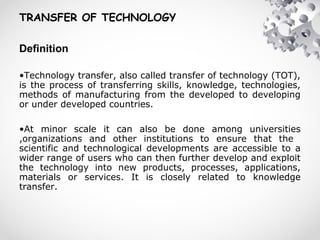
•Technology transfer, also called transfer of technology (TOT),
is the process of transferring skills, knowledge, technologies,
methods of manufacturing from the developed to developing
or under developed countries.
•At minor scale it can also be done among universities
,organizations and other institutions to ensure that the
scientific and technological developments are accessible to a
wider range of users who can then further develop and exploit
the technology into new products, processes, applications,
materials or services. It is closely related to knowledge
transfer.
1. CONCEPT OF TECHNOLOGY TRANSFER
• Concept
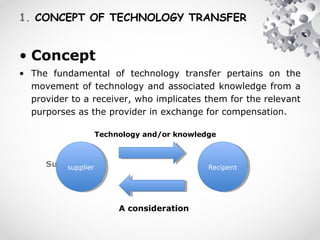
• The fundamental of technology transfer pertains on the
movement of technology and associated knowledge from a
provider to a receiver, who implicates them for the relevant
purporses as the provider in exchange for compensation.
RecipentRecipentSupplier
Technology and/or knowledge
A consideration
suppliersupplier
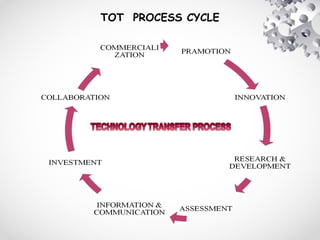
TOT PROCESS CYCLE
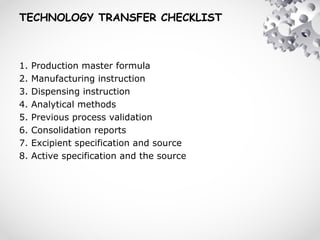
TECHNOLOGY TRANSFER CHECKLIST
1. Production master formula
2. Manufacturing instruction
3. Dispensing instruction
4. Analytical methods
5. Previous process validation
6. Consolidation reports
7. Excipient specification and source
8. Active specification and the source
TECHNOLOGY TRANSFER CHECKLIST
9. Primary packaging material specification and source.
10. Packaging instruction
11. Customer complaints
12. Process deviation file
13. Analytical deviation file
14. Reject/Rework file
15. Specimen manufacturing batch record
16. Specimen cartons, Labels, Leaflets.
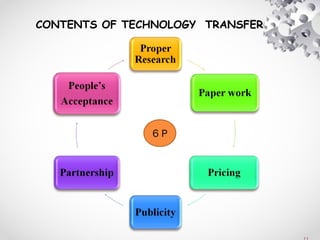
CONTENTS OF TECHNOLOGY TRANSFER
6 P
December 29, 2014
12
TYPES OF TECHNOLOGY
1) EMERGING TECHNOLOGY- is an innovative technology
that currently is undergoing bench scale testing, in which a
small version of the technology is tested in a laboratory.
2) INNOVATIVE TECHNOLOGY- is a technology that has
been field tested and applied to a hazardous waste problem at
a site, but lack a long history of full-scale use.
3) ESTABLISHED TECHNOLOGY- is a technology for which cost and
performance information is readily only after a technology has been
deployed at many different sites and the result is fully documented,
that technology is considered to be established.
December 29, 2014
FUNCTION OF TECHNOLOGY TRANSFER TEAM
1) Coordinate- Coordinating between technology users and
developer, between researcher and manufacturers is important
element of technology transfer.
2) Nurture- A main ingredient for moving technology from a
research laboratory to a new business enterprises successfully in
an environment that is supportive for entrepreneurship.
3) Link- Cataloging resources related to business enterprises &
connecting would be entrepreneurship / researcher and other
technology developers to outside group & organization which can
help in the process of starting new product, companies etc.
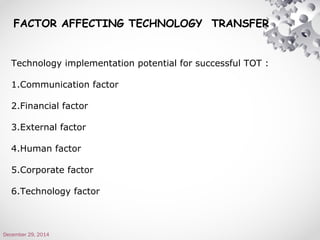
Technology implementation potential for successful TOT :
1.Communication factor
2.Financial factor
3.External factor
4.Human factor
5.Corporate factor
6.Technology factor
December 29, 2014
FACTOR AFFECTING TECHNOLOGY TRANSFER
BARRIERS TO TRANSFER
What hinders technology transfer and what causes leads it to
failure:
• Lack of awareness – what technologies are available to them
• Lack of knowledge – If staff of company is lacking technical
knowledge, it may not be able to capitalize on the technology
being offered in the transfer
• Lack of funds – company may not be able to afford the
development costs of the technology being transferred
• Lack of common interests – Individuals putting the interests of
their own company ahead of the alliance
• Conflict of interest – Even in collaborations on the technical
level or strong, it has been found that collaborations between
competing companies doesn’t work.
BARRIERS TO TRANSFER (CONT.)
• Lack of Trust – If little trust exists between companies,
it is doomed to fail
• Poor communications – Fail to keep each abreast on
everything relevant to the collaboration, activities,
thoughts, processes, goals, direction of venture
• Lack of infrastructure – company may lack equipment
and facility in infrastructure to take on the transfer
• Over-committed – The company may be over-
committed on current projects and simply lacks the
time needed for success.
BARRIERS – WITH REGARDS TO COLLABORATION
• Technical Problems – which are generally overcome, but
which add time and money and frustration
• Resource Limitation – Poor budget control
• Change in Project’s Structure – Loss of key members or
loss of partner
• Organizational Problems – due to a partner losing or
changing interest in the technological side.
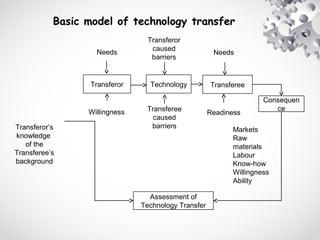
Transferor Technology Transferee
Consequen
ce
Assessment of
Technology Transfer
Markets
Raw
materials
Labour
Know-how
Willingness
Ability
Needs
Transferor
caused
barriers
Needs
Willingness Transferee
caused
barriers
Readiness
Transferor’s
knowledge
of the
Transferee’s
background
Basic model of technology transfer
Strategies for technology transfer
What are the technology transfer strategies?
• A plan of action designed to achieve a long-term or overall
aim.
• Process of transferring skills, knowledge, technologies,
methods of manufacturing, samples of manufacturing and
facilities among governments and non-governments.
STRATEGIES
• Turn key delivery
• Joint venture
• Licensing
• Reverse engineering
• Starting from outdated technology
• Starting from scratch
• Technology espionage
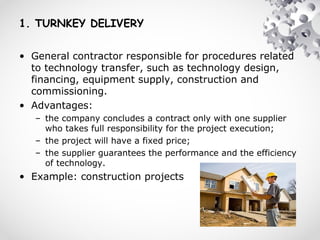
1. TURNKEY DELIVERY
• General contractor responsible for procedures related
to technology transfer, such as technology design,
financing, equipment supply, construction and
commissioning.
• Advantages:
– the company concludes a contract only with one supplier
who takes full responsibility for the project execution;
– the project will have a fixed price;
– the supplier guarantees the performance and the efficiency
of technology.
• Example: construction projects
2. JOINT VENTURE
• Agreement concluded between two or more
companies in order to execute a particular
business.
• Implies mutual assets, management, risks, profit
sharing, co-production, services and marketing.
• Benefits:
– long-term cooperation between the parties,
– reduce costs than if the companies have been working
separately.
• Example: Sony Ericsson, Proton
3. LICENSING
• Agreement which owner of a patent, trademark
or other intellectual property gives permission to
another company to use the technology in a
certain area during a certain period of time.
 exclusive right or non-exclusive right
• Could include sublicensing clause
– permits the licensee to grant to someone else
the right to use the technology.
• Advantage: it has lower costs, compared with
other technology transfer methods.
• Example: Licensing intellectual property of
university to industry
4. REVERSE ENGINEERING
• Process of extracting knowledge or design information from
anything man-made.
• Involves disassembling something (a mechanical device,
electronic component, computer program, or biological,
chemical, or organic matter) and analyzing its components
and workings in detail.
• Reasons vary from socially beneficial actions, to criminal
actions, depending upon the situation. Often no intellectual
property rights are breached.
• Common in Japan, China, Korea
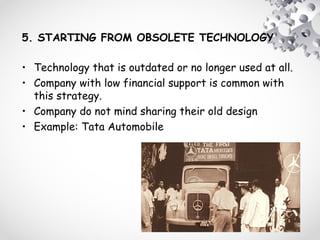
5. STARTING FROM OBSOLETE TECHNOLOGY
• Technology that is outdated or no longer used at all.
• Company with low financial support is common with
this strategy.
• Company do not mind sharing their old design
• Example: Tata Automobile
6. START FROM SCRATCH
• More towards technology creation
• Start from zero
• Require high level of skill, resource, expertize
• Example: Karl Benz (Germany) invented the first
car in 1886
7. TECHNOLOGY ESPIONAGE
• Theft of trade secrets by the removal, copying or
recording of confidential or valuable information
in a company for use by a competitor.
• Conducted for commercial purposes rather than
national security purposes
• Common among developed countries such as
USA and Germany
The Role of Technology Transfer in
Economic Development
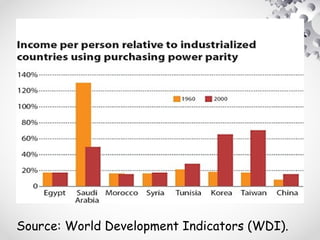
• In 1960, Korea, Taiwan, Syria, Tunisia, Morocco,
Jordan, and Egypt were in roughly the same
economic position
EXPORT-ORIENTED POLICIES VS ORIENTATION
TO THE DOMESTIC ECONOMY
• Asian governments encouraged high rates of investment in
physical capital such as roads, buildings, and machinery;
growing levels of education; a stable macroeconomic policy
that controlled inflation; and an emphasis on exports that
motivated firms to compete in global markets, thus
generating a demand for international technology transfer
• Wile in the middle east rather than openness to foreign
trade; the economy was domestically oriented, and no
international technology transfer; and less effort to build a
high-quality education system, which enabled local firms to
ignore international technology
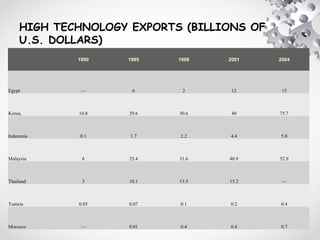
HIGH TECHNOLOGY EXPORTS (BILLIONS OF
U.S. DOLLARS)
  1990 1995 1998 2001 2004
Egypt — 6 2 12 15
Korea, 10.8 29.6 30.6 40 75.7
Indonesia 0.1 1.7 2.2 4.4 5.8
Malaysia 6 25.4 31.6 40.9 52.9
Thailand 3 10.1 13.5 15.2 —
Tunisia 0.05 0.07 0.1 0.2 0.4
Morocco — 0.01 0.4 0.4 0.7
Adopted TOT Strategies
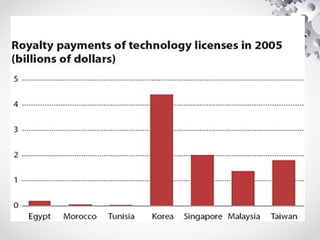
• Japan relied heavily on technology licensing while
discouraging FDI. In the 1960s and 1970s, Korea also
largely excluded FDI but used technology licensing,
consultants, and imported equipment and intermediates as
sources of technological advances. Countries such as
Malaysia and Thailand pursued several paths
simultaneously. The overarching orientation in the Asian
countries was openness to foreign ideas, some embodied in
physical inputs, others conveyed by manuals, blueprints,
and know-how
• To identify and apply such knowledge transfers requires a
highly educated domestic labor force that is critical in the
identification, modification, and absorption of foreign
technology
Source: World Development Indicators (WDI).
Islamic view to the technology transfer to the Muslim
World
 Seek knowledge even though it be in China.
 The acquisition of knowledge is compulsory for every Muslim,
whether male or female.
 The ink of the scholar is more sacred than the blood of the
martyr.
 Seek knowledge from the cradle to the grave.
 God has revealed to me, Whoever walks in the pursuit of
Knowledge I facilitate for him the way to heaven.
 The best form of worship is the pursuit of knowledge.
 Scholars should endeavour to spread knowledge and provide
education to people who have been deprived of it. For, where
knowledge is hidden it disappears.
 Some one asked the Prophet (SAS): Who is the biggest
scholar?. He replied: "He who is constantly trying to learn
from others, for a scholar is every hungry for more knowledge.
 Seek for knowledge and wisdom, for whatever the vessel from
which it flows, you will never be the loser.
 Thinking deep for one hour (with sincerity) is better than 70
years of (mechanical) worship.
 Worship without knowledge, has no goodness in it and
knowledge without understanding has no goodness in it.
 To listen to the words of the learned and to install unto others
the lessons of science is better than religious exercises.
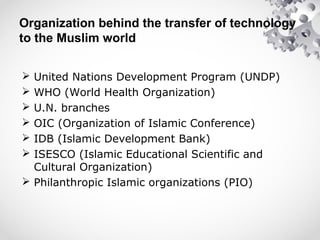
Organization behind the transfer of technology
to the Muslim world
 United Nations Development Program (UNDP)
 WHO (World Health Organization)
 U.N. branches
 OIC (Organization of Islamic Conference)
 IDB (Islamic Development Bank)
 ISESCO (Islamic Educational Scientific and
Cultural Organization)
 Philanthropic Islamic organizations (PIO)
Significant of TOT to the Muslim world
 Saving economics: Muslim world must
stop importing military weapons and start
manufacturing the needed weapons
including space satellites and their
launching vehicles(rockets and missiles),
to
 Defence their national security.
 Industrial development
 Daily life improvement
THANK YOU

Tot in muslim world

  • 1.
    In the nameof allah who Is most mercIful and most BenefIcent
  • 2.
    Group Members • MohammadGolam Mostafa • Mohd Izhar Abdul Malek • Syed Absar Kazmi • Abdallah Zyoud • Mohammad Jabed Perves • S. Md Ehsanur Rahman
  • 3.
    transfer of technology: means,methods and strategIes RKGS 6000 Values ,Technology and Society Dr. Abdi Omar Shuriye
  • 4.
    OUTLINES • Concept ofTOT • TOT process cycle • TOT check lists • Types of Technology (TOT) • Factor affecting TOT • Barrier to TOT • Model of TOT • Strategies of TOT
  • 5.
    OUTLINES (CONT.) • Roleof TOT in economic development and education • Islamic view of TOT to Muslim world • Organizations behind TOT in Muslim world & its significance
  • 6.
    TRANSFER OF TECHNOLOGY Definition •Technologytransfer, also called transfer of technology (TOT), is the process of transferring skills, knowledge, technologies, methods of manufacturing from the developed to developing or under developed countries. •At minor scale it can also be done among universities ,organizations and other institutions to ensure that the scientific and technological developments are accessible to a wider range of users who can then further develop and exploit the technology into new products, processes, applications, materials or services. It is closely related to knowledge transfer.
  • 7.
    1. CONCEPT OFTECHNOLOGY TRANSFER • Concept • The fundamental of technology transfer pertains on the movement of technology and associated knowledge from a provider to a receiver, who implicates them for the relevant purporses as the provider in exchange for compensation. RecipentRecipentSupplier Technology and/or knowledge A consideration suppliersupplier
  • 8.
  • 9.
    TECHNOLOGY TRANSFER CHECKLIST 1.Production master formula 2. Manufacturing instruction 3. Dispensing instruction 4. Analytical methods 5. Previous process validation 6. Consolidation reports 7. Excipient specification and source 8. Active specification and the source
  • 10.
    TECHNOLOGY TRANSFER CHECKLIST 9.Primary packaging material specification and source. 10. Packaging instruction 11. Customer complaints 12. Process deviation file 13. Analytical deviation file 14. Reject/Rework file 15. Specimen manufacturing batch record 16. Specimen cartons, Labels, Leaflets.
  • 11.
  • 12.
    December 29, 2014 12 TYPESOF TECHNOLOGY 1) EMERGING TECHNOLOGY- is an innovative technology that currently is undergoing bench scale testing, in which a small version of the technology is tested in a laboratory. 2) INNOVATIVE TECHNOLOGY- is a technology that has been field tested and applied to a hazardous waste problem at a site, but lack a long history of full-scale use. 3) ESTABLISHED TECHNOLOGY- is a technology for which cost and performance information is readily only after a technology has been deployed at many different sites and the result is fully documented, that technology is considered to be established.
  • 13.
    December 29, 2014 FUNCTIONOF TECHNOLOGY TRANSFER TEAM 1) Coordinate- Coordinating between technology users and developer, between researcher and manufacturers is important element of technology transfer. 2) Nurture- A main ingredient for moving technology from a research laboratory to a new business enterprises successfully in an environment that is supportive for entrepreneurship. 3) Link- Cataloging resources related to business enterprises & connecting would be entrepreneurship / researcher and other technology developers to outside group & organization which can help in the process of starting new product, companies etc.
  • 14.
    Technology implementation potentialfor successful TOT : 1.Communication factor 2.Financial factor 3.External factor 4.Human factor 5.Corporate factor 6.Technology factor December 29, 2014 FACTOR AFFECTING TECHNOLOGY TRANSFER
  • 15.
    BARRIERS TO TRANSFER Whathinders technology transfer and what causes leads it to failure: • Lack of awareness – what technologies are available to them • Lack of knowledge – If staff of company is lacking technical knowledge, it may not be able to capitalize on the technology being offered in the transfer • Lack of funds – company may not be able to afford the development costs of the technology being transferred • Lack of common interests – Individuals putting the interests of their own company ahead of the alliance • Conflict of interest – Even in collaborations on the technical level or strong, it has been found that collaborations between competing companies doesn’t work.
  • 16.
    BARRIERS TO TRANSFER(CONT.) • Lack of Trust – If little trust exists between companies, it is doomed to fail • Poor communications – Fail to keep each abreast on everything relevant to the collaboration, activities, thoughts, processes, goals, direction of venture • Lack of infrastructure – company may lack equipment and facility in infrastructure to take on the transfer • Over-committed – The company may be over- committed on current projects and simply lacks the time needed for success.
  • 17.
    BARRIERS – WITHREGARDS TO COLLABORATION • Technical Problems – which are generally overcome, but which add time and money and frustration • Resource Limitation – Poor budget control • Change in Project’s Structure – Loss of key members or loss of partner • Organizational Problems – due to a partner losing or changing interest in the technological side.
  • 18.
    Transferor Technology Transferee Consequen ce Assessmentof Technology Transfer Markets Raw materials Labour Know-how Willingness Ability Needs Transferor caused barriers Needs Willingness Transferee caused barriers Readiness Transferor’s knowledge of the Transferee’s background Basic model of technology transfer
  • 19.
  • 20.
    What are thetechnology transfer strategies? • A plan of action designed to achieve a long-term or overall aim. • Process of transferring skills, knowledge, technologies, methods of manufacturing, samples of manufacturing and facilities among governments and non-governments.
  • 21.
    STRATEGIES • Turn keydelivery • Joint venture • Licensing • Reverse engineering • Starting from outdated technology • Starting from scratch • Technology espionage
  • 22.
    1. TURNKEY DELIVERY •General contractor responsible for procedures related to technology transfer, such as technology design, financing, equipment supply, construction and commissioning. • Advantages: – the company concludes a contract only with one supplier who takes full responsibility for the project execution; – the project will have a fixed price; – the supplier guarantees the performance and the efficiency of technology. • Example: construction projects
  • 23.
    2. JOINT VENTURE •Agreement concluded between two or more companies in order to execute a particular business. • Implies mutual assets, management, risks, profit sharing, co-production, services and marketing. • Benefits: – long-term cooperation between the parties, – reduce costs than if the companies have been working separately. • Example: Sony Ericsson, Proton
  • 24.
    3. LICENSING • Agreementwhich owner of a patent, trademark or other intellectual property gives permission to another company to use the technology in a certain area during a certain period of time.  exclusive right or non-exclusive right • Could include sublicensing clause – permits the licensee to grant to someone else the right to use the technology. • Advantage: it has lower costs, compared with other technology transfer methods. • Example: Licensing intellectual property of university to industry
  • 25.
    4. REVERSE ENGINEERING •Process of extracting knowledge or design information from anything man-made. • Involves disassembling something (a mechanical device, electronic component, computer program, or biological, chemical, or organic matter) and analyzing its components and workings in detail. • Reasons vary from socially beneficial actions, to criminal actions, depending upon the situation. Often no intellectual property rights are breached. • Common in Japan, China, Korea
  • 26.
    5. STARTING FROMOBSOLETE TECHNOLOGY • Technology that is outdated or no longer used at all. • Company with low financial support is common with this strategy. • Company do not mind sharing their old design • Example: Tata Automobile
  • 27.
    6. START FROMSCRATCH • More towards technology creation • Start from zero • Require high level of skill, resource, expertize • Example: Karl Benz (Germany) invented the first car in 1886
  • 28.
    7. TECHNOLOGY ESPIONAGE •Theft of trade secrets by the removal, copying or recording of confidential or valuable information in a company for use by a competitor. • Conducted for commercial purposes rather than national security purposes • Common among developed countries such as USA and Germany
  • 29.
    The Role ofTechnology Transfer in Economic Development • In 1960, Korea, Taiwan, Syria, Tunisia, Morocco, Jordan, and Egypt were in roughly the same economic position
  • 30.
    EXPORT-ORIENTED POLICIES VSORIENTATION TO THE DOMESTIC ECONOMY • Asian governments encouraged high rates of investment in physical capital such as roads, buildings, and machinery; growing levels of education; a stable macroeconomic policy that controlled inflation; and an emphasis on exports that motivated firms to compete in global markets, thus generating a demand for international technology transfer • Wile in the middle east rather than openness to foreign trade; the economy was domestically oriented, and no international technology transfer; and less effort to build a high-quality education system, which enabled local firms to ignore international technology
  • 32.
    HIGH TECHNOLOGY EXPORTS(BILLIONS OF U.S. DOLLARS)   1990 1995 1998 2001 2004 Egypt — 6 2 12 15 Korea, 10.8 29.6 30.6 40 75.7 Indonesia 0.1 1.7 2.2 4.4 5.8 Malaysia 6 25.4 31.6 40.9 52.9 Thailand 3 10.1 13.5 15.2 — Tunisia 0.05 0.07 0.1 0.2 0.4 Morocco — 0.01 0.4 0.4 0.7
  • 33.
    Adopted TOT Strategies •Japan relied heavily on technology licensing while discouraging FDI. In the 1960s and 1970s, Korea also largely excluded FDI but used technology licensing, consultants, and imported equipment and intermediates as sources of technological advances. Countries such as Malaysia and Thailand pursued several paths simultaneously. The overarching orientation in the Asian countries was openness to foreign ideas, some embodied in physical inputs, others conveyed by manuals, blueprints, and know-how • To identify and apply such knowledge transfers requires a highly educated domestic labor force that is critical in the identification, modification, and absorption of foreign technology
  • 36.
    Source: World DevelopmentIndicators (WDI).
  • 37.
    Islamic view tothe technology transfer to the Muslim World  Seek knowledge even though it be in China.  The acquisition of knowledge is compulsory for every Muslim, whether male or female.  The ink of the scholar is more sacred than the blood of the martyr.  Seek knowledge from the cradle to the grave.  God has revealed to me, Whoever walks in the pursuit of Knowledge I facilitate for him the way to heaven.  The best form of worship is the pursuit of knowledge.
  • 38.
     Scholars shouldendeavour to spread knowledge and provide education to people who have been deprived of it. For, where knowledge is hidden it disappears.  Some one asked the Prophet (SAS): Who is the biggest scholar?. He replied: "He who is constantly trying to learn from others, for a scholar is every hungry for more knowledge.  Seek for knowledge and wisdom, for whatever the vessel from which it flows, you will never be the loser.  Thinking deep for one hour (with sincerity) is better than 70 years of (mechanical) worship.
  • 39.
     Worship withoutknowledge, has no goodness in it and knowledge without understanding has no goodness in it.  To listen to the words of the learned and to install unto others the lessons of science is better than religious exercises.
  • 40.
    Organization behind thetransfer of technology to the Muslim world  United Nations Development Program (UNDP)  WHO (World Health Organization)  U.N. branches  OIC (Organization of Islamic Conference)  IDB (Islamic Development Bank)  ISESCO (Islamic Educational Scientific and Cultural Organization)  Philanthropic Islamic organizations (PIO)
  • 41.
    Significant of TOTto the Muslim world  Saving economics: Muslim world must stop importing military weapons and start manufacturing the needed weapons including space satellites and their launching vehicles(rockets and missiles), to  Defence their national security.  Industrial development  Daily life improvement
  • 42.