
MC-KINSEY  7 S MODEL    AMIT KUMAR ROYREG. NO: 1014370005
INTRODUCTION:-MC KINSEY is a global management consulting firm & the trusted advisors to the worlds leading businesses, government, and institutions.Founded by James o. Mckinsey in 1926.
 The 7 S framework is a management model developed by Robert J. Waterman & Tom Peters (also developed MBWA i.e management by walking around).
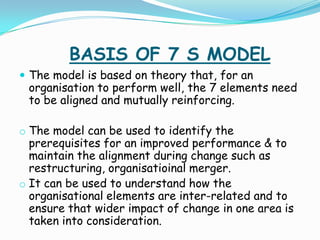
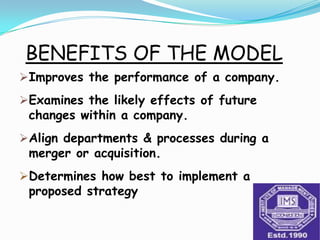
The model is most often used as tool to assess & monitor changes in the internal situation on organisation.BASIS OF 7 S MODELThe model is based on theory that, for an organisation to perform well, the 7 elements need to be aligned and mutually reinforcing.The model can be used to identify the prerequisites for an improved performance & to maintain the alignment during change such as restructuring, organisatioinal merger.
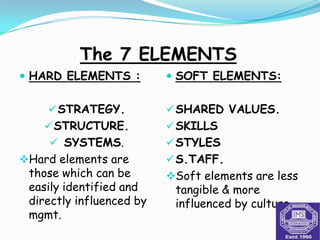
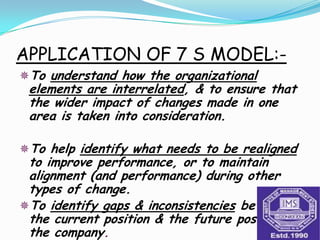
It can be used to understand how the organisational elements are inter-related and to ensure that wider impact of change in one area is taken into consideration.The 7 ELEMENTSHARD ELEMENTS :STRATEGY.
STRUCTURE.
 SYSTEMS.
Hard elements are those which can be easily identified and directly influenced by mgmt.SOFT ELEMENTS:SHARED VALUES.
SKILLS
STYLES
S.TAFF.
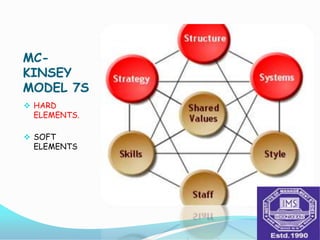
Soft elements are less tangible & more influenced by culture.MC-KINSEY  MODEL 7SHARD ELEMENTS.
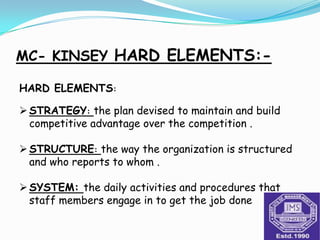
SOFT ELEMENTSMC- KINSEY HARD ELEMENTS:-HARD ELEMENTS:STRATEGY: the plan devised to maintain and build competitive advantage over the competition .
STRUCTURE: the way the organization is structured and who reports to whom .
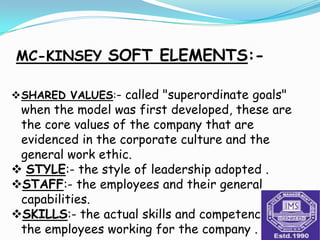
SYSTEM: the daily activities and procedures that staff members engage in to get the job done MC-KINSEY SOFT ELEMENTS:-SHARED VALUES:- called "superordinate goals" when the model was first developed, these are the core values of the company that are evidenced in the corporate culture and the general work ethic.

Mc kinsey 7 s model

  • 1.
    MC-KINSEY 7S MODEL AMIT KUMAR ROYREG. NO: 1014370005
  • 2.
    INTRODUCTION:-MC KINSEY isa global management consulting firm & the trusted advisors to the worlds leading businesses, government, and institutions.Founded by James o. Mckinsey in 1926.
  • 3.
    The 7S framework is a management model developed by Robert J. Waterman & Tom Peters (also developed MBWA i.e management by walking around).
  • 4.
    The model ismost often used as tool to assess & monitor changes in the internal situation on organisation.BASIS OF 7 S MODELThe model is based on theory that, for an organisation to perform well, the 7 elements need to be aligned and mutually reinforcing.The model can be used to identify the prerequisites for an improved performance & to maintain the alignment during change such as restructuring, organisatioinal merger.
  • 5.
    It can beused to understand how the organisational elements are inter-related and to ensure that wider impact of change in one area is taken into consideration.The 7 ELEMENTSHARD ELEMENTS :STRATEGY.
  • 6.
  • 7.
  • 8.
    Hard elements arethose which can be easily identified and directly influenced by mgmt.SOFT ELEMENTS:SHARED VALUES.
  • 9.
  • 10.
  • 11.
  • 12.
    Soft elements areless tangible & more influenced by culture.MC-KINSEY MODEL 7SHARD ELEMENTS.
  • 13.
    SOFT ELEMENTSMC- KINSEYHARD ELEMENTS:-HARD ELEMENTS:STRATEGY: the plan devised to maintain and build competitive advantage over the competition .
  • 14.
    STRUCTURE: the waythe organization is structured and who reports to whom .
  • 15.
    SYSTEM: the dailyactivities and procedures that staff members engage in to get the job done MC-KINSEY SOFT ELEMENTS:-SHARED VALUES:- called "superordinate goals" when the model was first developed, these are the core values of the company that are evidenced in the corporate culture and the general work ethic.