Methods or Techniques of

Technological Forecasting
INTRODUCTION
MIT and MIST started a collaborative research project
called “Technological Forecasting using Data Mining
and Semantics” (TFDMS) Four elements of forecast
require specification. “tech-mining”

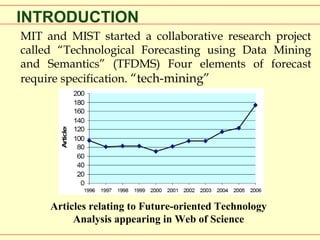
Articles relating to Future-oriented Technology
Analysis appearing in Web of Science
Leading FTA Journals:
Technological Forecasting & Social Change
International Journal of Technology Management
Futures
Research--Technology Management
Abstracts of Papers, American Chemical Society
Technovation
Journal of Cleaner Production
Journal of Forecasting
R & D Management
Solid State Technology
Technology Analysis & Strategic Management
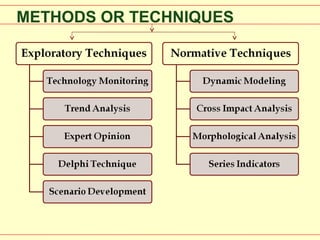
METHODS OR TECHNIQUES
Qualitative Vs Quantitative Methods
Exploratory : 1. Technology Monitoring
Having good Scanning and Intelligence System
It is the process of scanning the environment for
information about the subject of forecast.
“environmental scanning can be thought of as the
central input to futures research.”
The sources of information are indentified and then
information is gathered, filtered, processed and
structured for using forecasting.
The method is simple and give quick results.
Sometimes, information overload may result in
confusion and delays.
There should not be difficult and costly to gather
information.
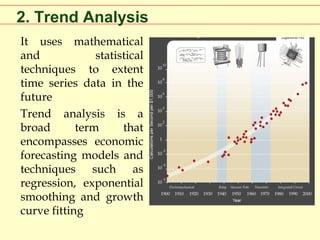
2. Trend Analysis
It uses mathematical
and
statistical
techniques to extent
time series data in the
future
Trend analysis is a
broad
term
that
encompasses economic
forecasting models and
techniques such as
regression, exponential
smoothing and growth
curve fitting
3. Expert Opinion
It collects opinion of chosen experts in a
particular area and arrives at a forecast
This methods include forecasting or
understanding technological development via
intensive consultation with subject matter
experts.
Identify experts in an area exist, data are
lacking and difficult to identify a model
Forecasting may be wrong when questions
posed to them are ambiguous and unclear
4. Delphi Technique
It was originally developed at Ran Corporation of
the USA in the late 1940s by Olaf Helmer
It consist of an attempt to arrive at a consensus in
an uncertain area by questioning a group of
experts repeatedly.
Leader first supplies questions to the experts who
are located at different places for their response
Each expert is given the opportunity to react to the
information or considerations advanced by others.
It reduces Helo Effect, Bandwagon Effect and Ego
Involvement with publicity expressed opinion
5. Scenario Development
A set of snapshot of some aspect of the future
situation
They encompass the believable range for chosen
aspect
A set on imaginative descriptions are developed
based on qualitative and quantitative data
It mixes imagination, intuition and scientific
data analysis
They are most useful on forecasting and in
communicating complex, highly uncertain
situations to non-technical audience.
Normative : 1. Dynamic Modeling
A model is a simplified representation of some
part of the real world
Models range from flow diagrams, simple
equations, and scale models, to sophisticated
computer simulations
Model can exhibit the future behavior of complex
systems simply by isolating important system
aspects from unessential details
2. Cross Impact Analysis
Researchers identify a set of key trends those
with high importance or probability
If event A occurs, what will be the impact on all
other trends ?
The success of the method depends on the
choice of events which are related, also the
ability to interpret the developments is
important
3. Morphological Analysis
It was developed by the well – known Swiss
astronomer wicky in his work in the field of jet
engines
An attractive characteristic of morphological
research is the assessment of the likelihood that a
future technology will be realized ( or a square in
the morphological box)
All solutions of the morphological box should be
examined for their feasibility and analyzed and
evaluated with respect to the purposes to be
achieved
4. Series Indicators
Each company establishes favorite indices of those
general economic conditions most relevant to its
product/technology category.
These indices should be examined for any
indicators that may affect the life of the technology
There are three general categories of indicators as
given under
1.

Leading Indicators

2.

Simultaneous (Coincident) Indicators

3.

Lagging Indictors
Choosing a Forecasting Technique
No single technique works in every
situation
Two most important factors
Cost
Accuracy

Other factors include the availability of:
Historical data
Computers
Time needed to gather and analyze the data
Forecast horizon
THANK YOU

Methods or Techniques of Technology Forecasting

  • 1.
    Methods or Techniquesof Technological Forecasting
  • 2.
    INTRODUCTION MIT and MISTstarted a collaborative research project called “Technological Forecasting using Data Mining and Semantics” (TFDMS) Four elements of forecast require specification. “tech-mining” Articles relating to Future-oriented Technology Analysis appearing in Web of Science
  • 3.
    Leading FTA Journals: TechnologicalForecasting & Social Change International Journal of Technology Management Futures Research--Technology Management Abstracts of Papers, American Chemical Society Technovation Journal of Cleaner Production Journal of Forecasting R & D Management Solid State Technology Technology Analysis & Strategic Management
  • 4.
  • 5.
  • 6.
    Exploratory : 1.Technology Monitoring Having good Scanning and Intelligence System It is the process of scanning the environment for information about the subject of forecast. “environmental scanning can be thought of as the central input to futures research.” The sources of information are indentified and then information is gathered, filtered, processed and structured for using forecasting. The method is simple and give quick results. Sometimes, information overload may result in confusion and delays. There should not be difficult and costly to gather information.
  • 7.
    2. Trend Analysis Ituses mathematical and statistical techniques to extent time series data in the future Trend analysis is a broad term that encompasses economic forecasting models and techniques such as regression, exponential smoothing and growth curve fitting
  • 8.
    3. Expert Opinion Itcollects opinion of chosen experts in a particular area and arrives at a forecast This methods include forecasting or understanding technological development via intensive consultation with subject matter experts. Identify experts in an area exist, data are lacking and difficult to identify a model Forecasting may be wrong when questions posed to them are ambiguous and unclear
  • 9.
    4. Delphi Technique Itwas originally developed at Ran Corporation of the USA in the late 1940s by Olaf Helmer It consist of an attempt to arrive at a consensus in an uncertain area by questioning a group of experts repeatedly. Leader first supplies questions to the experts who are located at different places for their response Each expert is given the opportunity to react to the information or considerations advanced by others. It reduces Helo Effect, Bandwagon Effect and Ego Involvement with publicity expressed opinion
  • 10.
    5. Scenario Development Aset of snapshot of some aspect of the future situation They encompass the believable range for chosen aspect A set on imaginative descriptions are developed based on qualitative and quantitative data It mixes imagination, intuition and scientific data analysis They are most useful on forecasting and in communicating complex, highly uncertain situations to non-technical audience.
  • 11.
    Normative : 1.Dynamic Modeling A model is a simplified representation of some part of the real world Models range from flow diagrams, simple equations, and scale models, to sophisticated computer simulations Model can exhibit the future behavior of complex systems simply by isolating important system aspects from unessential details
  • 12.
    2. Cross ImpactAnalysis Researchers identify a set of key trends those with high importance or probability If event A occurs, what will be the impact on all other trends ? The success of the method depends on the choice of events which are related, also the ability to interpret the developments is important
  • 13.
    3. Morphological Analysis Itwas developed by the well – known Swiss astronomer wicky in his work in the field of jet engines An attractive characteristic of morphological research is the assessment of the likelihood that a future technology will be realized ( or a square in the morphological box) All solutions of the morphological box should be examined for their feasibility and analyzed and evaluated with respect to the purposes to be achieved
  • 14.
    4. Series Indicators Eachcompany establishes favorite indices of those general economic conditions most relevant to its product/technology category. These indices should be examined for any indicators that may affect the life of the technology There are three general categories of indicators as given under 1. Leading Indicators 2. Simultaneous (Coincident) Indicators 3. Lagging Indictors
  • 15.
    Choosing a ForecastingTechnique No single technique works in every situation Two most important factors Cost Accuracy Other factors include the availability of: Historical data Computers Time needed to gather and analyze the data Forecast horizon
  • 16.