Change Process
            By
  Dr. Vijay Kr Khurana
What is Change ?
• “ It is not the strongest of the species that
  survive, nor the most intelligent; but the
  most responsive to change.”

• “ The quality of a successful man is to flow
  and not to freeze” – Ralph Waldo Emerson.

      What is Organizational Change ?
What is Change Problem?
• At the heart of change management lies the change
  problem, that is, some future state to be realized,
  some current state to be left behind, and some
  structured, organized process for getting from the
  one state to the other state.
• At a conceptual level, the change problem is a
  matter of moving from one state (A) to another
  state (B).
• In simpler terms, the change problem can be
  treated as smaller problems having to do with the
  how, what, and why of change.
• a. Change as a 'How’ Problem      b . Change as a
  ‘What’ Problem        c. Change as a ‘Why’ Problem
Nature / Features / Characteristics of
          Organizational Change
• Change makes things different
• Change is inevitable
• Change is usually an ongoing activity
• Change results from factors both inside and
  outside the organization
• Change offers new opportunities and poses new
  challenges
• Change takes place in all parts of an organisation
• Change takes place at varying rates in different
  parts of an organization.
Nature / Features / Characteristics of
          Organizational Change
Contd …
• Changes take place at different levels of an
  organization
• Change may be both planned & unplanned
• The rate of change may be slow or fast.
• The quantum / magnitude of change may be
  of First Order (Incremental) or Second
  Order (Radical).
• Organizational changes are not always
  uniform.
Importance of Change
• Change brings risk and uncertainties, which,
  if not managed properly, may lead to huge
  costs to the organization or even collapse of
  the organization
• Change sometimes bring challenges without
  which life and business activities may
  become monotonous and repetitive.
• Change may bring new business
  opportunities
• Change sometimes brings new threats which
  act as stimuli for improvements
Importance of Change
Contd …
• Change process may be used by the organizations to
  move from current state of business operations to
  next higher state of business operations.
• Change process may enable the organization to
  abandon some negative cultural values, some
  outdated & obsolete practices and methods etc.
• Change process can be used to raise motivation viz.
  by creating desire to support and participate in the
  change
• Change process may lead to more satisfaction
  through improvement in worker skills and more
  worker participation
Types of Organizational Change
a. Planned Change (intentional or goal oriented) and
   Unplanned Change (accidental)
b. Fast Change and Slow Change ( in terms of rate of
   change)
c. First Order Change (incremental) and Second
   Order Change (fundamental or radical) in terms of
   magnitude / quantum
Causes / Reasons / Factors for
         Organizational Change
a. External Factors: some factors are:
• Change in Government Policies
• Technological Advancement / Progress in external
   environment
• Change in demographic characteristics
• Market changes
• Change in economic conditions – boom vs recession
• Increase in raw material / input costs
• Social Pressures etc.
Causes / Reasons / Factors for
         Organizational Change
b. Internal Factors: some factors are:
• Change in leadership
• Structural reorganization
• Adoption or Implementation of new technology
• Decline in profitability
• Productivity concerns
• Industrial Relation Problems etc.
10 Major Forces of Change in Current Era
• Demographic Changes
• Political Stability - demand for social justice,
  inclusive growth
• Environmental issues
• Health Care issues - medical tourism etc
• Tech & Innovation – breakthrough & disruptive
  technologies / innovation
• Economic Transformation – globalization, open &
  inter-connected economies
• Education & Awareness
• Rising needs for Infrastructure
• Safety and Security
• Balance of Power- Have vs have-nots, Developed vs
  Developing countries, North vs south
What is Change Process?
• It is the process which changes the
  state or which results in change
• Change process as “Unfreezing, Changing
  & Refreezing”
• Change process as problem solving &
  problem finding
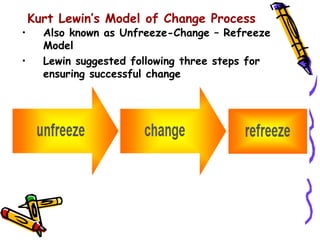
Kurt Lewin’s Model of Change Process
•     Also known as Unfreeze-Change – Refreeze
      Model
•     Lewin suggested following three steps for
      ensuring successful change
Kurt Lewin’s Model of Change Process
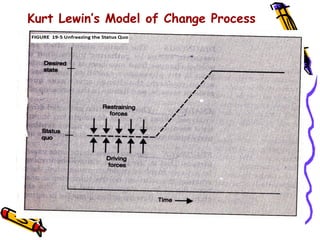
1. Unfreeze – change efforts to overcome the
   pressures of resistance to change. Driving
   forces for change need to be greater than
   restraining forces working for status quo.
   Following steps need to be taken:
•  Determine what needs to be done
•  Ensure there is strong support from upper
   management
•  Create the need for change
•  Understand & Manage doubts & concerns
Kurt Lewin’s Model of Change Process
contd …
2. Change – moving to new state. Following steps need to
    be taken:
•   Communicate often
•   Dispel rumours
•   Empower action
•   Involve people in the process
3. Refreeze – Stabilizing the change; making new
    change permanent. Following steps need to be
    taken:
•   Anchor the changes into culture
•   Develop ways to sustain the change
•   Provide support & training
•   Celebrate success
Bringing Organizational Change
a.    Diagnosing the Organizational capability to
      change
b.    Formula for Change
c.    Bringing change - Seven Levels of Change Model
Bringing Organizational Change
a.   Diagnosing the Organizational capability to change
•    Before initiating change process, it is very
     important to diagnose / assess the organizational
     capability to change.
•    If it is not assessed / diagnosed, then, at later
     stages, change process may go out of control,
     leading to huge costs to the organization.
Following parameters can be used to diagnose / assess
     organizational capability to change: -----
•    Organization culture
•    Vision for future
•    Commitment of top management
Bringing Organizational Change
a. Diagnosing the Organizational capability to change
Contd ....
•   Risk taking attitude of top management
•   Risk taking capabilities of the organization
•   Degree of flexibility in organizational systems and
    overall working
•   Effective communication
•   Strong leadership
•   Pool of dedicated managers and senior executives
•   Commitment, motivation and participation of
    workforce
•   Convergence of organizational goals and individual
    goals
Bringing Organizational Change
b. Formula for Change
•   The formula for change was developed by Richard
    Beckard and and David Gleicher. It is sometimes
    referred to as Gleicher’s formula.
•   The Gleicher’s formula stresses that the
    combination of organisational dissatisfaction,
    vision for the future and the possibility of
    immediate, tactical action must be stronger than
    the resistance within the organisation in order for
    meaningful change to occur.
•   Driving forces must be > restraining forces
Bringing Organizational Change
            Modified / Rectified Model
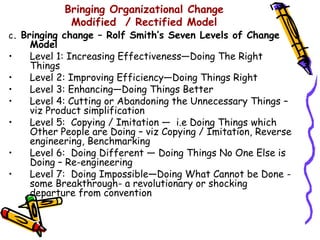
c. Bringing change – Rolf Smith’s Seven Levels of Change
    Model
•   Level 1: Increasing Effectiveness—Doing The Right
    Things
•   Level 2: Improving Efficiency—Doing Things Right
•   Level 3: Enhancing—Doing Things Better
•   Level 4: Cutting or Abandoning the Unnecessary Things –
    viz Product simplification
•   Level 5: Copying / Imitation — i.e Doing Things which
    Other People are Doing – viz Copying / Imitation, Reverse
    engineering, Benchmarking
•   Level 6: Doing Different — Doing Things No One Else is
    Doing – Re-engineering
•   Level 7: Doing Impossible—Doing What Cannot be Done -
    some Breakthrough- a revolutionary or shocking
    departure from convention
Change Process
           By
 Dr. Vijay Kr Khurana

Change process

  • 1.
    Change Process By Dr. Vijay Kr Khurana
  • 2.
    What is Change? • “ It is not the strongest of the species that survive, nor the most intelligent; but the most responsive to change.” • “ The quality of a successful man is to flow and not to freeze” – Ralph Waldo Emerson. What is Organizational Change ?
  • 3.
    What is ChangeProblem? • At the heart of change management lies the change problem, that is, some future state to be realized, some current state to be left behind, and some structured, organized process for getting from the one state to the other state. • At a conceptual level, the change problem is a matter of moving from one state (A) to another state (B). • In simpler terms, the change problem can be treated as smaller problems having to do with the how, what, and why of change. • a. Change as a 'How’ Problem b . Change as a ‘What’ Problem c. Change as a ‘Why’ Problem
  • 4.
    Nature / Features/ Characteristics of Organizational Change • Change makes things different • Change is inevitable • Change is usually an ongoing activity • Change results from factors both inside and outside the organization • Change offers new opportunities and poses new challenges • Change takes place in all parts of an organisation • Change takes place at varying rates in different parts of an organization.
  • 5.
    Nature / Features/ Characteristics of Organizational Change Contd … • Changes take place at different levels of an organization • Change may be both planned & unplanned • The rate of change may be slow or fast. • The quantum / magnitude of change may be of First Order (Incremental) or Second Order (Radical). • Organizational changes are not always uniform.
  • 6.
    Importance of Change •Change brings risk and uncertainties, which, if not managed properly, may lead to huge costs to the organization or even collapse of the organization • Change sometimes bring challenges without which life and business activities may become monotonous and repetitive. • Change may bring new business opportunities • Change sometimes brings new threats which act as stimuli for improvements
  • 7.
    Importance of Change Contd… • Change process may be used by the organizations to move from current state of business operations to next higher state of business operations. • Change process may enable the organization to abandon some negative cultural values, some outdated & obsolete practices and methods etc. • Change process can be used to raise motivation viz. by creating desire to support and participate in the change • Change process may lead to more satisfaction through improvement in worker skills and more worker participation
  • 8.
    Types of OrganizationalChange a. Planned Change (intentional or goal oriented) and Unplanned Change (accidental) b. Fast Change and Slow Change ( in terms of rate of change) c. First Order Change (incremental) and Second Order Change (fundamental or radical) in terms of magnitude / quantum
  • 9.
    Causes / Reasons/ Factors for Organizational Change a. External Factors: some factors are: • Change in Government Policies • Technological Advancement / Progress in external environment • Change in demographic characteristics • Market changes • Change in economic conditions – boom vs recession • Increase in raw material / input costs • Social Pressures etc.
  • 10.
    Causes / Reasons/ Factors for Organizational Change b. Internal Factors: some factors are: • Change in leadership • Structural reorganization • Adoption or Implementation of new technology • Decline in profitability • Productivity concerns • Industrial Relation Problems etc.
  • 11.
    10 Major Forcesof Change in Current Era • Demographic Changes • Political Stability - demand for social justice, inclusive growth • Environmental issues • Health Care issues - medical tourism etc • Tech & Innovation – breakthrough & disruptive technologies / innovation • Economic Transformation – globalization, open & inter-connected economies • Education & Awareness • Rising needs for Infrastructure • Safety and Security • Balance of Power- Have vs have-nots, Developed vs Developing countries, North vs south
  • 12.
    What is ChangeProcess? • It is the process which changes the state or which results in change • Change process as “Unfreezing, Changing & Refreezing” • Change process as problem solving & problem finding
  • 13.
    Kurt Lewin’s Modelof Change Process • Also known as Unfreeze-Change – Refreeze Model • Lewin suggested following three steps for ensuring successful change
  • 14.
    Kurt Lewin’s Modelof Change Process 1. Unfreeze – change efforts to overcome the pressures of resistance to change. Driving forces for change need to be greater than restraining forces working for status quo. Following steps need to be taken: • Determine what needs to be done • Ensure there is strong support from upper management • Create the need for change • Understand & Manage doubts & concerns
  • 15.
    Kurt Lewin’s Modelof Change Process
  • 16.
    Kurt Lewin’s Modelof Change Process contd … 2. Change – moving to new state. Following steps need to be taken: • Communicate often • Dispel rumours • Empower action • Involve people in the process 3. Refreeze – Stabilizing the change; making new change permanent. Following steps need to be taken: • Anchor the changes into culture • Develop ways to sustain the change • Provide support & training • Celebrate success
  • 17.
    Bringing Organizational Change a. Diagnosing the Organizational capability to change b. Formula for Change c. Bringing change - Seven Levels of Change Model
  • 18.
    Bringing Organizational Change a. Diagnosing the Organizational capability to change • Before initiating change process, it is very important to diagnose / assess the organizational capability to change. • If it is not assessed / diagnosed, then, at later stages, change process may go out of control, leading to huge costs to the organization. Following parameters can be used to diagnose / assess organizational capability to change: ----- • Organization culture • Vision for future • Commitment of top management
  • 19.
    Bringing Organizational Change a.Diagnosing the Organizational capability to change Contd .... • Risk taking attitude of top management • Risk taking capabilities of the organization • Degree of flexibility in organizational systems and overall working • Effective communication • Strong leadership • Pool of dedicated managers and senior executives • Commitment, motivation and participation of workforce • Convergence of organizational goals and individual goals
  • 20.
    Bringing Organizational Change b.Formula for Change • The formula for change was developed by Richard Beckard and and David Gleicher. It is sometimes referred to as Gleicher’s formula. • The Gleicher’s formula stresses that the combination of organisational dissatisfaction, vision for the future and the possibility of immediate, tactical action must be stronger than the resistance within the organisation in order for meaningful change to occur. • Driving forces must be > restraining forces
  • 21.
    Bringing Organizational Change Modified / Rectified Model c. Bringing change – Rolf Smith’s Seven Levels of Change Model • Level 1: Increasing Effectiveness—Doing The Right Things • Level 2: Improving Efficiency—Doing Things Right • Level 3: Enhancing—Doing Things Better • Level 4: Cutting or Abandoning the Unnecessary Things – viz Product simplification • Level 5: Copying / Imitation — i.e Doing Things which Other People are Doing – viz Copying / Imitation, Reverse engineering, Benchmarking • Level 6: Doing Different — Doing Things No One Else is Doing – Re-engineering • Level 7: Doing Impossible—Doing What Cannot be Done - some Breakthrough- a revolutionary or shocking departure from convention
  • 22.
    Change Process By Dr. Vijay Kr Khurana