By-
Supreet Anand
Vijay Kumar Mishra
Semester III (MBA – M52)
MONIRBA, University of Allahabad

 The term innovation refers to a “new way of doing
something”. It may refer to incremental and emergent or
radical and revolutionary changes in thinking, products,
processes, or organizations.
 Innovation recipes = Creativity + Failure + Iteration
What is innovation?

 Schumpeter argued that innovation comes about through
new combinations made by an entrepreneur, resulting in
 a new product,
 a new process,
 opening of new market,
 new way of organizing the business,
 new sources of supply
What is innovation?

 An innovation can increase profits on the
 Value side (customers value your innovation enough
to pay more for it)
 Or the cost side ( the company produces the offering
in a more efficient way)
 Either way, value is created for the firm and the
consumer.
What is innovation?

Innovation and Invention

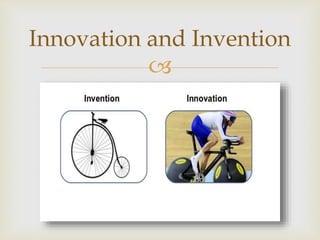
 An invention is different from an innovation at any
particular time in that it doesn't have commercial value
but it may have in future.
 There is no shortage of ideas and inventions in the
world. The challenge is to introduce these successfully to
a market.
 Only that idea/invention can be called an innovation.
Innovation and Invention

 In other words, innovation requires interplay
between a product offering (technology) and a
market (people).
 Innovation provides better quality product at lower
price which leads to higher standard of living.
 Old strategies are replicated.
Innovation and Invention

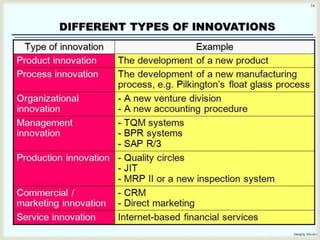
 Product Innovation
 Process Innovation
 Service Innovation
Types of Innovation

Product Innovation

 Change in how the product is noticed by the
consumers (change in physical structure).
 These changes include change in product design,
research and development, and new product
development (NPD).
 To meet customer needs and demands (why change?)
Product innovation

 The degree of change can include the following:
 Incremental improvements
 Addition to product families
 Next-gen products
 New core products
 Examples of product innovation are as follows:
 Introducing a new screen size for TVs.
 Changing from a CRT TV to a flat screen.
 Adding functionality such as internet access to TVs.
Product innovation

 Continuous improvements, making the product more:
 efficient, effective
 useful or user friendly
 valuable to users
 integrated with other products, technologies, or
systems.
Product Innovation

 It involves a new or significantly improved method for the
production or delivery of output that adds value to the
organization.
 The term “process” refer to an interrelated set of activities
designed to transform inputs into a specified output for benefits
of customers.
 Processes relate to all operational activities by which value is
offered to the end customer, such as acquisition of raw
Material, manufacturing logistics and after sales service.
Process Innovation

 Make processes:
 simpler
 faster
 more accurate
 more reliable
 less expensive
 Reducing unit costs by improving the production capacity.
Process Innovation

Service Innovation

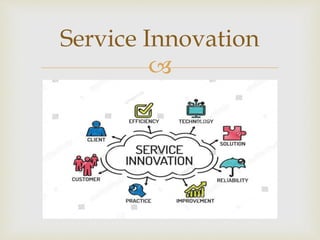
 Services involves products (intangible) that form an extended
part of the product life cycle, from initial sales to end-of-life
recycling and disposal.
 Service industries in areas such as finance, food, education,
transportation, health make up most organizations in any
economy. These organizations also need to innovate
continuously so that they can increase/improve the levels of
service to their customers.
Service Innovation

 New way of providing service / a new service.
 New information technology platforms, particularly the
internet have also added the scope of service innovation. The
internet is a valuable resource on which new service
relationships between organizations and their customers are
being developed every day.
 Technology + better service.
Service Innovation


Innovation has
two phases :
Design Phase
Implementation
Phase
Phases of Innovation

 The design phase is marked by much divergent thinking
and creativity, brainstorming, search for alternatives, etc.
Research studies suggest that the management of the
design phase needs to be marked by great administrative
flexibility and these types of innovation to achieve the
necessary growth to survive.
Design Phase

 It requires a very different mode of management.
 It involves putting the chosen innovation to work.
 Much planning needs to be done, careful
coordination & control, and evaluation of progress.
Implementation Phase

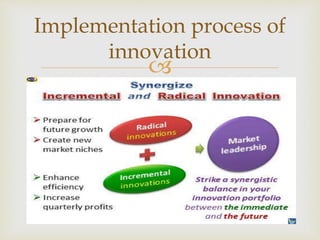
 Radical innovation - It is about making major
changes in something established. Focus is
significant in relation to expected changing in the
system. A change can be represent a radical
innovation, when viewed at technological level, but
the impact may be only incremental when viewed at
an organization level.
Implementation Process Of
Innovation

 Incremental innovation :- It is less ambitious in its
scope and offers less potential for returns for the
organization, but consequently the associated risks
are much less. It consists of smaller endeavors,
making than easier to manage than their larger
innovation.
Implementation process of
innovation

Implementation process of
innovation

Implementation process of
innovation

THANK YOU

Innovation - Types and Phases

  • 1.
    By- Supreet Anand Vijay KumarMishra Semester III (MBA – M52) MONIRBA, University of Allahabad
  • 3.
      The terminnovation refers to a “new way of doing something”. It may refer to incremental and emergent or radical and revolutionary changes in thinking, products, processes, or organizations.  Innovation recipes = Creativity + Failure + Iteration What is innovation?
  • 4.
      Schumpeter arguedthat innovation comes about through new combinations made by an entrepreneur, resulting in  a new product,  a new process,  opening of new market,  new way of organizing the business,  new sources of supply What is innovation?
  • 5.
      An innovationcan increase profits on the  Value side (customers value your innovation enough to pay more for it)  Or the cost side ( the company produces the offering in a more efficient way)  Either way, value is created for the firm and the consumer. What is innovation?
  • 6.
  • 7.
      An inventionis different from an innovation at any particular time in that it doesn't have commercial value but it may have in future.  There is no shortage of ideas and inventions in the world. The challenge is to introduce these successfully to a market.  Only that idea/invention can be called an innovation. Innovation and Invention
  • 8.
      In otherwords, innovation requires interplay between a product offering (technology) and a market (people).  Innovation provides better quality product at lower price which leads to higher standard of living.  Old strategies are replicated. Innovation and Invention
  • 9.
      Product Innovation Process Innovation  Service Innovation Types of Innovation
  • 10.
  • 11.
      Change inhow the product is noticed by the consumers (change in physical structure).  These changes include change in product design, research and development, and new product development (NPD).  To meet customer needs and demands (why change?) Product innovation
  • 12.
      The degreeof change can include the following:  Incremental improvements  Addition to product families  Next-gen products  New core products  Examples of product innovation are as follows:  Introducing a new screen size for TVs.  Changing from a CRT TV to a flat screen.  Adding functionality such as internet access to TVs. Product innovation
  • 13.
      Continuous improvements,making the product more:  efficient, effective  useful or user friendly  valuable to users  integrated with other products, technologies, or systems. Product Innovation
  • 14.
      It involvesa new or significantly improved method for the production or delivery of output that adds value to the organization.  The term “process” refer to an interrelated set of activities designed to transform inputs into a specified output for benefits of customers.  Processes relate to all operational activities by which value is offered to the end customer, such as acquisition of raw Material, manufacturing logistics and after sales service. Process Innovation
  • 15.
      Make processes: simpler  faster  more accurate  more reliable  less expensive  Reducing unit costs by improving the production capacity. Process Innovation
  • 16.
  • 17.
      Services involvesproducts (intangible) that form an extended part of the product life cycle, from initial sales to end-of-life recycling and disposal.  Service industries in areas such as finance, food, education, transportation, health make up most organizations in any economy. These organizations also need to innovate continuously so that they can increase/improve the levels of service to their customers. Service Innovation
  • 18.
      New wayof providing service / a new service.  New information technology platforms, particularly the internet have also added the scope of service innovation. The internet is a valuable resource on which new service relationships between organizations and their customers are being developed every day.  Technology + better service. Service Innovation
  • 19.
  • 20.
     Innovation has two phases: Design Phase Implementation Phase Phases of Innovation
  • 21.
      The designphase is marked by much divergent thinking and creativity, brainstorming, search for alternatives, etc. Research studies suggest that the management of the design phase needs to be marked by great administrative flexibility and these types of innovation to achieve the necessary growth to survive. Design Phase
  • 22.
      It requiresa very different mode of management.  It involves putting the chosen innovation to work.  Much planning needs to be done, careful coordination & control, and evaluation of progress. Implementation Phase
  • 23.
      Radical innovation- It is about making major changes in something established. Focus is significant in relation to expected changing in the system. A change can be represent a radical innovation, when viewed at technological level, but the impact may be only incremental when viewed at an organization level. Implementation Process Of Innovation
  • 24.
      Incremental innovation:- It is less ambitious in its scope and offers less potential for returns for the organization, but consequently the associated risks are much less. It consists of smaller endeavors, making than easier to manage than their larger innovation. Implementation process of innovation
  • 25.
  • 26.
  • 27.