TEACHING
METHODS
Faculty Development Training
Panpacific University North Philippines
Urdaneta City, Pangasinan, Philippines
IGS Conference Room
May 23, 2013
HRM Function Hall
October 23, 2012
MARIA MARTHA MANETTE APOSTOL MADRID, Ed.D.
Lecturer
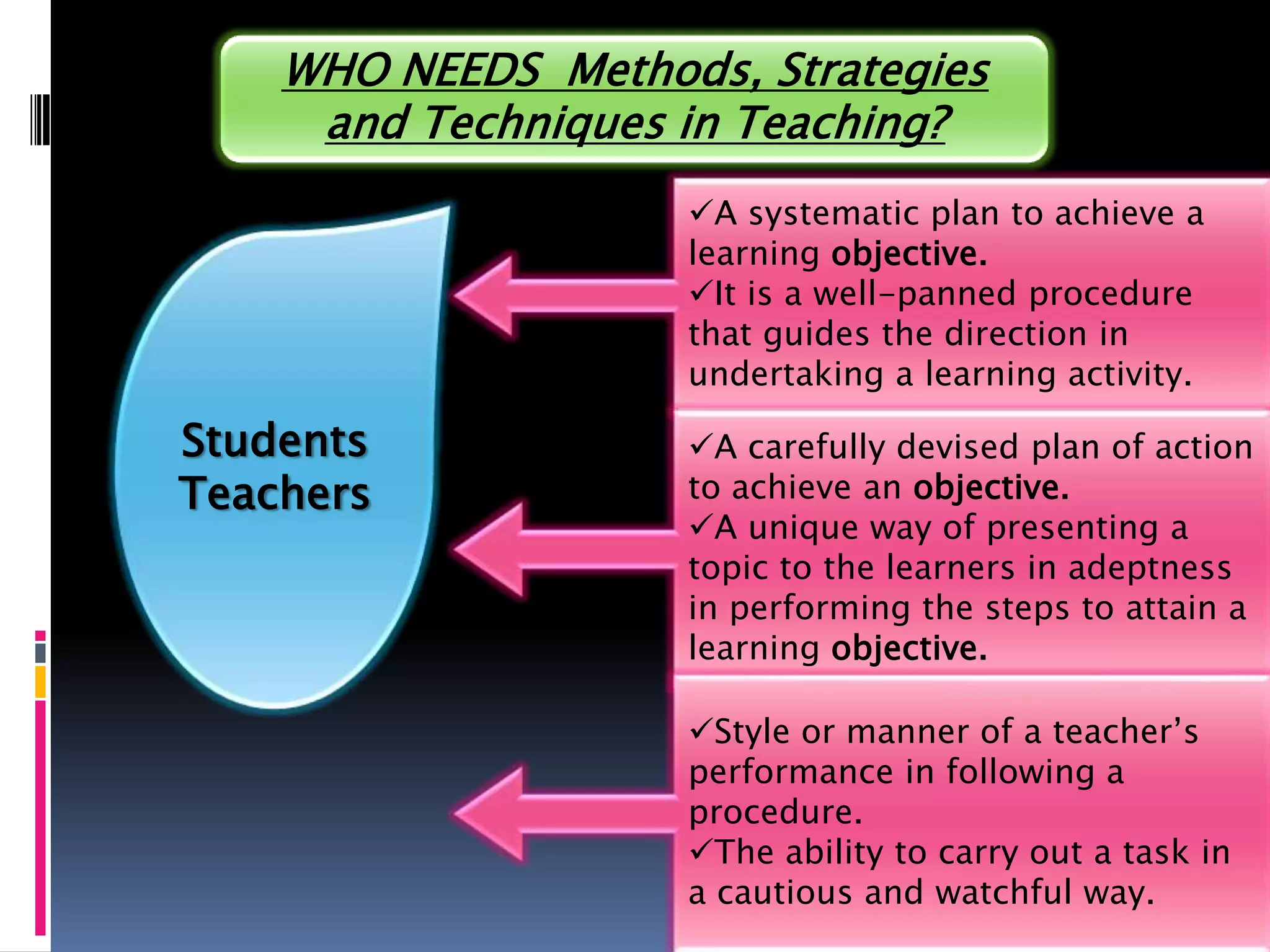
WHO NEEDS Methods, Strategies
and Techniques in Teaching?
Students
Teachers
A systematic plan to achieve a
learning objective.
It is a well-panned procedure
that guides the direction in
undertaking a learning activity.
A carefully devised plan of action
to achieve an objective.
A unique way of presenting a
topic to the learners in adeptness
in performing the steps to attain a
learning objective.
Style or manner of a teacher’s
performance in following a
procedure.
The ability to carry out a task in
a cautious and watchful way.
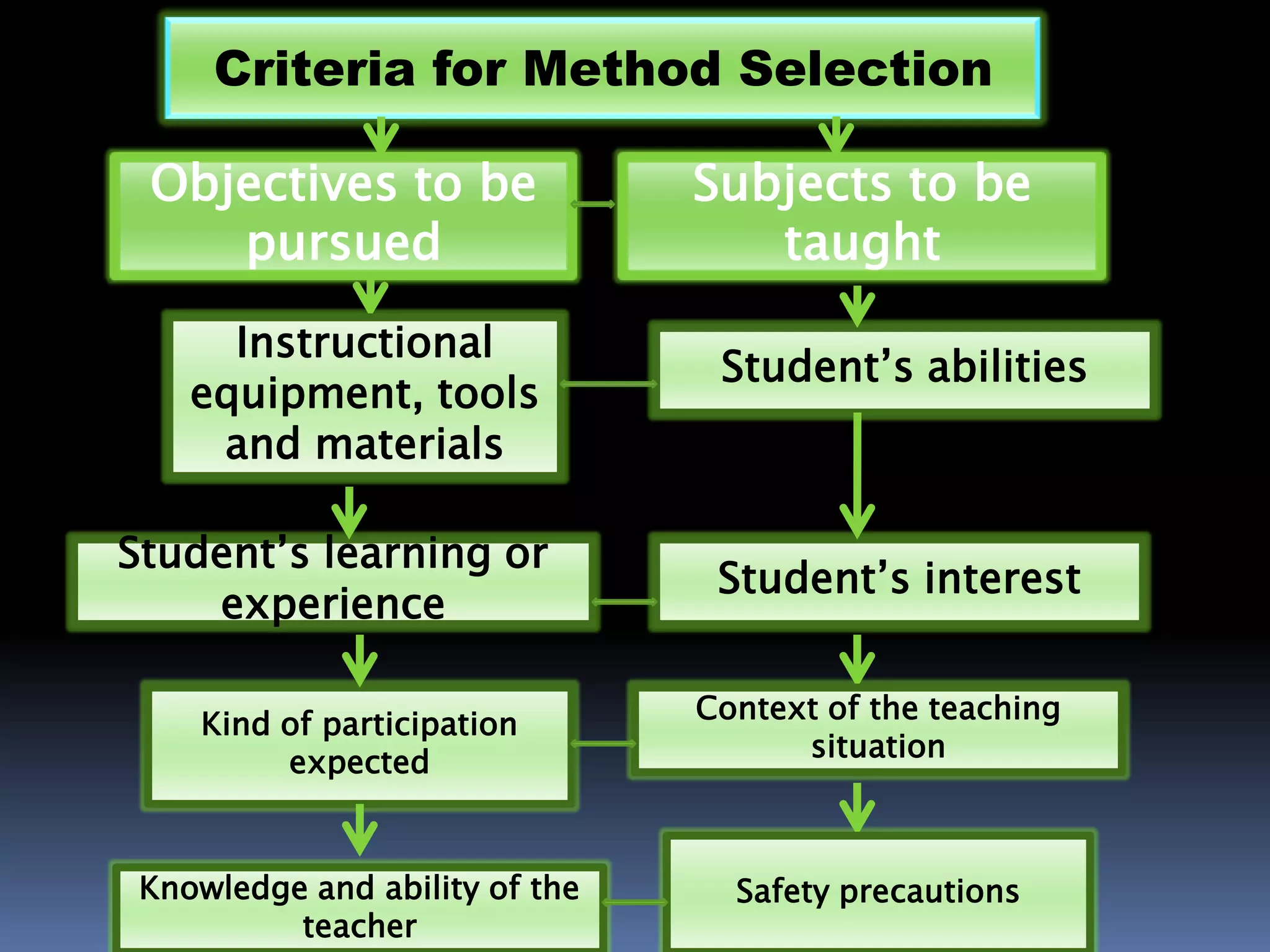
Criteria for Method Selection
Objectives to be
pursued
Kind of participation
expected
Student’s learning or
experience
Student’s interest
Student’s abilities
Subjects to be
taught
Instructional
equipment, tools
and materials
Context of the teaching
situation
Knowledge and ability of the
teacher
Safety precautions
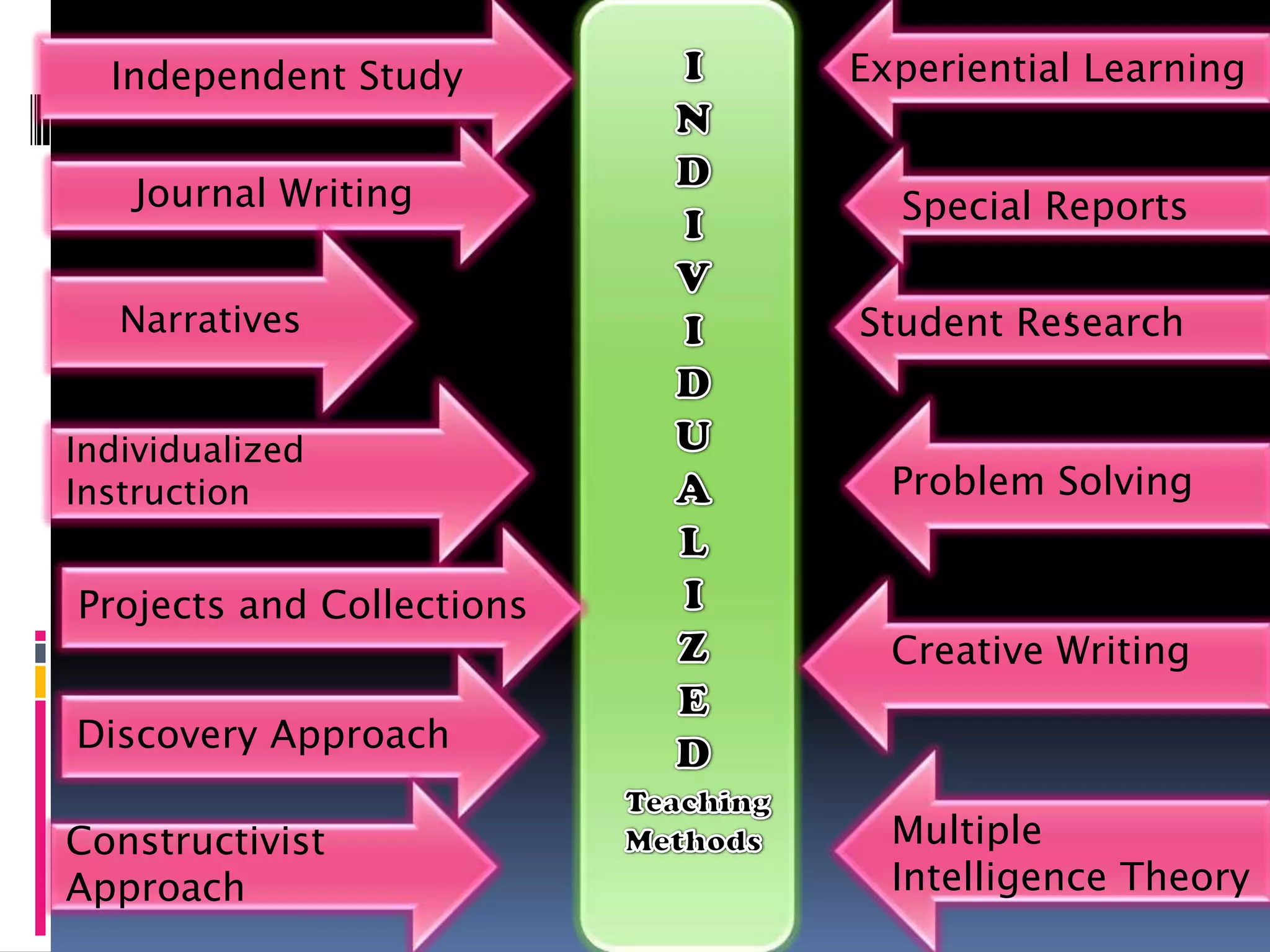
Independent Study
Journal Writing
Narratives
Individualized
Instruction
Discovery Approach
Experiential Learning
Special Reports
,Student Research
Multiple
Intelligence Theory
Projects and Collections
Constructivist
Approach
Creative Writing
Problem Solving
Individualized Teaching Methods
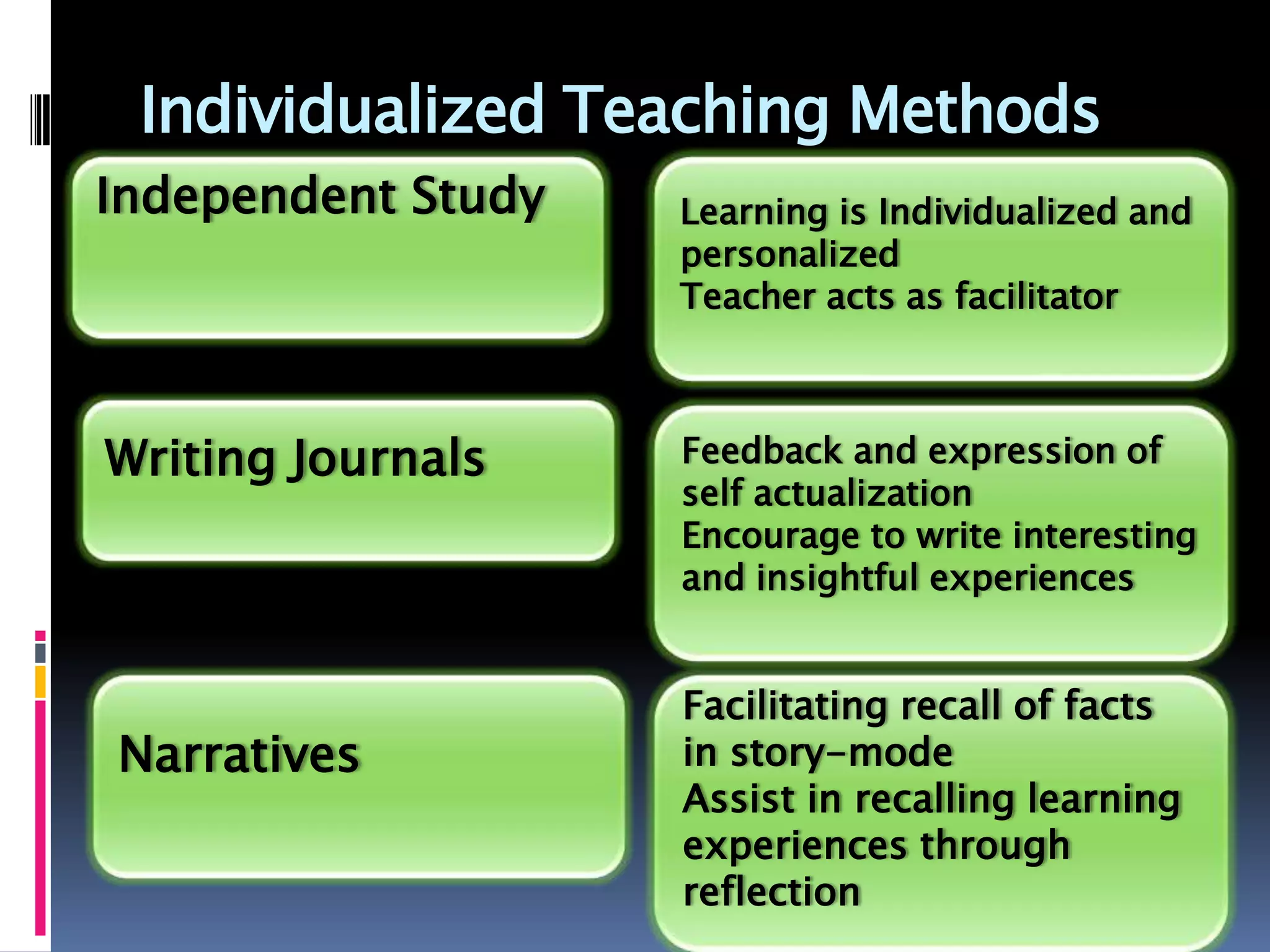
Learning is Individualized and
personalized
Teacher acts as facilitator
Independent Study
Writing Journals Feedback and expression of
self actualization
Encourage to write interesting
and insightful experiences
Narratives
Facilitating recall of facts
in story-mode
Assist in recalling learning
experiences through
reflection
Individualized Teaching Methods
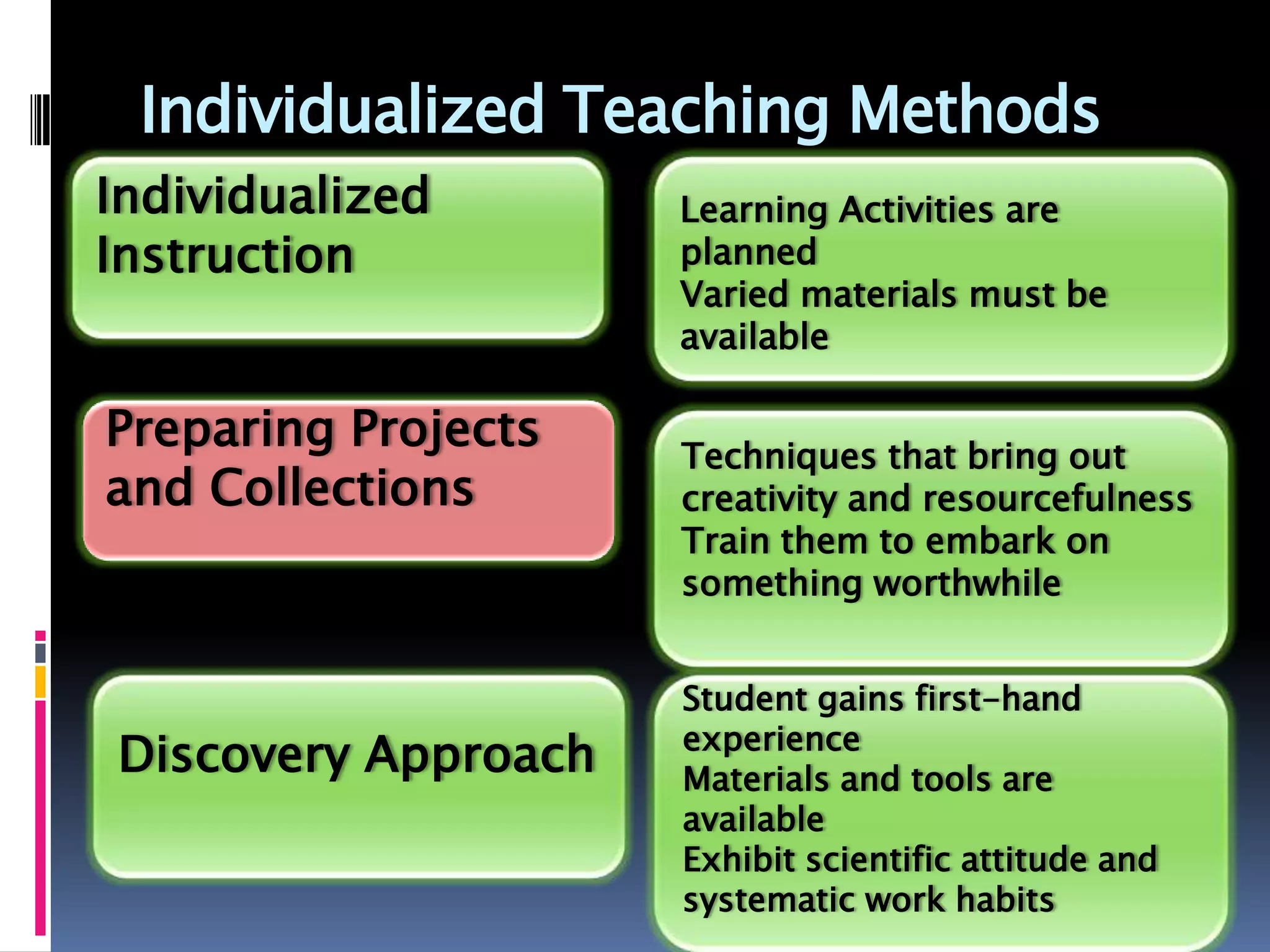
Learning Activities are
planned
Varied materials must be
available
Individualized
Instruction
Preparing Projects
and Collections
Techniques that bring out
creativity and resourcefulness
Train them to embark on
something worthwhile
Discovery Approach
Student gains first-hand
experience
Materials and tools are
available
Exhibit scientific attitude and
systematic work habits
Individualized Teaching Methods
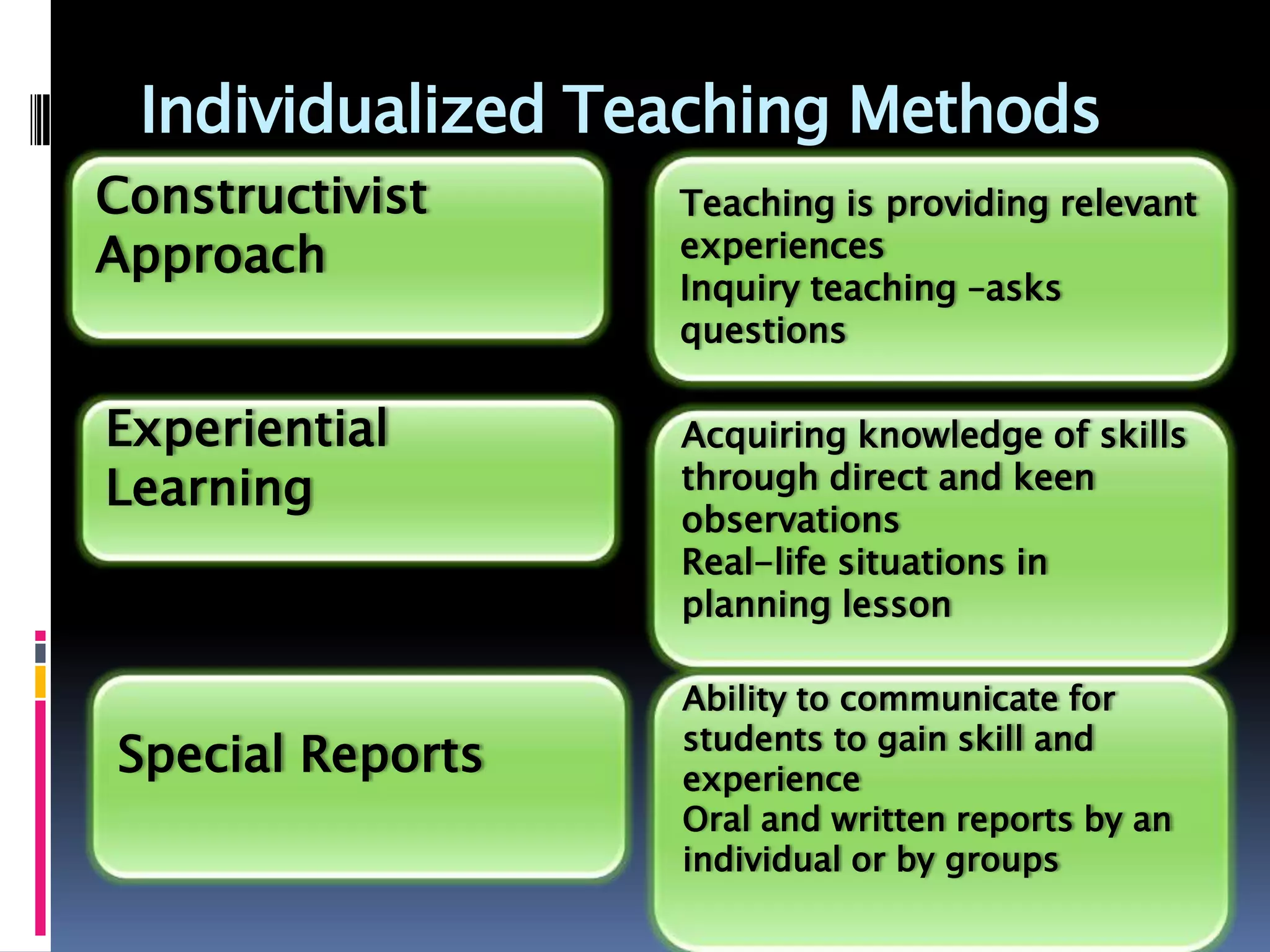
Teaching is providing relevant
experiences
Inquiry teaching –asks
questions
Constructivist
Approach
Experiential
Learning
Acquiring knowledge of skills
through direct and keen
observations
Real-life situations in
planning lesson
Special Reports
Ability to communicate for
students to gain skill and
experience
Oral and written reports by an
individual or by groups
Individualized Teaching Methods
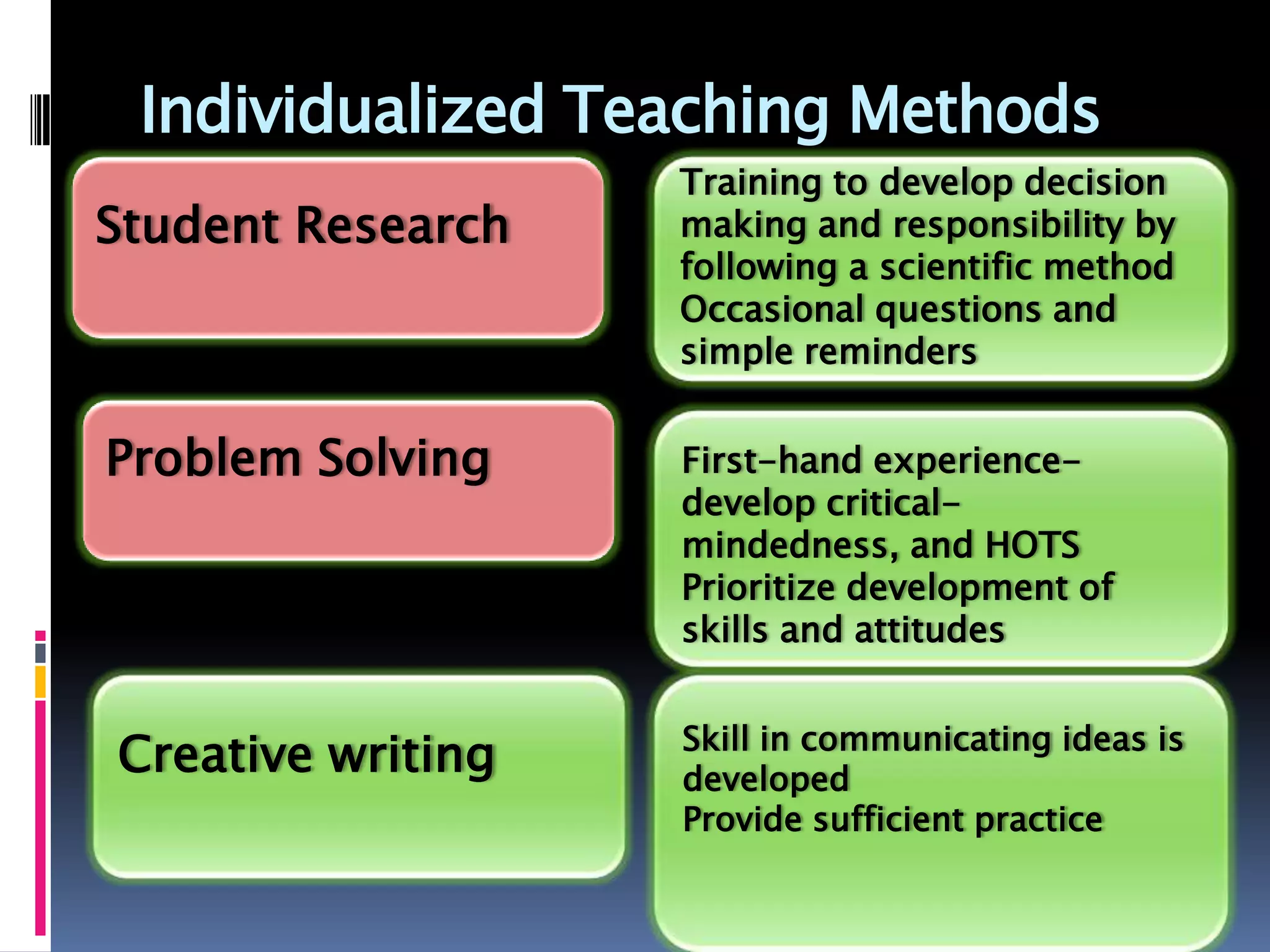
Training to develop decision
making and responsibility by
following a scientific method
Occasional questions and
simple reminders
Student Research
Problem Solving First-hand experience-
develop critical-
mindedness, and HOTS
Prioritize development of
skills and attitudes
Creative writing Skill in communicating ideas is
developed
Provide sufficient practice
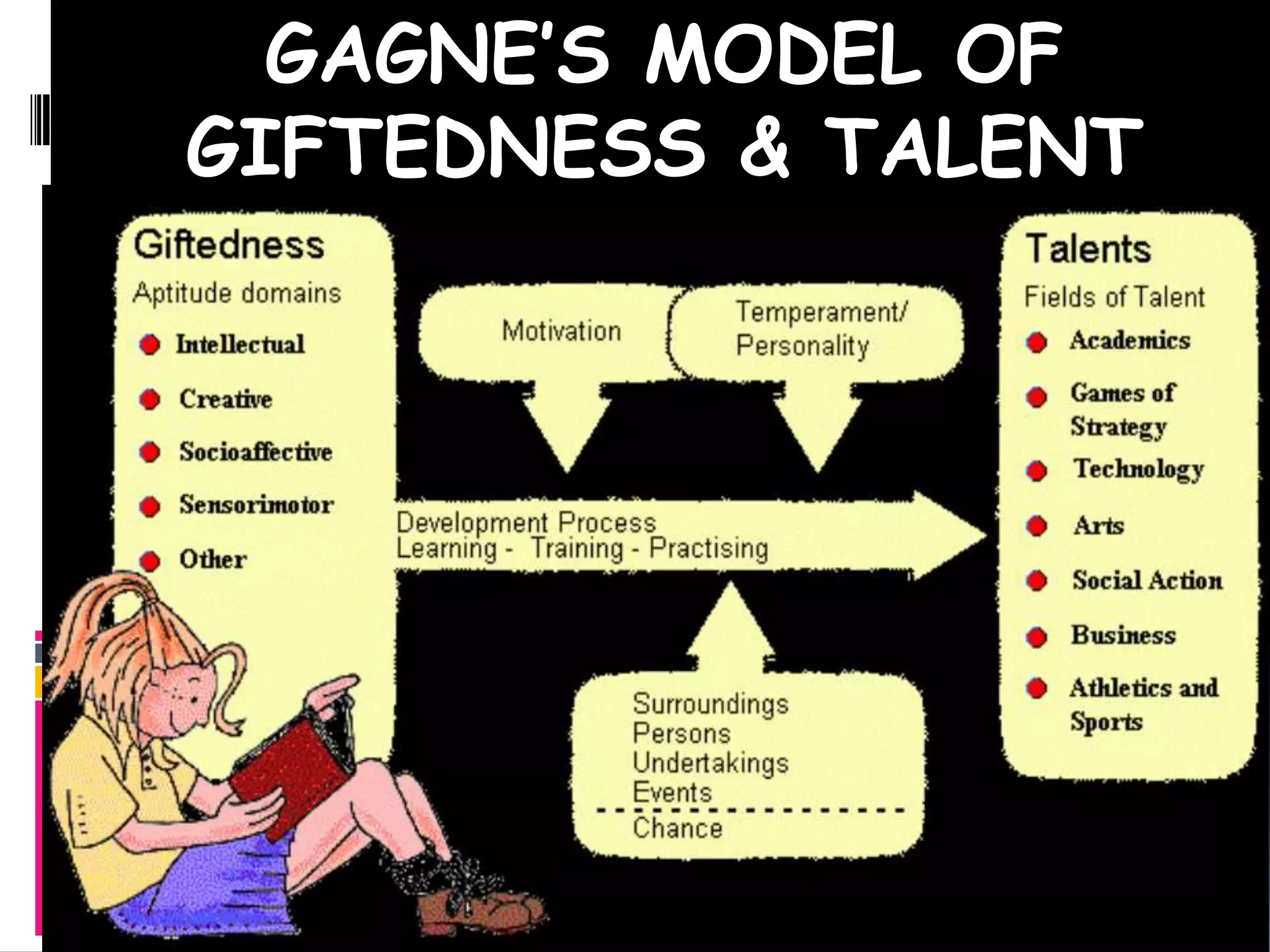
GAGNE’S MODEL OF
GIFTEDNESS & TALENT
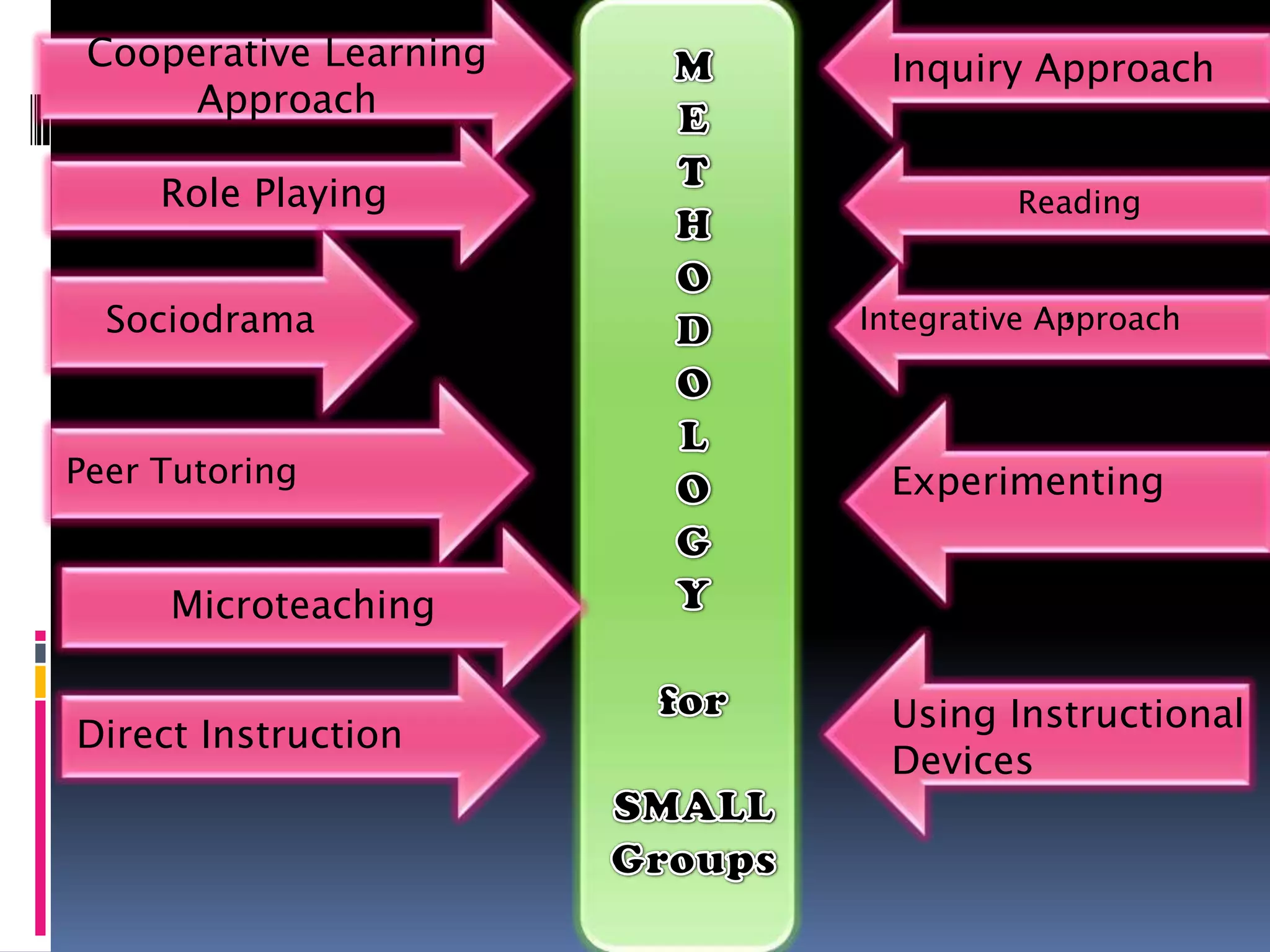
Cooperative Learning
Approach
Role Playing
Sociodrama
Peer Tutoring
Direct Instruction
Inquiry Approach
Reading
,Integrative Approach
Microteaching
Experimenting
Using Instructional
Devices
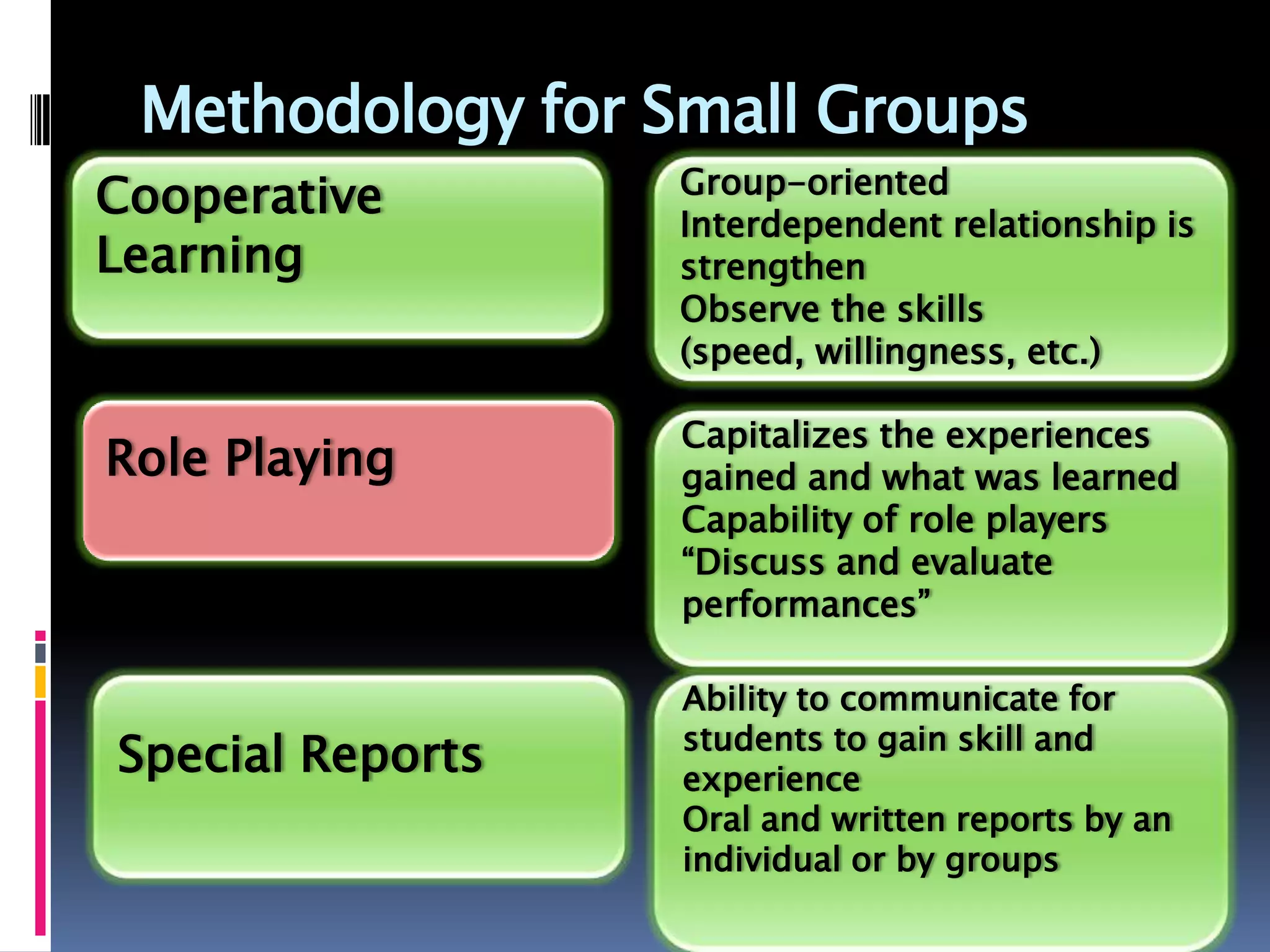
Methodology for Small Groups
Group-oriented
Interdependent relationship is
strengthen
Observe the skills
(speed, willingness, etc.)
Cooperative
Learning
Role Playing
Capitalizes the experiences
gained and what was learned
Capability of role players
“Discuss and evaluate
performances”
Special Reports
Ability to communicate for
students to gain skill and
experience
Oral and written reports by an
individual or by groups
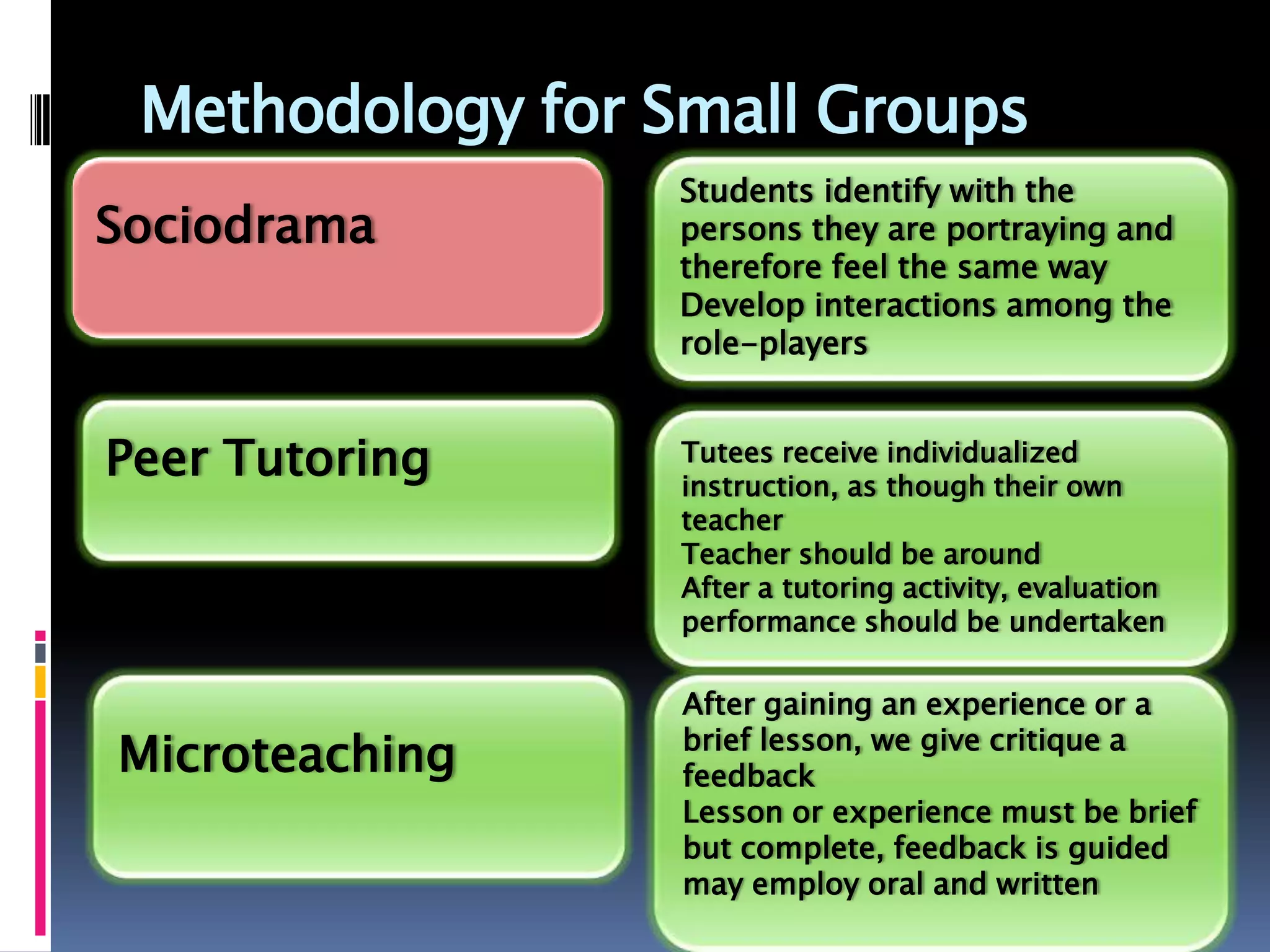
Methodology for Small Groups
Students identify with the
persons they are portraying and
therefore feel the same way
Develop interactions among the
role-players
Sociodrama
Peer Tutoring Tutees receive individualized
instruction, as though their own
teacher
Teacher should be around
After a tutoring activity, evaluation
performance should be undertaken
Microteaching
After gaining an experience or a
brief lesson, we give critique a
feedback
Lesson or experience must be brief
but complete, feedback is guided
may employ oral and written
Methodology for Small Groups
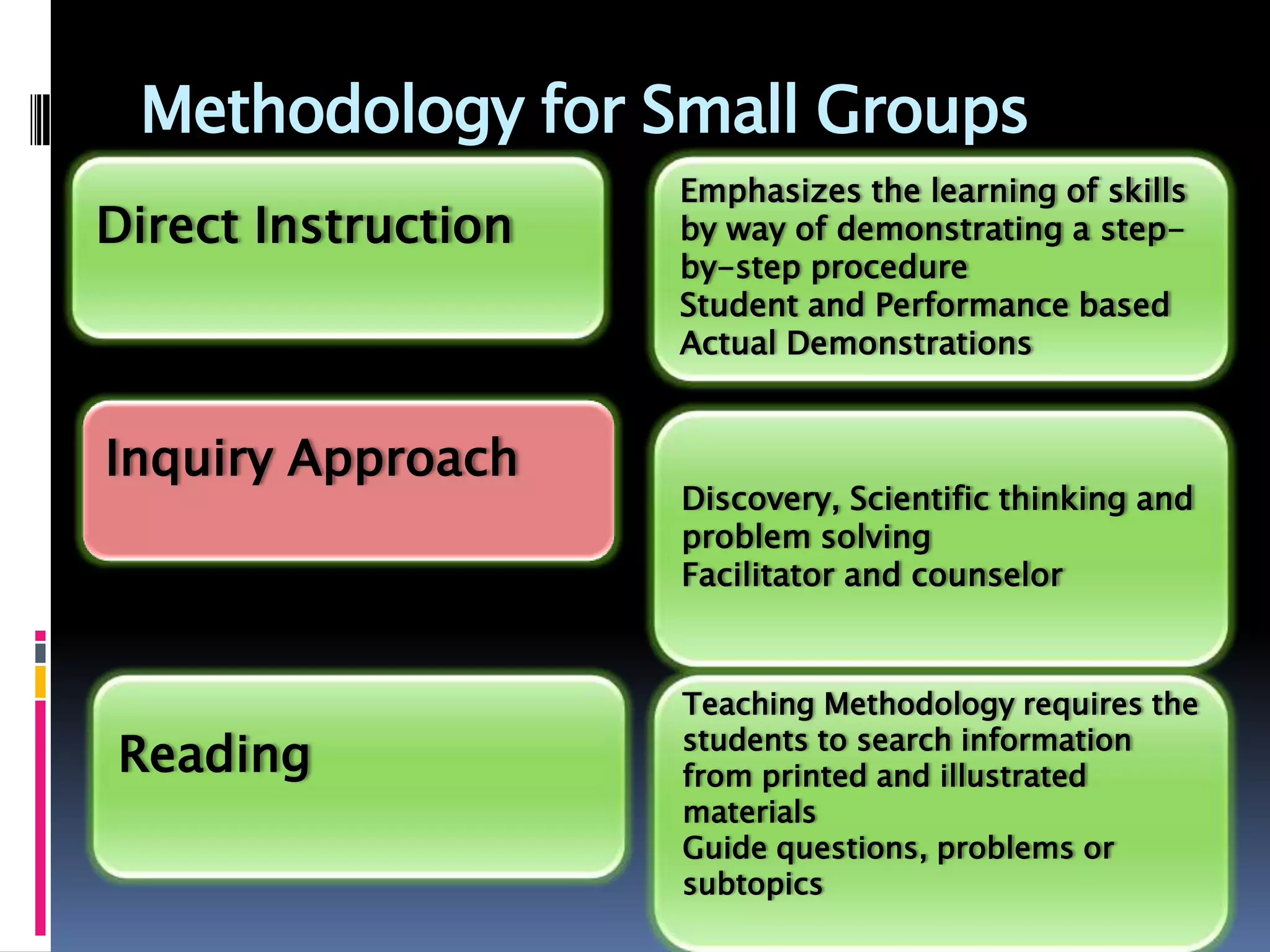
Emphasizes the learning of skills
by way of demonstrating a step-
by-step procedure
Student and Performance based
Actual Demonstrations
Direct Instruction
Inquiry Approach
Discovery, Scientific thinking and
problem solving
Facilitator and counselor
Reading
Teaching Methodology requires the
students to search information
from printed and illustrated
materials
Guide questions, problems or
subtopics
Methodology for Small Groups
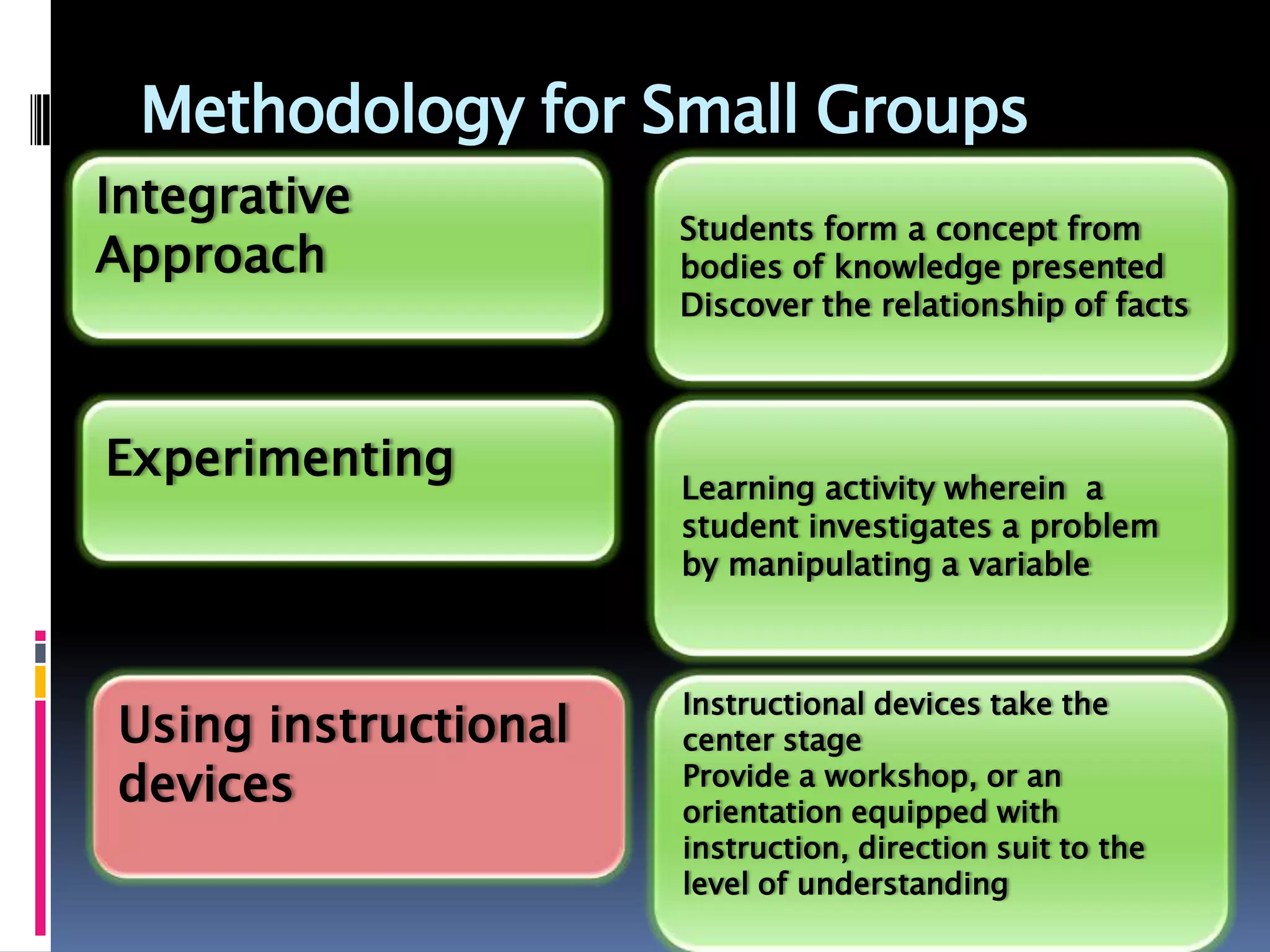
Students form a concept from
bodies of knowledge presented
Discover the relationship of facts
Integrative
Approach
Experimenting Learning activity wherein a
student investigates a problem
by manipulating a variable
Using instructional
devices
Instructional devices take the
center stage
Provide a workshop, or an
orientation equipped with
instruction, direction suit to the
level of understanding
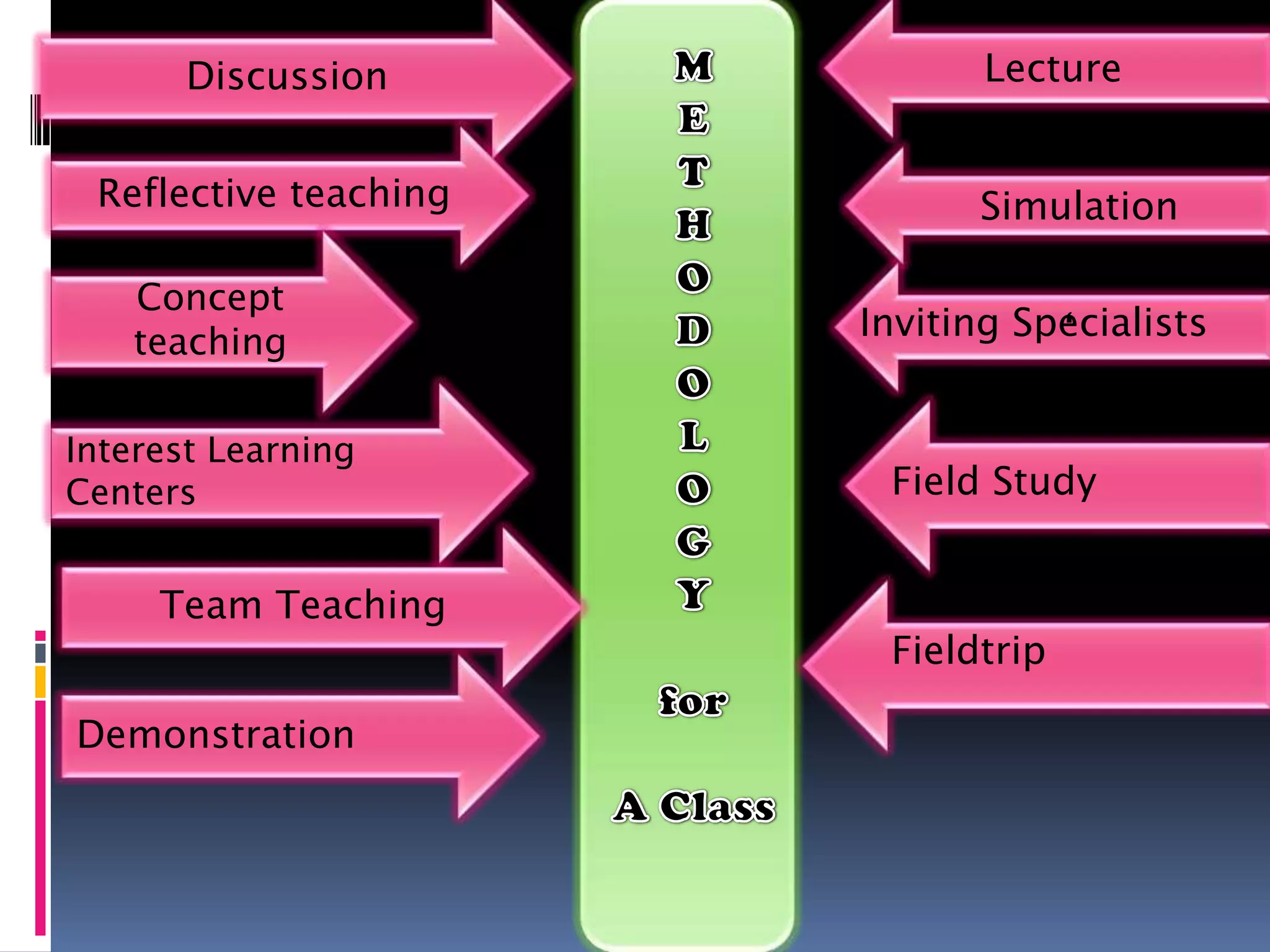
Discussion
Reflective teaching
Concept
teaching
Interest Learning
Centers
Demonstration
Lecture
Simulation
,Inviting Specialists
Team Teaching
Fieldtrip
Field Study
Methodologies for a Class
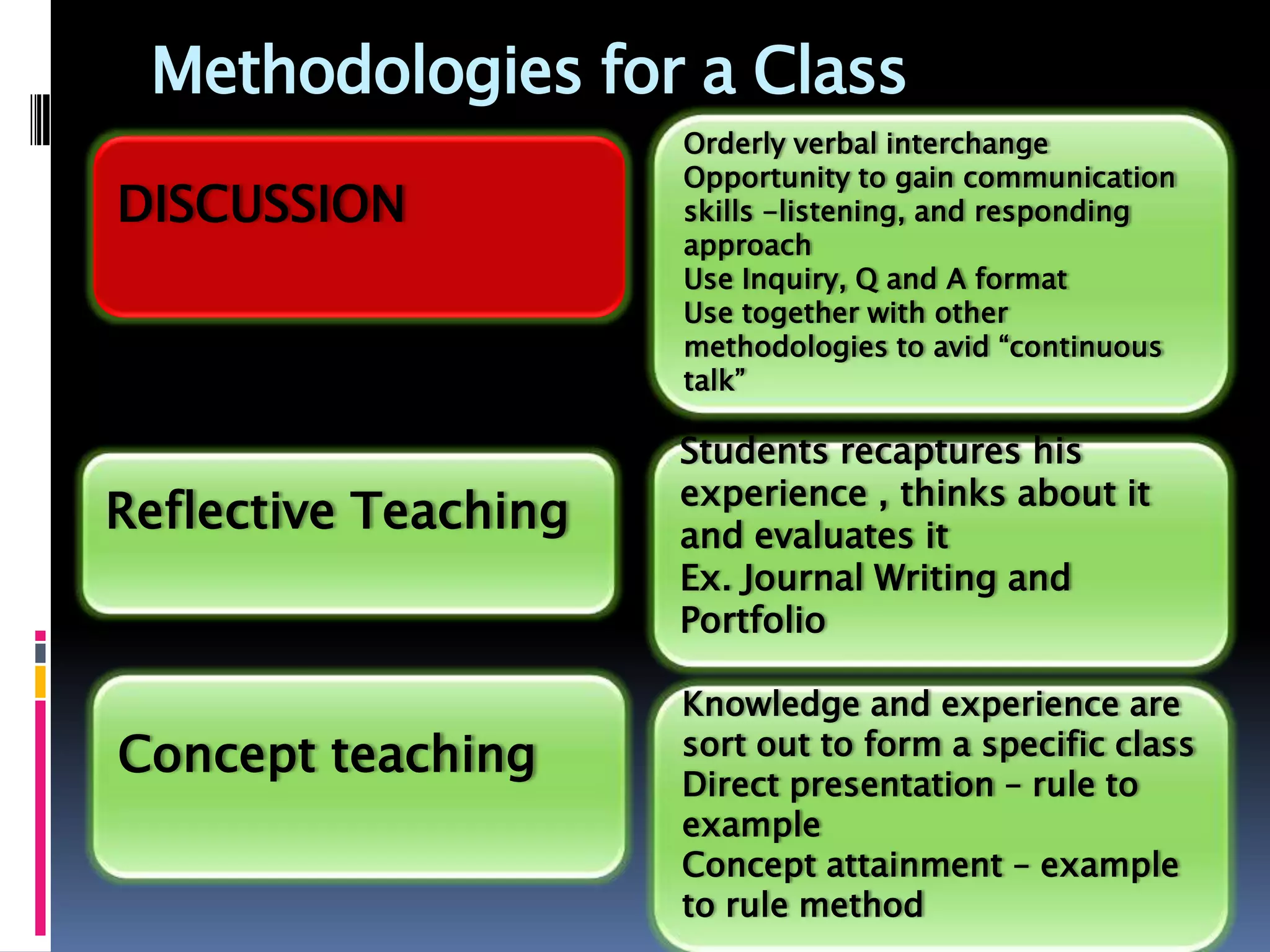
Orderly verbal interchange
Opportunity to gain communication
skills -listening, and responding
approach
Use Inquiry, Q and A format
Use together with other
methodologies to avid “continuous
talk”
DISCUSSION
Reflective Teaching
Students recaptures his
experience , thinks about it
and evaluates it
Ex. Journal Writing and
Portfolio
Concept teaching
Knowledge and experience are
sort out to form a specific class
Direct presentation – rule to
example
Concept attainment – example
to rule method
Methodologies for a Class
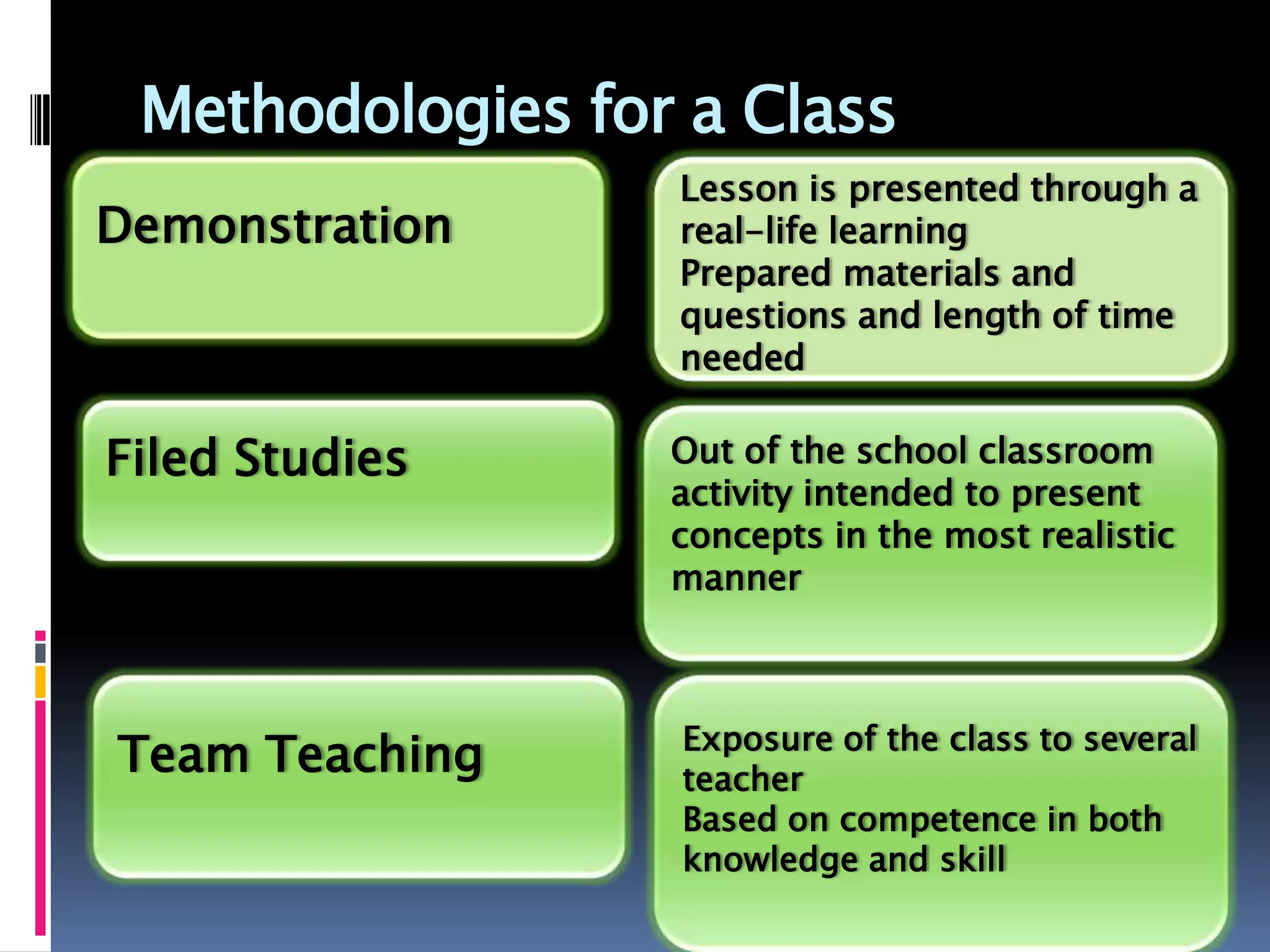
Lesson is presented through a
real-life learning
Prepared materials and
questions and length of time
needed
Demonstration
Filed Studies Out of the school classroom
activity intended to present
concepts in the most realistic
manner
Team Teaching Exposure of the class to several
teacher
Based on competence in both
knowledge and skill
Methodologies for a Class
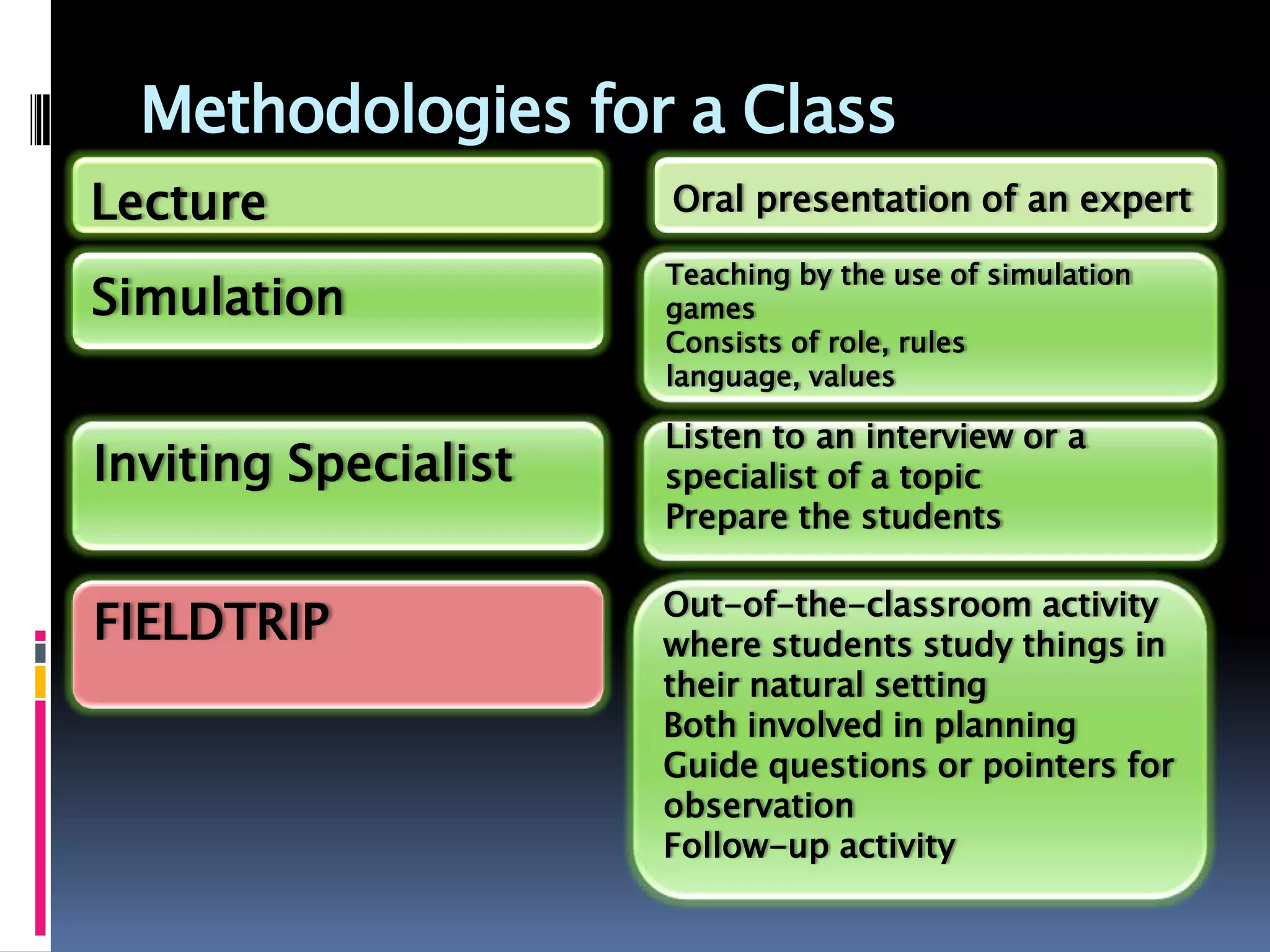
Oral presentation of an expertLecture
Simulation
Teaching by the use of simulation
games
Consists of role, rules
language, values
Inviting Specialist
Listen to an interview or a
specialist of a topic
Prepare the students
FIELDTRIP Out-of-the-classroom activity
where students study things in
their natural setting
Both involved in planning
Guide questions or pointers for
observation
Follow-up activity
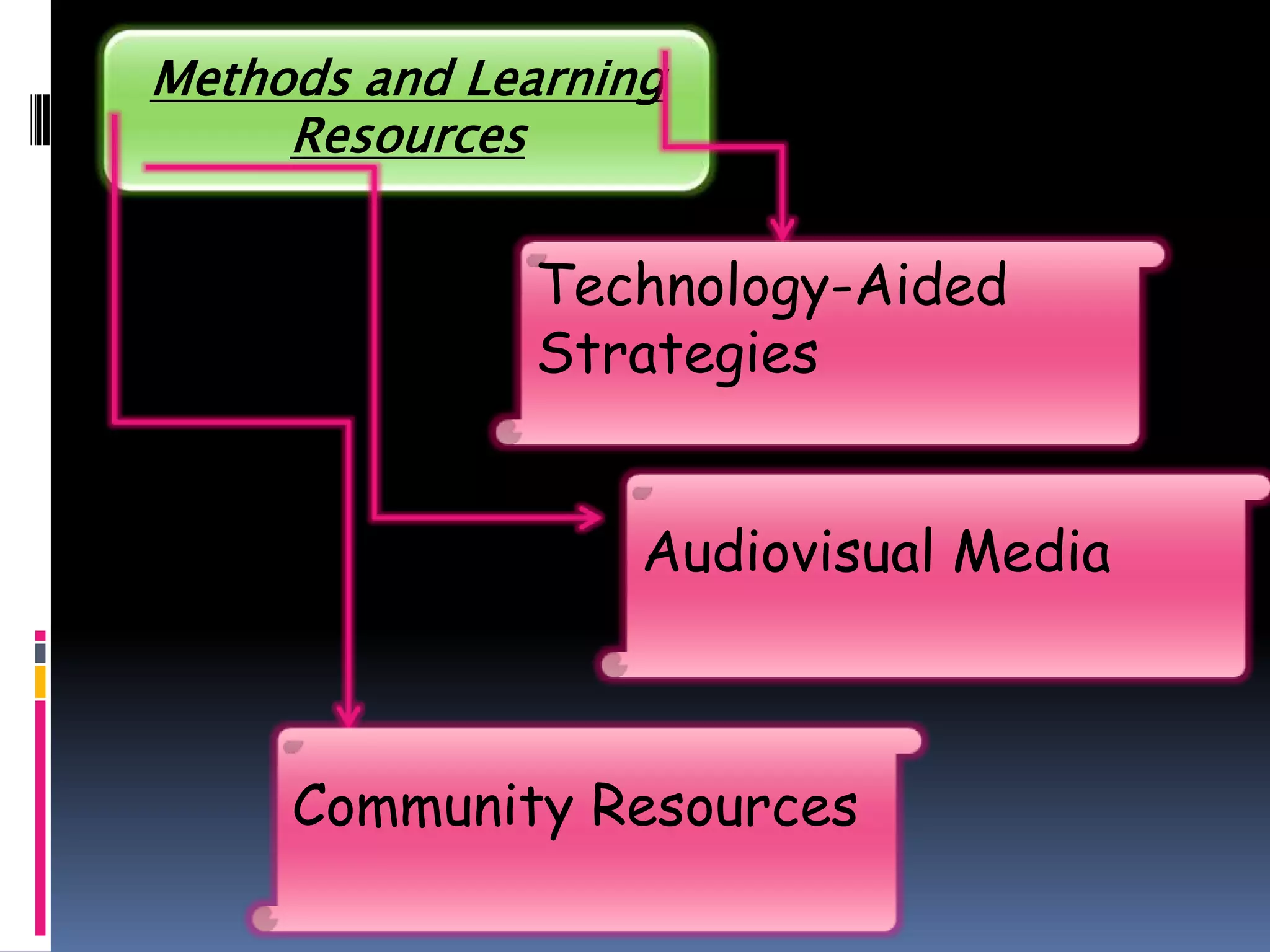
Methods and Learning
Resources
Technology-Aided
Strategies
Audiovisual Media
Community Resources
Reference/s
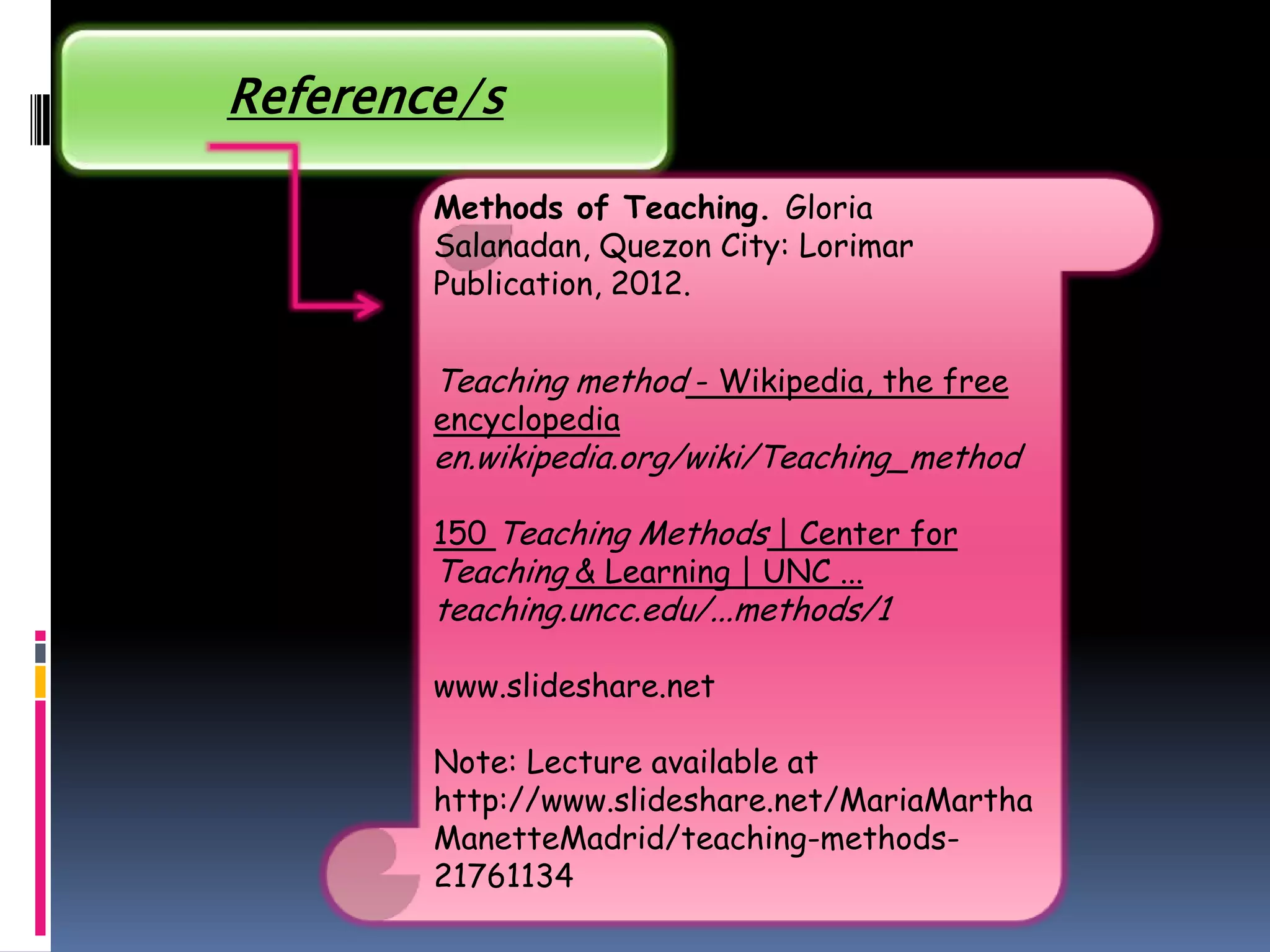
Methods of Teaching. Gloria
Salanadan, Quezon City: Lorimar
Publication, 2012.
Teaching method - Wikipedia, the free
encyclopedia
en.wikipedia.org/wiki/Teaching_method
150 Teaching Methods | Center for
Teaching & Learning | UNC ...
teaching.uncc.edu/...methods/1
www.slideshare.net
Note: Lecture available at
http://www.slideshare.net/MariaMartha
ManetteMadrid/teaching-methods-
21761134
Harry Wong had said, true
educators are the ones who
will always be willing to
share their knowledge and
resources to other
educators.

Teaching methods

  • 1.
    TEACHING METHODS Faculty Development Training PanpacificUniversity North Philippines Urdaneta City, Pangasinan, Philippines IGS Conference Room May 23, 2013 HRM Function Hall October 23, 2012 MARIA MARTHA MANETTE APOSTOL MADRID, Ed.D. Lecturer
  • 2.
    WHO NEEDS Methods,Strategies and Techniques in Teaching? Students Teachers A systematic plan to achieve a learning objective. It is a well-panned procedure that guides the direction in undertaking a learning activity. A carefully devised plan of action to achieve an objective. A unique way of presenting a topic to the learners in adeptness in performing the steps to attain a learning objective. Style or manner of a teacher’s performance in following a procedure. The ability to carry out a task in a cautious and watchful way.
  • 3.
    Criteria for MethodSelection Objectives to be pursued Kind of participation expected Student’s learning or experience Student’s interest Student’s abilities Subjects to be taught Instructional equipment, tools and materials Context of the teaching situation Knowledge and ability of the teacher Safety precautions
  • 4.
    Independent Study Journal Writing Narratives Individualized Instruction DiscoveryApproach Experiential Learning Special Reports ,Student Research Multiple Intelligence Theory Projects and Collections Constructivist Approach Creative Writing Problem Solving
  • 5.
    Individualized Teaching Methods Learningis Individualized and personalized Teacher acts as facilitator Independent Study Writing Journals Feedback and expression of self actualization Encourage to write interesting and insightful experiences Narratives Facilitating recall of facts in story-mode Assist in recalling learning experiences through reflection
  • 6.
    Individualized Teaching Methods LearningActivities are planned Varied materials must be available Individualized Instruction Preparing Projects and Collections Techniques that bring out creativity and resourcefulness Train them to embark on something worthwhile Discovery Approach Student gains first-hand experience Materials and tools are available Exhibit scientific attitude and systematic work habits
  • 7.
    Individualized Teaching Methods Teachingis providing relevant experiences Inquiry teaching –asks questions Constructivist Approach Experiential Learning Acquiring knowledge of skills through direct and keen observations Real-life situations in planning lesson Special Reports Ability to communicate for students to gain skill and experience Oral and written reports by an individual or by groups
  • 8.
    Individualized Teaching Methods Trainingto develop decision making and responsibility by following a scientific method Occasional questions and simple reminders Student Research Problem Solving First-hand experience- develop critical- mindedness, and HOTS Prioritize development of skills and attitudes Creative writing Skill in communicating ideas is developed Provide sufficient practice
  • 9.
  • 10.
    Cooperative Learning Approach Role Playing Sociodrama PeerTutoring Direct Instruction Inquiry Approach Reading ,Integrative Approach Microteaching Experimenting Using Instructional Devices
  • 11.
    Methodology for SmallGroups Group-oriented Interdependent relationship is strengthen Observe the skills (speed, willingness, etc.) Cooperative Learning Role Playing Capitalizes the experiences gained and what was learned Capability of role players “Discuss and evaluate performances” Special Reports Ability to communicate for students to gain skill and experience Oral and written reports by an individual or by groups
  • 12.
    Methodology for SmallGroups Students identify with the persons they are portraying and therefore feel the same way Develop interactions among the role-players Sociodrama Peer Tutoring Tutees receive individualized instruction, as though their own teacher Teacher should be around After a tutoring activity, evaluation performance should be undertaken Microteaching After gaining an experience or a brief lesson, we give critique a feedback Lesson or experience must be brief but complete, feedback is guided may employ oral and written
  • 13.
    Methodology for SmallGroups Emphasizes the learning of skills by way of demonstrating a step- by-step procedure Student and Performance based Actual Demonstrations Direct Instruction Inquiry Approach Discovery, Scientific thinking and problem solving Facilitator and counselor Reading Teaching Methodology requires the students to search information from printed and illustrated materials Guide questions, problems or subtopics
  • 14.
    Methodology for SmallGroups Students form a concept from bodies of knowledge presented Discover the relationship of facts Integrative Approach Experimenting Learning activity wherein a student investigates a problem by manipulating a variable Using instructional devices Instructional devices take the center stage Provide a workshop, or an orientation equipped with instruction, direction suit to the level of understanding
  • 15.
  • 16.
    Methodologies for aClass Orderly verbal interchange Opportunity to gain communication skills -listening, and responding approach Use Inquiry, Q and A format Use together with other methodologies to avid “continuous talk” DISCUSSION Reflective Teaching Students recaptures his experience , thinks about it and evaluates it Ex. Journal Writing and Portfolio Concept teaching Knowledge and experience are sort out to form a specific class Direct presentation – rule to example Concept attainment – example to rule method
  • 17.
    Methodologies for aClass Lesson is presented through a real-life learning Prepared materials and questions and length of time needed Demonstration Filed Studies Out of the school classroom activity intended to present concepts in the most realistic manner Team Teaching Exposure of the class to several teacher Based on competence in both knowledge and skill
  • 18.
    Methodologies for aClass Oral presentation of an expertLecture Simulation Teaching by the use of simulation games Consists of role, rules language, values Inviting Specialist Listen to an interview or a specialist of a topic Prepare the students FIELDTRIP Out-of-the-classroom activity where students study things in their natural setting Both involved in planning Guide questions or pointers for observation Follow-up activity
  • 19.
  • 20.
    Reference/s Methods of Teaching.Gloria Salanadan, Quezon City: Lorimar Publication, 2012. Teaching method - Wikipedia, the free encyclopedia en.wikipedia.org/wiki/Teaching_method 150 Teaching Methods | Center for Teaching & Learning | UNC ... teaching.uncc.edu/...methods/1 www.slideshare.net Note: Lecture available at http://www.slideshare.net/MariaMartha ManetteMadrid/teaching-methods- 21761134
  • 21.
    Harry Wong hadsaid, true educators are the ones who will always be willing to share their knowledge and resources to other educators.