PRESENTED TO: MADAM SAIRA
IJAZ
PRESENTED BY: LARAIB
(15061701-005)
M.PHIL
SEMESTER 1ST
12 january,2016
EEFECTIVE CLASSROOM
STRATEGIES
Contents 1. Cognitive Psychology: Models of
Learning
2. Discovery, Guided Discovery and
Expository Methods of Teaching
3. Behavior Modification: Social and
Academic Learning
4. Reinforcement
5. Modeling
6. Shaping Techniques
Cognitive Psychology:
Models of Learning
What is cognitive psychology?
 Cognitive psychology is the study of
perception, attention, memory, language, and
thinking in humans...how we know about the
world.
 ...the scientific study of the human mind and
information processing
 Related to other fields - linguistics, computer
science, philosophy, development, etc.
What is Learning?
 A change in behavior as a result of experience or
practice.
 The acquisition of knowledge.
 Knowledge gained through study.
 To gain knowledge of, or skill in, something
through study, teaching, instruction or experience.
 The process of gaining knowledge.
 A process by which behavior is changed, shaped
or controlled.
 The individual process of constructing
understanding based on experience from a wide
range of sources.
Learning Model
 Learning model is defined as a systematic procedure in organizing
learning experiences to achieve learning objectives. Can also mean
an approach that is used in learning activities.
 Learning models are patterns of interactions and activities to ensure
any learning you create is effective. Using a learning model when
developing rapid e-learning allows you to accelerate your writing
and development by giving you a repeatable structure to follow. It
can also accelerate the learner’s experience as it gives them a
repeated structure.
 Learning models are good for inexperienced designers to follow and
provide a consistent approach if you have a number of designers on
one large project
Types of Learning Models
A. Learning Model Based on Theory
1. Social Interaction Model (Allen and Rayn1969)
2. Information Processing Model
3. Personal Model
4. Behavior Modification Model (Behavioral)
5. Contextual Learning Model
B. Quantum Learning Model
Quantum model of teaching is the learning model
used in the presentation of the study design that are
strung together into a package that is multisensory,
multi intelligence, and is compatible with the brain,
including specific instructions to create an effective
learning environment, curriculum design, deliver
content and facilitate the learning process
C. PAIKEM Learning Model
According Tarmizi (2009) learning is an acronym for
Active, Innovative, Creative, Effective and Fun.
D. Learning Model Lesson Study
Director General for Quality Improvement of
Teachers and Education Personnel (PMPTK)
suggested that Lesson Study is a professional
educator development through collective
assessment and continuous learning.
E. Active Learning Model
Active learning is a term that underlies some of the
learning model that focuses on the responsibility of
the student learning process.
Action Learning Model
 The Action Learning Model was first
introduced by Professor Reginald Revans in
1980, who was a noted physicist and the first
known Industrial Management Professor.
Reginald Revans also described the Revans
Formula as L= P+Q, where:
 L is learning
 P is programming and
 Q is questioning (closed, open, objective, and
relative)
Discovery, Guided
Discovery and Expository
Methods of Teaching
Discovery Method
 A method in which thoughts are synthesized to perceive
something that the individual has not known before. the
learner gets directly involved in learning.
 learning is a result of the learners own internalized, insights,
reflection and experiences
Inductive :
an exploratory method of logic where one arrives at a
fact, principle, truth or generalization. : Formulating
conclusion, a definition, a rule, a principle or a formula
based on knowledge of examples and details Studying:
observing, comparing many instances or cases in
several instances to discover the common element and
form generalization.
What is the Guided
Discovery?
 A renowned cognitive psychologist at Harvard
University named Jerome Bruner promoted the
approach on the basis that students are more likely to
remember concepts and principles when they
discover them on their own.
 Guided Discovery is an inquiry-based learning
technique in which students investigate, question, and
respond to issues in a constructive manner.
 Students solve problems using their own experiences
and prior knowledge to building knowledge in a very
natural way.
When to use the Guided Discovery
Method
 Guided discovery problems may be used at
the start of a new concept or content area,
thus allowing students to build upon their prior
knowledge of the subject before a new reading
or lecture.
 They may also be used at the end of a unit to
allow students to apply what they have learned
in a real-world situation.
Expository or Deductive Method
 Expository or Deductive Method : a telling method
where facts, concepts, principles and
generalizations, are stated presented,
defined, interpreted by the teacher and
followed by the application of testing of three
concepts, principles, generalizations in new
examples generated by the student.
 Deductive Teaching : process of teaching that
starts with a rule or general statement that is
applied to specific cases/examples
Behavior Modification:
Social and Academic
Learning
Behavior Modification
Behavior Modification is a therapeutic technique
based on the work of B.F. Skinner, a famous
psychologist who is known as the "Father of
Behaviorism." Skinner developed a theory of operant
conditioning, which states that all behavior is
governed by reinforcing and punishing stimuli.
Behavior modification uses a scheduled approach
that rewards desired behavior and "punishes"
undesirable behavior. This technique continues to be
used in therapy and is used in many psychological
settings.
Behavior Modification
 Systematic application of learning principles to
change people’s actions and feelings
 Involves a series of well-defined steps to change
behavior.
 The success of each step is carefully evaluated to find
the best solution for a given situation.
 Modeling, classical conditioning, operant
conditioning
The History of Behavior
Modification
 The first use of the term behavior modification appears to
have been by Edward Thorndike in 1911 .
 His article "Provisional Laws of Acquired Behavior or
Learning" makes frequent use of the term "modifying
behavior. " Through early research in the 1940s and the
1950s, the term was used by Joseph Wolpe's research
group.
 The experimental tradition in clinical psychology used it to
refer to psycho-therapeutic techniques derived from empirical
research.
 It has since come to refer mainly to techniques for increasing
adaptive behavior through reinforcement and decreasing
maladaptive behavior through extinction or punishment (with
emphasis on the former).
Behavior Modification and Social
Learning
 Social learning which is informal learning of the
individual, plays a vital role towards Behavior
Modification.
 Norms and Values of the society are directions
towards desired Behavior/ Behavior Modification.
 Every individual is born in a social group in a
family.
 As a member of a family, he has to learn certain
language, ways of dealing with siblings, parents
and other members of the group.
 As he grow up, he has to acquire certain modes of
behavior and social attitudes as approved by the
society. All these amounts to Behavior
Modification.
Behavior Modification and
Academic Learning
 Leaning is a very comprehensive term. Learning does not
mean only the acquisition of knowledge or skills.It includes
acquiring of attitudes, values, likes, dislikes and many other
habits.
 A number of psychologists have defined leaning as change or
modification of behavior.
 Thus leaning is the process by which an organism, as a result
of its interaction with a situation, acquires a new mode of
behavior, which tends to persist and affect the general
behavioral pattern of the organism to some degree.
 Munn says “ Learning is more or less permanent, incremental
modification of behavior which results from activity, special
training or observation.
 Thorpe defines learning as that “process which manifests
itself by adoptive changes in individual’s behavior as a result
of experience.
Behavior Modification and
Academic Learning
 All learning is modification of behavior, but all
modification of behavior is not learning. We may
conclude by saying that ‘ learning is limited to those
changes in behavior which are a result of maintaining
or temporary physiological or psychological states of
the organism.
 Modification of behavior may take place in desirable
direction or in the undesirable direction. For example
children learn good habits as well as bad habits.
Teachers and parents must always encourage
children to learn desirable behavior patterns.
 Learning stands for relatively permanent change or
modification of behavior. The temporary changes in
behavior do not constitute learning.
Five Ways of BEHAVIOR MODIFICATION
 1. Identify the Root Cause of the Problem
 2. Focus on a Proper Reinforcer
 3. Apply the Reinforcer Early
 4. Be Consistent in Your Application
 5. Adjust the Reinforcer to Adapt to New Goals and
Behavior
Behavioral Principles in the
Classroom
 Guidelines on the use of Rewards - Deci
 Give Rewards to Inform
 Rewards Should Not Be Used to Manipulate
 Reward for Academic Performance
 Reward Incentives Should Be Inconspicuous
 Bribes Weaken Intrinsic Motivation
REINFORCEMENT
HISTORY OF REINFORCEMENT
 The term reinforcement was introduced by Pavlov
in 1903.
 The concept of reinforcement means getting
the work completed by giving some incentives
or rewards to the certain person.
REINFORCEMENT MEANING
 The term reinforcement means to strengthen, and is
used in psychology to refer to anything stimulus which
strengthens, encouraging the designated behavior, or
increases the probability of a specific response.
 For example, if you want your dog to sit on command,
you may give him a treat every time he sits for you.
The dog will eventually come to understand that sitting
when told to will result in a treat. This treat is
reinforcing because he likes it and will result in him
sitting when instructed to do so.
TYPES OF REINFORCEMENT
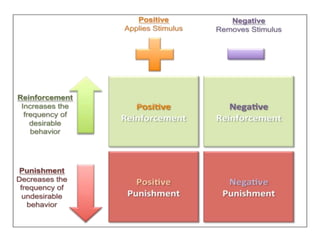
 Positive Reinforcement
 Negative Reinforcement
 Punishment Reinforcement
 Extinction
Positive Reinforcement
 Giving a positive response when an
individual shows positive and required
behavior. Think of it as adding something
in order to increase a response. The most
common types of positive reinforcement or
praise and rewards.
Negative Reinforcement
 Negative reinforcement involves the removal of a
negative condition in order to strengthen a behavior.
 It is a more effective tool for motivating employee
behavior and students.
 Negative reinforcement encourages students and
employees to perform better so they can have an
unpleasant condition removed from their work
environment.
Punishment refers to adding something
aversive in order to decrease a behavior.
 Punishment involves either presenting or
taking away a stimulus in order to weaken a
behavior.
 Extinction: Process of eliminating any
type of reinforcement causing any
undesirable behavior
Punishment Reinforcement:
Modeling
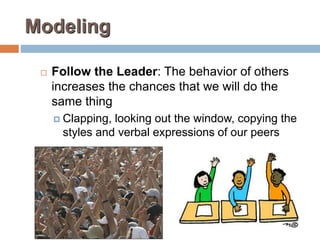
 Follow the Leader: The behavior of others
increases the chances that we will do the
same thing
 Clapping, looking out the window, copying the
styles and verbal expressions of our peers
Modeling
 Modeling is an instructional strategy in which the teacher demonstrates a new
concept or approach to learning and students learn by observing.
 An engaging teaching strategy, able to reach the learning needs of most
students. As a technique, teacher modeling involves breaking down a task into
specific tasks, and demonstrating each task multiple times in front of the class
and the students observe and repeat this activity.
According to social theorist Albert Bandura
 “Most human behavior is learned
observationally through modeling: from
observing others one forms an idea of how
new behaviors are performed, and on later
occasions this coded information serves as a
guide for action.”
How is Modeling done by the
teacher
The teacher provides a structure to guide
students by:
 Describing the skill or strategy
 Clearly describing features of the strategy or steps in
performing the skill Breaking the skill into learnable
parts
 Describing/modeling using a variety of techniques.
 Engaging students in learning through showing
enthusiasm, keeping a steady pace, asking good
questions, and checking for student understanding
Types of Modeling
 Disposition modeling
In disposition modeling, teachers and students
convey personal values or ways of thinking.
 Task and performance modeling
Task modeling occurs when the teacher demonstrates
a task students will be expected to do on their own.
 Modeling as a scaffolding technique
When using modeling as a scaffolding technique,
teachers must consider students’ position in the
learning process.
 Meta-cognitive modeling
Meta-cognitive modeling demonstrates how to think in
lessons that focus on interpreting information and data,
analyzing statements, and making conclusions about
what has been learned.
 Student-centered modeling
In student-centered modeling, teachers engage students
who have mastered specific concepts or learning
outcomes in the task of modeling for their peers.
Types of Modeling
Multiple Learning Modes
 The teacher modeling strategy engages students who are :
 Visual learners- see the teacher perform the task in front
of the class.
 Auditory learners- hear the teacher describe each step.
 Tactile learners- write notes about the process the teacher
uses
 Kinesthetic learners- benefit by seeing the steps to
perform the lesson, allowing them to repeat the steps in
their
Shaping Techniques
WHAT IS SHAPING?
 Shaping is a procedure used to establish a
behavior that is not presently performed by
an individual
 It was introduced by B.F. Skinner.
 Shaping assists in "discrimination", which is
the ability to tell the difference between
stimuli that are and are not reinforced, and in
"generalization", which is the application of
a response learned in one situation to a
different but similar situation.
There are four aspects of behavior that are
particularly subject to shaping:
1. Topography -- spatial configuration or form
of a particular response or the specific
movement involved. Examples: printing a
word and writing a word, the movements of a
variety of sports, speech, etc.
2. Amount -- the frequency of a behavior (the
number of times it occurs in a given time) or
its duration (the length of time that a
response lasts)
3. Latency -- reaction time
4. Intensity -- the force of a response
What two principles are involved
in shaping?
1. reinforcement and
2. extinction
When is Shaping Used?
 To develop new topographies of a
behavior
 To develop new dimensions of a
behavior
 To restore old behaviors that are not
occurring
 Accidentally to develop problem
Examples of Shaping
 Language development
 Getting a rat to press a lever
 Animal training
 Rehabilitation (O’Neill & Gardner, 1983)
Using Shaping
1. Define the target behavior
- Final behavior should be stated in way that all the
relevant characteristic of behavior ( topography, amount,
latency and intensity
2. Is shaping the preferred procedure?
- Use instructions/modeling/prompting if possible
3. Identify the starting behavior
- The person must already exhibit the behavior
- Choose a behavior you can build on to achieve the
target behavior
4. Choose the shaping steps
- Each step is a closer approximation to the target
behavior
- Steps are not too bi
- No specific guidelines for identifying the ideal
step size.
Using Shaping
5. Choose the reinforcer
- Must function as a reinforcer for the individual
- Consider the effects of satiation during shaping
(use conditioned reinforcers)
6. Reinforce each successive approximation
- Reinforce first approximation until it occurs a
number of times
- Stop reinforcing first approximation and reinforce
next approximation until it occurs a number
of times
- Continue until the target behavior occurs
7. Move at the proper pace
- Do not move to soon
- Proceed in sufficiently small steps
- Return to earlier approximation if you lose a
behavior because you moving too fast.
- It is also important not to progress too slowly
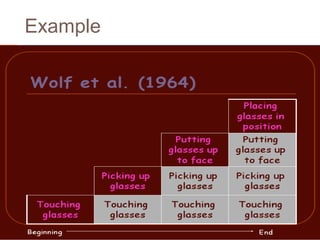
Example
Effective classroom strategies ppt

Effective classroom strategies ppt

  • 1.
    PRESENTED TO: MADAMSAIRA IJAZ PRESENTED BY: LARAIB (15061701-005) M.PHIL SEMESTER 1ST 12 january,2016
  • 2.
    EEFECTIVE CLASSROOM STRATEGIES Contents 1.Cognitive Psychology: Models of Learning 2. Discovery, Guided Discovery and Expository Methods of Teaching 3. Behavior Modification: Social and Academic Learning 4. Reinforcement 5. Modeling 6. Shaping Techniques
  • 3.
  • 4.
    What is cognitivepsychology?  Cognitive psychology is the study of perception, attention, memory, language, and thinking in humans...how we know about the world.  ...the scientific study of the human mind and information processing  Related to other fields - linguistics, computer science, philosophy, development, etc.
  • 5.
    What is Learning? A change in behavior as a result of experience or practice.  The acquisition of knowledge.  Knowledge gained through study.  To gain knowledge of, or skill in, something through study, teaching, instruction or experience.  The process of gaining knowledge.  A process by which behavior is changed, shaped or controlled.  The individual process of constructing understanding based on experience from a wide range of sources.
  • 6.
    Learning Model  Learningmodel is defined as a systematic procedure in organizing learning experiences to achieve learning objectives. Can also mean an approach that is used in learning activities.  Learning models are patterns of interactions and activities to ensure any learning you create is effective. Using a learning model when developing rapid e-learning allows you to accelerate your writing and development by giving you a repeatable structure to follow. It can also accelerate the learner’s experience as it gives them a repeated structure.  Learning models are good for inexperienced designers to follow and provide a consistent approach if you have a number of designers on one large project
  • 7.
  • 8.
    A. Learning ModelBased on Theory 1. Social Interaction Model (Allen and Rayn1969) 2. Information Processing Model 3. Personal Model 4. Behavior Modification Model (Behavioral) 5. Contextual Learning Model
  • 9.
    B. Quantum LearningModel Quantum model of teaching is the learning model used in the presentation of the study design that are strung together into a package that is multisensory, multi intelligence, and is compatible with the brain, including specific instructions to create an effective learning environment, curriculum design, deliver content and facilitate the learning process C. PAIKEM Learning Model According Tarmizi (2009) learning is an acronym for Active, Innovative, Creative, Effective and Fun.
  • 10.
    D. Learning ModelLesson Study Director General for Quality Improvement of Teachers and Education Personnel (PMPTK) suggested that Lesson Study is a professional educator development through collective assessment and continuous learning. E. Active Learning Model Active learning is a term that underlies some of the learning model that focuses on the responsibility of the student learning process.
  • 11.
    Action Learning Model The Action Learning Model was first introduced by Professor Reginald Revans in 1980, who was a noted physicist and the first known Industrial Management Professor. Reginald Revans also described the Revans Formula as L= P+Q, where:  L is learning  P is programming and  Q is questioning (closed, open, objective, and relative)
  • 12.
    Discovery, Guided Discovery andExpository Methods of Teaching
  • 13.
    Discovery Method  Amethod in which thoughts are synthesized to perceive something that the individual has not known before. the learner gets directly involved in learning.  learning is a result of the learners own internalized, insights, reflection and experiences Inductive : an exploratory method of logic where one arrives at a fact, principle, truth or generalization. : Formulating conclusion, a definition, a rule, a principle or a formula based on knowledge of examples and details Studying: observing, comparing many instances or cases in several instances to discover the common element and form generalization.
  • 14.
    What is theGuided Discovery?  A renowned cognitive psychologist at Harvard University named Jerome Bruner promoted the approach on the basis that students are more likely to remember concepts and principles when they discover them on their own.  Guided Discovery is an inquiry-based learning technique in which students investigate, question, and respond to issues in a constructive manner.  Students solve problems using their own experiences and prior knowledge to building knowledge in a very natural way.
  • 15.
    When to usethe Guided Discovery Method  Guided discovery problems may be used at the start of a new concept or content area, thus allowing students to build upon their prior knowledge of the subject before a new reading or lecture.  They may also be used at the end of a unit to allow students to apply what they have learned in a real-world situation.
  • 16.
    Expository or DeductiveMethod  Expository or Deductive Method : a telling method where facts, concepts, principles and generalizations, are stated presented, defined, interpreted by the teacher and followed by the application of testing of three concepts, principles, generalizations in new examples generated by the student.  Deductive Teaching : process of teaching that starts with a rule or general statement that is applied to specific cases/examples
  • 17.
  • 18.
    Behavior Modification Behavior Modificationis a therapeutic technique based on the work of B.F. Skinner, a famous psychologist who is known as the "Father of Behaviorism." Skinner developed a theory of operant conditioning, which states that all behavior is governed by reinforcing and punishing stimuli. Behavior modification uses a scheduled approach that rewards desired behavior and "punishes" undesirable behavior. This technique continues to be used in therapy and is used in many psychological settings.
  • 19.
    Behavior Modification  Systematicapplication of learning principles to change people’s actions and feelings  Involves a series of well-defined steps to change behavior.  The success of each step is carefully evaluated to find the best solution for a given situation.  Modeling, classical conditioning, operant conditioning
  • 20.
    The History ofBehavior Modification  The first use of the term behavior modification appears to have been by Edward Thorndike in 1911 .  His article "Provisional Laws of Acquired Behavior or Learning" makes frequent use of the term "modifying behavior. " Through early research in the 1940s and the 1950s, the term was used by Joseph Wolpe's research group.  The experimental tradition in clinical psychology used it to refer to psycho-therapeutic techniques derived from empirical research.  It has since come to refer mainly to techniques for increasing adaptive behavior through reinforcement and decreasing maladaptive behavior through extinction or punishment (with emphasis on the former).
  • 21.
    Behavior Modification andSocial Learning  Social learning which is informal learning of the individual, plays a vital role towards Behavior Modification.  Norms and Values of the society are directions towards desired Behavior/ Behavior Modification.  Every individual is born in a social group in a family.  As a member of a family, he has to learn certain language, ways of dealing with siblings, parents and other members of the group.  As he grow up, he has to acquire certain modes of behavior and social attitudes as approved by the society. All these amounts to Behavior Modification.
  • 22.
    Behavior Modification and AcademicLearning  Leaning is a very comprehensive term. Learning does not mean only the acquisition of knowledge or skills.It includes acquiring of attitudes, values, likes, dislikes and many other habits.  A number of psychologists have defined leaning as change or modification of behavior.  Thus leaning is the process by which an organism, as a result of its interaction with a situation, acquires a new mode of behavior, which tends to persist and affect the general behavioral pattern of the organism to some degree.  Munn says “ Learning is more or less permanent, incremental modification of behavior which results from activity, special training or observation.  Thorpe defines learning as that “process which manifests itself by adoptive changes in individual’s behavior as a result of experience.
  • 23.
    Behavior Modification and AcademicLearning  All learning is modification of behavior, but all modification of behavior is not learning. We may conclude by saying that ‘ learning is limited to those changes in behavior which are a result of maintaining or temporary physiological or psychological states of the organism.  Modification of behavior may take place in desirable direction or in the undesirable direction. For example children learn good habits as well as bad habits. Teachers and parents must always encourage children to learn desirable behavior patterns.  Learning stands for relatively permanent change or modification of behavior. The temporary changes in behavior do not constitute learning.
  • 24.
    Five Ways ofBEHAVIOR MODIFICATION  1. Identify the Root Cause of the Problem  2. Focus on a Proper Reinforcer  3. Apply the Reinforcer Early  4. Be Consistent in Your Application  5. Adjust the Reinforcer to Adapt to New Goals and Behavior
  • 25.
    Behavioral Principles inthe Classroom  Guidelines on the use of Rewards - Deci  Give Rewards to Inform  Rewards Should Not Be Used to Manipulate  Reward for Academic Performance  Reward Incentives Should Be Inconspicuous  Bribes Weaken Intrinsic Motivation
  • 26.
  • 27.
    HISTORY OF REINFORCEMENT The term reinforcement was introduced by Pavlov in 1903.  The concept of reinforcement means getting the work completed by giving some incentives or rewards to the certain person.
  • 28.
    REINFORCEMENT MEANING  Theterm reinforcement means to strengthen, and is used in psychology to refer to anything stimulus which strengthens, encouraging the designated behavior, or increases the probability of a specific response.  For example, if you want your dog to sit on command, you may give him a treat every time he sits for you. The dog will eventually come to understand that sitting when told to will result in a treat. This treat is reinforcing because he likes it and will result in him sitting when instructed to do so.
  • 29.
    TYPES OF REINFORCEMENT Positive Reinforcement  Negative Reinforcement  Punishment Reinforcement  Extinction
  • 30.
    Positive Reinforcement  Givinga positive response when an individual shows positive and required behavior. Think of it as adding something in order to increase a response. The most common types of positive reinforcement or praise and rewards.
  • 31.
    Negative Reinforcement  Negativereinforcement involves the removal of a negative condition in order to strengthen a behavior.  It is a more effective tool for motivating employee behavior and students.  Negative reinforcement encourages students and employees to perform better so they can have an unpleasant condition removed from their work environment.
  • 32.
    Punishment refers toadding something aversive in order to decrease a behavior.  Punishment involves either presenting or taking away a stimulus in order to weaken a behavior.  Extinction: Process of eliminating any type of reinforcement causing any undesirable behavior Punishment Reinforcement:
  • 34.
    Modeling  Follow theLeader: The behavior of others increases the chances that we will do the same thing  Clapping, looking out the window, copying the styles and verbal expressions of our peers
  • 35.
    Modeling  Modeling isan instructional strategy in which the teacher demonstrates a new concept or approach to learning and students learn by observing.  An engaging teaching strategy, able to reach the learning needs of most students. As a technique, teacher modeling involves breaking down a task into specific tasks, and demonstrating each task multiple times in front of the class and the students observe and repeat this activity.
  • 36.
    According to socialtheorist Albert Bandura  “Most human behavior is learned observationally through modeling: from observing others one forms an idea of how new behaviors are performed, and on later occasions this coded information serves as a guide for action.”
  • 37.
    How is Modelingdone by the teacher The teacher provides a structure to guide students by:  Describing the skill or strategy  Clearly describing features of the strategy or steps in performing the skill Breaking the skill into learnable parts  Describing/modeling using a variety of techniques.  Engaging students in learning through showing enthusiasm, keeping a steady pace, asking good questions, and checking for student understanding
  • 38.
    Types of Modeling Disposition modeling In disposition modeling, teachers and students convey personal values or ways of thinking.  Task and performance modeling Task modeling occurs when the teacher demonstrates a task students will be expected to do on their own.  Modeling as a scaffolding technique When using modeling as a scaffolding technique, teachers must consider students’ position in the learning process.
  • 39.
     Meta-cognitive modeling Meta-cognitivemodeling demonstrates how to think in lessons that focus on interpreting information and data, analyzing statements, and making conclusions about what has been learned.  Student-centered modeling In student-centered modeling, teachers engage students who have mastered specific concepts or learning outcomes in the task of modeling for their peers. Types of Modeling
  • 40.
    Multiple Learning Modes The teacher modeling strategy engages students who are :  Visual learners- see the teacher perform the task in front of the class.  Auditory learners- hear the teacher describe each step.  Tactile learners- write notes about the process the teacher uses  Kinesthetic learners- benefit by seeing the steps to perform the lesson, allowing them to repeat the steps in their
  • 41.
  • 42.
    WHAT IS SHAPING? Shaping is a procedure used to establish a behavior that is not presently performed by an individual  It was introduced by B.F. Skinner.  Shaping assists in "discrimination", which is the ability to tell the difference between stimuli that are and are not reinforced, and in "generalization", which is the application of a response learned in one situation to a different but similar situation.
  • 43.
    There are fouraspects of behavior that are particularly subject to shaping: 1. Topography -- spatial configuration or form of a particular response or the specific movement involved. Examples: printing a word and writing a word, the movements of a variety of sports, speech, etc. 2. Amount -- the frequency of a behavior (the number of times it occurs in a given time) or its duration (the length of time that a response lasts) 3. Latency -- reaction time 4. Intensity -- the force of a response
  • 44.
    What two principlesare involved in shaping? 1. reinforcement and 2. extinction When is Shaping Used?  To develop new topographies of a behavior  To develop new dimensions of a behavior  To restore old behaviors that are not occurring  Accidentally to develop problem
  • 45.
    Examples of Shaping Language development  Getting a rat to press a lever  Animal training  Rehabilitation (O’Neill & Gardner, 1983)
  • 46.
    Using Shaping 1. Definethe target behavior - Final behavior should be stated in way that all the relevant characteristic of behavior ( topography, amount, latency and intensity 2. Is shaping the preferred procedure? - Use instructions/modeling/prompting if possible 3. Identify the starting behavior - The person must already exhibit the behavior - Choose a behavior you can build on to achieve the target behavior 4. Choose the shaping steps - Each step is a closer approximation to the target behavior - Steps are not too bi - No specific guidelines for identifying the ideal step size.
  • 47.
    Using Shaping 5. Choosethe reinforcer - Must function as a reinforcer for the individual - Consider the effects of satiation during shaping (use conditioned reinforcers) 6. Reinforce each successive approximation - Reinforce first approximation until it occurs a number of times - Stop reinforcing first approximation and reinforce next approximation until it occurs a number of times - Continue until the target behavior occurs 7. Move at the proper pace - Do not move to soon - Proceed in sufficiently small steps - Return to earlier approximation if you lose a behavior because you moving too fast. - It is also important not to progress too slowly
  • 48.