LEARNING
METHODS
GROUP 3
OUR
TEAM
Danella Putri Wulandari
2304020013
Intan Dwi Kartika
2304020018
Rizki Yusup Pamuji S.
2304020082
Anasthasia Leona KA
2304020094
LEARNING
TERMS
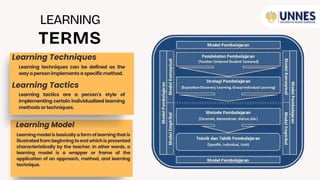
Inthe learning process, thereareseveraltermsthat have similar meanings, sopeople oftenfeelconfused
todistinguish them.These termsare:(1)learning approaches, (2)learning strategies, (3)learning methods,
(4)learning techniques, (5)learning tactics, and(6)learning models.
The learning approach can be defined as our
point of departure or point of view towards
the learning process, which refers to a view of
the occurrence of a process that is still very
general in nature, in which it embodies,
inspires, strengthens, and underlies learning
methods withacertaintheoretical scope.
Learning Approach
A learning strategy is a learning activity that
teachers and students must do so that learning
objectives can be achieved effectively and
efficiently.
Learning methods here can be interpreted as a way
used to implement plans that have been prepared
inthe form of realand practical activitiesto achieve
learning objectives.
Learning Strategy
Learning Method
Learning model is basically a form of learning that is
illustratedfrom beginningtoendwhichis presented
characteristically by the teacher. In other words, a
learning model is a wrapper or frame of the
application of an approach, method, and learning
technique.
Learning Model
Learning techniques can be defined as the
wayaperson implementsaspecificmethod.
Learning Techniques
Learning Tactics
Learning tactics are a person's style of
implementing certain individualized learning
methodsortechniques.
LEARNING
TERMS
Hebert Bisno (1968) the method is
techniques that are well generalized so
that they can be accepted or applied
equally in a practice, or field of discipline
and practice.
Hidayat (1990;60) the word method comes
from Greek, methodos which means path or
way. The path or way referred to here is an
effort or attempt to achieve something
desired.
What the meaning of “Methods” ?
LEARNING
METHODS
Definisi danPengertian Metode Pembelajaran Menurut Para Ahli. (2014, October 6). Eureka Pendidikan. Retrieved September 22,2024, from
https://shorturl.at/igYXu
LEARNING
METHODS
Learning methods here can be interpreted as a way used to
implement plans that have been prepared in the form of
realand practical activities toachieve learning objectives.
This method includes a variety of techniques and
approaches, from direct teaching to project-based
learning, as well as the use of technology in the teaching
and learning process.
Definition
SUDRAJAT, A. (2008, September 12). Pengertian Pendekatan, Strategi, Metode, Teknik, Taktik dan Model Pembelajaran. Pengertian
Pendekatan, Strategi, Metode, Teknik, Taktik dan Model Pembelajaran – AKHMAD SUDRAJAT. Retrieved September 22, 2024, from
https://shorturl.at/j7wLI
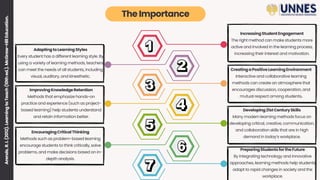
TheImportance
IncreasingStudentEngagement
The right method can make students more
active and involved in the learning process,
increasing their interest and motivation.
Arends,
R.
I.
(2012).
Learning
to
Teach
(10th
ed.).
McGraw-Hill
Education.
AdaptingtoLearningStyles
Every student has a different learning style. By
using a variety of learning methods, teachers
can meet the needs of all students, including
visual, auditory, and kinesthetic.
CreatingaPositiveLearningEnvironment
Interactive and collaborative learning
methods can create an atmosphere that
encourages discussion, cooperation, and
mutual respect among students.
ImprovingKnowledgeRetention
Methods that emphasize hands-on
practice and experience (such as project-
based learning) help students understand
and retain information better.
Developing21stCenturySkills
Many modern learning methods focus on
developing critical, creative, communication,
and collaboration skills that are in high
demand in today’s workplace.
EncouragingCriticalThinking
Methods such as problem-based learning
encourage students to think critically, solve
problems, and make decisions based on in-
depth analysis.
PreparingStudentsfortheFuture
By integrating technology and innovative
approaches, learning methods help students
adapt to rapid changes in society and the
workplace.
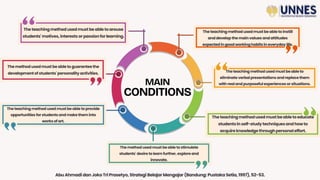
MAIN
CONDITIONS
AbuAhmadi dan JokoTri Prasetyo, Strategi Belajar Mengajar (Bandung: Pustaka Setia, 1997), 52-53.
Theteachingmethodusedmustbe abletoarouse
students'motives,interests orpassionfor learning.
Themethodusedmust beabletoguaranteethe
developmentofstudents'personalityactivities.
The teaching method used mustbe able toprovide
opportunities for students and make theminto
worksof art.
The method used must be able to stimulate
students' desire tolearn further, explore and
innovate.
Theteachingmethodusedmustbeabletoeducate
studentsin self-studytechniquesandhowto
acquireknowledgethroughpersonaleffort.
Theteachingmethod usedmustbeable to
eliminate verbalpresentations andreplacethem
withrealandpurposeful experiences orsituations.
Theteachingmethodusedmustbeabletoinstill
anddevelopthemainvaluesandattitudes
expectedingoodworkinghabitsineverydaylife.
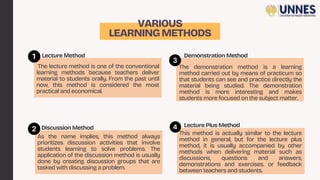
VARIOUS
LEARNINGMETHODS
The lecture method is one of the conventional
learning methods because teachers deliver
material to students orally. From the past until
now, this method is considered the most
practical and economical.
As the name implies, this method always
prioritizes discussion activities that involve
students learning to solve problems. The
application of the discussion method is usually
done by creating discussion groups that are
tasked with discussing a problem.
Lecture Method
Discussion Method
The demonstration method is a learning
method carried out by means of practicum so
that students can see and practice directly the
material being studied. The demonstration
method is more interesting and makes
students more focused on the subject matter.
Demonstration Method
This method is actually similar to the lecture
method in general, but for the lecture plus
method, it is usually accompanied by other
methods when delivering material such as
discussions, questions and answers,
demonstrations and exercises. or feedback
between teachers and students.
Lecture Plus Method
VARIOUS
LEARNINGMETHODS
The resitation method usually requires
students to make a resume about the material
that has been delivered by the teacher. Where
the resume is written on paper using the
student's own words. That way, students can
understand and more easily remember the
material in their own language.
The experimental method is carried out
through experiments or practicum activities in
the laboratory so that students can see
firsthand the subject matter being conveyed.
Recitation Method
Experimental Method
This method uses a particular place or
environment that has learning resources for
students. However, the application of this
method needs direct supervision from the
teacher. For example, museums or nature.
Field Trip Method
This method is a learning method that is
carried out by training skills to students by
stimulating, utilizing or making something.
Usually after the teacher's explanation,
students will be tested by several questions.
Practice Method
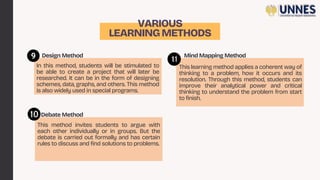
VARIOUS
LEARNINGMETHODS
In this method, students will be stimulated to
be able to create a project that will later be
researched. It can be in the form of designing
schemes, data, graphs, and others. This method
is also widely used in special programs.
This method invites students to argue with
each other individually or in groups. But the
debate is carried out formally and has certain
rules to discuss and find solutions to problems.
Design Method
Debate Method
This learning method applies a coherent way of
thinking to a problem, how it occurs and its
resolution. Through this method, students can
improve their analytical power and critical
thinking to understand the problem from start
to finish.
Mind Mapping Method
THEADVANTAGESAND
DISADVANTAGESOF DIFFERENT
TEACHINGMETHODS
• Advantages: Teachers can control the entire
class, efficient for delivering large amounts of
information to many students, Classroom
organization is simple.
• Disadvantages: Students tend to be passive
and only listen, less interactive; difficult to
assess student understanding directly, The
discussion often deviates from the main
topic.
• Advantages: Stimulates creativity, develops mutual
respect, broadens perspectives, encourages
collaborative problem-solving, enhances
communication skills.
• Disadvantages: Time-consuming, not suitable for
large groups, limited information gained,
dominated by talkative students.
Lecture Method
Discussion Method
• Advantages: Students’ attention can be focused
on important points, the learning process is more
structured, enhances students’ experiences,
reduces misunderstandings through clear
teaching.
• Disadvantages: Time-consuming, inefficient if
media or materials are lacking, high costs for
materials, requires significant effort, ineffective if
students are not actively engaged.
Demonstration Method
• Advantages: Enhances engagement, balances
theory and practice, increases retention,
accommodates different learning styles,
provides immediate feedback.
• Disadvantages: Time-consuming, requires more
preparation, difficult with large groups, may
overwhelm students.
Lecture Plus Method
• Advantages: Enhances students' understanding
of the material, helps students retain information
for a longer period, trains students to express
ideas in their own words, encourages
independent learning, makes it easier for
teachers to assess students' understanding.
• Disadvantages: Takes more time to complete,
can lead to boredom if overused, not all students
can effectively express material in written form.
• Advantages: Develops students' critical thinking
skills. Helps students understand concepts more
deeply through hands-on experience. Increases
students' curiosity and creativity. Makes learning
more engaging and interactive. Encourages
independent learning and problem-solving.
• Disadvantages: Requires more time for preparation
and execution. Needs equipment and materials that
can be expensive or hard to find. Not all concepts
can be taught through experiments. Requires
adequate space and facilities. Less active students
may be less involved in the learning process.
Recitation Method
Experimental Method
• Advantages: The learning environment is more
enjoyable, enhances students' physical activity,
utilizes concrete learning media, and learning
outcomes are more permanent and memorable.
• Disadvantages: Requires preparation involving
multiple parties, involves significant travel
distance and transportation needs, requires
considerable time and costs, can disrupt regular
school activities, and requires strict supervision.
Field Trip Method
• Advantages: Stimulates creativity and
innovation in students, encourages hands-
on experience through project-based
learning, enhances research skills and
critical thinking, allows for personalized
learning based on student interests, and
promotes collaboration and teamwork
among students.
• Disadvantages: Requires significant time
for project development, needs access to
resources and materials that may be
limited, may overwhelm students,
assessment can be subjective and
challenging, and requires careful planning
and support from instructors.
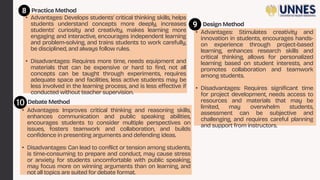
• Advantages: Improves critical thinking and reasoning skills,
enhances communication and public speaking abilities,
encourages students to consider multiple perspectives on
issues, fosters teamwork and collaboration, and builds
confidence in presenting arguments and defending ideas.
• Disadvantages: Can lead to conflict or tension among students,
is time-consuming to prepare and conduct, may cause stress
or anxiety for students uncomfortable with public speaking,
may focus more on winning arguments than on learning, and
not all topics are suited for debate format.
Design Method
Debate Method
Practice Method
• Advantages: Develops students' critical thinking skills, helps
students understand concepts more deeply, increases
students' curiosity and creativity, makes learning more
engaging and interactive, encourages independent learning
and problem-solving, and trains students to work carefully,
be disciplined, and always follow rules.
• Disadvantages: Requires more time, needs equipment and
materials that can be expensive or hard to find, not all
concepts can be taught through experiments, requires
adequate space and facilities, less active students may be
less involved in the learning process, and is less effective if
conducted without teacher supervision.
• Advantages: Improves knowledge management performance,
maximizes brain function, connects ideas and information, allowing
for greater explanation, stimulates creativity, is simple, and easy to
implement, and facilitates easy recall of existing data.
• Disadvantages: Only actively participating students are involved,
not all students learn effectively, and the variation in students' mind
maps can make it difficult for teachers to evaluate.
Mind Mapping Method
EXAMPLES OF
LEARNING METHOD
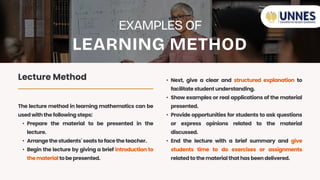
The lecture method in learning mathematics can be
used withthe following steps:
• Prepare the material to be presented in the
lecture.
• Arrangethestudents' seats tofacethe teacher.
• Begin the lecture by giving a brief introduction to
thematerial tobepresented.
• Next, give a clear and structured explanation to
facilitate student understanding.
• Show examples or real applications of the material
presented.
• Provide opportunities for students to ask questions
or express opinions related to the material
discussed.
• End the lecture with a brief summary and give
students time to do exercises or assignments
relatedtothematerial thathas beendelivered.
Lecture Method
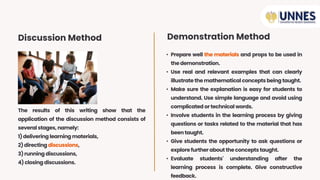
The results of this writing show that the
application of the discussion method consists of
several stages, namely:
1)delivering learning materials,
2)directing discussions,
3)running discussions,
4)closing discussions.
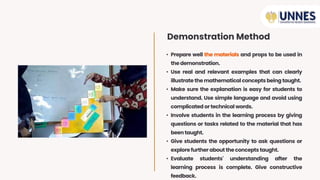
• Prepare well the materials and props to be used in
thedemonstration.
• Use real and relevant examples that can clearly
illustrate the mathematical concepts being taught.
• Make sure the explanation is easy for students to
understand. Use simple language and avoid using
complicated ortechnical words.
• Involve students in the learning process by giving
questions or tasks related to the material that has
beentaught.
• Give students the opportunity to ask questions or
explore further about theconcepts taught.
• Evaluate students' understanding after the
learning process is complete. Give constructive
feedback.
Discussion Method Demonstration Method
• Prepare well the materials and props to be used in
thedemonstration.
• Use real and relevant examples that can clearly
illustrate the mathematical concepts being taught.
• Make sure the explanation is easy for students to
understand. Use simple language and avoid using
complicated ortechnical words.
• Involve students in the learning process by giving
questions or tasks related to the material that has
beentaught.
• Give students the opportunity to ask questions or
explore further about theconcepts taught.
• Evaluate students' understanding after the
learning process is complete. Give constructive
feedback.
Demonstration Method
The resitation method in learning
mathematics can be done with several
steps, namely
(1)giving tasks
(2)taskimplementation
(3)taskaccountability
Lecture Plus Method
(1)PreparetheMaterial
Prepare the material to be delivered well and
completely.
(2)Create aPresentation
Use visualization techniques such as pictures,
graphs, or diagrams to help clarify difficult
concepts.
(3) Deliver the Explanation
Providereal-lifeexamplesorrelevantcasesto
strengthen learners' understanding.
(4)ProvideOpportunities toAskQuestions
Answer their questions clearly and
attentively.
(5) Evaluate understanding
Evaluate learners' understanding by giving
them tasks or questions to do independently
oringroups.
Resitation Method
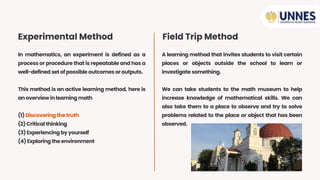
In mathematics, an experiment is defined as a
process or procedure that is repeatable and has a
well-defined setofpossible outcomes oroutputs.
This method is an active learning method, here is
anoverviewinlearning math
(1)Discovering thetruth
(2)Criticalthinking
(3)Experiencing byyourself
(4)Exploring theenvironment
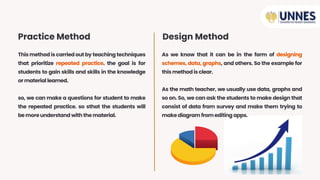
A learning method that invites students to visit certain
places or objects outside the school to learn or
investigate something.
We can take students to the math museum to help
increase knowledge of mathematical skills. We can
also take them to a place to observe and try to solve
problems related to the place or object that has been
observed.
Experimental Method Field Trip Method
This method is carried out by teaching techniques
that prioritize repeated practice. the goal is for
students to gain skills and skills in the knowledge
ormaterial learned.
so, we can make a questions for student to make
the repeated practice. so sthat the students will
bemoreunderstand withthe material.
As we know that it can be in the form of designing
schemes, data, graphs, and others. So the example for
this methodisclear.
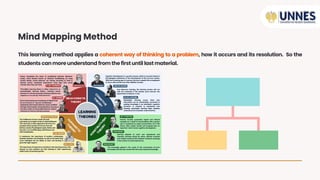
As the math teacher, we usually use data, graphs and
so on. So, we can ask the students to make design that
consist of data from survey and make them trying to
makediagram fromediting apps.
Practice Method Design Method
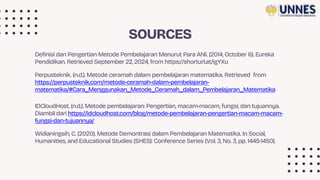
This learning method applies a coherent way of thinking to a problem, how it occurs and its resolution. So the
students canmoreunderstand fromthefirstuntil last material.
Mind Mapping Method
SOURCES
Definisi dan Pengertian Metode Pembelajaran Menurut Para Ahli. (2014, October 6). Eureka
Pendidikan. Retrieved September 22, 2024, from https://shorturl.at/igYXu
Perpusteknik. (n.d.). Metode ceramah dalam pembelajaran matematika. Retrieved from
https://perpusteknik.com/metode-ceramah-dalam-pembelajaran-
matematika/#Cara_Menggunakan_Metode_Ceramah_dalam_Pembelajaran_Matematika
IDCloudHost. (n.d.). Metode pembelajaran: Pengertian, macam-macam, fungsi, dan tujuannya.
Diambil dari https://idcloudhost.com/blog/metode-pembelajaran-pengertian-macam-macam-
fungsi-dan-tujuannya/
Widianingsih, C. (2020). Metode Demontrasi dalam Pembelajaran Matematika. In Social,
Humanities, and Educational Studies (SHES): Conference Series (Vol. 3, No. 3, pp. 1445-1450).
PARTICIPATIONS
1. Rifqy Fadlillah (2304020034)
2.Resty Kartika Sari (2304020066)
3.Nurul Ridhowati (2304020085)
THANK
YOU
Q & A

About Learning Methods In Education .pdf

  • 1.
  • 2.
    OUR TEAM Danella Putri Wulandari 2304020013 IntanDwi Kartika 2304020018 Rizki Yusup Pamuji S. 2304020082 Anasthasia Leona KA 2304020094
  • 3.
    LEARNING TERMS Inthe learning process,thereareseveraltermsthat have similar meanings, sopeople oftenfeelconfused todistinguish them.These termsare:(1)learning approaches, (2)learning strategies, (3)learning methods, (4)learning techniques, (5)learning tactics, and(6)learning models. The learning approach can be defined as our point of departure or point of view towards the learning process, which refers to a view of the occurrence of a process that is still very general in nature, in which it embodies, inspires, strengthens, and underlies learning methods withacertaintheoretical scope. Learning Approach A learning strategy is a learning activity that teachers and students must do so that learning objectives can be achieved effectively and efficiently. Learning methods here can be interpreted as a way used to implement plans that have been prepared inthe form of realand practical activitiesto achieve learning objectives. Learning Strategy Learning Method
  • 4.
    Learning model isbasically a form of learning that is illustratedfrom beginningtoendwhichis presented characteristically by the teacher. In other words, a learning model is a wrapper or frame of the application of an approach, method, and learning technique. Learning Model Learning techniques can be defined as the wayaperson implementsaspecificmethod. Learning Techniques Learning Tactics Learning tactics are a person's style of implementing certain individualized learning methodsortechniques. LEARNING TERMS
  • 5.
    Hebert Bisno (1968)the method is techniques that are well generalized so that they can be accepted or applied equally in a practice, or field of discipline and practice. Hidayat (1990;60) the word method comes from Greek, methodos which means path or way. The path or way referred to here is an effort or attempt to achieve something desired. What the meaning of “Methods” ? LEARNING METHODS Definisi danPengertian Metode Pembelajaran Menurut Para Ahli. (2014, October 6). Eureka Pendidikan. Retrieved September 22,2024, from https://shorturl.at/igYXu
  • 6.
    LEARNING METHODS Learning methods herecan be interpreted as a way used to implement plans that have been prepared in the form of realand practical activities toachieve learning objectives. This method includes a variety of techniques and approaches, from direct teaching to project-based learning, as well as the use of technology in the teaching and learning process. Definition SUDRAJAT, A. (2008, September 12). Pengertian Pendekatan, Strategi, Metode, Teknik, Taktik dan Model Pembelajaran. Pengertian Pendekatan, Strategi, Metode, Teknik, Taktik dan Model Pembelajaran – AKHMAD SUDRAJAT. Retrieved September 22, 2024, from https://shorturl.at/j7wLI
  • 7.
    TheImportance IncreasingStudentEngagement The right methodcan make students more active and involved in the learning process, increasing their interest and motivation. Arends, R. I. (2012). Learning to Teach (10th ed.). McGraw-Hill Education. AdaptingtoLearningStyles Every student has a different learning style. By using a variety of learning methods, teachers can meet the needs of all students, including visual, auditory, and kinesthetic. CreatingaPositiveLearningEnvironment Interactive and collaborative learning methods can create an atmosphere that encourages discussion, cooperation, and mutual respect among students. ImprovingKnowledgeRetention Methods that emphasize hands-on practice and experience (such as project- based learning) help students understand and retain information better. Developing21stCenturySkills Many modern learning methods focus on developing critical, creative, communication, and collaboration skills that are in high demand in today’s workplace. EncouragingCriticalThinking Methods such as problem-based learning encourage students to think critically, solve problems, and make decisions based on in- depth analysis. PreparingStudentsfortheFuture By integrating technology and innovative approaches, learning methods help students adapt to rapid changes in society and the workplace.
  • 8.
    MAIN CONDITIONS AbuAhmadi dan JokoTriPrasetyo, Strategi Belajar Mengajar (Bandung: Pustaka Setia, 1997), 52-53. Theteachingmethodusedmustbe abletoarouse students'motives,interests orpassionfor learning. Themethodusedmust beabletoguaranteethe developmentofstudents'personalityactivities. The teaching method used mustbe able toprovide opportunities for students and make theminto worksof art. The method used must be able to stimulate students' desire tolearn further, explore and innovate. Theteachingmethodusedmustbeabletoeducate studentsin self-studytechniquesandhowto acquireknowledgethroughpersonaleffort. Theteachingmethod usedmustbeable to eliminate verbalpresentations andreplacethem withrealandpurposeful experiences orsituations. Theteachingmethodusedmustbeabletoinstill anddevelopthemainvaluesandattitudes expectedingoodworkinghabitsineverydaylife.
  • 9.
    VARIOUS LEARNINGMETHODS The lecture methodis one of the conventional learning methods because teachers deliver material to students orally. From the past until now, this method is considered the most practical and economical. As the name implies, this method always prioritizes discussion activities that involve students learning to solve problems. The application of the discussion method is usually done by creating discussion groups that are tasked with discussing a problem. Lecture Method Discussion Method The demonstration method is a learning method carried out by means of practicum so that students can see and practice directly the material being studied. The demonstration method is more interesting and makes students more focused on the subject matter. Demonstration Method This method is actually similar to the lecture method in general, but for the lecture plus method, it is usually accompanied by other methods when delivering material such as discussions, questions and answers, demonstrations and exercises. or feedback between teachers and students. Lecture Plus Method
  • 10.
    VARIOUS LEARNINGMETHODS The resitation methodusually requires students to make a resume about the material that has been delivered by the teacher. Where the resume is written on paper using the student's own words. That way, students can understand and more easily remember the material in their own language. The experimental method is carried out through experiments or practicum activities in the laboratory so that students can see firsthand the subject matter being conveyed. Recitation Method Experimental Method This method uses a particular place or environment that has learning resources for students. However, the application of this method needs direct supervision from the teacher. For example, museums or nature. Field Trip Method This method is a learning method that is carried out by training skills to students by stimulating, utilizing or making something. Usually after the teacher's explanation, students will be tested by several questions. Practice Method
  • 11.
    VARIOUS LEARNINGMETHODS In this method,students will be stimulated to be able to create a project that will later be researched. It can be in the form of designing schemes, data, graphs, and others. This method is also widely used in special programs. This method invites students to argue with each other individually or in groups. But the debate is carried out formally and has certain rules to discuss and find solutions to problems. Design Method Debate Method This learning method applies a coherent way of thinking to a problem, how it occurs and its resolution. Through this method, students can improve their analytical power and critical thinking to understand the problem from start to finish. Mind Mapping Method
  • 12.
    THEADVANTAGESAND DISADVANTAGESOF DIFFERENT TEACHINGMETHODS • Advantages:Teachers can control the entire class, efficient for delivering large amounts of information to many students, Classroom organization is simple. • Disadvantages: Students tend to be passive and only listen, less interactive; difficult to assess student understanding directly, The discussion often deviates from the main topic. • Advantages: Stimulates creativity, develops mutual respect, broadens perspectives, encourages collaborative problem-solving, enhances communication skills. • Disadvantages: Time-consuming, not suitable for large groups, limited information gained, dominated by talkative students. Lecture Method Discussion Method • Advantages: Students’ attention can be focused on important points, the learning process is more structured, enhances students’ experiences, reduces misunderstandings through clear teaching. • Disadvantages: Time-consuming, inefficient if media or materials are lacking, high costs for materials, requires significant effort, ineffective if students are not actively engaged. Demonstration Method • Advantages: Enhances engagement, balances theory and practice, increases retention, accommodates different learning styles, provides immediate feedback. • Disadvantages: Time-consuming, requires more preparation, difficult with large groups, may overwhelm students. Lecture Plus Method
  • 13.
    • Advantages: Enhancesstudents' understanding of the material, helps students retain information for a longer period, trains students to express ideas in their own words, encourages independent learning, makes it easier for teachers to assess students' understanding. • Disadvantages: Takes more time to complete, can lead to boredom if overused, not all students can effectively express material in written form. • Advantages: Develops students' critical thinking skills. Helps students understand concepts more deeply through hands-on experience. Increases students' curiosity and creativity. Makes learning more engaging and interactive. Encourages independent learning and problem-solving. • Disadvantages: Requires more time for preparation and execution. Needs equipment and materials that can be expensive or hard to find. Not all concepts can be taught through experiments. Requires adequate space and facilities. Less active students may be less involved in the learning process. Recitation Method Experimental Method • Advantages: The learning environment is more enjoyable, enhances students' physical activity, utilizes concrete learning media, and learning outcomes are more permanent and memorable. • Disadvantages: Requires preparation involving multiple parties, involves significant travel distance and transportation needs, requires considerable time and costs, can disrupt regular school activities, and requires strict supervision. Field Trip Method
  • 14.
    • Advantages: Stimulatescreativity and innovation in students, encourages hands- on experience through project-based learning, enhances research skills and critical thinking, allows for personalized learning based on student interests, and promotes collaboration and teamwork among students. • Disadvantages: Requires significant time for project development, needs access to resources and materials that may be limited, may overwhelm students, assessment can be subjective and challenging, and requires careful planning and support from instructors. • Advantages: Improves critical thinking and reasoning skills, enhances communication and public speaking abilities, encourages students to consider multiple perspectives on issues, fosters teamwork and collaboration, and builds confidence in presenting arguments and defending ideas. • Disadvantages: Can lead to conflict or tension among students, is time-consuming to prepare and conduct, may cause stress or anxiety for students uncomfortable with public speaking, may focus more on winning arguments than on learning, and not all topics are suited for debate format. Design Method Debate Method Practice Method • Advantages: Develops students' critical thinking skills, helps students understand concepts more deeply, increases students' curiosity and creativity, makes learning more engaging and interactive, encourages independent learning and problem-solving, and trains students to work carefully, be disciplined, and always follow rules. • Disadvantages: Requires more time, needs equipment and materials that can be expensive or hard to find, not all concepts can be taught through experiments, requires adequate space and facilities, less active students may be less involved in the learning process, and is less effective if conducted without teacher supervision.
  • 15.
    • Advantages: Improvesknowledge management performance, maximizes brain function, connects ideas and information, allowing for greater explanation, stimulates creativity, is simple, and easy to implement, and facilitates easy recall of existing data. • Disadvantages: Only actively participating students are involved, not all students learn effectively, and the variation in students' mind maps can make it difficult for teachers to evaluate. Mind Mapping Method
  • 16.
    EXAMPLES OF LEARNING METHOD Thelecture method in learning mathematics can be used withthe following steps: • Prepare the material to be presented in the lecture. • Arrangethestudents' seats tofacethe teacher. • Begin the lecture by giving a brief introduction to thematerial tobepresented. • Next, give a clear and structured explanation to facilitate student understanding. • Show examples or real applications of the material presented. • Provide opportunities for students to ask questions or express opinions related to the material discussed. • End the lecture with a brief summary and give students time to do exercises or assignments relatedtothematerial thathas beendelivered. Lecture Method
  • 17.
    The results ofthis writing show that the application of the discussion method consists of several stages, namely: 1)delivering learning materials, 2)directing discussions, 3)running discussions, 4)closing discussions. • Prepare well the materials and props to be used in thedemonstration. • Use real and relevant examples that can clearly illustrate the mathematical concepts being taught. • Make sure the explanation is easy for students to understand. Use simple language and avoid using complicated ortechnical words. • Involve students in the learning process by giving questions or tasks related to the material that has beentaught. • Give students the opportunity to ask questions or explore further about theconcepts taught. • Evaluate students' understanding after the learning process is complete. Give constructive feedback. Discussion Method Demonstration Method
  • 18.
    • Prepare wellthe materials and props to be used in thedemonstration. • Use real and relevant examples that can clearly illustrate the mathematical concepts being taught. • Make sure the explanation is easy for students to understand. Use simple language and avoid using complicated ortechnical words. • Involve students in the learning process by giving questions or tasks related to the material that has beentaught. • Give students the opportunity to ask questions or explore further about theconcepts taught. • Evaluate students' understanding after the learning process is complete. Give constructive feedback. Demonstration Method
  • 19.
    The resitation methodin learning mathematics can be done with several steps, namely (1)giving tasks (2)taskimplementation (3)taskaccountability Lecture Plus Method (1)PreparetheMaterial Prepare the material to be delivered well and completely. (2)Create aPresentation Use visualization techniques such as pictures, graphs, or diagrams to help clarify difficult concepts. (3) Deliver the Explanation Providereal-lifeexamplesorrelevantcasesto strengthen learners' understanding. (4)ProvideOpportunities toAskQuestions Answer their questions clearly and attentively. (5) Evaluate understanding Evaluate learners' understanding by giving them tasks or questions to do independently oringroups. Resitation Method
  • 20.
    In mathematics, anexperiment is defined as a process or procedure that is repeatable and has a well-defined setofpossible outcomes oroutputs. This method is an active learning method, here is anoverviewinlearning math (1)Discovering thetruth (2)Criticalthinking (3)Experiencing byyourself (4)Exploring theenvironment A learning method that invites students to visit certain places or objects outside the school to learn or investigate something. We can take students to the math museum to help increase knowledge of mathematical skills. We can also take them to a place to observe and try to solve problems related to the place or object that has been observed. Experimental Method Field Trip Method
  • 21.
    This method iscarried out by teaching techniques that prioritize repeated practice. the goal is for students to gain skills and skills in the knowledge ormaterial learned. so, we can make a questions for student to make the repeated practice. so sthat the students will bemoreunderstand withthe material. As we know that it can be in the form of designing schemes, data, graphs, and others. So the example for this methodisclear. As the math teacher, we usually use data, graphs and so on. So, we can ask the students to make design that consist of data from survey and make them trying to makediagram fromediting apps. Practice Method Design Method
  • 22.
    This learning methodapplies a coherent way of thinking to a problem, how it occurs and its resolution. So the students canmoreunderstand fromthefirstuntil last material. Mind Mapping Method
  • 23.
    SOURCES Definisi dan PengertianMetode Pembelajaran Menurut Para Ahli. (2014, October 6). Eureka Pendidikan. Retrieved September 22, 2024, from https://shorturl.at/igYXu Perpusteknik. (n.d.). Metode ceramah dalam pembelajaran matematika. Retrieved from https://perpusteknik.com/metode-ceramah-dalam-pembelajaran- matematika/#Cara_Menggunakan_Metode_Ceramah_dalam_Pembelajaran_Matematika IDCloudHost. (n.d.). Metode pembelajaran: Pengertian, macam-macam, fungsi, dan tujuannya. Diambil dari https://idcloudhost.com/blog/metode-pembelajaran-pengertian-macam-macam- fungsi-dan-tujuannya/ Widianingsih, C. (2020). Metode Demontrasi dalam Pembelajaran Matematika. In Social, Humanities, and Educational Studies (SHES): Conference Series (Vol. 3, No. 3, pp. 1445-1450).
  • 24.
    PARTICIPATIONS 1. Rifqy Fadlillah(2304020034) 2.Resty Kartika Sari (2304020066) 3.Nurul Ridhowati (2304020085)
  • 25.